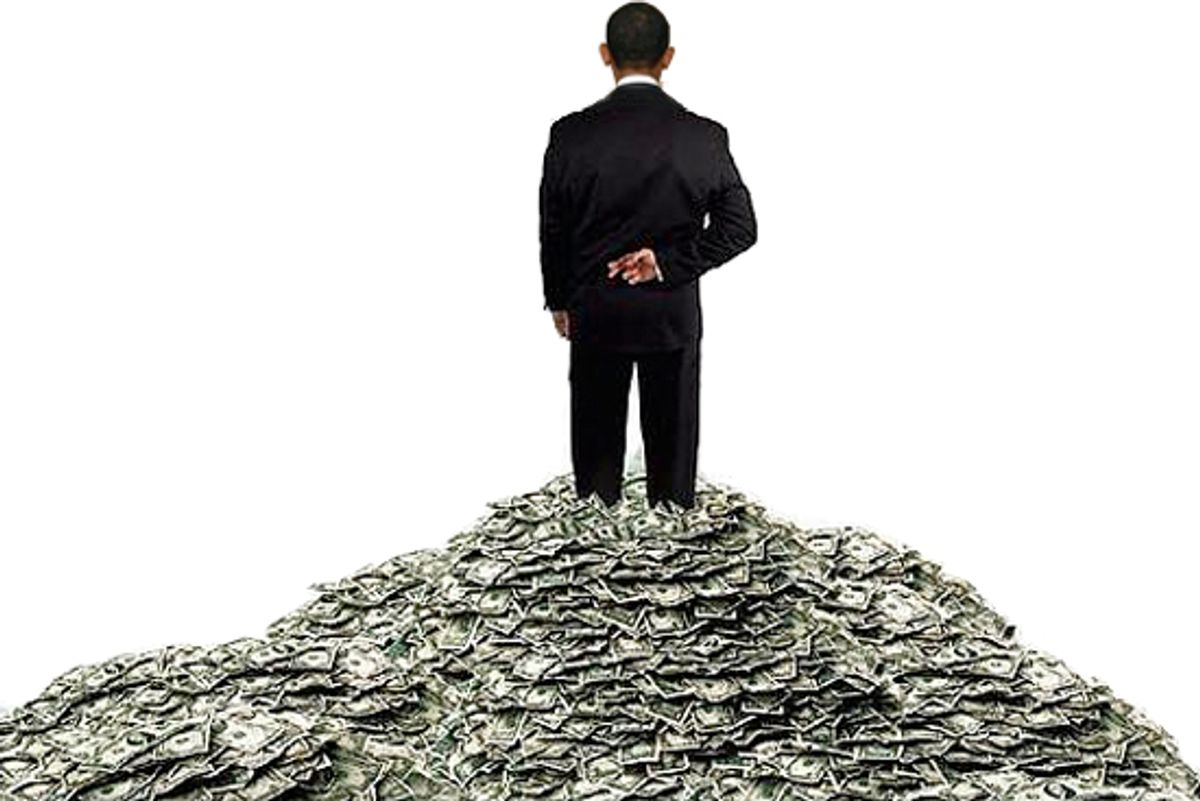
When I first decided to make a documentary about the financial crisis, in late 2008, my biggest question was how to handle Barack Obama. Alas, the answer rapidly became all too clear, as my film "Inside Job" shows in painful detail.
When Barack Obama was elected, he had an unprecedented opportunity to shape American history by bringing the country's new financial oligarchy under control. Elected on a platform of change and renewal by a nation in crisis and with strong majorities in both houses of Congress, his election celebrated throughout the world, Obama could have done great things. Instead, he gave us more of the same. America will be paying for his decision for a very long time.
The first troubling sign was his personnel appointments: Larry Summers, the man behind nearly every disastrous policy that created the crisis, fresh from making $20 million from hedge funds and investment banks while at Harvard, to become the director of the National Economic Council; Tim Geithner, plucked from the New York Federal Reserve Bank and put in charge at Treasury; as Geithner's chief of staff, Mark Patterson, a former Goldman Sachs lobbyist; to succeed Geithner at the New York Fed, William C. Dudley, who was chief economist of Goldman Sachs during the housing bubble years; Michael Froman, straight from Citigroup Alternative Investments, which lost billions while its executives became rich, to coordinate economic policy for the National Security Council; Jacob Lew, who was the CFO of Citigroup Alternative Investments, as deputy secretary of state (and now, Obama's nominee to run the Office of Management and Budget); Gary Gensler, a former Goldman executive who helped ban the regulation of over-the-counter derivatives, to lead the Commodity Futures Trading Commission, which regulates derivatives; Mary Shapiro, former head of the Financial Industry Regulatory Agency, the investment banking industry’s self-policing body, to run the Securities and Exchange Commission; reappointing Ben Bernanke. And on and on.
These moves were excused as the understandable actions of a president-elect without a background in finance turning to the most experienced people in a time of crisis. But even then, it was clear that these people had been part of the problem, not the solution, and that other highly competent but untainted candidates were available.
And now, nearly two years later, the Obama administration has established a clear record. Beginning almost immediately, the president consistently opposed any effort to control financial industry compensation -- even for firms receiving federal aid, as most were in 2009. Then came a long period of total inaction, followed by the toothless Wall Street reform bill passed this summer and the appointment of a former Fannie Mae lobbyist, Tom Donilon, as the new national security advisor. There was no action on the foreclosure crisis and no serious attempt to investigate the causes of the crisis. The SEC has brought only a handful of civil cases ending in trivial fines, with neither firms nor individuals required to admit any wrongdoing.
Most tellingly, there has not been a single criminal prosecution of any firm or any individual senior financial executive -- literally zero -- and, of course, no appointment of a special prosecutor. While we can debate the extent to which fraud caused the crisis, and precisely how much fraud was committed, the answer is clearly not zero. We already know that Lehman and other firms used fake accounting to hide liabilities and inflate assets; that lenders and securitizers frequently knew that the loans they sold and packaged were fraudulent or defective; and, of course, we also now know that Goldman Sachs and other investment banks sold securities they knew to be defective (they were often sold to pension funds for low-paid government employees, by the way) -- and that they designed many of these securities so that they could profit by betting against them after they were sold. Stunningly, this last practice was not ipso facto illegal; but as a practical matter, it’s pretty hard to do if you’re telling the truth. Yet nobody has been prosecuted, and only a very few individuals have even been sued in civil cases.
It is, in short, overwhelmingly clear that President Obama and his administration decided to side with the oligarchs -- or at least not to challenge them. This raises the question of why they have made this choice, and whether it is a correct (in the sense of rationally self-interested) calculation on their part.
As to the "why," several explanations have been proposed. One is that the president, as a matter of individual psychology, is extremely conflict-averse, preferring to avoid fights no matter how important. A second hypothesis is that the president is simply doing the most he can, given the political climate and the furious lobbying effort with which he is confronted. This explanation, however, is belied by the personnel appointments, among other evidence.
A more disturbing possibility is that the Obama administration has simply codified a new strategic equilibrium in American politics, one first devised by the Clinton administration, in which both parties are supine with regard to the financial sector and the wealthy.
The objection to this view is that there is some evidence, in conventional political terms, that the Obama strategy of giving in to Wall Street might be a mistake. The economy remains in bad shape, bad enough to be a major political handicap, and will likely stay that way for several years. Democrats are having trouble fundraising (from individuals, at least; interest group donors remain plentiful), union voters may desert them, and it looks like Republicans and the Tea Party will make substantial inroads in the midterm elections. The liberal media, most prominently the Huffington Post but many other outlets as well, have turned sharply critical of administration policy. And my own conversations with friends and colleagues have revealed a deep, angry disillusionment with Obama.
But consider the situation more broadly. If the two parties both lie down for Wall Street in roughly equal measure, but fight viciously over other issues, it is possible to construct a stable strategic equilibrium. At the margin, the Democrats are slightly less favorable to business, at least for unionized industries, but nobody upsets the financial sector apple cart.
This angers much of the Democratic base. But the Democrats avoid the epic confrontation that would surely ensue if they were to take on the financial sector, which would retaliate with a massively funded effort. Instead, the two parties fight furiously, or at least pretend to fight furiously, about a wide range of other social issues that affect many voters deeply -- abortion, gay rights, gun control, stem cell research, creationism, global warming, health insurance and so on. Each side can credibly warn its base that if it deserts the party, apocalypse may follow. So, while some citizens may register as independents, or stop voting, or stop donating to the system, the entrenched establishments of both parties will remain safe.
Of course, the sustainability of this strategic duopoly depends on the absence of truly independent challenges, such as third parties. Third parties can and do arise in America -- George Wallace, Ross Perot, Ralph Nader and, now (sort of), the Tea Party -- but they tend to be short-lived, in part because they face enormous structural obstacles in becoming a sustainable political force. For one, America doesn't have a parliamentary system, and most localities don’t use ranked-choice or "instant-runoff" voting. Plus, given the structure of American elections, the Obama administration can credibly warn, pointing to the example of Ralph Nader, that any splinter effort would hand the White House to the Republicans. And, given the enormous role now played by money in American elections, the logistical and financial efforts required to create a grass-roots third party would be huge. In contrast, the financial sector possesses the twin advantages of concentration and cohesion on the one hand, and of enormous financial resources on the other.
So, then, the Obama administration’s choices may be depressingly rational, given the "quiet coup," to use Simon Johnson’s term, constituted by the spectacular rise of the financial industry and the wealthy over the last quarter-century. This does not mean we should all despair; there have been times before in American history when the American people had to force their leaders to follow them. A century ago, the progressive movement achieved major reforms in the face of an economy even more concentrated than today. But it won’t be easy. To reverse the hegemony of the financial sector, and the danger it poses both to economic stability and to real democracy, will require an enormous outpouring of popular anger and organizational energy, probably a considerable period of time, and perhaps could be generated only by ... another, even worse, financial crisis, such as might well occur a decade hence, given the absence of real reform after this one…
Charles Ferguson’s new film, "Inside Job," a documentary about the financial crisis, is now in theaters nationwide. Ferguson holds a B.A. in mathematics from U.C. Berkeley, a Ph.D. In political science from MIT, and is the author of four books on various policy issues. "Inside Job" is his second film; his first, "No End in Sight," analyzed the occupation of Iraq and was nominated for an Academy Award in 2008.
Shares