Food Psychology

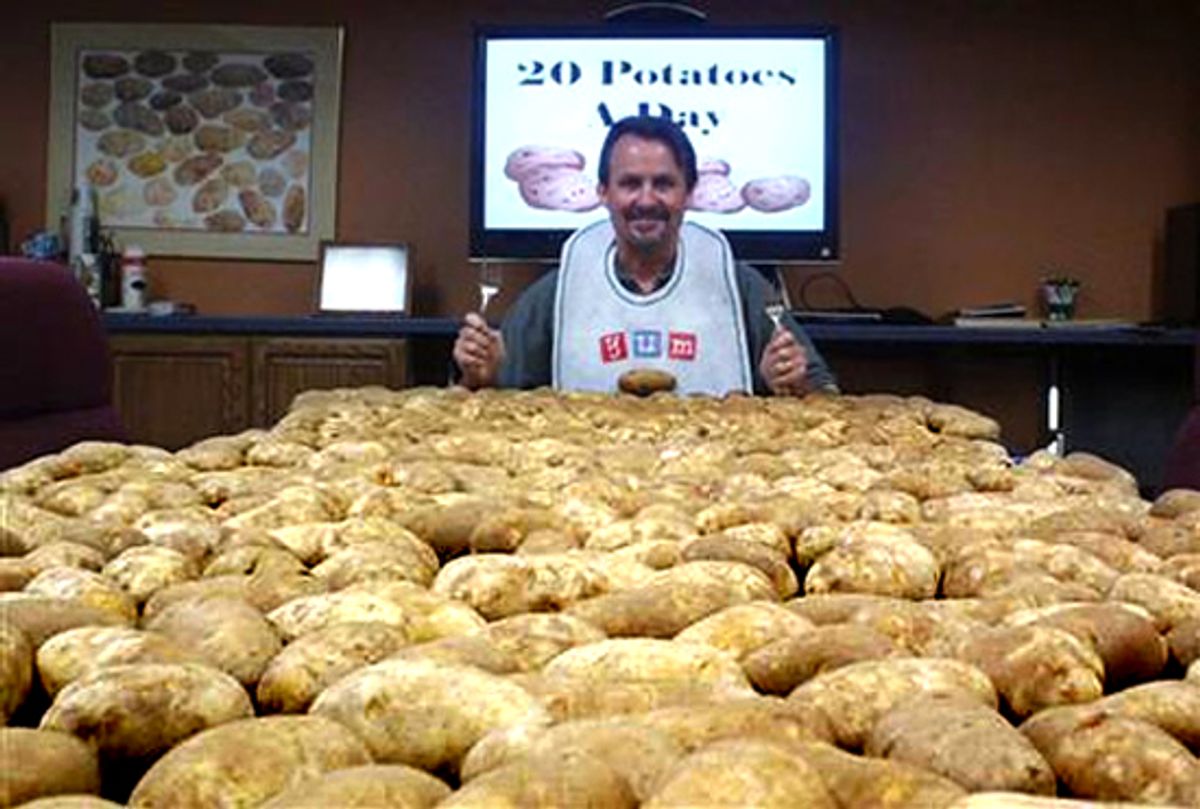
This is what it’s like to eat only potatoes for 60 days

A man does an extreme diet to prove the nutritional value of spuds. But he's losing his mind

  • more
    • All Share Services

Topics: , ,

This is what it's like to eat only potatoes for 60 days

First there were hunger strikes to protest brutal injustices. Then there was “Super Size Me,” an all-McDonald’s regimen captured on film to show us what fast food is doing to us. But now Chris Voigt is bringing the extreme diet noise to … promoting potato sales.

For 60 days, all the executive director of the Washington State Potato Commission will eat are potatoes, seven pounds a day of them, to demonstrate that potatoes are so nutritionally whole that you can live off them for months. Sure, his body might live, but what about his mind and spirit? I don’t know, but when our friends at Eater.com referred to Voigt’s potato-diet blog as a document of “an increasingly broken and desperate man,” well, we had to take a look at the slow-motion car crash.

He’s nearly halfway through his challenge, which began on Oct. 1, and reading his posts is a little like reading diaries from the Donner Party, eerie announcements from a mental state slipping further and further away. It’s amazing. We’ve combed through his record (sorry, there are no links to individual posts) to help tell his story (in a form edited for space). Enjoy, and maybe shed a tear for Chris Voigt. 

9/29/10

Just filmed a new video that we’ll show later next week. Its about vitamin C. Did you know that potatoes can provide vitamin C to your family cheaper than oranges? Something to think about.

Ah, he’s so earnest, so hopeful before he begins his diet. He believes in the potato, and he wants you to, too! Yes, the vitamin C of a potato is something to think about, and the next time I have a glass of orange juice, and I will think, “Yes, I’d rather be drinking the juice of orange than potato.”

10/1/10

I’ve completed day one of my 60 days of potato bliss! What a whirlwind of a day. But the real news for today was that it was my wife’s birthday! (I am amazed at how good she looks) While my family had all the fixings at the steakhouse celebrating my wife’s birthday, I had garlic mashed potatoes and an order of steak fries. The all potato diet wasn’t too bad today, but I did cringe a little when everyone had ice cream for dessert. But overall, a great day!

10/4/10

I finished day three last night. I have to admit, it has finally sunk in that “I’LL BE EATING JUST POTATOES FOR 57 MORE DAYS”. So Sunday in church, I took communion, which is the only time I will stray from my diet. It was just a little piece of bread, smaller than a breath mint, and a thimble of grape juice. I noticed I kept the bread in my mouth an extended period of time just enjoying how it felt and the sweetness. I’ve never realized how sweet it was in the past. My sense of smell and taste have increased greatly over the last few days. And after church, there was the monthly potluck. Walking down the hall towards the room with the food was like a walk through a gourmet food court. The multitude of aromas was tempting my taste buds. Unfortunately, there wasn’t anything there that would fit the guidelines of my diet so I just mingled and watched others eat. And I was really OK with that…until I got home. Home to another cooked potato. I needed a change in texture so I decided I was going to eat just potato chips.

It is fascinating how the senses change on you. I once spent a year avoiding beef, and from then on, every bite of beef I had was so incredibly flavorful. But this poor guy’s been doing this for three days and already his brain is starving.

10/4/10

The family had chicken that was slow cooked in the crock pot, with some of the mashed potatoes I made for my lunch tomorrow. But they got gravy and I got none.

Things are not going to go well in this home for very long.

10/6/10

Was in potato Nirvana tonight. My wife boiled a bouillon cube with potato starch to make me “pseudo gravy”. It was awesome! She smothered Yukon Gold and Purple potato slices in this gravy and baked it in the oven for an hour. Then cooked homemade yellow and purple chips with artificial sweetener and cinnamon for dessert. It was heaven for a flavor deprived husband. I would marry her all over again because of this!

Or maybe the marriage will be great!

10/8/10

Ok, my chicken bouillion cube/potato starch gravy has run its course. I’ve had 6 meals of it in the last two days. Time for something different

Oh well. Maybe stay together for the kids?

10/12/0

Was hoping to try coloring my hair today with purple potatoes but we ran into a snag. We picked up the wrong variety of purple potatoes, this one is a mix of purple and white flesh, we need all purple to get a good dose of pigment. Anyone experienced in coloring hair with natural pigments?

You’d think that he would spend his leisure time doing anything but finding more ways to put potatoes in his body, but he has the zeal of the true fanatic. If someone radicalizes him, this man will be dangerous.

10/20/10

Yesterday was tough. It was just one of those days where you really wonder what the heck you’re doing. While I know I love potatoes, it was hard to keep eating them. I hung in there but I was the star of my own little pity party yesterday.

10/22/10

I had about a pound of hash browns this morning for breakfast, two pounds of mashed potatoes with black pepper for lunch, which means I have to eat close to 4 more pounds before bed. I’m leaning towards baked potatoes with balsamic vinegar for dinner but I’m not sure I’m ready for 4 pounds of it.

What we are watching here, ladies and gentlemen, is a man putting on a hair shirt.

10/22/10

Now I only have to eat 3 more pounds of potatoes before bed. Just consumed a pound of yellow potatoes I baked in the microwave. And if anyone is looking for the two packets of Taco Bell hot sauce that we’re left in the break room…they’ve been consumed!

What’s really brutal, though, is this comment from a reader, “Paula,” on the post above:

It seems like when this started, you were just going to eat potatoes and maybe minimal spices, or sometimes minimal oils for seasoning. Now it’s all artificial sweeteners, cocoa powder, taco bell sauce, etc. That’s not a strictly potato diet anymore, Chris.

My God, woman! The man is going crazy, he’s eating Taco Bell sauce for fun, and he’s not doing enough for you? How about if he mutilates himself for your amusement too?

10/24/10

At the conclusion of my son’s soccer game yesterday, we had our end of season BBQ. Which turned out to be my annual trip to the emergency room! I grabbed a very hot part of a camping stove we were using. Typing with a wad of bandages on your hand is a little slower than usual.

There, Paula, happy now??

10/24/10

So here is a new one that my wife made up. Fake ice cream made from potatoes. She took 1/2 cup cocoa powder, 1/2 cup artificial sweetener, and a little water to make a chocolate sauce. Then mixed it with about 2 cups of “riced” potatoes and ice. Blended it and put in freezer. It was actually really good, ju…st a strange texture though. I love my wife! What a treat!

She’s trying to kill you.

10/26/10

So it was my son’s 9th birthday today. My little spud! So he wanted Thai food for a birthday dinner with the extended family. Guess what…no potatoes on the menu! They gave me a 1/2 oz bag of chips! That’s all they had…and the best part…the chips expired back in August.

So that’s where we are in this saga. Check out his blog for the further adventures of a brain getting mashed. And someone tell his kid to watch out. He called him “spud,” which means he might be getting ready to eat him. 

Continue Reading Close

Francis Lam is Features Editor at Gilt Taste, provides color commentary for the Cooking Channel show Food(ography), and tweets at @francis_lam.

Gwyneth Paltrow prefers crack to canned cheese

The Joan Crawford of the kitchen talks drugs, alcohol and the ultimate danger to her children -- McDonald's

  • more
    • All Share Services

Topics: , , , , ,

Gwyneth Paltrow prefers crack to canned cheeseGwyneth Paltrow doesn't even own a can opener... just a knife.

Everything in moderation, especially moderation. That was the truism passed down to me from my father when we would turn into the McDonald’s drive-thru and order our occasional Big Macs and Happy Meals. And despite what macrobiotic mommy dearest Gwyneth Paltrow might think, I somehow grew up without any Mc’Deformities.

During a conversation with former BBC host Jonathan Ross for the iTunes Festival earlier this week, Gwyneth confessed that she never let her kids pass through the Golden Arches, something that shouldn’t come as a surprise to anyone who hears the self-confessed “foodie” talk about her healthy culinary home.

Although hey, maybe it’s not as healthy living as she’d like America to believe. “I’d rather smoke crack than eat cheese from a can,” said the mother of two, before admitting that she “drinks constantly” while cooking. While it’s probably equally difficult to find canned Kraft and cocaine rocks anywhere in a 40-mile radius of the Paltrow-Martin estate, I can’t help but worry a little bit for young Moses and Apple. Undoubtedly she was being more facetious than factual, but what kind of example is mom setting when she talks about the evil of trans fats while guzzling Romane Conti straight from the bottle every time she puts on an apron?

Continue Reading Close

Drew Grant is a staff writer for Salon. Follow her on Twitter at @videodrew.

How comfort foods work like Prozac

The psychology behind why we turn to fatty staples like French fries and fried chicken when life gets rough

  • more
    • All Share Services

Topics: ,

How comfort foods work like Prozac

When the recession hit, you could hear the words buzzing from the cell phones of every restaurant consultant in America: “It’s time for comfort food.” But under the mashed potatoes and meatloaf lies a question: What does “comfort food” really mean? What about it actually comforts us?

Let’s look at some big-time comfort foods: Fried chicken. French fries. Chocolate cake. When people talk about comfort food, the obvious explanation is that it’s all about nostalgia and missing Mommy. But that’s also cultural. Look at lutefisk, natto and the reddish-black blood sausage I was served once by a sad Belgian who took comfort in what struck me as something you might see in a hospital. And really, it takes more than this to create the rush of sensations that make us feel safe, calm and cared for. It’s a complex interplay of memory, history and brain chemistry, and while some basics apply — most of us are soothed by the soft, sweet, smooth, salty and unctuous — the specifics are highly personal.

In a certain cheese shop in my town, there is a rack of rolls. Gleaming golden outside and airy, stretchy, satiny inside, they’re sourdough and only vaguely square as if cut by clowns. One fits in my palm, then my sweatshirt pocket, which it must because this is the acid test by which I define comfort food: It’s small. It’s portable. It can be consumed silently. My comfort food must never call attention to itself. It must be dazzlingly bland, like Zen koans. Rolls. Marshmallows. Mochi. One round bowl of rice.

For you, of course, it’s something else. Celery, say, or vindaloo or wings. A friend of mine craves slick, sticky, flamboyant food that she can stir with slow, exaggerated swirls to make a sucking sound. This is her comfort food.

When you begin to eat, your eyes, hands and mouth start the chain of command. Then the brain kicks in. Sugar and starch spur serotonin, a neurotransmitter known to increase a sense of well-being. (It’s what makes Prozac work.) Salty foods spur oxytocin, aka the “cuddle chemical,” a hormone that is also spiked by hugs and orgasm. Hence, potato chips. Mice unable to taste the difference between regular and extra-high-calorie food in a recent study preferred the high-calorie kind, which suggests that fattening food appeals simply because it is fattening. Which makes sense, given how much fuel our prehistoric ancestors burned crisscrossing savannahs, fleeing carnivores and chasing prey. Fat is a good balm for the fear of starvation.

There’s also how the brain links emotion, memory and sensory stimuli. Popsicles nibbled to break childhood fevers, pizza when your track team won, coconut on your honeymoon: The brain associates good experiences with specific flavors, fragrances and textures, coding them as harbingers of happiness. Henceforth, even when you neither have a fever nor have won a race, eating Popsicles still brings the rush of relief and pizza feels like a reward.

But buried in this (like the caramel at the heart of a Milk Dud) is the deeper question of what counts as comfort.

Neuroscientists define it as the opposite of stress. Whether with pharmaceuticals or firearms or flannel sheets or funnel cake, we seek to de-stress by any means necessary. The brain reaches its relaxed, restorative comfort state when we feel safe and/or when we receive rewards and/or when we feel part of something bigger than ourselves — a culture or a community.

Security, reward and connectedness: Each of these three feelings activates a different portion of the brain, and each of these is more or less crucial to each of us, which further explains why we don’t all relish the same comfort foods. A competitive person or one who feels chronically undervalued cherishes foods that the brain has coded as rewards. A loner finds no comfort in those foods the brain links with community. An abused person who lives in fear might hoard safety foods.

When we feel endangered, unsung and/or lonesome, we eat.

Food is a fort we build. Rolls in my pocket feel like ballast. As a former anorexic, I imagine they will keep me safe because they are small, round, clean, dry and can be eaten stealthily. Someone else might feel most secure when eating pudding, say, because she ate it in the playroom before knowing the meaning of pain.

Food is the gift we give ourselves. My husband beams as if it’s Christmas whenever Sriracha sauce or tonsil-searing salsa make him sweat. His Jewish/Danish DNA never predicted this. He grew up in a capsicum-free home. Yet kimchee signals “treat” to him, because hot-spicy foods were his private discovery, not something that was ever given to him but something he gave himself. They are his prize, and thus they comfort him in that explosive, pore-widening way by which hot saunas heal. (Which makes me think: Is it reincarnation? Given that some people find comfort in what they grew up with, and others specifically in what they didn’t grow up with, do we choose our comfort foods or do they choose us? Does this process parallel the ways in which we acquire other preferences — for bondage, say, or for stiletto heels or hairy men?)

Food is also the friend who never disappoints or ditches us. Psychologists call comfort food a “social surrogate” — in other words, not quite replacing real companions but reminding us of them. Participants in yet another recent study felt less lonely after writing about — and not even necessarily eating — comfort foods. The psychologists who designed that study theorized correctly that consuming comfort foods soothes us in the exact same ways as wearing our favorite clothes or watching our favorite TV shows. Reminding us of those who love us and/or look and talk like us, comfort food also reminds us of who we are. Away from home, we seek the foods of home.

Of course, all matters of psychology are unrelentingly complex. Comfort food feels good, but — for some of us — in that first rush is also a twinge: For some, comfort food invokes a special hot-faced shame because both food and comfort are so intimate, and using one to do the other borders on self-pleasure. From there, it’s just one small step to guilty pleasure, which is what most of us would call caramel corn and curly fries. Perhaps it’s because in this crowded, hard world, we have convinced ourselves that seeking comfort is itself embarrassing, as if need makes us weak. We are ashamed to crave the salty, starchy, soft, unctuous and sweet, because we tell ourselves we are too smart to want what the judgmental would call junk — although, surrounded by food that is market-tested to appeal to our most primal urges, we don’t stand a chance. If comfort food exposes those urges, a drive-thru window can become a harsh confessional.

Continue Reading Close

Anneli Rufus is the author of several books, most recently "Magnificent Corpses: Searching through Europe for St. Peter's Head, St. Stephen's Hand, St. Chiara's Heart and Other Saints' Relics" (Marlowe & Co.).

“Freaky Eaters’” JJ Virgin on shock therapy and french fries

We spoke to the TLC show's nutritionist about the science of food addiction -- and her "shock therapy" approach

  • more
    • All Share Services

Topics: , , , , ,

JJ Virgin and Dr. Mike Dow on "Freaky Eaters."

JJ Virgin has one of the stranger jobs out there: After spending 25 years studying health and fitness, she now spends her time on TLC, turning around the lives of food addicts on “Freaky Eaters.” (No, that’s not the show about people who eat laundry soap, a similar program on the same network called “My Super Strange Addiction.”) “Freaky Eaters” documents the life of a person addicted to a certain type of edible food — french fries, meat, and corn syrup have all been on the menu — as well as their recovery with the help of two specialists, Virgin and Dr. Mike Dow.

We spoke to JJ Virgin over the phone about what qualifies someone to be a “freaky eater,” as well as some of the more extreme measures they’ve taken on the program to make people confront their dangerous life choices.

This is the second season of the show, and there has been a lot of controversy about programs similar to “Freaky Eaters,” like “Hoarders” and “Intervention.” Some people are wondering if putting these people up on screen is helpful or just exploitative. What is your response to that sort of claim?

On “Freaky Eaters” we are dealing with people who don’t really fall into one specific disorder, one kind of psychological classification that can be treated. These are people that fall through the cracks, and they are desperate. They need help. I watch some of these shows out there that I do think are exploitative — though I do think most of them are more life-changing than exploitative — and I have to tell you, that’s not what we do. We do shock therapy, so you have people see the extent that they need to make the change, but I think everything is done in a very respectful way.

When you are dealing with someone who drinks gallons of tartar sauce and make them wade around in a pool of it, or have a guy who loves meat spend a day turning a pile of it into ground chuck in a freezer basement, would you call that behavioral therapy? Is that something you’d see psychological professionals doing if people weren’t falling through the cracks?

You know, behavioral therapy is really more what we do at the end of the show, what I call the “lateral shift”: having people make small changes in their lives. When someone is an addict of any type, the classic thing is to deny the problem or the extent of it. Shock therapy is to show these people their problem in a way that makes it impossible to deny or to downplay it.

What were some of the more outrageous examples you’ve had on the show?

The meat episode, that was so disgusting. We were hysterically laughing because the meat was spewing everywhere, as it was being ground up. The first season, we had a girl who ate 6,200 calories of sugar every day. She did all her shopping at the dollar store; it was amazing she wasn’t morbidly obese. So we had her lie down in a coffin and covered her with all the sugar she ate, and had her son read off a eulogy about all the things she was going to miss if she died from her lifestyle.

That’s intense.

We also had a pizza guy, where we had him pour all the fat from all the pizzas he ate in a year into a big bucket. And then we had him pour the bucket into jars. And at the end we had him dump the bucket, but instead he threw it, and it landed right on the cameraman, who was then covered in fat goop. And then we had a guy who ate 3-6 burgers a day, so we backed a truck filled with burgers right up to him and dumped out all the patties, just covered him up.

I can see how a lot of this is TV-friendly. Do you have a hard time differentiating yourself from the other TLC show, “My Strange Addiction,” where people eat stuff that is non-edible (like couch cushions, cigarette ash, and laundry detergent)?

People confuse us all the time. But what I think makes our show stand out is how relatable it is. I have people come up and ask me all the time, “This is what I do, am I freaky eater?” And I’m like “No, just because you eat a muffin everyday doesn’t get you qualified, sorry.”

Well that’s what’s so interesting, right? How blurry the lines can get? Because you’re not showing people with Pica, you’re showing people addicted to French fries. And I think a lot of people at home roll their eyes and go “Sure, we’re all addicted to French fries” until they see exactly how much this person is eating of it.

We did have a woman who had Pica and ate a lot of corn syrup, but that is still edible.

In my mind, the difference is severity … you can die from being obese, but it’s probably not going to kill you as fast as, say, downing laundry detergent every day.

Maybe not as fast, but you’ll find what we deal with is way more common, and therefore way more relatable. We try to get to the root of a lot of these issues on the show, because there is a psychological element to it, though a big part of being a “freaky eater” is biochemistry. Many of these people have a food sensitivity. They either are addicted to one taste, or they hate another kind. So the burger guy and the french fries person, they were both supertasters, they could taste things a mile away. And then this year we have a guy addicted to maple syrup, and he’s a “sweet taster”: nothing is sweet enough for him. These people can’t taste sweet well, so they keep wanting things sweeter and sweeter.

That’s interesting: so our predetermined sensitivity to different tastes can determine how hooked we get on a food?

Oh totally…we’re only at the beginning of understanding the biochemistry behind “taste.” It turns out you can taste things all down your G.I. tract. What we’re seeing now is just the tip of the iceberg in terms of some of the extreme forms of people with a tasting sensitivity.

“Freaky Eaters” can be found on TLC at 10:00 and 10:30 EST every Sunday night.


Continue Reading Close

Drew Grant is a staff writer for Salon. Follow her on Twitter at @videodrew.

911 called over botched Chinese food order

What do you do when your dinner isn't delivered properly? Call the police, of course

  • more
    • All Share Services

Topics: , , , , ,

911 called over botched Chinese food orderThe police are not here to deal with your delivery mix-up.

How many times has this happened to you? You go home and try to enjoy a nice dinner of Chinese food delivery. But when your meal arrives, they’ve got the order completely wrong!

Do you:

A) Call back the restaurant and ask for a refund;

B) Just eat the food and promise to deal with it next time;

C) Call the police

If you answered C, you are not alone. A woman in Savannah, Ga., called 911 to rectify her dinner order yesterday. This was the result:


Sadly, these kinds of calls aren’t as uncommon as you might think. In March 2009 a woman called the police after being given the wrong order of McNuggets at McDonald’s.

That wasn’t even the first time that year an emergency hotline was called because of fast food. In fact, it happened quite a bit in 2009. (Maybe McDonald’s was just particularly sucky that year.)

Regardless, it’s 2011 now and we’re all grown-ups. That doesn’t mean we expand our 911 repertoires to calling in about botched Chinese food orders. It means that we stop tying up the police phone line unless we actually have an emergency that doesn’t involve a delivery service.

Continue Reading Close

Drew Grant is a staff writer for Salon. Follow her on Twitter at @videodrew.

The five most ridiculous defenses of Ronald McDonald

A watchdog group is calling for the clown mascot's retirement, but is being creepy grounds for firing?

  • more
    • All Share Services

Topics: , , , , , ,

The five most ridiculous defenses of Ronald McDonaldWho wouldn't accept food from this guy?

McDonald’s is under attack again for force-feeding our nation’s children greasy, delicious fries. A group called Corporate Accountability International took out full-page ads today in several prominent newspapers, titled “Doctor’s Orders: Stop Marketing Junk Food to Children.

And while this grievance might not seem new, exactly, CAI is launching another campaign on Thursday against Ronald McDonald himself, whom the watchdog group called a “Deep Fried Joe Camel.” They claim Ronald’s the equivalent of a drug pusher for MSG-addicted kids.

But how “friendly” is Ronald? A new study done by outside marketing group Ace Metric found that in a survey group of 500, an overwhelming amount found a guy with big red lips and white greasepaint more creepy than cute.

McDonald’s refuses to give up on Ronald, though, and its defense on why it needs to keep a terrifying clown as its mascot would be charming if it weren’t so ridiculous and backward. Below, five of the responses McDonald’s has given for keeping Ronald on the payroll.

1. Complaint: “It’s really remarkable how often I saw the word ‘creepy’ [in regards to Ronald],” says the V.P. of a company that conducted the survey.

McDonald’s response: “For everyone who may feel that way, there are more who feel the opposite.”

2. Complaint: Ronald McDonald is an evil clown.

McDonald’s response: “He is a force for good,” says McD’s CEO, Jim Skinner.

3. Complaint: Too many damn clowns running around.

McDonald’s response: “There’s only one Ronald,” McDonald’s chief creative officer Marlena Peleo-Lazar said in response to several questions about how many actors portray the smiling clown.

4. Complaint: He is hurting a brand image that is trying to be more adult … like Starbucks.

McDonald’s response: He is the brand image. “It would be almost as if the Geico gecko disappeared, or the Aflac duck,” says one marketing strategist. God forbid.

5. Complaint: Ronald encourages childhood obesity.

McDonald’s response: Around 2004, McDonald’s christened Ronald as a “balanced, active lifestyles ambassador,” and stuck him in commercials where he trained for the Olympics. He got workout clothes. He got a tuxedo. He moved from McDonaldLand into the real world. 

You know who can also move into the real world after being trapped in a fantasy land? Freddy Krueger.

It’s actually in CAI’s favor to have a scary mascot act as a deterrent for children trying to buy fries. It should be thanking McDonald’s for keeping such a creepy figure right in front of the golden arches.

Continue Reading Close

Drew Grant is a staff writer for Salon. Follow her on Twitter at @videodrew.

Page 1 of 5 in Food Psychology