John Boehner, R-Ohio

Boehner stumps for Nazi-reenactor

The GOP leader wants to be speaker of the House badly, and he's not going to let a little Nazism get in his way

  • more
    • All Share Services

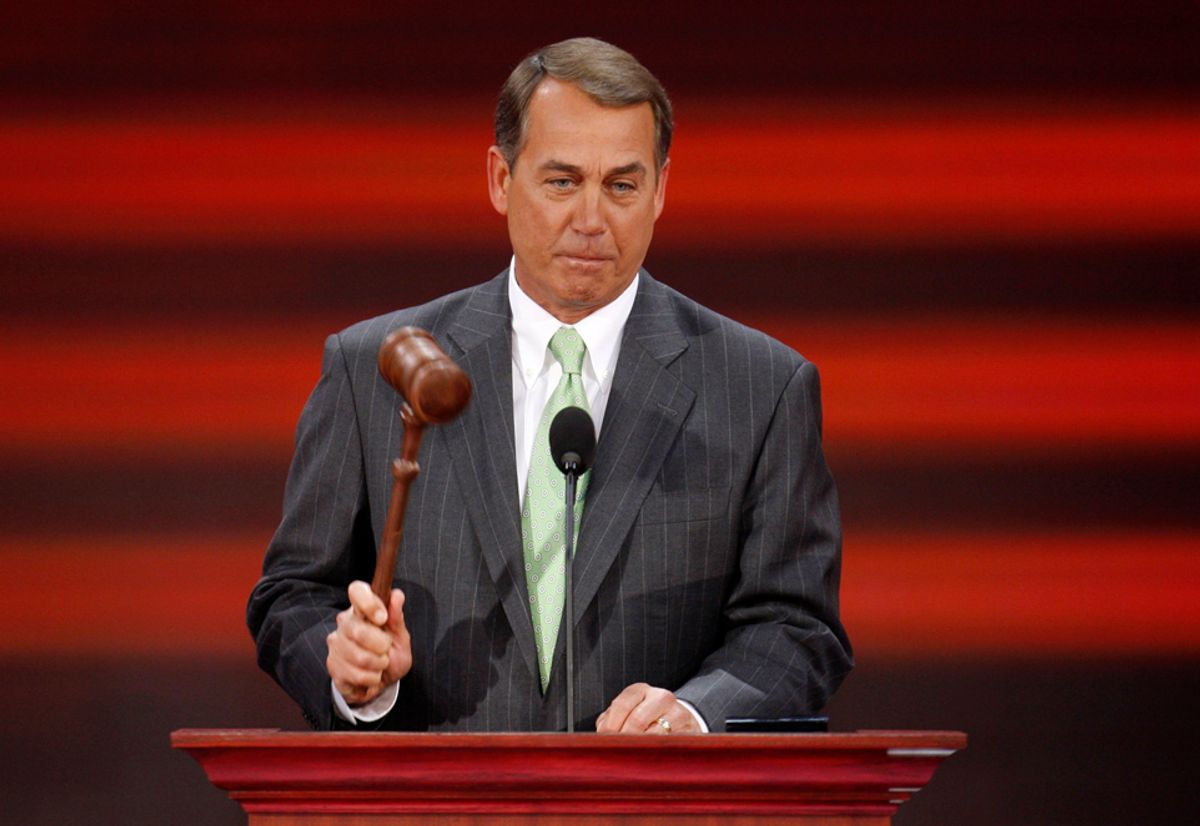
Boehner stumps for Nazi-reenactorRep. John Boehner (R-OH) bangs the gavel to open the second day of the 2008 Republican National Convention in St. Paul, Minnesota, September 2, 2008. REUTERS/Mike Segar (UNITED STATES) US PRESIDENTIAL ELECTION CAMPAIGN 2008 (USA)(Credit: © Mike Segar / Reuters)

Why is anyone surprised that John Boehner decided to campaign for Ohio congressional candidate Rich Iott, one of the GOP’s assortment of extremist 2010 candidates, which includes a Marine who killed two unarmed Iraqi prisoners, a guy whose security detained reporters at a public school event and one whose volunteers stomped a MoveOn volunteer?

Iott’s in a category by himself, as someone who admits he’s enjoyed attending Nazi history reenactments dressed up in an SS Waffen uniform. But he’s not a Nazi sympathizer! “It’s purely historical interest in World War II,” Iott told the Atlantic’s Josh Green. “I’ve always been fascinated by the fact that here was a relatively small country that from a strictly military point of view accomplished incredible things. I mean, they took over most of Europe and Russia, and it really took the combined effort of the free world to defeat them. From a purely historical military point of view, that’s incredible.”

Remember the outrage that ensued when Nation of Islam’s Louis Farrakhan declared Adolf Hitler “wickedly great”? Imagine if Obama was stumping for an NOI member who’d praised Nazi Germany. You can’t, right? That’s where we are, folks, less than a week before this crucial and possibly crushing (for Democrats) midterm election.

Still, it makes a kind of political sense in 2010. With only a few days left, there’s a real chance Republicans can take back the House. Boehner wants to be speaker, he can taste it, Marcy Kaptur’s seat is a possible pickup for his party — so he’s not going to let a little Nazi reenactment stand in the way. That’s John Boehner. His pal, whip Eric Cantor, who is Jewish,  had a rare outbreak of principle and denounced Iott.

I don’t know why Iott’s candidacy is just a footnote in 2010 politics; I guess Republicans are constantly hitting new bottom. Sure, people do all kinds of things in the name of history. They attend Renaissance Faires. They get involved with various American war battle reenactments. I know folks who play dramatic World Series matchups on PlayStation. You can reenact a lot of things. If you really wanted to commemorate underdogs defeating supposed overdogs during WWII, why not play French Resistance? What’s next: Reenacting cross-burnings while denying fealty to the Ku Klux Klan, just because you like the way some scrappy Southerners defended home and hearth? Torching Catholic convents in Know-Nothing reenactments? Wait, let’s not give Pam Geller any ideas about the Park51 Islamic center.

What’s next? Whatever it takes for Boehner to get his majority, I think. The only thing amusing about the Tea Party’s  clout within the GOP is the reckoning it will force within the party after Nov. 2. If Tea Partiers and their supporters do well, Boehner’s courting of extremists may not make him speaker. Just Thursday, Michele Bachmann told The Hill she couldn’t commit to voting for Boehner. “If John Boehner’s the only candidate running, I’ll be voting for John Boehner.” But she added: “I would look at all the candidates and weigh it accordingly.” It will be fun to watch Boehner reckon with Bachmann next week. And if you don’t like the idea of Speaker Boehner, go out and work to elect Democrats this weekend.

Joan Walsh

Joan Walsh is Salon's editor at large.

The hardy myth of “job creators”

From Ayn Rand to John Boehner, a persistent talking point

  • more
    • All Share Services

The hardy myth of (Credit: Wikipedia/AP)

With the announcement last Monday of President Obama’s plan to pay for his jobs bill with, among other things, the so-called “Buffett Rule,” we’re going to be hearing a lot more about the “job creators.” Over the last year, Congressional Republicans have consistently invoked them as a hex of sorts against any proposal to raise new tax revenue. “I am not for raising taxes in a recession,” Eric Cantor declared last November, when the Bush tax cuts were a bargaining chip in the protracted budget debate, “especially when it comes to the job creators that we need so desperately to start creating jobs again.”

Ten months, no new taxes, and one debt ceiling crisis later, Cantor said the same thing last week in response to the president’s jobs bill: “I sure hope that the president is not suggesting that we pay for his proposals with a massive tax increase at the end of 2012 on job creators that we’re actually counting on to reduce unemployment.” Given that 44 percent of the nation’s unemployed have been without work for at least six months and more Americans are living below the poverty line than at any time in the last 50 years, one marvels at Cantor’s faith in the truant “job creators” as well as his forbearance in the face of human misery. To the jobless, he is counseling the patience of Job.

But who exactly are these “job creators?” The phrase is not new. Republicans have been using it for years to underscore a particular vision of capitalism in which those who have benefitted most by the system are also most essential to its continued success. As long ago as 1991, Newt Gingrich characterized Democratic opposition to a cut in the capital gains tax as evidence that liberals reject this vision. “They hate job creators,” he told a gathering of Senate Republicans, “they’re envious of job creators. They want to punish job creators.” With no apparent sense of irony, Gingrich added this was proof liberals “believe in class warfare.”

A more telling example for our current political impasse is the debate over the 1993 Clinton budget plan, which aimed to cut the deficit by, among other things, raising the top income tax rate. Congressional Republicans fought the bill tooth and nail, no one more so than former Texas Senator Phil Gramm. On the eve of its passage, he expressed the hope that the bill would “defy history” and prove that “raising taxes on job creators can promote investment and promote job creation.” Gramm, of course, did not think this was very likely to happen. “Only in Cuba and in North Korea and in Washington, D.C., does anybody believe that today,” he said, “but perhaps the whole world is wrong.”

Hindsight suggests that the world wasn’t wrong so much as Phil Gramm, along with every other Republican member of Congress. Not one of them voted for the bill, which cleared the House by only two votes and required Al Gore’s tie-breaking vote in the Senate. While higher taxes on the “job creators” proved no obvious hurdle to economic growth — the economy grew for 116 consecutive months, the most in U.S. history — it did cut the deficit from $290 billion when Clinton took office to $22 billion by 1997 and helped put the country on a projected path to paying off the national debt by 2012.

So much for ancient history. If the term “job creators” is no new addition to the lexicon of American politics, it has enjoyed quite a renaissance since President Obama took office. A Lexis-Nexis search of U.S. newspapers and wire services turns up 1,082 individual mentions of “job creators” in the month before the debt ceiling deal was reached, or just 175 fewer mentions than for George W. Bush’s entire second term.

Jon Stewart, for one, did not fail to notice the uptick. “Republicans are no longer allowed to say that people are rich,” he noted during the deficit ceiling debate, “You have to refer to them as ‘job creators.’” Stewart’s observation is funny only to the extent to which you believe that saying you’re a member of the top tax bracket and saying that you create jobs is not an obvious redundancy. If you believe, however, that the cast of “Jersey Shore” has just as much claim to being called “job creators” as Bill Gates or Steve Jobs, then Stewart’s joke not only falls flat, but misses the point. The wealthy are the “job creators,” whether or not they spend their time actually trying to create jobs.

The problem, of course, with upholding a definition of “job creators” that does not turn on the dedicated effort to create jobs is that it becomes hard to figure out what distinguishes the “job creators,” as a group, from everyone else — at least beyond their relative wealth. All Americans spend, save, and invest in varying degrees; most just do so with a lot less money.

In this light, the “jobs creators” rhetoric highlights a theory of capitalism in which those at the very top of the economic pyramid end up supporting the base. We might call this theory the Visible Hand of Capitalism in order to distinguish it from Adam Smith’s Invisible Hand. In “The Wealth of Nations,” he famously located the enduring success of capitalism in an increasingly complex system of work and exchange that sees “the assistance and co-operation of many thousands.” In such a society, no single group can be meaningfully called the “job creators.” They are as much the managers of capital as the men on the factory line.

As an intellectual matter, the Visible Hand of Capitalism has enjoyed support from figures as disparate as Destutt de Tracy, the French philosopher and economist whom Thomas Jefferson championed, to the steel baron and indefatigable philanthropist, Andrew Carnegie. As a rhetorical matter, however, the phrase “job creators” appears to come directly from the work of Ayn Rand. She favored the term “creators” to describe an elite caste in society and her highest human ideal.

John Boehner made reference to “Atlas Shrugged,” Rand’s most famous novel, in a speech he gave recently to the Economic Club of Washington, D.C. “Job creators in America are essentially on strike,” he said, in an obvious nod to the decision by the “creators” in the novel to go on strike in defiance of an intrusive federal government. The nation immediately begins to falter, and the books concludes with its hero, John Galt, giving a marathon address in which he explains to the rest of the country why America is crumbling. The nation, in brief, has scared away the very people who keep the economy working, leaving behind those who are ill-equipped to fend for themselves.  Describing the economic and social theory underpinning this vision, Galt says:

In proportion to the mental energy he spent, the man who creates a new invention receives but a small percentage of his value in terms of material payment, no matter what fortune he makes, no matter what millions he earns. But the man who works as a janitor in the factory producing that invention, receives an enormous payment in proportion to the mental effort that his job requires of him. And the same is true of all men between, on all levels of ambition and ability. The man at the top of the intellectual pyramid contributes the most to all those below him, but gets nothing except his material payment, receiving no intellectual bonus from others to add to the value of his time. The man at the bottom who, left to himself, would starve in his hopeless ineptitude, contributes nothing to those above him, but receives the bonus of all of their brains.

For all that it lacks in human decency, Rand’s vision of who makes capitalism work at least has the advantage of isolating a group of people who actually create something. By contrast, the current “job creators” rhetoric seems to elevate a group of people whose shared tax bracket is their only outstanding trait.

As the debate over the president’s jobs bill takes shape, the “job creators” rhetoric is certainly deserving of a little more scrutiny, especially by those who don’t qualify for the distinction. Otherwise, they might as well accept the judgment of a far greater authority than even John Galt:

The fault, dear Brutus, is not in our stars,
But in ourselves, that we are underlings.

Continue Reading Close

John Paul Rollert is a doctoral student at the Committee on Social Thought at the University of Chicago.

The audacity of weakness

Another embarrassing fail betrays a White House in a bubble

  • more
    • All Share Services

The audacity of weaknessHouse Speaker John Boehner of Ohio speaks during a news conference on Capitol Hill in Washington, Thursday, July 28, 2011. (AP Photo/J. Scott Applewhite)(Credit: J. Scott Applewhite)

Here was the headline on Yahoo News tonight: “Obama bows to Boehner on jobs speech.”

Bows to Boehner: I can tell you what any progressive who has been paying attention thought, “Oh boy, here we go again.”

President Obama has now changed the day of his address to Congress to accommodate the Republicans. They were having a GOP presidential debate on the original date he picked. So, Boehner told him to move his speech. He is the president for Christ’s sake. Of course, they should have accommodated him, not the other way around. But as usual, President Obama bowed.

So, this leads to the eternal question of whether Obama is just weak or if he is a brilliant strategist who has been playing rope-a-dope all along. I am so silly that I still had hope. My hope this morning was that Obama was laying a trap for the Republicans. He picks a day for his speech that is the same as the GOP debate. Then if Boehner says he won’t let him give the speech on that day, he seems so petty and harsh.

That way, either the president gives his big speech on jobs and bigfoots the Republican contenders or the Republicans look disrespectful and petulant for turning down the president. Well, if you’re playing rope-a-dope, that’s not a bad maneuver. But it turns out that’s not what he was doing at all. He just stumbled into this problem and then stumbled out when he let Boehner dictate when he could and could not have his speech. That looks so sad.

You see, if you’re playing rope-a-dope, at some point you have to actually swing. When your opponent has worn himself out knocking you around the ring, you counter-attack. But that counter-attack is never coming. We’re holding our collective breaths in vain.

Why is this definitely not rope-a-dope? Because Obama hates risk. Even his most ardent supporters will tell you that he does not like to take big risks. He thinks it is imprudent. They see that as one of his strengths. McCain was a wild gambler, Obama was a cautious and smart poker player. That’s why he won the election.

But would a man who dislikes risk that much risk his entire presidency on a strategy where he gets pummeled for three straight years and then finally comes out swinging at the very end? No way. That’s a tremendous amount of risk. I don’t mind taking plenty of risks, and I wouldn’t do anything half that crazy.

No, the answer is much simpler. He doesn’t realize he’s getting pummeled. He thinks this is all still a genius strategy to capture centrists by compromising on every single little thing. He is not trying to put on an appearance of weakness to lull his opponent into a false sense of complacency. He doesn’t even realize he is being weak. He’s the one with the false sense of complacency. As he’s getting knocked around the ring, he thinks he’s winning.

These guys in the Obama camp are in for a horrible, rude awakening. Sometime in the next year, they are going to blink and realize they are lying flat on their back on the canvas. Then as they finally stumble up, they’ll realize they should have started fighting 11 rounds ago. Then a panic will set in, but I’m afraid it will be too late by then.

Here is what all voters, and especially independents, despise and disdain in a politician — weakness. Nobody wants to see their leader get beat to a pulp every night and then bow his head again.

There is no secret, brilliant strategy. This White House is in a bubble. They think they’re winning when the roof is about to cave in. 

Cenk Uygur is the host of “The Young Turks” online news talk show.

Continue Reading Close

How John Boehner destroyed a nation’s confidence

As the economy stalled, House Republican debt ceiling hostage-taking pushed us in the wrong direction

  • more
    • All Share Services

How John Boehner destroyed a nation's confidenceHouse Speaker John Boehner Ohio speaks during a news conference on Capitol Hill in Washington, Monday, Aug. 1, 2011, as lawmakers work to finalize the debt deal agreement with one day left to avert a default. (AP Photo/J. Scott Applewhite)(Credit: AP)

Tuesday’s big U.S. stock market plunge, following so closely on the heels of the resolution of the debt ceiling crisis, prompted a bumper crop of liberal schadenfreude. A deficit reduction deal that ruled out tax increases, we were told again and again by Republicans, would build “confidence” that Obama’s free-spending ways had supposedly undermined. With their spirits newly bolstered, employers would feel encouraged to start hiring more aggressively. Voilà: an “expansionary fiscal contraction.”

Except, the Dow Jones industrial average has been dropping for eight straight days, and the sell-off accelerated as it became clear that the deal was done. How ironic!

But it’s almost certainly wrong to attribute Tuesday’s big sell-off, as some commentators would like us to believe, to the sudden realization that a fiscal contraction is sure to retard future economic growth. By Tuesday, investors had already figured out that there was going to be a deal — that scenario, as the market-watchers like to say, was already “priced in.” What they didn’t know, and what has been fueling negative investor sentiment all week, was how bad the numbers on manufacturing activity and consumer spending were going to be. There has been almost no good news in the economic data for several months now. Each additional negative piece of data solidifies a bleak narrative: The economy has stalled.

That doesn’t mean, however, that there isn’t a direct connection between the current state of the economy and the decision by Republicans to put the “full faith and credit” of the United States at risk. There’s a good argument to be made that the Republican strategy proactively undermined confidence, with unfortunate economic consequences. Economist James Hamilton spells it out: 

But I think there was some damage done by carrying the drama as far as we did. People were getting nervous about how this would all play out. When people get nervous they sit on the sidelines, and when folks sit on the sidelines, the economy can stall. Concerns about how this would all end up could have been one factor contributing to the July plunge in consumer sentiment, and that loss in confidence could also be relevant for recent weakness in consumer spending. I found myself getting calls from friends worried about what the wrangling in Washington might mean — was it still safe to be holding T-bills, and if not, where should people put their money? A few years ago, hardly anybody was talking seriously about the possibility that the U.S. might fail to honor its statutory debt. Today, there is open discussion of downgrading U.S. debt. Although we got through this episode, a residual uneasiness is still going to be there, and may leave us with less room to maneuver when a real problem shakes people’s confidence.

We now know that economic growth has been slowing all year, for a number of obvious reasons — Japan’s earthquake, high gas prices, European sovereign debt problems, a gradual deceleration in the Chinese economy. An then, as nervousness started to mount, we watched our own government manufacture an utterly unnecessary crisis that froze investors, employers, and consumers in their tracks at exactly the wrong time.

On Friday, we’ll get to see the government’s jobs reports for July. If it comes in low, Republicans will immediately claim that the bad numbers are a reflection of Obama’s stewardship of the economy. But if you were an employer making hiring decisions in July, while watching House Republicans openly root for a government default, would you open up your company wallet? If Americans aren’t feeling confident about the future, John Boehner is at least as much to blame as Barack Obama.

Continue Reading Close
Andrew Leonard

Andrew Leonard is a staff writer at Salon. On Twitter, @koxinga21.

The debt ceiling “mess” is almost over

The Tea Party cheers and liberals moan as the House votes to lift the debt limit

  • more
    • All Share Services

The debt ceiling U.S. House Speaker John Boehner (R-OH) (L) shakes hands with with Majority Leader Eric Cantor (R-VA) (R) as they depart after a news conference about debt relief legislation at the U.S. Capitol in Washington August 1, 2011. Congressional leaders scrambled for enough support from skeptical lawmakers on Monday to push through an 11th-hour deal to raise the U.S. borrowing limit and avert a potentially devastating debt default. REUTERS/Jonathan Ernst (UNITED STATES - Tags: POLITICS BUSINESS)(Credit: Reuters)

Our long national debt ceiling nightmare is almost over. Early Monday evening, the House of Representatives voted, 269-161,  to pass the deal to hike the debt limit cooked up over the weekend by Senate negotiators. Many Democrats held off voting in favor until the last minute, in an attempt to get as many Republicans to take ownership of the bill as possible. Passage in the Senate is a foregone conclusion, and the White House has already promised that President Obama will promptly sign it into law. The most dramatic moment: A surprise appearance by Gabby Giffords, D-Ariz., who came to vote for the bill and was greeted by a standing ovation.

So there will be no disastrous default. But there is also no joy in liberal Mudville. While some conservatives are grumping their dismay that all their hostage demands weren’t met, or that cuts in defense spending are too high, the truth of the tale can be found easily in the gamut of partisan reaction.

The Wall Street Journal is running a lead editorial with the headline “A Tea Party Triumph.“Meanwhile Paul Krugman has been reduced to posting YouTube videos of incredibly depressing Portishead songs. Triumphalism on one side, despair on the other. As Andrew Sullivan summed it up: “In a negotiation where one party is insanely committed and the other is marginally ambivalent, we all know who wins.”

As for everybody else? Their reactions are likely summed up by my nomination for tweet of the day, from the Pew Research Center:

Public Sees Budget Negotiations as “Ridiculous,” “Disgusting,” “Stupid” 

And there’s more where that came from. Because if there’s one lesson that Republicans are likely to learn from this drama, it’s that extreme hardball is rewarded with great victories. Even when Republicans can be credibly accused of overstepping, events seem to end up ratifying their strategy.

Last Thursday, in what appeared at the time to be a massive miscalculation by the House GOP leadership, John Boehner was forced to rejigger his debt ceiling bill after it became clear that he could not deliver the necessary votes from his own caucus for passage. The failure was unexpected and embarrassing, but as some commentators warned immediately, it was a mistake to make too much of it.

Without even the necessity of a full blown market panic to force both sides to the negotiating table, Senate Majority Leader Harry Reid speedily put together a deal that most observers believe matches up more closely to the priorities of Republicans than Democrats. How this happened when Democrats controlled the White House and the Senate and appeared to be winning the public relations battle is an enduring, frustrating mystery, and will likely bedevil Obama for the rest of his term. As his own press secretary conceded:

“This was a mess. There is no question.”

Continue Reading Close
Andrew Leonard

Andrew Leonard is a staff writer at Salon. On Twitter, @koxinga21.

Finally the House does… something

John Boehner's hardline debt ceiling plan makes it through. But it has no chance in the Senate. So now what?"

  • more
    • All Share Services

Finally the House does... something

Nancy Pelosi called it a “total waste of time.” Harry Reid promised it would be “dead on arrival” in the Senate. The White House threatened to veto it. Nonetheless, after much drama, the U.S. House of Representatives finally passed the new, revised, more-friendly-to-the-Tea Party “Budget Control Act” by a vote of 218-210. 22 Republicans voted no. Not a single Democrat voted yes.

Speaker of the House John Boehner should be proud of himself. He’s had quite a week. On Wednesday Boehner had to delay bringing the first version of his plan to the House floor after his caucus erupted in dismay at a Congressional Budget Office analysis that declared the bill would not deliver the spending cuts originally claimed by the Speaker. On Thursday, after nearly two hours of debate, Boehner was forced to postpone a scheduled vote when it became clear that his measure would not pass. And then finally, on Friday, with only four days remaining before the August 2nd debt ceiling deadline, Boehner orchestrated passage of a bill that has no chance of becoming law.

At the same time, in the seven days since Boehner abandoned the “grand bargain” negotiations with President Obama last weekend, the Dow Jones Industrial Average fell 598 points, or 4.2 percent, its worst weekly showing of the year. It’s almost as if investors were influenced by the Speaker’s remarkably inept performance. It’s almost as if Wall Street is somehow alarmed at the chaotic uncertainty that Republicans have injected into the process by which the U.S. government pays its bills.

So where do we stand? The ball is in Senate Majority Leader Harry Reid’s court. His first step will probably be to “table” Boehner’s bill, thus swiftly consigning it into never-never limbo land. He will then begin the convoluted process of proceeding towards a vote on his own debt ceiling bill.

The big difference between the Boehner bill and the Reid bill is simple. Boehner’s plan offers only a short term hike in the debt ceiling, after which both houses of Congress must pass a balanced budget amendment in order to get the ceiling lifted again. Reid’s bill extends the debt ceiling into 2013.

Talking Points Memo’s Brian Beutler has a nice analysis of the maneuverings necessary to get enough Republican Senators on board the Reid bill to beat back a filibuster. The short version is that the horsetrading is likely to hinge on some kind of trigger that will ensure further, more ambitious spending cuts and tax reforms down the line.

Whatever emerges from the Senate over the weekend will then go back to the House, and that’s where this whole drama will reach its peak. The Republican hardliners are unlikely to vote for anything they deem weaker than the Boehner bill. But Boehner will put his own career in jeopardy if he pushes through a bill that relies on too many Democrat votes to gain passage.

The clock will be ticking down, the markets will be on a razor’s edge, and the health of the U.S. and global economy will be at stake.

Should be fun.

Continue Reading Close
Andrew Leonard

Andrew Leonard is a staff writer at Salon. On Twitter, @koxinga21.

Page 1 of 22 in John Boehner, R-Ohio