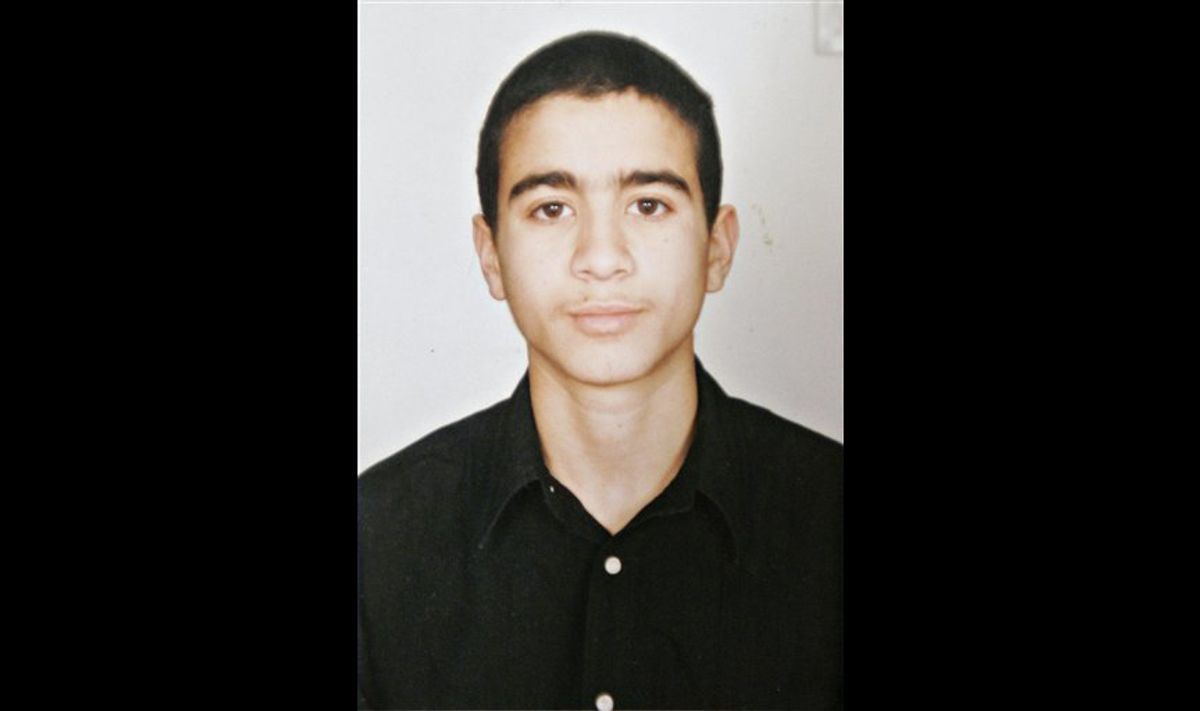
When I was down in Guantánamo a few months ago, a veteran German journalist let it slip that she didn’t much care for the place. “This,” she confided in me, and many of the other journalists there as well, “is the worst place I have ever visited in my entire career.”
It’s not hard to see why my superlative-loving friend felt this way: we were covering the case of Omar Khadr, a 15-year-old Canadian captured after a firefight with U.S. forces outside Kabul in July 2002, tortured and interrogated for a few months at Bagram Air Base in Afghanistan, then transported to Guantánamo. He just reached a plea agreement that will avoid a trial before a military commission at Gitmo for five “war crimes.” Four of them, freshly invented for the occasion, are not recognized as war crimes in any other court on the planet. (Khadr pled guilty to all charges and will get at least one year more at Gitmo — in solitary — then perhaps be transferred to Canada for a remaining seven years.)
Aside from Khadr and about 130 other prisoners who may one day see a trial, Guantánamo also holds 47 more War on Terror prisoners who are expected to be “detained” indefinitely without being tried at all. This was one of the radical policies of George W. Bush and Dick Cheney that is now cheerfully defended by the human rights grandees in Barack Obama’s State Department.
Gitmo and all other places without habeas corpus rights are indeed dismal places — and there is certainly something disgusting about the first conviction of a child soldier since World War II. All the same, I couldn’t help but wonder if my vehement Kollegin had ever visited a homegrown federal prison like the one in Terre Haute, Indiana (whose maximum security wing was copied down to the smallest detail at Gitmo’s Camp 5), or even your run-of-the-mill overcrowded state lock-up, the kind you pass on the highway without even noticing that you’ve done so, or one of the crumbling youth detention facilities in New York State which, as we lawyers who have represented youth offenders know, are hellish.
Such prisons may lack the exotic setting of Gitmo’s Camp Delta, but they should not be forgotten. At the risk of sounding boosterish, it so happens that a great many of America’s unsung domestic prisons also routinely abuse inmates, Guantánamo-style, are unable or unwilling to prevent inmate rape, employ long-term, sustained solitary confinement (which gives waterboarding a run for its money), and in actual practice are often beyond the rule of law. Confessions, true or false, obtained through violence and threats, aren’t restricted to Guantánamo either. They are not all that hard to find in our contiguous 48 states. And for the rest of our prison system, where are the outraged German journalists? Why are no British “law lords” calling the federal supermax in Florence, Colorado, a “legal black hole” as law lord Johan Steyn termed Guantánamo?
Alas, in so many ways Guantánamo is not the exception but far closer to the rule of our criminal justice system, and the case of Omar Khadr, rather than being an anomaly of the War on Terror, is in all too many ways positively all-American. To be sure, taking a child soldier you’ve captured in a foreign land, whose interrogation entailed stringing him up half-naked in a five-foot-square cell with wrists chained to the bars at eye level and a hood clamped tightly over his face, then prosecuting him for “murder” because he allegedly tossed a grenade on a foreign battlefield, does present some legal issues that don’t ordinarily come up in Spokane or Chillicothe.
But Gitmo, a “betrayal of American values”? Would that it were! Alas, for nearly every grisly tabloid feature of the Khadr case, you can find an easy analog in our everyday criminal justice system. In a sense, much of our War on Terror has proven a slightly spicier version of our “normal” way of doing criminal justice. Using the case of Omar Khadr, let’s take this step by step.
Child Soldiers and Juvenile Offenders
The Khadr case should have been a bit queasy-making for us Americanos. Hasn’t there been a surge of concern for child soldiers in book clubs and church groups across the land? Turns out, however, that this long-distance compassion goes up in smoke at closer range. The second a child soldier points his gun at an American, not another African, it’s adiós victimized child, hello hardened terrorist.
The hypocrisy in all this is less flaming than it may appear. After all, clemency for youth offenders, be they child soldiers or just local kids, runs against the American grain these days. If we routinely prosecute children even younger than 15 as adults — and we do — why should a foreign child soldier be any different?
In fact the U.S. even has a few dozen inmates doing life without parole for acts committed when they were 13 or 14, and most of these sentences were mandatory rather than the prerogative of a particularly nasty judge. (Some small progress: Last May in Graham v. Florida the Supreme Court decided that juveniles can get life without parole only if there’s homicide involved.) Overall, the U.S. has in recent years had precious little mercy for its children, or anyone else’s.
Coercive Interrogation of Minors
Back in May, the Gitmo press corps gasped when Khadr’s “Interrogator Number One,” Joshua Claus, described the veiled threats of rape he wielded at Bagram Prison to try to break the young prisoner. If Khadr should fail to cooperate, Claus told him, he would meet the same fate as another young (and imaginary) Afghan detainee who was supposedly sent to a U.S. penitentiary and raped to death in a shower room by “neo-Nazis, and four big black guys.” Claus, a court-martialed detainee abuser, had been the leader of the final interrogation of a mistakenly imprisoned Afghan taxi driver who was beaten to death by American guards at Bagram in 2002. Before receiving a rather light sentence in the case, Claus pledged his full cooperation with the Khadr prosecution, and he kept his part of the bargain with visible enthusiasm.
As it happens, Claus’s veiled threats of rape and violence to a minor would not have been that uncommon in domestic interrogation rooms. “From the stories I’m familiar with, threats like that are a pretty garden-variety police interrogation tactic,” says Locke Bowman, legal director of the MacArthur Justice Center at Northwestern University.
With youths, it’s not that much of a challenge to get a false confession, even without the threat of or actual physical violence being brought to bear, as the case of Marty Tankleff in Long Island shows, not to mention the seven and eight year-old boys from the Englewood neighborhood of Chicago who, in the summer of 1998, “confessed” to murdering a girl for her bicycle. Even after DNA evidence from semen found on the corpse was matched to an adult serial sex offender, the Chicago Police Superintendent at first refused to exonerate them. The State’s Attorney might well have prosecuted the boys, too, if the entire South Side of Chicago hadn’t threatened to explode.
Torture
Okay, but what about torture? We bemoan with great feeling that America has “become” a state that uses torture. Alas, this, too, is not so new, nor has it ever been limited to foreign insurgents (be they Comanche, Filipino, or Vietnamese) or suspected terrorists. Take, for example, the former high-ranking Chicago police detective Jon Burge who, over a 20-year career, enhanced his interrogations with mock executions, suffocation, electroshocks, pistol-whipping, and yes, a form of waterboarding. All this was uncovered in 2002 in an epic special investigation which led to the reexamination of more than 100 cases, several overturned convictions, multiple Governor’s pardons and the usual massive lawsuits against the Chicago Police Department. Because the statute of limitations for Burge’s crimes had run out, the disgraced police officer was convicted this past June for perjury and obstruction of justice. He currently awaits sentencing.
Routinized Prison Abuse
As for routinized prison abuse, Bagram and Abu Ghraib have regularly been described as one-off aberrations, but the origins of such brutality are not hard to spot in our treatment of prisoners at home. This continuity is personified by Charles Graner, the ringleader of the Abu Ghraib torture. He had fittingly been a guard at maximum-security State Correctional Institute-Greene in southwestern Pennsylvania, itself subject to a major prisoner-abuse scandal in the late 1990s which got several guards fired, though not Graner.
Fact is, the abuse and/or torture of prisoners, though far from systematic, is not all that uncommon in many American prisons. What came out in the Abu Ghraib photos is, according to the (increasingly busy) United States program of Human Rights Watch, not so different from the abuse and brutality of many of our own stateside lock-ups.
In New York, for instance, a state task force convened by Governor David Paterson in 2008 deemed the entire youth detention system “broken.” The official report found that guards throughout the system regularly used “excessive force” on youth inmates, sometimes breaking bones and shattering teeth.
Prison abuse here at home can be just as fatal as at Bagram. In New York, an emotionally disturbed 15-year-old died in 2006 after corrections officers pinned him face down on the ground. (Remember, at Bagram the interrogators tried to make young Khadr talk by threatening to send him to an American prison, which they apparently considered at least as threatening as anything Afghanistan had to offer.)
This is not lost on lawyers representing Gitmo detainees. “I might well advise a client to take ten years in the communal wing of Guantánamo over three years in solitary at the supermax in Florence,” says Shayana Kadidal, senior managing attorney at the Guantánamo Global Justice Initiative at the Center for Constitutional Rights. Attorney Joshua Dratel, who took part in the very successful defense of Gitmo detainee David Hicks, told me recently that he thought the worst American-run prison is not Guantánamo’s Camp Delta, but rather the Metropolitan Correctional Center in lower Manhattan. And yet, somewhat mysteriously, New Yorkers are more likely to know about the brutality of Gitmo and Abu Ghraib than the fatal abuse and abysmal prison conditions in their own state.
To be sure, in significant ways Gitmo and the CIA’s various global “black sites” were significantly worse. First, the use of torture has been far more widespread at Bagram, Abu Ghraib, Guantánamo, and the other secret prisons established in the Bush years than at home. In addition, the government has also made the decision to imprison some detainees without trial for the duration of what has often been described as a “multigenerational” global war on terror. Even those prisoners with habeas rights have had trouble getting release orders granted by the judiciary enforced. Half a dozen Guantánamo prosecutors — prosecutors, mind you, not defense lawyers — have quit in disgust with the whole process, offering harsh words about the structural flaws which tilt the system towards securing convictions at the expense of impartial justice.
In important ways, however, our domestic justice system is no better. Darrell Vandeveld is a former Guantánamo prosecutor. He resigned in a crisis of conscience in 2009. He was also once a public defender in San Diego where he found that many defendants were able to get only a semblance of justice. ”Most of the defendants’ rights were honored only in the breach. It’s an overburdened system that has only become worse. Comparable to Gitmo? No doubt.” Vandeveld, who now heads the public defender office in Erie, Pennsylvania, stresses that, while the outrages are not identical, they are comparable.
Legal Black Holes, At Home and Abroad
Gazing into Gitmo’s black hole can also easily provoke disturbing reflections on the rule of law in wartime America. As another lawyer remarked 2,000 years ago while his republic was degenerating into empire, “Inter armas silent leges” (in time of war, the laws fall silent).
Keep in mind that the Global War on Terror — a name the Obama administration has demurely dropped without dropping the war that went with it — is by no means the only war deforming our justice system. For the past three decades, the War on Crime and the War on Drugs have been in full fury, becoming ever less metaphorical as budgets for police and prisons skyrocket, and then skyrocket some more. These domestic crackdowns have come with much martial rhetoric and political manipulation of fear and anger, clearing a wide path for the excesses of that Global War on Terror. By overburdening the criminal courts and prison system to a hitherto unimaginable degree, these “wars” also created legal black holes where the rule of law is notional at best.
Take the Prison Litigation Reform Act of 1995, which made it nearly impossible for inmates to sue prison authorities, and has put thousands of Americans beyond the reach of any kind of juridical authority. According to Bryan Stevenson, a peerless capital-defense litigator and executive director of the Equal Justice Initiative in Montgomery, Alabama:
U.S. prison officials have obtained greater and greater discretion to send someone to solitary confinement for years; to force people into their cells naked, without meals; to inflict punitive measures without any possibility of outside intervention. It’s often a closed system whose managers have all the authority, especially at our supermax facilities. They function in many ways like Guantánamo.
Gitmo and Bagram were well within our capabilities before 9/11. Yes, it’s true that Bush administration officials and pundits told us with excitement about how, in our counterattack on al-Qaeda, “the gloves were coming off.” For a great many Americans already in U.S. prisons, however, those gloves had never gone on to begin with. This raises some vexing questions about how we budget our indignation. It is not at all clear why violent interrogations, abuse, and torture should be more scandalous when they happen overseas than in Chicago.
What explains this collective Jellybyism? Is it because so many of our domestic inmates, especially in the regions where national opinion is produced, are African American and Latino, whereas most of our professional social reformers in the nonprofit sector are white and Asian? Is it because most of our elite public-interest lawyers and white-shoe pro bono advocates come out of a top half-dozen law schools where they most likely got a nice taste of well-tended federal courts, but little if any exposure to our overburdened state criminal courts? Is it just too depressing to think about our crumbling, overstrained criminal justice system in Guantánamo-like terms? Does compassion fatigue for those atrocities closest at hand always set in first, and hardest? Whatever the reasons, the gaping legal black holes in our domestic justice and penal system have acquired the seamless invisibility of an open secret.
It is no coincidence that most of the American intellectuals who have pointed out these domestic precursors to the Global War on Terror — journalists like Margaret Kimberley and Bob Herbert, and law professor James Forman, Jr. — are African American. Black Americans, whose overall incarceration rate today is probably higher than that of Soviet citizens at the peak of the gulag, have had ample reasons over the centuries, and now as much as ever, to doubt the fundamental fairness of American justice. When advocates compare the military tribunals unfavorably to “the Cadillac version of justice” that U.S. citizens supposedly get (which was how one Gitmo defense attorney described America’s domestic courts), it is simply baffling to those aware of how our system actually works.
In fact, the ho-hum familiarity of much of the War on Terror’s nastiness may help explain why so many Americans view what’s gone on at Gitmo with a shrug, and often respond to the liberal shock and horror with exasperation. This has been going on right here for decades, where have you been?
Prosecuting a 15-year-old for “murder” with the help of a little torture and some threats of rape may not be the kind of thing we want show German journalists. They’ll just get upset. They lack the context. But we Americans really have no right to claim that we’re shocked, shocked. We got used to this kind of thing a long time ago. The prosecution of former child soldier Omar Khadr has been nothing, in other words, if not all-American.
Facing the truth is hard to do, especially the truth about ourselves. So Americans have been sorely pressed to come to terms with the fact that after 9/11 our government began to torture people, and did so in defiance of domestic and international law. Most of us haven’t come to terms with what that meant, or means today, but we must reckon with torture, the torture done in our name, allegedly for our safety.
It’s no secret such cruelty occurred; it’s just the truth we’d rather not think about. But Memorial Day is a good time to make the effort. Because if we really want to honor the Americans in uniform who gave their lives fighting for their country, we’ll redouble our efforts to make sure we’re worthy of their sacrifice; we’ll renew our commitment to the rule of law, for the rule of law is essential to any civilization worth dying for.
After 9/11, our government turned to torture, seeking information about the terrorists who committed the atrocity and others who might follow after them. Senior officials ordered the torture of men at military bases and detention facilities in Afghanistan and Iraq, in secret CIA prisons set up across the globe, and in other countries – including Libya and Egypt — where abusive regimes were asked to do Washington’s dirty work.
The best known of all the prisons remains Guantanamo on the southeast coast of Cuba. For years, the United States naval base there seemed like an isolated vestige of the Cold War – defying the occasional threat from Fidel Castro to shut it down. But since 9/11, Guantanamo – Gitmo – has been a detention center, an extraterritorial island jail considered outside the jurisdiction of US civilian courts and rules of evidence. Like the notorious Room 101 of George Orwell’s “1984,” the chamber that contains the thing each victim fears the most to make them confess, Guantanamo’s name has become synonymous with torture. Nearly 800 people have been held there. George W. Bush eventually released 500 of them, sometimes after years of confinement and cruelty. Barack Obama has freed 67, but 169 remain, even though the president pledged to close the Guantanamo prison within a year of his inauguration. Now, forty-six are so dangerous, our government says, they will be held indefinitely, without trial.
We almost never see the detainees. Were it not for the work of human rights organizations and the forest of lawsuits that have arisen from our actions, the prisoners would be out of sight, out of mind. Five of the Guantanamo prisoners were recently arraigned before a military commission for their role in the attacks. One of them is Khalid Sheikh Mohammed, who says he was the mastermind behind 9/11. He was waterboarded by interrogators 183 times. Pentagon officials predict it will be at least another year before the five go on trial.
Earlier this month, lawyers for Mohammed al-Qahtani – the so-called “20th hijacker” who didn’t make it onto the planes — filed suit in New York federal court to make public what they described as “extremely disturbing” videotapes of his interrogations. He was charged in 2008 with war crimes and murder but the charges were dropped after the former convening authority for the Guantanamo military commissions, Susan Crawford, told journalist Bob Woodward that al-Qahtani’s treatment “met the legal definition of torture.”
He remains in indefinite detention, as does Abu Zubaydah, a Saudi citizen alleged to have run terrorist training camps. He was waterboarded at least 83 times in a single month. Just this week a federal appeals court refused to release information on the interrogation methods the CIA used on Abu Zubaydah and other terrorist suspects.
You may also have seen the flurry of action this month around a section of the new National Defense Authorization Act that allows the military to detain indefinitely not only members of al Qaeda, the Taliban and “associated forces” but anyone who has “substantially supported” them. A federal court struck down that provision in response to journalists and advocates who believe it could be so broadly interpreted it would violate civil liberties. Nonetheless, two days after the court’s decision, the House of Representatives reaffirmed the original provision.
The other day, eight members of the Bush Administration – including President Bush, Vice President Cheney, and Defense Secretary Rumsfeld – were found guilty of torture and other war crimes by an unofficial tribunal meeting in Malaysia. The story was played widely in parts of the world press, with reports that the judgment could lead the way to proceedings before the International Criminal Court in The Hague. It received almost no mention here in the United States.
This summer, it’s believed that the United States Senate’s intelligence committee finally will release a report on “enhanced interrogation techniques,” that euphemistic phrase for what any reasonable person not employed by the government would call torture. The report has been three years in the making, with investigators examining millions of classified documents. The news service Reuters says the report will conclude that techniques such as waterboarding and sleep deprivation do not yield worthwhile intelligence information.
So here we are, into our eleventh year after 9/11, still at war in Afghanistan, still at war with terrorists, still at war with our collective conscience as we grapple with how to protect our country from attack without violating the basic values of civilization — the rule of law, striving to achieve our aims without corrupting them, and restraint in the use of power over others, especially when exercised in secret.
In future days and years, how will we come to cope with the reality of what we have done in the name of security? Many other societies do seem to try harder than we do to come to terms with horrendous behavior commissioned or condoned by a government. Beginning in 1996, in South Africa, the Truth and Reconciliation Commission held hearings at which whites and blacks struggled to confront the cruelty inflicted on human beings during apartheid.
And perhaps you caught something said the other day by the president of Brazil, Dilma Roussef. During the early seventies she was held in prison and tortured repeatedly by the military dictators who ruled her country for nearly 25 years. The state of Rio de Janeiro has announced it will officially apologize to her. Earlier, when she swore in members of a commission investigating the dictatorship, President Roussef said: “We are not moved by revenge, hate or a desire to rewrite history. The need to know the full truth is what moves us.”
In other words, “You shall know the truth and the truth shall make you free.”
Continue Reading
Close
A military guard will be on each arm of Khalid Sheikh Mohammed as he is led into a courtroom on Saturday to be arraigned for a second time before a military commission at Guantanamo Bay. He went through the same process in the same courtroom on nearly the same charges almost four years ago in the closing months of the Bush administration. The fact that President Obama chooses now, six months before voters choose between him and Mitt Romney, to restart what some have dubbed “the trial of the century,” using a second-rate system of justice he had ordered stopped at a facility he had ordered closed, makes an unflattering statement about the timidity of his leadership and the malleability of his principles.
Apologists for the tarnished military commissions, like Attorney General Eric Holder and the sixth and current chief prosecutor Brigadier General Mark Martins, acknowledge that our regular federal courts are best suited for terrorism trials. Holder told an audience at Northwestern University in March:
Simply put, since 9/11, hundreds of individuals have been convicted of terrorism or terrorism-related offenses in Article III courts and are now serving long sentences in federal prison. Not one has ever escaped custody. No judicial district has suffered any kind of retaliatory attack. These are facts, not opinions. There are not two sides to this story. Those who claim that our federal courts are incapable of handling terrorism cases are not registering a dissenting opinion – they are simply wrong.
After singing the praises of the federal courts – which really have been swift, severe and successful in comparison to the six and-a-half dubious trials completed over the past decade at Guantanamo – Martins and Holder pivot to polishing the image of the tarnished military commissions they argue are well-suited for a small category of cases. Martins told an audience at Harvard in April:
It is perfectly reasonable to ask why – with concurrent jurisdiction over offenses that can be characterized as both federal civilian crimes and violations of the law of war and with comparable procedural protections – we should invest great energy and resources in military trials. The answer is that there is a narrow but important category of cases in which the pragmatic and principled choice among the lawful tools available to protect our people and serve the interests of justice is a reformed military commission.
Beltway bureaucrats are prone to using buzzwords to shade the truth. For example, rather than saying “yes, it makes us look bad when we lock people away in prison for a decade without a trial,” some might soften it up by using more subtle Beltway language: “The optics are not optimal.” The word “pragmatic” has become a favorite of the spinmeisters. In truth, being pragmatic has become a synonym for being a wuss. When a bureaucrat capitulates instead of confronting barriers standing in the way of doing the right thing, and then cites the barriers as an excuse for choosing the easier path, he is lauded for making the “pragmatic choice.” Others might say he simply wussed out. President Obama has been “pragmatic” far too often on national security choices in his first three years in office.
There is nothing pragmatic or principled about undermining America’s reputation as a champion of the rule of law and a supposed model for the world to follow. The apologists for Obama’s decision to embrace military commissions call attention to similarities between the commission rules and the rules in federal courts, and they claim those rules are essentially the same. They argue that the two systems are virtually identical and that trial observers will find trials in the two forums nearly indistinguishable. In some things, however, close is just not good enough. An O’Doul’s looks like a beer and has a beer-like flavor, but a real beer drinker would never argue that an O’Doul’s is virtually indistinguishable from a Sam Adams. Just as a near-beer is not practically the same as a real beer, neither is near-justice the equivalent of real justice. The apologists may think they are fooling the rest of the world when they say at long last military commissions do real justice, but they are wrong.
Holder and Martins justify the need for a second-rate military commission system by talking up the alleged realities of the battlefield that they say make it impracticable for troops to worry about doing rights advisements and establishing a chain of custody for evidence while in the midst of a war. Their general principle is entirely valid … but also totally irrelevant in the cases they intend to prosecute before military commissions. Few of the 779 men ever held at Guantanamo were captured by members of the U.S. armed forces and even fewer still were apprehended on the battlefield as that term is commonly understood by ordinary human beings. Khalid Sheikh Mohammed, for instance, was rousted from a sound sleep and arrested in Rawalpindi, Pakistan, by the Pakistani Inter-Services Intelligence Directorate based on information developed by our civilian Central Intelligence Agency. Abd al Rahim al Nashiri, the alleged USS Cole bomber, was apprehended in Dubai, a bustling global business center in the United Arab Emirates that no one considers a battlefield. Hambali was arrested near Bangkok, Thailand, by Thai authorities and later turned over to the CIA. The truth is that not a single one of the 14 so-called high-value detainees was captured by members of the U.S. armed forces on a battlefield; in fact, none were even apprehended in Afghanistan. The perception of some inexperienced 19-year-old Army private trying to read Miranda rights to a captured al Qaeda fighter while hunkered down in a foxhole with bombs exploding nearby and bullets whizzing past overhead is a canard.
Military commission apologists should have the integrity to stand up and tell the public the truth about the small category of cases they believe are best-suited for the second-rate procedures of the tarnished military commissions. The truth is the reason the apologists want a second-rate military commission option is because of what we did to the detainees, not because of what the detainees did to us. This is not about the exigencies of the battlefield and the problems our soldiers face trying to fight a war; this is about torture, coercion, rendition and a decade or more in confinement without an opportunity to confront the evidence – abuses that would have us up in arms if done to an American citizen by some other country – that make the tarnished military commissions uniquely suited to try and accommodate the small category of cases where we crossed over to the dark side. A military commission may be a justice-themed theatrical production – complete with a script, actors, a sound stage and costumes that create a passable courtroom-like atmosphere – but beneath that facade is a ‘heads we win, tails you lose’ charade where, as the government admits, even if a KSM or a Nashiri is found not guilty he returns to a cell to continue serving what is likely a life sentence. That should not inspire anyone to wave the flag and shout USA! USA! in celebration of our vaunted exceptionalism.
Lloyd Cutler was the youngest member of the prosecution team in the trial of eight Nazi saboteurs captured, convicted by a military commission and executed in a span of six weeks in the summer of 1942. He wrote an op-ed in the Wall Street Journal on December 31, 2001, nearly 60 years after his military commission experience ended and 10 days before the first detainees arrived at Guantanamo Bay. Mr. Cutler said that how we prosecute alleged al Qaeda terrorists will say as much about us as it does about al Qaeda. He warned that success will be judged by our ability to show the world that justice is in fact being done.
Had we heeded Mr. Cutler’s advice back in 2001 we would not be where we are now in 2012, fumbling along more than a decade later still trying to mold a second-rate process to fit around sets of bad facts we created when we turned our backs on the law and our values. In normal practice, cases are developed to conform to the court. Here, because of how we mistreated some of the detainees, we are trying to develop a court to conform to the cases. We are setting an example for the world, but not a good one.
Continue Reading
Close
The U.S. Defense Department specializes in euphemism. “Limited kinetic action” is a polite way of saying “war,” and “collateral damage” does not sound as blunt as “dead children.” When I was chief prosecutor for the military commissions at Guantanamo Bay during the Bush administration, I was told not to say publicly that a detainee had “attempted suicide.” The government-approved term for the act was “self-injurious behavior.” I could not say “torture,” or as some called it, the “T-word.” Instead, I had to say “enhanced interrogation techniques.”
The euphemism tradition remains alive and well in the Obama administration. The slogan “fairness, transparency, justice” is featured prominently throughout the military commissions’ new half-million-dollar website. The slogan even shows up when case document links lead to a notice saying the “document you are trying to access is currently undergoing a security review” and might be posted later if the government decides it is “publicly releasable.”
Say you are interested in the case against Abd Rashim Nashiri, the alleged mastermind of the USS Cole bombing in Yemen in October 2000 that killed 17 U.S. sailors. You are not allowed to see the judge’s docketing order setting April 11-13 for the next session to consider motions.
You are not allowed to see a key motion seeking authorization for Nashiri’s lawyers to depose former Yemeni President Ali Abdullah Saleh while he is in the United States. The Obama administration is permitting Saleh to visit New York City for medical care; many believe he should be at the International Criminal Court facing charges for turning his forces on Yemeni protesters resulting in 270 civilian deaths.
Before being elected to the presidency, Barack Obama condemned what he said were “flawed” Bush-era military commissions. He voted against the Military Commissions Act of 2006 when he was a member of the Senate and he argued that detainees accused of criminal conduct should be tried in federal courts or courts-martial, either of which he said would “demonstrate our commitment to the rule of law.” Six years later it appears all it takes to transform fatally flawed into fundamentally fine for Barack Obama is to tack a new word onto an old title to give it a euphemistic revival: now we have “reformed military commissions.”
Brig. Gen. Mark Martins, the sixth and current chief prosecutor for the military commissions, gave a talk to the New York City Bar Association last month. In it, he used the phrase “reformed military commissions” more than three dozen times. Apparently tacking the word “reformed” onto “military commissions” and using it over and over is supposed to erase a decade-long record of failure that has, as then-Sen. Obama said, tarnished “our credibility as a nation committed to the rule of law.”
The failure of the military commission system is well documented. President Bush first authorized military commissions in an order he issued on Nov. 13, 2001. Six military commission trials were completed in the decade that followed. Two of the six “worst of the worst” war criminals – David Hicks and Salim Hamdan – have served their short military commission sentences and are free men back in their home countries.
Over the same period, hundreds of terrorism-related cases were tried with success and without incident in federal courts resulting in typical sentences that exceeded those in military commissions by a wide margin. The Bush administration’s initial notion that military commissions would be more swift, more secret and more severe than federal courts has proven clearly wrong. Nonetheless, the Obama administration intends to press ahead with “reformed military commissions,” U.S. credibility be damned.
I was one of the most public advocates of the original military commission structure that the U.S. Supreme Court ruled was illegal in June 2006. Congress revived and reformed the military commissions in September 2006 with the Military Commissions Act (that Sen. Obama voted against). These “reformed” military commissions were implemented through a series of documents that set out new rules and procedures to improve the process that the Supreme Court had struck down. Once again, I publicly praised their virtues to an increasingly skeptical world audience. Before I resigned as chief prosecutor in October 2007, I personally authorized charges against David Hicks, Salim Hamdan and Omar Khadr under the 2006 “reformed” military commission system.
President Obama ordered a halt to military commissions as soon as he took office in January 2009, but he backtracked a few months later in the face of conservative fear-mongering. Nine months after President Obama took office, the Democrat-controlled Congress passed the Military Commissions Act of 2009 to replace and reform the process it had created in 2006 to replace the process President Bush created in 2001. The slight change in 2009 is supposed to let President Obama save face. The military commissions authorized in 2001, 2006 and 2009 have so far generated 51 implementing documents totaling 2,352 pages setting out rules and procedures. Each series of reforms purports to be better than the last, which had purported to be better than ones before. Each has failed.
I honestly believed we were committed to full, fair and open trials when I became chief prosecutor in 2005, but I lost confidence in that commitment over time as political appointees tried to manipulate the process and make it more like a theatrical production than a judicial proceeding. After more than a decade of futility and failure, the question is no longer whether the U.S. could proceed with “reformed again and again and again military commissions,” but whether it should.
In his recent talk, Brig. Gen. Martins said, “while federal courts will and should objectively be the appropriate forum in most instances, reformed military commissions will sometimes be the better choice.” His rather vague statement raises some issues that should be considered before lumbering along even further down the sullied military commission path.
Which cases are candidates for military commissions? Brig. Gen. Martins said federal courts are the appropriate forum in most instances and that military commission cases may be “numerically few.” The administration has identified fewer than three dozen detainees they intend to prosecute for alleged criminal conduct. How will those cases be divided between federal courts and military commissions? Sen. Dianne Feinstein hinted at the answer during a Senate Judiciary Committee hearing in 2010 when she told Attorney General Eric Holder that in choosing between the two forums, “make the decisions based on the legal facts and where we best get a conviction.” If you peel back the rhetoric and examine the ground truth, military commissions likely end up the “better choice” when there is a chance the U.S. government might not be assured of a conviction elsewhere. In other words, the U.S. will afford an accused all the justice possible while ensuring the cards are stacked decidedly in the government’s favor.
Military commission proponents rationalize the need for this peculiar forum citing the exigencies of war and the unique circumstances presented on the battlefield. That argument would be more persuasive had most of the Guantanamo detainees been captured under circumstances bearing some resemblance to battle. They were not. For example, Khalid Sheikh Mohammed was rousted from a bed in a house in Rawalpindi, Pakistan, by Pakistani authorities, and Abd al-Rahim al-Nashiri was captured in the United Arab Emirates without any U.S. military involvement. In the end, it is not so much what the detainees did that make military commissions the better choice, it is what the U.S. did that may not stand up to traditional principles of justice.
The U.S. has invested a great deal of effort in trying to revive a military commission process it last used in World War II and make it fit the unique circumstances of a handful of post-9/11 terrorism cases. There have been 779 men detained at Guantanamo over the past decade. Only 171 remain, and a majority of them have been cleared for transfer (about 89 men) or designated for indefinite detention without trial (about 46 men). Four more have already been convicted and sentenced, leaving 32 potential cases for prosecution. The last of the 32 was captured in 2006, so the facts of any case have not changed in more than five years.
Rather than developing these few cases to conform to the rules of regular federal court, the U.S. has tried to develop an irregular military court to accommodate the cases. The end result – at least until the next reform attempt – is a process where an accused can spend a decade or more waiting for his day in court; nearly all of the information is classified and the accused only gets to see what the prosecution decides is appropriate; the government demands that it gets to see the information shared between the accused and his attorney; and even if the accused wins, he is likely to still spend the rest of his life in prison.
This is the kind of “heads we win, tails you lose” process the U.S. condemns when it is used in other countries. If President Obama thinks this is going to restore America’s reputation as a nation committed to the rule of law he is mistaken. Pinning the word “reformed” to the title does not make a silk purse out of this sow’s ear of justice.
Continue Reading
Close
Brig. Gen. Mark Martins, chief prosecutor for the Office of Military Commissions, has lately appeared at bar association conferences promoting “reformed military commissions” at Guantanamo. Speaking to the New York City bar association on January 11, Martins said the military commissions were “comparable to federal courts in their incorporation of all of the fundamental guarantees of a fair and just trial demanded by our values.” Indeed, a new masthead on the military commission website, put up after Martins took over, reads: “Fairness, Transparency, Justice.”
Yet this week, behind thick bulletproof glass in a secure hangar-like courtroom at Guantanamo, I saw vast differences between the two systems. One notices first the physical – the few observers permitted to visit the isolated island base reach the courthouse through a maze of walkways secured by high dark-mesh fences, guards and double barbed wire on both sides. Instead of sitting in the courtroom, observers sit in an adjoining room, behind glass, and hear voices on 40-second delay to allow court security officers to cut off the audio should any classified information be uttered. In the dock this week was Abd al-Rahim al-Nashiri, a Saudi of Yemeni descent accused of planning and participating in the bombing of the destroyer, the USS Cole, on October 12, 2000. The attack killed 17 US servicemen and injured many more. With US service members killed a federal court clearly would have jurisdiction over the case, so the government must have some other reason for choosing a military commission.
Nashiri’s is the first death penalty case to move forward in the military commissions. The fact that it is just being heard now, nine years after he was apprehended, demonstrates one of the starkest differences between the military commissions and federal courts – the absence of any real right to a speedy trial. This type of delay would never occur in federal court and greatly prejudices both sides, as memories fade and witnesses disappear.
Further, nearly every substantive issue litigated in Guantanamo this week would never have arisen in civilian court. For example, the defense asked the judge to order the military to stop reading mail marked attorney-client privileged. In a federal prison, while mail might be inspected for physical contraband, a warden wouldn’t read clearly marked legal mail to determine if it was truly a privileged communication.
The defense also sought permission from the judge alone to request funds for expert witnesses, a routine motion in federal court. But in the military commissions, the defense normally shares its request with the prosecution, potentially revealing its case theory and litigation strategy. Observers and reporters dozed during the hours of debate about whether defense email could be encrypted –- a seemingly dry issue until one realizes that request was being made because the Defense Department has been reading all the defense attorneys’ email.
The defense has still not received roughly 70,000 pages of documents deemed relevant and material to the defense. Much of the evidence in the case is classified. After his capture, Nashiri was held in a secret CIA “black site” for four years, and waterboarded — a form of mock execution by inducing near suffocation long considered torture under US and international law. He was also threatened with a gun and, later, with a revving power drill near his head while he was hooded but otherwise naked. Details of his torture, while available in the public domain, are largely treated as classified.
The classified nature of the evidence means the defense only gets summaries of parts the prosecution deems relevant and that the judge approves. A request by the defense to challenge the accuracy of the summaries was denied. But civilian judges recognize that the parties should be able to challenge summaries, and may do so with a motion to reconsider.
Despite the volume of documents, the prosecution pressed for trial to begin on March 3. That type of timeline is unheard of in federal court, especially in a death penalty case. The federal court case against 9/11 conspirator Zacarias Moussaoui took more than four years. Richard Kammen, one of Nashiri’s defense attorneys, called the prosecution’s proposed schedule “a time line for secret justice, for expedient justice, for under-resourced defense justice, and for justice that is fundamentally unfair.” He asked for ten months to two years depending upon whether he gets the resources and access to documents he needs. Ultimately the judge did not fix a trial date but gave the defense only two months to read all the documents and file any motions to challenge their adequacy.
Even in the presentation of evidence, the military commissions have vastly different rules of evidence. Statements from the accused obtained by torture are prohibited. But evidence derived from other types of coercion may be admitted. In federal court, any evidence derived from coercion would be barred, absent a showing that it would have been discovered in another lawful way. Also, unlike in federal court or the US courts martial system, multiple levels of hearsay are admissible (like a memo reporting on a conversation), denying a defendant any genuine right to confront witnesses against him.
Given the stark differences on display this week, it was startling to hear Martins say after the proceedings that military commissions “like federal court and courts martial” provide a fair system of justice. The US does not need to use this fundamentally flawed military commission system. As Martins himself admits, and the Obama administration has acknowledged, detainees can be prosecuted in either system for virtually the same offenses.
Whether one agrees with the use of military commissions or not, Martins and the Obama administration should at least be honest about the differences: as demonstrated by the proceedings this week, fundamental procedural protections afforded defendants in federal courts simply do not exist in military commissions. And without comparable fairness and transparency, the promise of justice remains a big question mark.
Continue Reading
Close