Eyewitness Cook

The best part of fried chicken without making fried chicken

Don't throw out the skin from your chicken. Turn it into crisp, airy cracklins! Chickarrones for everyone!

  • more
    • All Share Services

Topics: ,

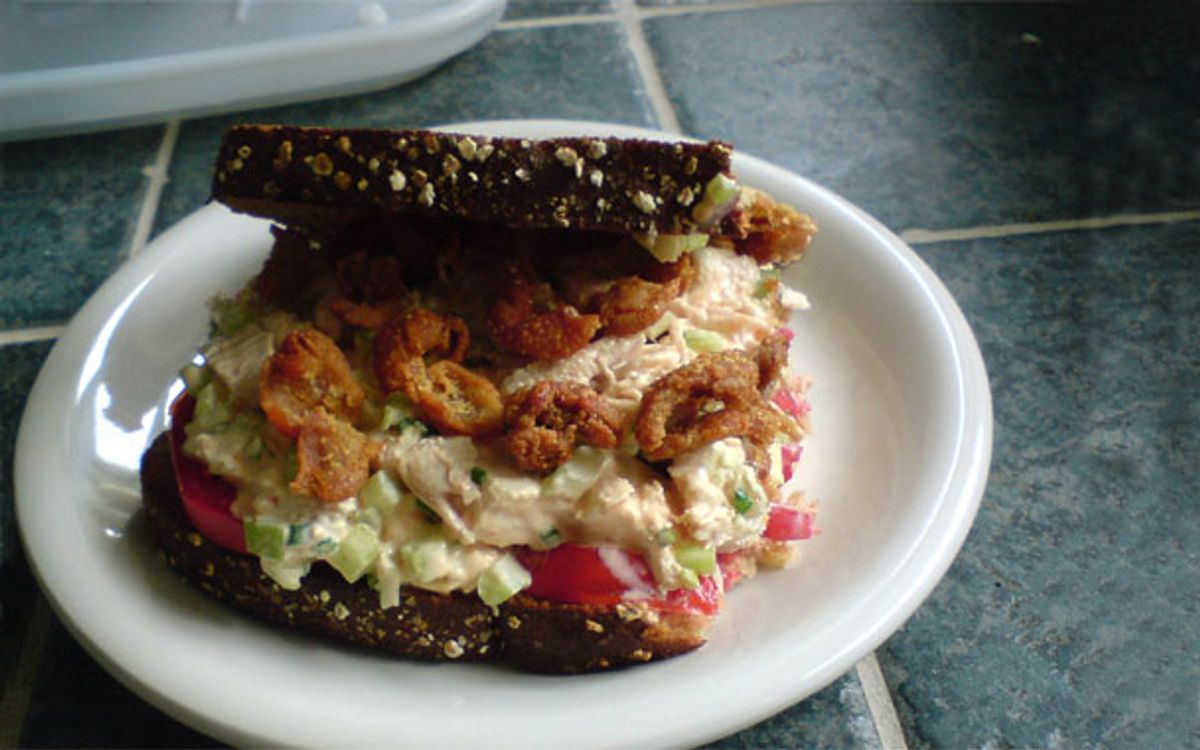
The best part of fried chicken without making fried chickenChicken salad is good, but chicken salad topped with fried chicken skins is the bomb

My ladyfriend is mostly a vegetarian — but, I one day found, with a don’t-ask-don’t-tell policy on meat stock. Excited by the news, I ran to the store for chicken bones, only to find a whole bird that was almost the same price. I wasn’t happy to buy into the system that would render such an economic improbability true, but, in a misguided reading of vegetarianism, I bought it anyway. I mean, the cheap chicken was probably an industrially made android, and barely a real animal in the first place. (I’M JOKING, PEOPLE.)

I separated the poor thing from its skeleton and started cooking the bones in water with some vegetables. After a little while, with visions of chicken salad dancing in my head, I skinned and defatted the meat to poach it in the stock. (Which, incidentally, also makes the stock richer. Win-win.)

And then I stared for a while at the pile of fat and skin on my cutting board. You know what I like doing? Staring at piles of fat and skin on my cutting board. Maybe you, too, have stared at piles of fat and skin on your cutting board. Maybe it’s because you’ve had your cousin Phyllis over for dinner, who pales at the sight of anything that isn’t boneless and skinless and, while you fret and talk to your therapist about it, you realize that she’s family and you can’t disown her.

If so, I hope you did what I did: fried it all up into chicken cracklins, the noblest form of chicken byproduct. Crunchy and airy and rich and salty, a few of them can send a chicken salad sandwich to a higher plane or make a perversely delicious topping for, well, anything. You know how it’s food-dork cool to sneak bacon into everything? Imagine how totally cool you would be sneaking the best part of fried chicken into everything.

Chicken cracklins aka chickarrones* aka the Path to Avian Enlightenment

Ingredients

  • Chicken skins and fat, from parts or a whole bird
  • Salt, to taste
  • Vegetable oil, as needed (you probably won’t need much, if any at all)

Directions

  1. Mince up all the pure yellow chicken fat you can find — there’s usually a nice big chunk on the tail.
  2. Throw it with a few tablespoons of water into a heavy-bottomed pot over high heat to get it going. When it comes up to a boil, turn it down and keep the heat low to let everything render slowly.
  3. Cut the skin into something like half-inch strips and dump them into the pot, seasoning lightly with salt. Not much will happen for a bit. The skin will turn gray. Gross.
  4. Go about your business. Give a stir every 5 or 10 minutes. Eventually you will see a little color around the edges of the pot, and around the edges of the cracklins. If at this point the skins haven’t rendered enough fat to nearly cover them, pour in a little vegetable oil to help them out. Stir again, being sure to scrape the bottom.
  5. When the strips of skin start to get sticky, they’ll want to clump up and it’s time to get nosy. Keep stirring every minute or two so they don’t permanently stick together. Be merciless in breaking them apart — if all that skin was meant to be in one piece, the chicken would’ve found a way to stay alive.
  6. Around this time, you’ll start to see foam coming to the surface and some real color developing as the skin gives up its water and begins to crisp.
  7. Eventually, you’ll notice that the skin doesn’t mind coming back apart when you give it a stir. It’ll start making a beautiful, delicate, sandpapery sound. That’s the sound of cracklins. Keep it going for a while yet; there’s still a lot of water inside the skin that needs to come out. Taste one every once in a while until they’re crisp, not chewy. (At this point, you can turn the heat up if you’re impatient, but be careful to not burn them.)
  8. When they’re crisp and light all the way through, drain them on paper towels and season with another sprinkle of salt, if need be. Try not to eat them all right then. Or go ahead.

Note: Strain the fat through a very fine strainer or cheesecloth and save it in the fridge. Cook things in it without telling anyone and wait for people to ask you why your food tastes so good. It’s up to you to tell them the truth.

 * Thanks to Rachael Oehring for coming up with that particular genius name

Continue Reading Close

Francis Lam is Features Editor at Gilt Taste, provides color commentary for the Cooking Channel show Food(ography), and tweets at @francis_lam.

A brilliant chef’s potato crisps

Michel Bras is a hero because he inspires me to look at simple food a new way. I hope I've done a bit of the same

  • more
    • All Share Services

Topics: ,

A brilliant chef's potato crisps

In my very first piece for Salon — if you don’t count our little Salon Food birth announcement — I wrote about discovering a hero in the chef Michel Bras. I’d never met him, never eaten his food. All I knew of him was from a movie, a decade-old documentary in which he sometimes struggles to articulate in words what it is that inspires him, but also in which he beautifully articulates his philosophy and character in the way he cooks — with respect, humility and curiosity. Watching him handle and hold the vegetables he’s cutting is a marvel; you’re watching a sense of wonder made physical.

I realize that sounds kind of laughable. But then again, how is it that a man whose signature dish is, essentially, a salad can be regarded as one of the greatest chefs in the world?

I think it’s because of his compelling sense of wonder, of his endless fascination with his ingredients — what they taste like, what they feel like, what they smell and look like. What he might be able to do with even the simplest food to make it seem new again, to reveal more of its character. I recently had the opportunity to watch him peel a carrot. (Yes, that sentence is for real, and the experience was spectacular.) He did this utterly pedestrian thing with such focus and care that when he’d cleared off all the peel and continued shaving into the carrot, beautiful, noodley ribbons curling onto his board, I could imagine the first time he did this, the first time he noticed this gorgeous shape, the first time he realized he could present carrots in a form so delicate and elegant.

So much of the soul of cooking is learning to open your eyes to the possibilities of anything in the kitchen. In my copy of his book “Essential Cuisine,” he wrote an inscription: “Nature speaks; experience translates.”

I’m thinking about this today because I hope that in my own, tiny, nongenius way, I’ve been able to help inspire your own cooking in this column. I’ve tried to share simple concepts and techniques to demystify new-to-you ingredients, or to make old ones taste new again. (For some reason, I also found it necessary to describe these “simple concepts” in 1,500-word columns. Sorry, I’m a yapper.) Whether it was to rediscover the aromatic pleasures of ginger and scallion by splashing them with sizzling oil, or to concentrate summer vegetables into a dense brick of pure flavor, to brulee and caramelize your Easter Peeps or to share the recipe for the greatest roast beef sandwich I have ever met, I hope you’ve enjoyed reading, talking and cooking with me.

If all this sounds a little bit like a soft-focus flashback montage sequence, it’s because, well, it is. Cue the waterworks: This is my last column for Salon.

What we’ve planned here is food coverage for curious people, for people who care about people, for people who are passionate about finding new ways to look at the world, whether they are “foodies” or people who think foodies’ main contribution to our society is allowing us to call wine dorks “winies.”

That’s what I said when I started, and I’m proud of the stories, essays and conversations we’ve shared here. For the last year and a half, I’ve had the pleasure and privilege of discussing the issues of food with you, big and small, from wondering about the ethnic politics of shark’s fin soup bans to the taste of things too horrible to enjoy in polite company. (Wait, this is going to turn into another montage sequence. Somebody stop me!)

It’s been a wild, educational, gratifying, infuriating, thrilling, humbling, exciting time. And so it’s with gratitude and sadness that I’m leaving Salon, but I won’t be going too terribly far. I hope to still contribute some meandering thoughts, and I’m excited by what’s coming up. I’ll be easy to find, on Twitter at <strong>@francis_lam, and on the web at about.me/francis_lam. I hope you’ll say hello!

But one more thing before I go — a recipe from Michel Bras. It’s for a long potato crisp, crackly and browned like the best chips, but with a softer, more mellow heart. In his truest spirit, they’re simple, delightful and just odd enough to get you wondering what else you might do with them … other than mow them all down before dinner’s served.

Michel Bras’ crispy potatoes

Adapted from “Essential Cuisine” by Michel Bras

Ingredients

  • Potatoes, starchy, like russets. About one medium-sized potato per baking sheet tray works.
  • Good olive oil or clarified butter, as needed
  • Salt, to taste

Directions

  1. Preheat oven to 275 F.
  2. Peel the potatoes and slice them lengthwise as thin as possible. I use a mandoline for this, one of those $20 Japanese babies, and cut them about 1 millimeter (a 25th of an inch) thin. In a pinch, you can improvise with a potato peeler; just use it to cut wide ribbons from the spud.
  3. Lay parchment paper or a Silpat (silicon baking sheet) on a baking tray. Brush it lightly with oil or clarified butter.
  4. Lay the potato slices in rows on the tray, overlapping the slices by about 1/3, to form long, shingled ribbons. Brush them lightly with oil or clarified butter.
  5. Bake, rotating after 20 minutes if your oven isn’t perfectly even, until the potatoes are a rich golden brown, crisp and translucent. Pale splotches are OK; in fact, they provide for an interesting textural contrast — a little less crisp, a little chewy. The only trick is to bake them long enough that the paler spots are cooked through and not rubbery, approaching crispness, about 45 minutes. When done, lightly salt them and let them cool a bit on the pan, and serve immediately or store in an airtight container. If they get a little stale, refresh them in a warm oven.
Continue Reading Close

Francis Lam is Features Editor at Gilt Taste, provides color commentary for the Cooking Channel show Food(ography), and tweets at @francis_lam.

Lemon icebox pie: A gift from the fates

I didn't deserve it, but the universe saw fit to send me this recipe for smooth, cold, lemony, creamy goodness

  • more
    • All Share Services

Topics: ,

Lemon icebox pie: A gift from the fates

There are some recipes you work for, that you earn — the ones you butter up a neighbor for, that you learn while getting hammered on the line at a restaurant. There are ones that are your cultural inheritance, and the ones that come through your bloodlines (which, depending on your family, might also mean that you suffered enough to deserve them). And then there are the ones that come to you like sweet destiny, like a flower borne in air, like a sudden, raunchy late-night call from someone you thought you’d never get to make out with again. You didn’t work for it, you might not even deserve it, but here it is and there you are.

Martha Foose’s Lemon Icebox Pie is that recipe for me.

Some time in 2008, when I was at the height of my Mississippi powers, living part-time on the Gulf coast and chatting up cooks and shrimpers and such, a group organizing a conference panel on culinary tourism asked me to come speak. Flattered and hubristic, I said yes. And only then did I proceed to ask myself, “What the hell do I know about promoting culinary tourism?”

The answer, of course, was, “Not a whole hell of a lot.” So I talked about it with my friend Google, jotted down some notes about magazine advertising rates or something, and showed up confident I could avoid sounding like I was just there for the free drinks at the reception.

I took my place at the panel, flashed a flirty smile at the (very beautiful, it turns out) woman who invited me, and heard the introductions of the other speakers. One was a culinary tourism promoter who’d been in the game for roughly three quarters of my life. The next was a woman who’d basically invented the term culinary tourism, who could tell you the name of every person to visit the great states of Louisiana, Mississippi, Arkansas, Florida and Montana from the years 1984-2007. And then there was me. With my notes. From a 20-minute round of Googling.

The rest is a little too painful to go over, but suffice it to say that I learned a few very important lessons that day:

  1. If you actually, literally ask the audience to laugh at your next joke, they will. But they will not actually be amused.
  2. Self-deprecating jokes from the stage are funny. Unless you’re bombing. Then they’re just depressing.
  3. No beautiful woman will be impressed with a flirty smile if you are obviously, appallingly incompetent.

Anyway, my time finally ground to an end, and I booked it out of that conference like my house was on fire.

On my way out, though, one of the organizers caught sight of me and, bless her heart, made sure I took home one of the thank-you gift bags. I wanted to protest. I wanted to give it back. I didn’t deserve it. I got home and opened it up, full of all manner of shameful reminders of my humiliation. I wanted to put them all out of my sight — the tumblers, the cooler bags, the aprons. But then I pulled out “Screen Doors and Sweet Tea,” Martha Foose’s cookbook.

A proud daughter of Mississippi, Martha left for a spell to train with some of the most renowned pastry chefs in France, and then returned home to cook, bake and teach up in the Mississippi Delta. I knew her from a random, wild-eyed moment years earlier, when I ran up to her after having a taste of her signature Sweet Tea Lemon Chess Pie, a pastry that will forever change the way you think about Mississippi, France, iced tea, pies, unicorns and ligers. I don’t even remember our conversation, but that there was some wary smiling and the word fraisage floated in the air (which is French for “smearing the crust dough in little circles and then stacking them all back on one another so it’s ridiculously flaky”), and I walked away hoping that I didn’t scare her too badly.

So then, in the comfort and social-awkwardness safety of my home, I opened the book to smashing success. The first page I opened to was banana pudding, which is as good a sign as there is in cookbooking. Four pages later, and I was in the promised land — “Lemon Icebox Pie: The Wonder of Sweetened Condensed Milk.”

I am a great lover of lemons, any food that includes the word “icebox,” and most of all, of the gooey ambrosia that is sweetened condensed milk. My feelings of shame and embarrassment gave way. I fired up the oven. I ground up graham crackers to make crumbs. And soon, spoon deep in its tart, creamy goodness, I started to thank fate for sending this recipe my way.

Martha Foose’s Lemon Icebox Pie

From “Screen Doors and Sweet Tea.” Used with permission, except for the stupid commentary, which is my own.

Makes one 9-inch pie

Ingredients

  • 1½ cups graham cracker crumbs (Whirl the graham crackers in a food processor for crumbs.)
  • ¼ cup granulated sugar
  • ½ teaspoon ground cinnamon (Cinnamon? In a lemon dessert? Yes. Just do it. You’ll thank Martha later.)
  • ½ cup (1 stick) unsalted butter, melted
  • 2 14-ounce cans sweetened condensed milk
  • 4 large egg yolks
  • 1 teaspoon grated lemon zest (I actually like a little more than this)
  • ½ cup fresh lemon juice (And I like a little more juice than this too, but taste it before baking and add to taste.)
  • 2 cups heavy cream
  • 6 tablespoons confectioners’ sugar

Directions

  1. Preheat the oven to 350 F.
  2. In a medium bowl, combine the crumbs, granulated sugar, cinnamon and melted butter. Pat into a 9-inch deep-dish pie pan and bake for 6 to 8 minutes, or until slightly browned. Remove to a wire rack to cool.
  3. Meanwhile, in a large bowl, whisk together the milk, yolks, lemon zest and lemon juice. Pour the lemon filling into the cooled crust. Bake for 10 minutes, or until set. Cool on a rack. Chill the pie for 30 minutes.
  4. When the pie is completely cooled, whip the cream with the confectioners’ sugar until stiff peaks form. Mound the whipped cream on top of the pie and chill for 1 hour. (The chilling together isn’t strictly necessary, but it does make the whipped cream bond to the pie in a sort of fabulous way.)
Continue Reading Close

Francis Lam is Features Editor at Gilt Taste, provides color commentary for the Cooking Channel show Food(ography), and tweets at @francis_lam.

Mussels: Your go-to sustainable seafood

They're cheap, they're tasty, they are actually good for the environment, and they're infinitely variable

  • more
    • All Share Services

Topics: , , ,

Mussels: Your go-to sustainable seafood

Sometimes, this is the kind of chatter you hear in a coffee shop in Fancy Brooklyn:

Man 1: “Well, how are we going to drive home the point that sustainable seafood is good? I think I should have, like, five to seven minutes to talk about it before we serve.”

Man 2: “You’re going to have to do all the talking while I cook. I have to focus on the food while I cook. Don’t let people bother me.”

Woman: “I think mussels. We have to do mussels. They’re responsibly farmed, and they carry around their own sauce. They’re perfect.”

Man 1: “OK, but will we serve wine too? Or is just the lecture and the food enough?”

Aren’t you sad you didn’t get an invitation to the World’s Most Sanctimonious Dinner Party? I am. I want to know what gets served for dessert at a soiree like this.

But my Fancy Brooklyner self-hatred aside, the lady had it right, for sure — mussels are the jam. They taste great, are cheap, are ridiculously easy to cook, still pack some heat on the impress-the-guests scale, are seriously versatile and are, yes, sustainable. Calling seafood “sustainable” is usually tricky business because there are so many variables, but with mussels, you’ll almost always get responsibly farmed shellfish that actually clean the water they’re grown in. (They’re a “best choice” on the well-respected Monterey Bay Aquarium Seafood Watch list.)

For too long relegated to “mixed-seafood pasta” jumbles or clichéd steams with white wine and herbs, it’s time for mussels to get shown a little love. They can seem intimidating for home cooks, but really, I can’t think of anything easier to prepare. And I love how sitting there with a big pot of them, slurping them out of the shell, soaking up the broth with bread, turns dinner into an event of conversation and juice-slicked hands.

How to clean mussels

Most mussels come pretty clean, actually, and there’s pretty much never a problem with grit or sand, as you might have with clams. If there’s a beard coming out of one — you’ll know it when you see it — just give it a yank to pull it off. Some chefs want you to scrub them afterwards with a stiff brush or pad, but I never do. Your call.

How to store mussels

You don’t want to hang on to them for too terribly long, more than a couple days, but they’re fine in the fridge. Especially if you keep them in a bowl lined and topped with a moistened towel or paper towel. Whatever you do, don’t keep them in water; fresh water will kill them.

How to cook mussels

Get them hot. They will open. They are cooked.

How to cook delicious mussels

OK, this is the fun part. Mussels have a flavor that’s unmistakably oceanic — salty, briny, minerally. They’re not as saline or meaty as clams, not as clear and ringing as oysters, but they’re a little earthier, a little down-and-dirtier. And they pair beautifully with anything you can think of that would do well with that salty, earthy bass note.

Earlier, I knocked on the combination of mussels with garlic and shallots, white wine, herbs and butter, but there’s a lot to be learned in the basics. You have garlic and shallots (and usually butter or olive oil) as the aromatic base; an acidic liquid to help the steaming and to lighten the flavor; a bunch of fresh herbs towards the end of cooking to add a nice top note, and a finishing stir-in of butter to enrich the broth.

Using this framework, you can start improvising your way to limitless combinations. Basically, if you can imagine a bunch of flavors tasting good together, they will probably be good with mussels. Like a version with leeks or onions (aromatics), bacon (just because) and dark beer (liquid), and finished with a stir-in of crushed or ground nuts for more richness. (And maybe a final splash of malt vinegar or something if it wants a little brightness.)

The handsome chef Barton Seaver (who once chipped the hell out of my cleaver when I was in culinary school with him, and no, that’s not a euphemism) has a new, excellently named book, “For Cod and Country,” and it’s got a bunch of fantastic mussel pairings: mustard in the classic white wine version, with scallions instead of herbs. Shallots, roasted until soft and caramelized, with red wine, finished with butter and rosemary. Roasted garlic and IPA or another strong beer, also finished with butter. A fistful of spices, finished with chorizo. (That one’s called Mussels Saint-Ex, and it’s probably worth buying the book for.)

Steamed mussels

This isn’t a recipe so much as a basic method for steaming mussels; please do improvise with different flavor combinations, liquids, finishers, etc. Serve with big hunks of bread, crisp toasts, French fries, rice, pasta or whatever floats your boat. Allow about 1 pound of mussels per person for a main course, or half that for an appetizer.

Ingredients

  • Aromatics, sliced or chopped, to taste (garlic, onion, shallots, ginger, lemongrass, chilies, bacon, salami, you name it. Just make sure it’s tasty stuff.)
  • ½ cup wine, beer, juice or whatever liquid you’d like (use more for a brothier dish, but the mussels themselves will release a lot of juice)
  • 2 pounds mussels, cleaned (see above)
  • Herbs, chopped (parsley, thyme, rosemary or others) or other delicate flavor additions, to taste (orange zest? A little more raw shallot?)
  • Butter, cream, olive oil, ground nuts or other finishing touch to enrich the broth, to taste
  • Lemon, vinegar or some other kind of tart flavoring, to taste, if your liquid isn’t very bright
  • Salt and pepper, to taste (mussels do tend to be salty, so this might not be necessary)

Directions

  1. Grab a pan big enough to fit all the mussels comfortably, preferably with a lid. Get it hot over medium heat. Add a touch of butter or oil, and sweat or sauté your aromatics. When they’re throwing off delicious smells, add the liquid and turn the heat up to high.
  2. When the liquid is boiling, add the mussels all at once, cover the pan, and give it a couple of good, hard shakes. Peek under the lid after about two minutes to see how they’re doing. Once they’re open, they’re cooked. Give the pan another shake, and another after two minutes or so, until all the shells are open. (If there are stubborn stragglers, way behind the rest, just ditch them. They might be dead, and you don’t want to overcook the rest of the mussels waiting for the dead to make contact.)
  3. Now have a taste of the broth. Season it with salt and pepper if need be, but here’s a tip — when you season, tip the pan and season directly into the broth, and stir it in to dissolve. (Just tossing salt into the pan might get a bunch of it tucked into the mussels’ shells, and you won’t be able to really tell how seasoned the broth is.)
  4. Add your herbs, butter and/or other finishers. Stir or toss to combine everything and emulsify the butter to a creamy sauce, and serve right away.
Continue Reading Close

Francis Lam is Features Editor at Gilt Taste, provides color commentary for the Cooking Channel show Food(ography), and tweets at @francis_lam.

How to brown butter, and bake it into brownies

A classic technique to get more flavor out of butter, good enough to be a sauce on its own. Or to amp up brownies

  • more
    • All Share Services

Topics: ,

How to brown butter, and bake it into brownies

Today, we’re going to talk about how to clarify and brown butter, but before we start, let’s take a look at what’s actually in butter. “Wait, what’s in butter? Isn’t butter just butter?” Pipe down, kids, we’re about to talk about it. And no one likes it when you shout your questions just to make yourself look smart, Stanley.

So: If you look on the nutrition facts label of standard unsalted butter, you’ll see that in one tablespoon (14 grams) of the stuff, there are 11 grams of fat. A little quick division, and you see that only about 73 percent of the butter is fat. (Actually, that’s not correct either, since butter legally has to be 80 percent fat or more, but accepted rounding in the math lets the label show less fat, so as not to scare consumers.)

Anyway, the point is this: There’s a lot in butter that’s not butterfat. The vast majority of that is water, and then there are milk solids, which are mainly sugars and proteins. Normally, all those elements are emulsified together, but you see them break apart when you heat it — ever notice how butter sizzles in a hot pan? That’s the water boiling furiously out of it. That foaming? That’s a mix of proteins trying to hold onto water that’s desperately trying to escape. And then, of course, there’s the browning.

Remember that the milk solids in butter are mainly sugars and proteins?

That’s the key. See, where there’s sugar, there can be caramelization. Where there’s protein, there can be meaty browning. Where there’re both of them, there can be THE BOMB.

Brown butter is a wonderful, wonderful thing. Evocatively called beurre noisette (hazelnut butter) in French, it gives God’s own grease a sweet, nutty flavor, turning in its smooth richness for one more liquid, dark and complex. It’s a classic “sauce” nearly on its own when splashed with a little lemon juice or vinegar to brighten it, maybe with some shallots and capers to bring it up even higher, or some chopped nuts to accentuate its fatty goodness. Herbs like parsley, thyme or rosemary get all happy in there, too, chopped and tossed in at the last second. Spoon some on sautéed chicken, fish or pork, and you’re in business.

But brown butter is one of those things that can turn on you in a second. It just gets more and more flavorful as it browns, until it hits some evilly magic point that turns it black, bitter and nasty. (There actually are uses for “buerre noir,” but I tend to leave that napalm alone.) So for beginners, it’s best to brown your butter slowly.

The safest way I’ve found to do it is this: Put a heavy, light-colored pan over medium heat. (Black-bottomed or nonstick pans make it hard to see the color.) Cut the butter into one-inch pieces, so that they melt and color evenly — you don’t want a big lump of butter still sliding around solid while stuff is already burning around it.

If you’re using just a small amount of butter, there’s really no mystery. Just let it get hot, foam and settle, and keep a close eye on the color of the milk solids at the bottom. Like caramel, the darker they are, the more complex the flavor, but the jump from dark to burnt is a shockingly quick one, so err on the side of safety. If you’re using this is as a sauce, add your lemon juice or capers or whatever else immediately, as it will help to cool it down and set the color.

But if you’re using a larger amount of Paula Deen’s best friend — as in the recipe below — you can work it a little more precisely. I like to use a lower heat, more medium to medium-low, to get a nice even color. As the water in the butter eventually comes to bubble up and boil, be careful — it has a tendency to splatter. Gently swirl the pan so that those bubbles dissipate a bit, and use a heatproof rubber spatula or spoon to clean up any early-browning bits along the side of the pan. (Don’t throw them out — just start adding them to whatever you’re going to put the butter on or in.) Stir often while cooking. Eventually, you’ll cook off the water, the milk solids will settle at the bottom, and the foamy proteins will look like a scum at the surface. You can skim it, if you’d like.

At this point, what you’re doing is clarifying the butter, and if you keep the heat pretty low, all the water will eventually evaporate without the milk solids browning. What you’ll be left with is crystal-clear pure butterfat. (It’s great for sautéing and high-heat cooking that you can’t normally do with butter.)

But let it keep going on the flame, and the solids will brown after a few minutes. Watch the pan. Once they turn a medium brown color, take them off; they’ll keep coloring from the residual heat.

The brownies below are from a recent issue of Bon Appetit magazine, and are fantastic. Instead of using chocolate, the recipe calls for cocoa, letting you use brown butter as the fat, which flavors them with that subtle, round nuttiness. I’ve modified the recipe to crank up that brown butter flavor, using the milk solids from twice the amount of butter — and you get to keep the extra!

Brown butter brownies

Modified from Alice Medrich, published in Bon Appetit, Feb. 2011

Makes 16 brownies

Ingredients

  • 2½ sticks of unsalted butter (Don’t freak out! You’ll only really use half of it.)
  • 1 cup sugar
  • ¾ cup unsweetened cocoa powder (you’d be amazed at how much difference there is in cocoa powders; get a good quality one)
  • ¼ teaspoon salt
  • 1 teaspoon vanilla extract
  • 2 teaspoons water
  • 2 large eggs, cold
  • 1/3 cup plus 1 tablespoon all-purpose flour
  • 1 cup walnuts, lightly toasted

Directions

  1. Preheat oven to 325 F.
  2. Line an 8×8-inch baking pan with aluminum foil, pressing it into the corners of the pan and leaving a couple inches of overhang. (You’re going to use this to lift the brownies out later. Genius! This is what you get for using recipes written by real professionals.) Rub a little butter over the foil to grease it.
  3. Melt and brown butter, as described above.
  4. While the butter is still in the early stages of cooking, combine the sugar, cocoa and salt in a fairly heatproof bowl.
  5. Have a second heatproof cup or bowl ready. When the milk solids are beautifully browned, either pour or scoop out ½ cup (8 tablespoons) of the butter into that cup, being careful to keep all the browned bits with you in the pan. Then all at once dump the butter from the pan into the bowl with the cocoa mixture. Scrape in all the browned bits stuck to the pan, unless they’re burnt. Add the vanilla and water, and stir to blend. It will come together like rough concrete. The mixture should be fairly hot; let cool for 5 minutes. (You get to keep the extra butter for other uses; store in fridge.)
  6. Beat in one of the eggs vigorously. It will look horrible. The butter will probably separate out of the cocoa/sugar mass, and it will start to make you very sad. About now, you will be cursing. Beat in the second egg, though, and watch it all come back together. Egg saves the day!
  7. When your mixture looks shiny and uniform, add the flour and stir until blended. The recipe continues: “Beat vigorously 60 strokes.” And seriously, they’re not kidding. As you work it, the gluten will develop in the flour and make it firmer and tougher. Just take a breath, hold on and crank it.
  8. Stir in the nuts, and scrape the batter into the baking pan. Bake 25 minutes, or until a toothpick in the center comes out not quite clean (there should be a few moist crumbs sticking to it). Cool the pan on a rack, then lift the brownies out with the foil. Cut into four strips, and quarter those to make 16 brownies.
Continue Reading Close

Francis Lam is Features Editor at Gilt Taste, provides color commentary for the Cooking Channel show Food(ography), and tweets at @francis_lam.

How to make cream-of-anything soup

Sure, here's a recipe. But you won't even need it to make rich-but-not-heavy soup. Don't submit to the can opener!

  • more
    • All Share Services

Topics: , ,

How to make cream-of-anything soupFresh asparagus soup in white plate close up(Credit: Dusan Zidar)

I know it’s embarrassingly old fashioned, but I’ve always loved “cream of” soups. And while we’re being honest, it’s never even really mattered too much to me what came after the “cream of,” because I’m really just in it for that floating, haunting richness, that deep savoriness, that smooth, velvety feeling on my tongue. If I end up getting some broccoli or asparagus or whatever in my system while I’m at it, well hey — winning!

But cream-ofs rarely get people excited anymore. Maybe it’s because they seem a little too Miss Daisy? Or because it’s hard to come back into the fold once you’ve opened a red-labeled can of the stuff and watched it fall, in gloopy chunks, into your casserole dish? Or maybe because every cafeteria has a tub of some poor, misbegotten cream-of sitting somewhere, hot and gluey, tasting like milk and flour and sadness?

Well, imagine for a minute a better place, a happy place, where cream-ofs are lively and vibrant, where they have real flavor and a texture that’s smooth and satisfying, not leaden and semisolid. That happy place is in your pot, and it’s easier than you might realize. You don’t really even need a recipe.

The key is knowing the procedure: You sweat some aromatics and the main ingredient (the part that comes after “of”) in a little butter or oil, sprinkle on just enough flour to pull it together, add some stock, simmer, puree it and finish with a shot of cream. The sweating brings out flavor, the flour mixes with the fat to form a quick, thickening roux, the simmering marries all the ingredients, pureeing smoothes and thickens, and the cream, well, the cream is the power move, of course.

Fundamental cream-of-anything soup

Adapted from “The Professional Chef,” 7th edition, Culinary Institute of America

Serves 4-6 as an appetizer (about 1 quart of soup)

Ingredients

  • 1 pound broccoli (or whatever — asparagus, mushrooms, celery, lettuce, cauliflower, chicken, carrot, peas, you get the picture), roughly chopped
  • ½ cup chopped onion (about 2 ounces, or ½ of a small onion)
  • 1 stalk celery, chopped
  • Aromatics of your choice — garlic, shallots, ginger, scallions, chilies etc.
  • 3 tablespoons butter or vegetable oil
  • 3 – 4 tablespoons flour
  • 2 cups (plus more as needed) chicken, vegetable, or other kind of stock
  • ¼ – ½ cup heavy cream
  • Salt and pepper to taste

Directions

  1. In a heavy pot over medium heat, sweat the broccoli (or whatever you’re using), the onions, celery and aromatics in the butter or oil. Stir frequently and don’t let it brown — turn down the heat if you have to — but cook them until the onions are translucent and soft, and the other vegetables are softening. Season with a little bit of salt and pepper.
  2. Sprinkle on three tablespoons of flour and stir thoroughly. You want the flour to start to pull all the vegetables together and turn them dull-looking, absorbing all their sheen. If they’re still kind of shiny with fat, sprinkle on the remaining flour — go by eye, and just use enough to make it look like there’s a matte coat on everything. Cook, stirring, until the flour starts to turn a light blond color, about 10 minutes. Congratulations, you just made a roux and sweated your vegetables at the same time. See? Told you this was easy.
  3. Slowly add the stock to the pot, stirring or whisking to make sure no lumps form in the roux. Once all the stock is in, bring it up to a boil over high heat, then turn down to a gentle simmer. Simmer at least 20 minutes, stirring every few minutes, until the vegetables are all quite soft and the soup appears thickened. (You want to simmer it at least 20 minutes to cook all the raw taste of the flour out.) If foam or scum floats to the top, just skim it off.
  4. When all the vegetables are soft, puree the soup in a blender, with an immersion blender, or if you’re old-school, in a food mill. (If you’re using a green vegetable as your main flavor ingredient and want some more color, feel free to add in some fresh parsley leaves to the simmering soup three minutes before pureeing — its color will brighten it back up a bit.)
  5. Put the soup back in the pot, add cream to taste and bring back up to a simmer. If it’s too thick, thin it with a little stock; too thin, add a little more cream or let it gently simmer to reduce. Taste, adjust seasoning with salt and pepper, garnish and serve.

How to garnish your soup: “Garnish” is the term of art, but I admit it sounds a little silly and froufrou. And, of course, garniture can be extraneous, but there’s a lot to be said for the added element of surprise, flavor, texture or visual appeal of a nicely garnished soup. So when deciding whether and how to garnish a soup, think of complementary or contrasting textures and flavors. Maybe a few crisp croutons or toasted nuts. Maybe an extra dollop of sour cream, or flavored whipped cream. Maybe a few bits of fried ham, chopped herbs or something as simple as bite-size pieces of the main ingredient, like extra broccoli florets quickly boiled tender-crisp and floating on top.

Continue Reading Close

Francis Lam is Features Editor at Gilt Taste, provides color commentary for the Cooking Channel show Food(ography), and tweets at @francis_lam.

Page 1 of 13 in Eyewitness Cook