Salon Home
Topic

LGBT

Saturday, Nov 6, 2010 12:32 PM UTC2010-11-06T12:32:00Zl, M j, Y g:i A T

Smithsonian explores impact of gays on art history

A new exhibit includes works ranging from 19-century portraits to photographs by Annie Leibovitz

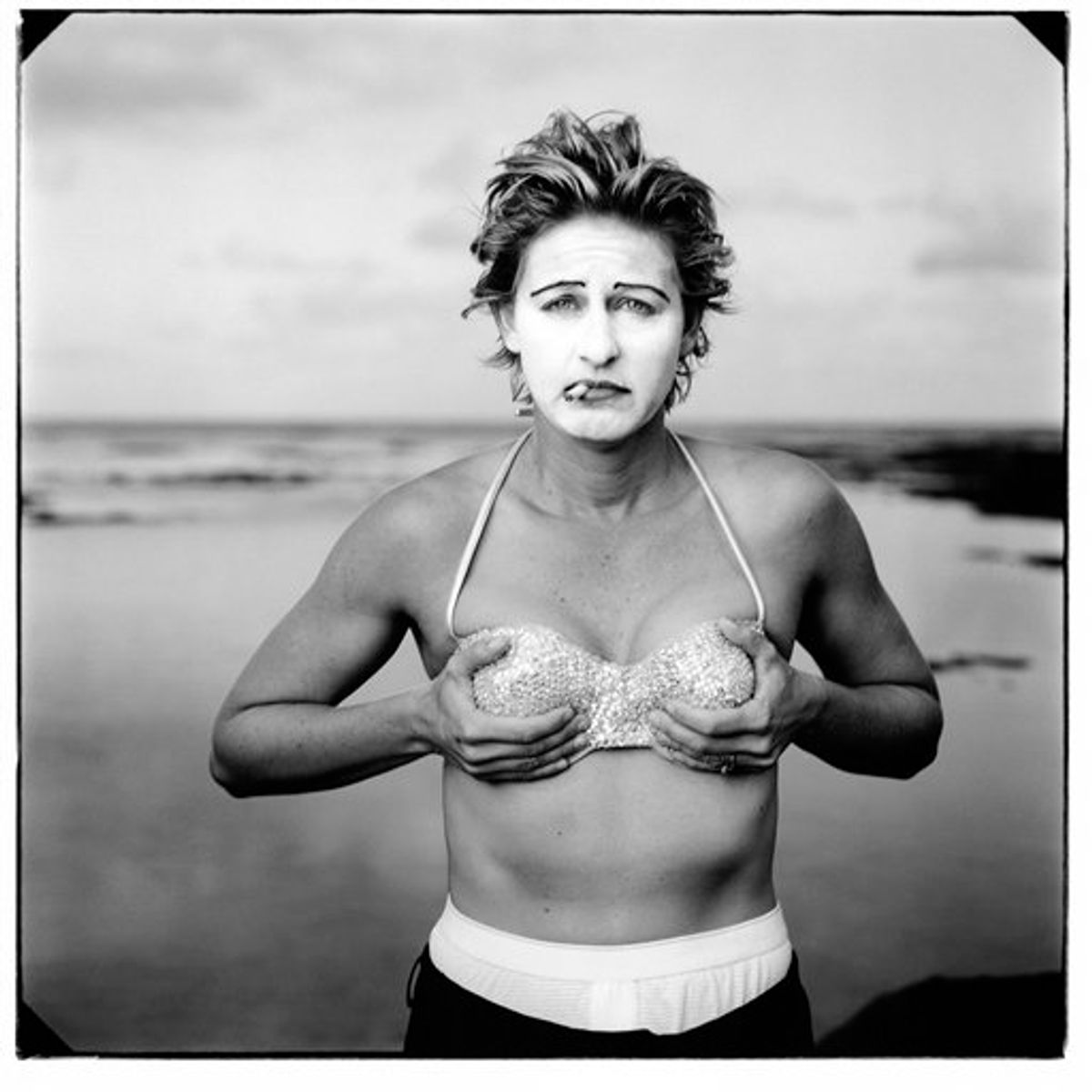
Ellen DeGeneres

This undated handout photo provided by the National Portrait Galley shows a photo of Ellen DeGeneres by Annie Leibovitz, part of an exhibit entitled: “Hide/Seek: Difference and Desire in American Portraiture” which opened Oct. 30 and runs through Feb. 13, 2011. The Gallery stages the first major museum exhibit showing how sexual orientation and gender identity has been portrayed in American art through history. The installation will feature 105 works by such masters as Thomas Eakins, Jasper Johns, Robert Rauschenberg, Andy Warhol and others. (AP Photo/National Portrait Gallery) (Credit: AP)

Topics:

When artist Jasper Johns was mourning the end of his relationship with Robert Rauschenberg, he took one of his famous flag paintings, made it black, and dangled a fork and spoon together from the top.

Hidden symbols in Johns’ “In Memory of My Feelings,” tell part of story, curators said. Color from the relationship is gone. A fork and spoon elsewhere in the painting are separated. Here we have a coded glimpse into a six-year relationship that was rarely acknowledged — even in Rauschenberg’s 2008 obituary.

The Smithsonian’s National Portrait Gallery is decoding such history from abstract paintings and portraits in the first major museum exhibit to show how sexual orientation and gender identity have shaped American art. The installation, “Hide/Seek: Difference and Desire in American Portraiture,” opened Saturday and is on view through Feb. 13.

“There’s been an entire history hiding in plain sight,” said Portrait Gallery historian and curator David C. Ward. “Telling the history of art without the history of gay people is like telling the history of slavery without mentioning black people.”

Continue Reading

  More Brett Zongker

Thursday, Feb 23, 2012 1:00 PM UTC2012-02-23T13:00:00Zl, M j, Y g:i A T

Bathrooms: the new transgender battleground

A Baltimore victory proves that the ladies' room is equality's final frontier

ladies_room

 (Credit: iStockphoto/ShutterWorx)

Topics:

It’s a quiet little provision in a meaningful victory for equal rights. On Tuesday, Baltimore County approved measures prohibiting discrimination “on the basis of gender identity and expression and sexual orientation when it comes to housing, employment, public accommodations and financing.”

It’s that “public accommodation” part of Bill No. 3-12 that is especially hard-won, and so deeply meaningful. It was just last April that Chrissy Lee Polis, a 22-year-old transgender Baltimore woman, was beaten, kicked, dragged and spit upon by two teenaged girls after trying to enter a McDonald’s ladies room. A video shot by  McDonald’s employee Vernon Hackett, who kept filming even as Polis went into a seizure, swiftly went viral. In it, several red-shirted McDonald’s workers can be seen plainly standing around and doing nothing to intervene.

Continue Reading
Mary Elizabeth Williams

Mary Elizabeth Williams is a staff writer for Salon and the author of "Gimme Shelter: My Three Years Searching for the American Dream." Follow her on Twitter: @embeedubMore Mary Elizabeth Williams

Wednesday, Feb 22, 2012 2:00 AM UTC2012-02-22T02:00:00Zl, M j, Y g:i A T

Is homophobia disappearing?

Sociologist Mark McCormack says it is -- in the U.K., at least -- and that it's revolutionizing male friendships

homophobia

 (Credit: iStockphoto/zorani)

Topics:,

Teenage boys sitting on each other’s laps, exchanging back rubs and dolling out hugs: This was the sight that researcher Mark McCormack found when he went to a British high school to research masculinity.

It was a shocking departure from the aggressive homophobia that he himself observed as “a shy, geeky, closeted teenager” in the late ’90s and early 2000s. For his new book, “The Declining Significance of Homophobia: How Teenage Boys Are Redefining Masculinity and Heterosexuality,” McCormack spent the year observing social interactions and collecting data from three high schools in the U.K. Over and over again, he saw the same surprising scene: young straight men being physically affectionate and emotionally expressive with one another. What’s more, he found that homophobic behavior is a rarity and that when someone does express anti-gay beliefs, they “are reprimanded by other students.”

Continue Reading
Tracy Clark-Flory

Tracy Clark-Flory is a staff writer at Salon. Follow @tracyclarkflory on Twitter.  More Tracy Clark-Flory

Monday, Feb 20, 2012 10:00 PM UTC2012-02-20T22:00:00Zl, M j, Y g:i A T

Inside the sexual counterrevolution

For the last 40 years, the right's sexual paranoia has warped our politics. An expert explains how to change that

Rick Santorum and Mitt Romney

Rick Santorum and Mitt Romney  (Credit: AP)

These days, watching politicians debate sex legislation feels a lot like watching footage from decades ago. In the last few months alone, Rick Santorum has called contraception “dangerous,” Mississippi’s Initiative 26 nearly granted “personhood” to fertilized eggs and thereby potentially made birth control illegal, and the anti-gay rights movement once again garnered headlines around the country. While politicians argue endlessly over what Americans should be doing in their bedrooms, statistics show that middle America agrees on legal abortion, gay civil unions and access to birth control. So why are politicians debating issues that have long been settled, while more pressing topics like unemployment, renewable energy and overseas wars remain on the back burner?

Continue Reading

Megan Wood is an editorial fellow at Salon.  More Megan Wood

Tuesday, Feb 14, 2012 6:00 PM UTC2012-02-14T18:00:00Zl, M j, Y g:i A T

An offensive advocate for LGBT rights

By choosing Goldman CEO Blankfein as a spokesman, HRC signals that corporate malfeasance is perfectly acceptable

Lloyd Blankfein

Lloyd Blankfein  (Credit: AP/Alessandro della Valle)

Topics:,

Last week, the Human Rights Campaign, the organization that advocates for equal rights for gay, lesbian, bisexual and transgender people, announced that Goldman Sachs CEO Lloyd Blankfein will be its first “national corporate spokesman for same-sex marriage.” HRC’s move was almost universally portrayed in the media as a laudable one for the cause of equality: a supposed Nixon-goes-to-China-esque coup that aligned a politically conservative icon with a liberal cause. As one HRC executive told the New York Times: “Lloyd Blankfein is not someone average Americans would think is going to support marriage equality.”

Continue Reading
David Sirota

David Sirota is a best-selling author of the new book "Back to Our Future: How the 1980s Explain the World We Live In Now." He hosts the morning show on AM760 in Colorado. E-mail him at ds@davidsirota.com, follow him on Twitter @davidsirota or visit his website at www.davidsirota.com.  More David Sirota

Sunday, Feb 12, 2012 2:00 PM UTC2012-02-12T14:00:00Zl, M j, Y g:i A T

Is gay literature over?

In an era of same-sex marriage and "Modern Family," the role of gay writers is changing. An expert explains how

Gore Vidal, Tony Kushner and James Baldwin

Gore Vidal, Tony Kushner and James Baldwin  (Credit: Library of Congress/Carl Van Vechten/Reuters/Phil McCarten/Miami Dade College)

Gay life in America has utterly transformed itself since World War II. In the 1950s, homosexuality was a crime. Now, openly gay people are everywhere in popular culture, gay kids are coming out as early as elementary school and we can get even get married in a half-dozen states (including, soon, Washington). One of the most crucial, but least-talked about, reasons for this change is gay literature. Starting in the 1940s, a coterie of bold writers — Gore Vidal, James Baldwin, Armistead Maupin and Tony Kushner, among many others — played a central role in creating what we now think of as gay life. Their words gave voice to a segment of the American population that, for much of its history, was hidden away.

Continue Reading

Thomas Rogers is Salon's deputy arts editor.   More Thomas Rogers

Page 1 of 123 in LGBT

Other News