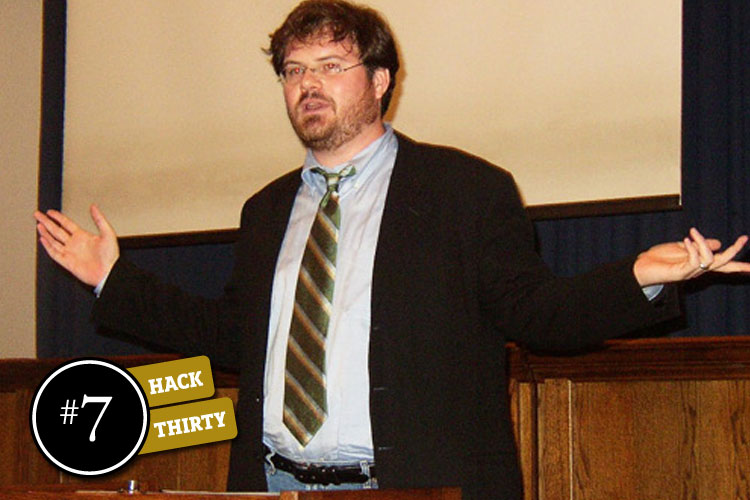

No. 7: Jonah Goldberg
He'd like to be taken seriously as a public intellectual. He got the public part right
Jonah Goldberg Jonah Goldberg writes the political column equivalent of weekly fart jokes, but longs to be taken seriously as a public intellectual. He has a job solely because his repellent mother took credit for inspiring Linda Tripp to secretly record private conversations with Monica Lewinsky. In 1998, in the midst of a terribly boring career producing PBS documentaries and local television, young Jonah somehow managed to get a plum gig at the National Review, the leading journal of conservative opinion.
It was at the National Review Online that he honed his dreadfully imitable style: He is an eternal college freshman, both in terms of intellectual pretensions and cultural references. He skimmed the assigned reading but writes like an expert on Schopenhauer. (Also, there are “Simpsons” jokes.)
Goldberg favorite rhetorical move is to pretend that he’s making some grand, semi-controversial point, then back off when asked to defend it. He wrote an entire book called “Liberal Fascism,” about how liberals are the real fascists, but constantly insists that the theme of his book was not “liberals are fascists.” He wrote a column about how Julian Assange should be assassinated, but insisted that the point of his column was not to say that Julian Assange should be assassinated. Did you know that proposing that kids perform community service ‘is modern slavery?!? (“No, national service isn’t slavery,” he eventually writes, before saying, again, that it’s basically the same thing.)
That tic aside, Goldberg’s at his most plainly repulsive when he’s just jokin’ around.
While he is the National Review’s second-dumbest contributor, he is that publication’s finest example of how far a name — unattached to anything resembling an intellect — can take you in the parallel conservative press. If the name were also attached to an attractive woman, he’d probably have his own show by now. It’d be called “No, You Completely Misunderstood My Point, With Janice Goldberg,” and he could end each hour by claiming he never actually said what he said at the top of the show.
Repeat offenses: Juvenile (but unamusing) sense of humor, adolescent writing style unbecoming a 41-year-old, laziness, “Simpsons”-quoting, inability/unwillingness to defend arguments when challenged.
Representative quote:
In today’s syndicated column I trot out the cliche that “hindsight’s always crystal clear.” Several readers have already reminded me that I wrote a column arguing exactly the opposite in June of 2002. This is the danger of cliches. I was trying to make a general point which everyone understands but also ended up communicating an even more general falsehood. Like saying violence never solves anything, people understand what I mean even when in reality what I’m saying isn’t true.
Alex Pareene writes about politics for Salon and is the author of "The Rude Guide to Mitt." Email him at apareene@salon.com and follow him on Twitter @pareene More Alex Pareene.
The War Room Hack Thirty
Our complete list of America's worst pundits
The War Room Hack Thirty is a list of our least favorite political commentators, newspaper columnists and constant cable news presences, ranked roughly (but only roughly) in order of awfulness and then described rudely. Criteria for inclusion included writing the same column every week for 30 years, warmongering, joyless repetition of conventional wisdom, and making bad puns.
The full list can be found here. Pass it along, argue about it, and print it out and glue each pundit’s photo into your scrapbook!
Alex Pareene writes about politics for Salon and is the author of "The Rude Guide to Mitt." Email him at apareene@salon.com and follow him on Twitter @pareene More Alex Pareene.
No. 1: Richard Cohen
The looooongtime Washington Post columnist is the hackiest pundit in America
Richard Cohen The Washington Post’s Richard Cohen has been a columnist since 1976. He’s good friends with Ben Bradlee and Sally Quinn. He works one day a week. At a certain point, in that exceptionally privileged and cushy position, his brain disintegrated. He’s not so much an old liberal who grew conservative as he is a simplistic old hack who believes his common prejudices to be politically incorrect truths and his Beltway conventional wisdom to be bracing political insight.
That’s how we get work like “leave Roman Polanski alone!” and sending me mean e-mails is “digital lynching” and affirmative action punishes all white people and you stupid snot-nosed bloggers don’t get that Cheney was probably right to torture people and Barack Obama should read a newspaper instead of a BlackBerry because a BlackBerry is full of lies. All in the singularly smug, grating prose style of a man who knows he’s an immovable object in one of the most comfortable positions in all of journalism.
Continue Reading Close
Alex Pareene writes about politics for Salon and is the author of "The Rude Guide to Mitt." Email him at apareene@salon.com and follow him on Twitter @pareene More Alex Pareene.
No. 2: Mark Halperin
The Drudge-loving political analyst who gets everything wrong
Mark Halperin I thought we were all done talking about former Bob Dole speechwriter former ABC News political director Mark Halperin, whose star had seemed to stop rising toward the end of the Bush years — but then he attached himself, leechlike, to reporter John Heilemann, to co-write “Game Change,” a lengthy catalog of the 2008 presidential campaign’s moments of least import.
Halperin used to write this thing called the Note, which was an e-mail newsletter that various Washingtonians whom Halperin referred to as “The Gang of 500″ used to read to find out what they themselves thought about the news of the day. It was written as privileged wisdom from Beltway insiders — cryptic references, obscure jokes, endless name-dropping, constant inexplicable plugs for the Palm restaurant — when it was in fact just “whatever a professional political operative recently told Mark Halperin, along with links to political stories in the major papers.”
Continue Reading Close
Alex Pareene writes about politics for Salon and is the author of "The Rude Guide to Mitt." Email him at apareene@salon.com and follow him on Twitter @pareene More Alex Pareene.
No. 3: Thomas Friedman
The flat-earther and metaphor-mangler pollutes the minds of our CEOs
Thomas Friedman Thomas Friedman is an environmentalist, now. When he’s not jetting around the world on the literally unlimited expense account his money-bleeding newspaper provides him, pondering KFC billboards he spots outside the windows of gleaming office towers in Delhi — or when he’s not lounging beside the pool at his absurd home — the second-most-influential business thinker in the country is worrying about carbon emissions. Which is, I freely admit, a nice change of pace from back when he was telling the world that the invasion and occupation of Iraq would lead to a glorious new dawn of freedom/democracy/whiskey/iPods/Old Navy in the Middle East as a whole.
Continue Reading Close
Alex Pareene writes about politics for Salon and is the author of "The Rude Guide to Mitt." Email him at apareene@salon.com and follow him on Twitter @pareene More Alex Pareene.
No. 4: David Broder
"The Dean" never met a problem that couldn't be solved by more serious calls for bipartisanship
David Broder The dean of the Washington Press Corps, David Broder has also been What’s Wrong With the Washington Press Corp ever since he stepped off the campaign bus and began applying his wisdom toward the great problems plaguing the country.
He has a simplistic understanding of politics and no understanding of the electorate except as an abstract concept. His hatred of partisanship is actually a thinly veiled disdain for popular rule itself. He defines extremism as principled adherence to any sort of ideology. When he wants to understand what The Voters are thinking, he asks a think tank academic. Despite his disdain for the fiery populists that the idiot voters repeatedly send to our sadly broken Congress, he remains convinced that The American People are a wise and noble breed who long for sensible, bipartisan moderation in all things.
Continue Reading Close
Alex Pareene writes about politics for Salon and is the author of "The Rude Guide to Mitt." Email him at apareene@salon.com and follow him on Twitter @pareene More Alex Pareene.
Page 1 of 6 in War Room's Hack Thirty