Best of 2010

The best nonfiction books of 2010

Mad Russians, scheming bond traders and an immortal woman are some of the unforgettable characters in our picks

  • more
    • All Share Services

The best nonfiction books of 2010

Yes, “nonfiction” is a misbegotten category that defines a mind-boggling assortment of books by what they are not. On the upside, though, when you’re selecting the five best new books from a vast conglomeration that encompasses history, current events, science, biography, autobiography and more, you end up with the real crème de la crème. Here are the titles that most enchanted and best informed us in the past year.

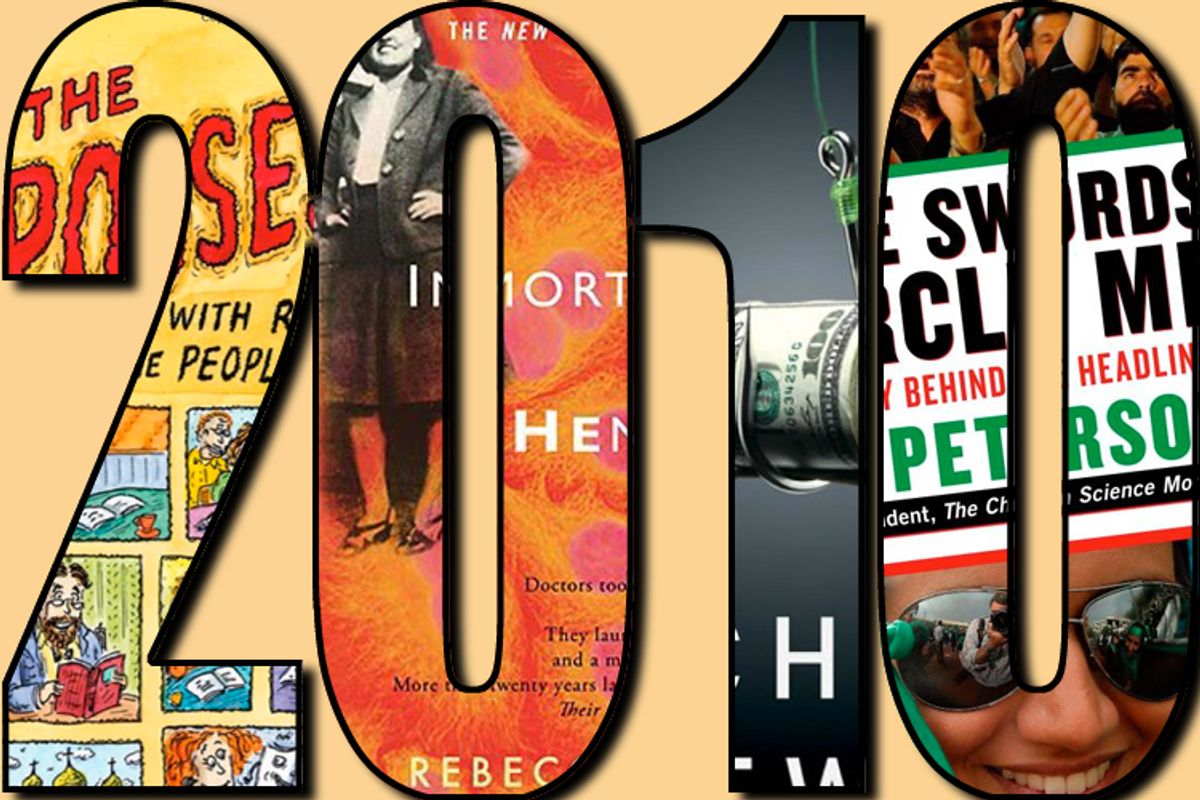
The Possessed: Adventures With Russian Books and the People Who Read Them by Elif Batuman
Think of this charming collection of essays and reportage as an idiosyncratic safari into both academia and Slavomania. Well, except for the hilarious account of Batuman’s season spent studying the somewhat mythical Turkic language of “Old Uzbek” in Samarkand, a city whose bookstores carried no publications in what’s supposed to be its native classical tongue. It seems that Batuman can’t go anywhere without being strong-armed into judging a “best legs” contest at a Hungarian boy’s camp, instructed on the finer points of Muscovite ice sculpture or invited to contemplate the metaphysical significance of Aeroflot’s lost luggage department. Even in graduate school, she watched as her circle enacted the storyline of a Dostoevski novel titled “The Demons” and befriended the kind of student who ended up joining a monastery. In other words, she’s a magnet for eccentrics, and they have never found a more gifted or devoted bard.
READ SALON’S REVIEW

The Big Short by Michael Lewis/I.O.U. by John Lanchester
This one’s a tie because, while Lewis’ impressively reported account of the careers of several players in the subprime mortgage bond meltdown turns the arcana of the financial crisis into a crackerjack story, there’s still a lot of arcana. Anyone who’s been dithering around in the humanities for the past couple of decades and has only the fuzziest grasp of high-altitude capitalism will get a lot more out of “The Big Short” if they first read “I.O.U.” Lanchester began poking his nose into the finance industry while researching a novel, which is what he ordinary writes (and very well, too). But his astonishment at the high-wire gambits of his sources soon led to gigs writing on the subject for British literary journals. As a result, his primer on the workings of late capitalist finance is lucid, funny and written with exceptional style. The more economically literate might want to jump straight to “The Big Short,” which chronicles the adventures of the handful of financiers who spotted the mortgage bubble for the Ponzi scheme it was.
READ SALON’S REVIEW OF “THE BIG SHORT” BY MICHAEL LEWIS
READ SALON’S REVIEW OF “I.O.U” BY JOHN LANCHESTER

Let the Swords Encircle Me: Iran — a Journey Behind the Headlines by Scott Peterson
Peterson’s history of Iran since the revolution of 1979 will leave you much better informed about the nation that has become the United States’ primary antagonist in one of the world’s most volatile regions — but that’s not the main reason to read it. It is above all a captivating epic. Peterson, a reporter who has visited Iran more than 30 times and done extensive interviews with Iranians from all walks of life, weaves the many strands of his subject’s individual stories into a narrative of Tolstoyan scope. A fanatical hard-liner, a womanizing businessman, a disillusioned reformer, a party-loving female student and an old Iran hand who dispenses hard-earned insights over endless cups of mint tea are among the many people whose personal experiences during the past three decades contribute to this saga. You will indeed finish “Let the Swords Encircle Me” with a far better understanding of Iran’s charismatic but erratic president, its restive younger generation, its tradition of ecstatic martyrdom and its love-hate relationship with America, but you’ll be too caught up in the story to notice that until after you’re done.
READ SALON’S REVIEW

The Immortal Life of Henrietta Lacks by Rebecca Skloot
In 1951, a sample of cancer cells was taken from an African-American woman in Baltimore’s Johns Hopkins Hospital. Henrietta Lacks died not long afterward, but her cells live on, proving to be so exceptionally easy to culture that if you were to gather together all the tissue grown from them, the result would weigh 50 million metric tons. Lacks’ famous cell line (christened HeLa) is now used in virtually every medical lab in the world, a remarkable scientific success story. Yet, as Skloot thoroughly and sensitively documents, Lacks’ own descendants muddle through without health insurance or the education required to understand what their forebear contributed to the world. In fact, the Lackses have had a long, fraught and confused relationship with Johns Hopkins Hospital itself, characterized by mistrust on one side and condescending utilitarianism on the other. Skloot’s skillful account of Henrietta’s dual legacy is not, however, an indictment of particular researchers or labs. Instead, it masterfully reflects the tricky intersection of science and society and an American medical establishment responsible for both astonishing triumphs and lamentable failures.
READ SALON’S REVIEW

The Warmth of Other Suns by Isabel Wilkerson
Two decades in the making, Wilkerson’s monumental reinterpretation of the Great Migration — the departure of nearly 40 percent of the South’s African-American population for the North between 1915 and 1970 — demonstrates how history can be transformed by the way we choose to frame its stories. Focusing on three individuals, each of whom moved north during a distinct phase of the migration, Wilkerson describes both the intolerably oppressive conditions they endured below the Mason-Dixon Line and the dreams they pursued in the storied cities above it. These Americans were, like the waves of white European immigrants who arrived in the U.S. during earlier periods, refugees seeking freedom and economic opportunity, and their courage and initiative changed the face of the nation.

Laura Miller

Laura Miller is a senior writer for Salon. She is the author of "The Magician's Book: A Skeptic's Adventures in Narnia" and has a Web site, magiciansbook.com.

My top 5 Web picks of 2010

From the cleverest blog to the best use for an iPad, here are the five things that became habits for me this year

  • more
    • All Share Services

My top 5 Web picks of 2010

View the slide show

As a person whose job it is to develop digital products, I’m online nearly every moment I’m awake (whether I’m looking at my phone, my iPad or a laptop), and I’m often asked for recommendations. Frankly, every year it gets tougher to be in-the-know. Just like there’s more and more content published on the Web every year, there are new technologies, sites, apps and devices rolling out at a breathless pace. But you don’t need me to tell you this; it’s a problem we all face on some level.

Given that, I tend to gravitate toward things that are either curatorial in nature — offering me new ways to skip past the chaff (of whatever variety) and get straight to the wheat — or that make it easier for me to do things I’ve always done. So while this is by no means a definitive list, what follows are the five things that elbowed their way out of the crowd and onto my pinned tabs or my home screen in the past year.

View the slide show

Karen Templer is the director of product development and design at Salon. Follow her on Twitter at http://twitter.com/karentempler.

The most memorable images of 2010

From the shocking to the hilarious to the utterly heartbreaking, our favorite photos of the year

  • more
    • All Share Services

To say 2010 was an eventful year would be quite the understatement. It was an election year, of course. Also a year of plane crashes, landmark legislation, meat dresses, flash mobs, Tea Party protests, faux scandals, Wikileaks and more devastating floods, earthquakes, landslides, volcano eruptions, factory explosions, mine collapses, oil spills and forest fires than we could even begin to count. The world cheered the Olympics, the World Cup and the return of Tiger Woods, and mourned the death of Paul the Octopus. Election disputes turned bloody. The Roma were driven out of France. Celebrities posed for their mug shots. And through it all, the situation in Haiti — which began with an earthquake on January 12 — went from bad to worse to indescribably tragic.

Many of these events yielded striking images. Others made for great stories but not such great photos. Every week (or nearly so), in putting together The Week in Pictures, we sorted through thousands of images — riot police, baby animals, rising waters, red carpet appearances — and narrowed them down to a group that attempted to tell the story of what it was like to be in the world that week. But here at the end of the year, we won’t try to recap the news. What we’ve gathered instead are the 50 images that have stuck with us — the most beautiful, shocking, wacky or haunting scenes we published throughout the year — which still tell a story of the year that was.

For our cover art, above, we’ve chosen the image you all found by far the most compelling, judging by clicks — the lovely Dita Von Teese.

These are our favorites. We hope you’ll tell us about yours.

View the slide show

Continue Reading Close

10 from 2010: Our favorite Salon stories

One final look back at our own work, and what we liked best

  • more
    • All Share Services

10 from 2010: Our favorite Salon stories

Don’t worry — the tsunami of Best Of lists is almost over. I think we’re all looking forward to the fresh mystery of the new year. And right now, our necks ache from looking back so much; we’re particularly sick of the forced remembering of Christine O’Donnell and the Trololo guy. To the annals of footnoted history, we banish ye!

But we did want to highlight the pieces in Salon that — through an unscientific staff poll — we decided we liked the best this year. None of these should be a huge surprise to Salon readers; they were all big hits with you, too. From Glenn Greenwald’s incisive exploration of WikiLeaks, to Mary Elizabeth Williams’ gripping accounts of her cancer diagnosis and treatment, our favorite stories this year run a familiar Salon gamut of world-changing importance to the expressly, meaningfully personal.

And with no more fanfare than that, in chronological order, our 10 staff favorites:

  1. Hipsters on Food Stamps

    They’re young, they’re broke, and they pay for organic salmon with government subsidies. Got a problem with that?

    By Jennifer Bleyer

  2. The Tina Fey Backlash

    The “30 Rock” star’s pathetic single girl shtick is getting criticism from an unlikely source: Women who love her

    By Rebecca Traister

  3. The Civil Rights Heroism of Charles Sherrod

    Andrew Breitbart sure picked the wrong people to symbolize black “racism.” Taylor Branch and Clay Carson weigh in

    By Joan Walsh

  4. The Strange and Consequential Case of Bradley Manning, Adrian Lamo and WikiLeaks

    By Glenn Greenwald

  5. My Cancer Diagnosis

    Until last week, it was the best summer of my life. Then my doctor gave me the news I dreaded

    By Mary Elizabeth Williams

  6. How the “Ground Zero Mosque” Fear Mongering Began

    A viciously anti-Muslim blogger, the New York Post and the right-wing media machine: How it all went down

    By Justin Elliott

  7. My Relentless Pursuit of the Guy Who Robbed Me

    A thief broke into my car. I used Craigslist, a dating site, MySpace and a fast food joint to track him down

    By Amanda Enayati

  8. “Sopranos” Family Tree: Edith Bunker to Don Draper

    We chart the ancestors of the groundbreaking show — and how it continues to shape American TV

    By Matt Zoller Seitz

  9. Better Yet, DON’T Write That Novel

    Why National Novel Writing Month is a waste of time and energy

    By Laura Miller

  10. The War Room Hack Thirty

    By Alex Pareene

And 10 more honorable mentions: David Rakoff’s wonderfully moving “Made” essay on his distinct craft; Andrew O’Hehir’s vivid takedowns of “Secretariat” and “Sex and the City 2″; mighty intern Emma Mustich’s gotcha on Sarah Palin’s desecration of the flag; our inside scoop on the biggest Oscar story of the year; Tracy Clark-Flory’s wonderful, moving piece about her mother and Christmas; Glenn Greenwald’s searing look at how Americans have been trained to think about Afghanistan; Francis Lam’s first time killing a chicken and his illuminating history lesson on General Tso’s chicken; and on Open Salon, Nelle Engoron’s intensely thought-out coverage of “Mad Men.”

Now, on to 2011!

Continue Reading Close
Kerry Lauerman

Kerry Lauerman is Salon's Editor in Chief. Follow him on Twitter: @kerrylauerman.

1. “Let Me In”

The scene of the year is a squirm-inducing stunner that manages to make us sympathize with a would-be murderer

  • more
    • All Share Services

1.

I’m reluctant to use the word “remake” to describe strong new versions of material that was great the first time around. The directors of such films sometimes call them “cover versions.” That’s a somewhat defensive term — “I liked the original, too! This is just my version!” — but it’s more palatable and in some ways more accurate. The filmmakers aren’t presumptuously trying to fix what wasn’t broken but trying to bask in the success of a beloved work while putting their own (hopefully unique) spin on it. Any music buff will tell you that cover versions of a great recording sometimes end up being different from but equal to the original. Not always, but sometimes.

Such is the case with “Let Me In,” American writer-director Matt Reeves’ adaptation of the 2008 Swedish vampire love story “Let the Right One In.”

The original filmmakers — director Tomas Alfredson and writer John Ajvide Lindqvist (adapting his own novel) — made a classic the first time out, a vampire picture with all the hallmarks of recent-vintage northern European genre cinema: naturalistic-seeming performances, unfussy camerawork, a pervasive red/gold/brown color scheme suggesting that the whole movie was shot through a glass of rye whiskey. The differences between the films are legion, starting with the change of locale to 1980s Albuquerque and Reeves’ decision to make the young vampire more identifiably female (even though she tells the hero she’s without gender).

But what’s even more striking is Reeves’ forceful yet elegant visual style, which is so different from his work on the 2008 documentary-styled, shaky-cam monster epic “Cloverfield” that it takes a moment to register that the two movies were made by the same director. Every shot in “Let Me In” has a clearly defined narrative purpose and is gorgeous, too. Like Steven Spielberg and Brian DePalma in the 1970s and early ’80s — the last American masters of pre-digital blockbuster moviemaking, and clearly Reeves’ main visual inspirations — the director pushes right up to the edge of vainglorious cleverness, but never succumbs. When the movie abandons its go-to mode, muted efficiency, and becomes boldly emotional or visually arresting, it’s never superimposing spectacle on top of a story that doesn’t need it. Both the flourishes and fleeting grace notes amplify emotions that were present in the script.

Nowhere is this more apparent than in the aborted kidnapping sequence highlighted here. Shot for shot, beat for beat, it’s the scene of the year, laying a foundation of succinct but meaningful shots and then building a madhouse on top of it. The pièce de résistance — you’ll know it when you see it — is one of the great recent examples of show-off filmmaking in service of story. The universe has been turned upside-down.

Continue Reading Close

2. “Toy Story 3″

The merciless suspense of this fateful action sequence shows why the movie franchise is so beloved

  • more
    • All Share Services

2.

Oh, come on! They wouldn’t kill off Cowboy Woody and Buzz and Jessie and Mr. and Mrs. Potato Head and Hamm and Rex and Slinky Dog!

Would they?

Page 1 of 5 in Best of 2010