Floods

Relief flights help flood-affected Australian city

While the death count rises, military rushes to restock Rockhampton before it's cut off by the rising waters

  • more
    • All Share Services

Topics:

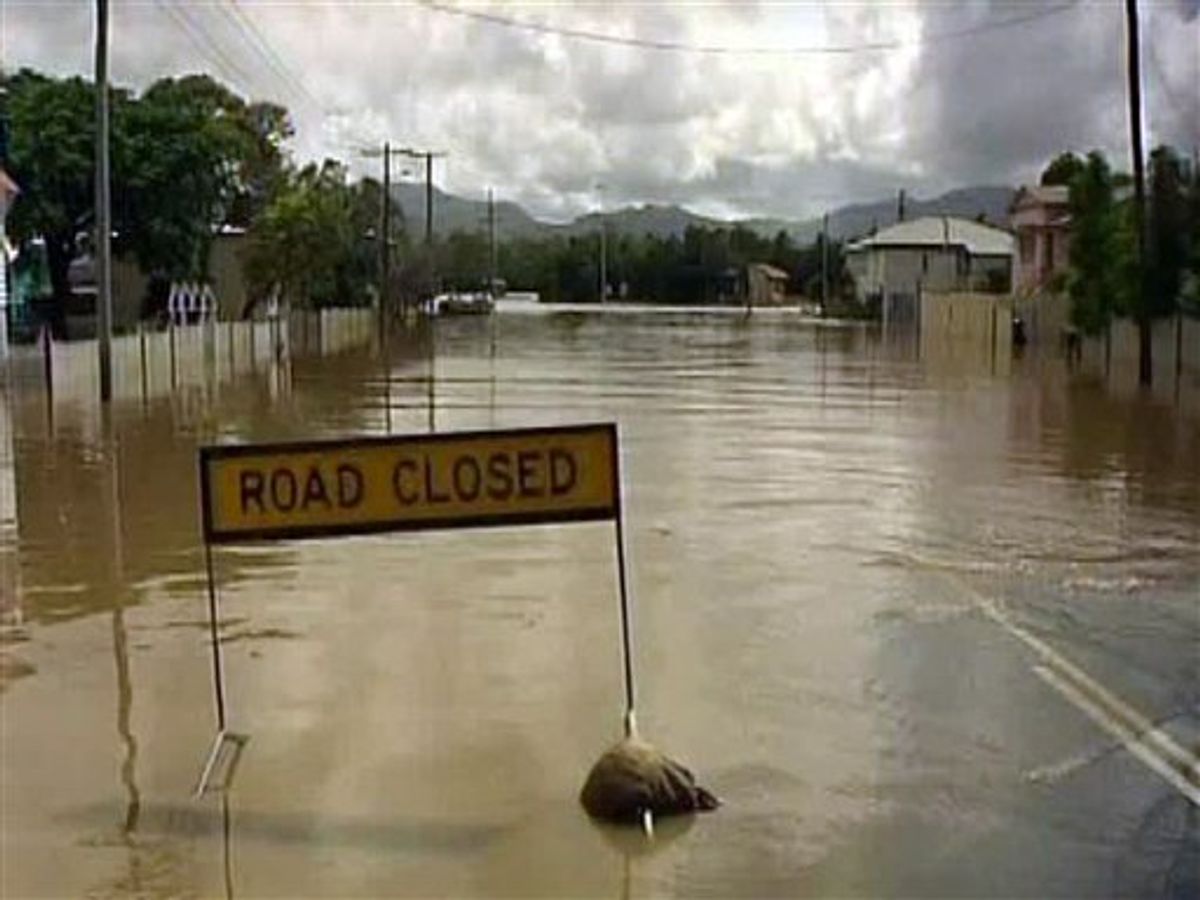
Relief flights help flood-affected Australian cityThis image made from AuBC video via Associated Press Television News shows a flooded street in Rockhampton, Australia, Sunday, Jan. 2, 2011. Days of pounding rain last week left much of northeastern Australia swamped by a sea of muddy water, with flooding affecting about 200,000 people in an area larger than France and Germany combined. (AP Photo/AuBC via Associated Press Television News) AUSTRALIA OUT, TV OUT(Credit: AP)

Military flights rushed Monday to restock an Australian city before it was cut off by floodwaters that have turned a huge swath of the Outback into a lake, while police confirmed two more deaths in the crisis.

Drenching rain that started before Christmas has flooded an area the size of France and Germany combined in northeastern Queensland state. Rivers are overflowing and at least 22 towns and cities in the farming region are inundated.

In the coastal city of Rockhampton, waters from the still-swelling Fitzroy River closed the airport and cut the main highway to the state capital of Brisbane. Scores of families abandoned their homes for relief centers on high ground.

By Monday night, floodwaters had inundated the last route into the city, Queensland Premier Anna Bligh said.

“Rockhampton is now completely stranded — a town of 75,000 people — no airport, rail or road,” Bligh told Australian Broadcasting Corp. radio.

Residents emptied supermarket shelves of food and bottled water in recent days as they stocked up to reduce the need to get around in waist-deep waters.

Acting Defense Minister Warren Snowdon said a C-130 military cargo plane would fly to a town north of Rockhampton on Monday carrying food, medical supplies and other items that would then be trucked to the stricken city.

Authorities have warned the Fitzroy will continue rising until late Tuesday or early Wednesday local time.

Mayor Brad Carter has said about 40 percent of the city could be affected by the surging waters, and residents could be forced to wait at least two weeks before returning home.

State authorities say about 200,000 people have been affected by the floods, Australia’s worst in a decade, and Prime Minister Julia Gillard on Monday extended emergency relief to those affected, including low-interest loans to farmers to begin cleaning up and get their businesses running again.

“This is a major natural disaster, and recovery will take a significant amount of time,” Gillard said. The damage could ultimately amount to hundreds of millions of dollars, she told reporters.

Three people have died in the flooding since Saturday, though police in Queensland state say seven other people have drowned separately involving swollen rivers and water accidents since tropical deluges began in late November.

Chief Superintendent Alistair Dawson said the latest victim was a man who drowned Monday when the car he was traveling in was washed off a flooded causeway in the town of Aramac, in central Queensland.

Earlier Monday, police said they had recovered the body of a man who was last seen Saturday when his small boat was swamped by raging waters in a different part of the state.

The rains that started the flooding have eased, and water levels have been dropping in some towns. But officials said about 1,000 people were living in evacuation centers across Queensland, and it may be a month before the floodwaters dry up completely.

Continue Reading Close

Sirens sound as Souris tops levees in NDakota city

The resulting deluge is expected to dwarf a historic flood of 1969

  • more
    • All Share Services

Topics:

Sirens sound as Souris tops levees in NDakota cityWater flows from Lake Darling into the Souris River on Wednesday, June 22, 2011. Lake Darling is located about fifteen miles north of Minot, ND. As many as 10,000 people raced to evacuate Wednesday as water began spilling over Minot's levees. The river, which begins in the Canadian province of Saskatchewan and flows for a short distance though North Dakota, was all but certain to inundate thousands of homes and businesses during the next week. (AP Photo/Will Kincaid)(Credit: AP)

Sirens in the North Dakota city of Minot are sounding to warn that the Souris River has begun to overtop levees earlier than anticipated.

The warning came five hours ahead of a looming deadline for nearly 11,000 residents to evacuate their homes for a second time in a month.

Water from the Souris River, which loops down from Canada through north central North Dakota, has been bloated by heavy spring snowmelt and rain on both sides of the border.

The resulting deluge is expected to dwarf a historic flood of 1969, when the Souris reached 1,554.5 feet above sea level. The river is expected to hit nearly 1,563 feet this weekend — eventually topping the historical record of 1,558 feet set in 1881.

Freak weather and climate change: Don’t connect the dots!

Let's all just side with the House of Representatives and pretend global warming poses no real threats

  • more
    • All Share Services

Topics: ,

Freak weather and climate change: Don't connect the dots!Wreckage in Joplin, MO on Monday, May 23 after a tornado hit the area

Caution: It is vitally important not to make connections. When you see pictures of rubble like this week’s shots from Joplin, Mo., you should not wonder: Is this somehow related to the tornado outbreak three weeks ago in Tuscaloosa, Ala., or the enormous outbreak a couple of weeks before that (which, together, comprised the most active April for tornadoes in U.S. history). No, that doesn’t mean a thing.

It is far better to think of these as isolated, unpredictable, discrete events. It is not advisable to try to connect them in your mind with, say, the fires burning across Texas — fires that have burned more of America at this point this year than any wildfires have in previous years. Texas, and adjoining parts of Oklahoma and New Mexico, are drier than they’ve ever been — the drought is worse than that of the Dust Bowl. But do not wonder if they’re somehow connected.

If you did wonder, you see, you would also have to wonder about whether this year’s record snowfalls and rainfalls across the Midwest — resulting in record flooding along the Mississippi — could somehow be related. And then you might find your thoughts wandering to, oh, global warming, and to the fact that climatologists have been predicting for years that as we flood the atmosphere with carbon we will also start both drying and flooding the planet, since warm air holds more water vapor than cold air.

It’s far smarter to repeat to yourself the comforting mantra that no single weather event can ever be directly tied to climate change. There have been tornadoes before, and floods — that’s the important thing. Just be careful to make sure you don’t let yourself wonder why all these record-breaking events are happening in such proximity — that is, why there have been unprecedented megafloods in Australia, New Zealand and Pakistan in the past year. Why it’s just now that the Arctic has melted for the first time in thousands of years. No, better to focus on the immediate casualties, watch the videotape from the store cameras as the shelves are blown over. Look at the news anchorman standing in his waders in the rising river as the water approaches his chest.

Because if you asked yourself what it meant that the Amazon has just come through its second hundred-year drought in the past five years, or that the pine forests across the western part of this continent have been obliterated by a beetle in the past decade — well, you might have to ask other questions. Such as: Should President Obama really just have opened a huge swath of Wyoming to new coal mining? Should Secretary of State Hillary Clinton sign a permit this summer allowing a huge new pipeline to carry oil from the tar sands of Alberta? You might also have to ask yourself: Do we have a bigger problem than $4-a-gallon gasoline?

Better to join with the U.S. House of Representatives, which voted 240 to 184 this spring to defeat a resolution saying simply that “climate change is occurring, is caused largely by human activities, and poses significant risks for public health and welfare.” Propose your own physics; ignore physics altogether. Just don’t start asking yourself whether there might be some relation among last year’s failed grain harvest from the Russian heat wave, and Queensland’s failed grain harvest from its record flood, and France’s and Germany’s current drought-related crop failures, and the death of the winter wheat crop in Texas, and the inability of Midwestern farmers to get corn planted in their sodden fields. Surely the record food prices are just freak outliers, not signs of anything systemic.

It’s very important to stay calm. If you got upset about any of this, you might forget how important it is not to disrupt the record profits of our fossil fuel companies. If worst ever did come to worst, it’s reassuring to remember what the U.S. Chamber of Commerce told the Environmental Protection Agency in a recent filing: that there’s no need to worry because “populations can acclimatize to warmer climates via a range of behavioral, physiological, and technological adaptations.” I’m pretty sure that’s what residents are telling themselves in Joplin today.

Bill McKibben is founder of the global climate campaign 350.org and a distinguished scholar at Middlebury College in Vermont.

Continue Reading Close

Bill McKibben is the Schumann Distinguished Scholar at Middlebury College, and founder of the global climate campaign 350.org. His latest book is "Eaarth: Making a Life on a Tough New Planet.".

Obama to meet flood victims during trip to Memphis

The president has declared Memphis, Shelby County and surrounding counties disaster areas

  • more
    • All Share Services

Topics: ,

Obama to meet flood victims during trip to MemphisHomes on Mud Island sit in floodwater Tuesday, May 10, 2011, in Memphis, Tenn. The Mississippi River crested in Memphis at nearly 48 feet on Tuesday, falling short of its all-time record but still soaking low-lying areas with enough water to require a massive cleanup. (AP Photo/Jeff Roberson)(Credit: AP)

President Barack Obama will meet with families affected by flooding along the Mississippi River when he travels to Memphis, Tenn., on Monday.

The White House says Obama will also meet with first responders and state and local officials. The Mississippi crested in Memphis earlier this week at a near-record level, flooding low-lying neighborhoods and forcing hundreds of residents into emergency shelters.

Obama has declared Memphis, Shelby County and surrounding counties disaster areas, making them eligible for federal aid.

The president is traveling to Memphis to deliver a commencement address at a high school that won a White House education competition.

Intense footage from the storm-battered South

Videographers capture the devastation and extreme weather that has killed over 170 in the Southern U.S.

  • more
    • All Share Services

Topics: ,

Intense footage from the storm-battered SouthA car lies overturns and buildings destroyed in Tuscaloosa, Ala., Wednesday, April 27, 2011. A wave of severe storms laced with tornadoes strafed the South on Wednesday; buildings across swaths of the university town were damaged or destroyed. (AP Photo/Tuscaloosa News, Dusty Compton)(Credit: AP)

As of Thursday morning, storms ripping through the Southern U.S. had claimed 231 lives, according to CNN. Tornadoes and extreme weather killed at least 128 in Alabama alone. President Obama approved the requests of Alabama Gov. Robert Bentley for emergency federal assistance. Around 1,400 National Guard soldiers have been deployed around the state, in which 66 tornado reports have been made, reported the AP

To give some sense of the devastation, we have compiled the clips of video footage — both from amateurs and news networks — which convey the extremity of these storms and the aftermath in the South.

The college town of Tuscaloosa, the home of the University of Alabama, was flattened by a vast tornado, captured on this AP video:


This raw AP video captures a tornado in Cullman County, Ala., dominating the sky:


In CCTV footage that looks like it’s been lifted from an apocalypse movie, you can see the precise moment when a tornado hits St. Louis’ Lambert airport a few day ago, blowing out windows and plunging the building into darkness:


This CNN video, taken earlier in the week, shows one Oklahoma family, shot against a lightning-struck sky and a background of rubble (once their belongings), recounting their experience of a tornado:


Amateur footage from Byars, Okla., shows tornado funnels forming in the sky one week ago:


And this AP video details the aftermath in Arkansas after severe storms hit on April 26, leaving 10 dead in the state:


Continue Reading Close

Natasha Lennard covers the Occupy movement for Salon. A British-born, Brooklyn-based journalist, she has been covering Occupy Wall Street since before the first sleeping bag was unrolled in Zuccotti Park. One of the first journalists arrested at an Occupy action, she has managed to enrage Andrew Breitbart, Rush Limbaugh and Glenn Beck. You can follow her on Twitter (@natashalennard), and email her any Occupy updates/videos/ideas to natasha.lennard@gmail.com

6 days after deadly mudslides, survivors get help

Helicopters finally land in Brazil's most devastated areas carrying necessities for panicked survivors

  • more
    • All Share Services

Topics: , ,

6 days after deadly mudslides, survivors get helpA boy looks on as residents unload supplies from an Navy helicopter at Sumidouro, an area isolated due to landslides in Teresopolis, Brazil, Tuesday, Jan. 18, 2011. Brazil's army on Monday sent some 700 soldiers to help throw a lifeline to desperate neighborhoods that have been cut off from food, water or help in recovering bodies since mudslides killed at least 665 people. (AP Photo/Felipe Dana)(Credit: AP)

The call for help was clearly visible from the helicopter: SOS, carved into the immaculate lawn of an upscale home.

Next to it, people waved and jumped, desperate for help after being stranded for six days by mudslides that obliterated entire communities in the jagged mountains outside Rio de Janeiro, killing at least 677 people as of Tuesday and leaving nearly 14,000 homeless.

“Do we have enough space to land?” the pilot, Col. Orlando Artur da Costa, head of the air rescue sent by Parana state police, asked his crew mates.

Minutes earlier, an attempt to touch down in another isolated area with nearly 330 pounds (150 kilograms) of food, water and medical supplies had been aborted after what at first seemed to be flat dirt turned out to be nearly liquid mud that could have swamped the six-person helicopter.

Three men digging at the edge of the mud flat, their legs protected by trash bags tied around their thighs, were left behind for another mission.

This time Costa got the go-ahead: The space was tight, with sheer drops on three sides, but it was enough. He touched down on the grass and more a dozen women and children crowded around, barely waiting for the rotors to stop.

“We have almost no water left to drink, almost no food,” said Adriana Claudia de Melo, 31, gathering up the packages of rice, spaghetti, tomato sauce and bottled water. “We were starting to panic.”

Monday’s delivery was the first time Melo and nearly 30 other survivors stranded on a hilltop received aid from the government nearly a week after torrential rains unleashed avalanches of rocks and mud in these mountains. Many more families remained isolated by washed-out roads and bridges.

For days after the slides, residents in the most inaccessible areas were forced to fend for themselves, searching for the missing and the dead in the mud and constant rain, and then hiking provisions for hours up and down mountainsides.

Bad weather meant aircraft could not reach more than 20 neighborhoods and villages for days. A break in the rain and improved visibility on Sunday finally allowed 12 helicopters to begin taking supplies and rescue personnel in, and shuttling injured residents out.

Costa’s crew started flying Monday. Seen from the air, the scale of the destruction was even more striking: Dozens of crumbled cliffs stood out against the lush green; valleys had turned into muddy rivers; and rivers into silted mud flats, obliterating the communities along their banks.

The city’s wealthy often escape Rio’s heat to estates nestled in these forested peaks, which are also home to a national park. It was in their employer’s stately country house that Melo and the other residents of the cluster of homes called Mariana — caretakers, maids, ranch hands and others — took shelter after their homes were buried or heavily damaged by the slides.

For the five families huddled in the ranch house, the helicopter’s arrival staved off desperation.

Diesel fuel for the home’s generator was nearing its end, water in the cistern was low and food was being rationed — there were 30 people to feed. There was no phone line to call for help, or to get news of other family members.

Normally, Mariana is a 40-minute drive from Teresopolis, the nearest city. With the five bridges along the route wrecked and the access road washed away, the only way to get to town was a five-hour slog on foot, including several dangerous river crossings.

Larissa Francisco Carvalho, 14, showed off the bruises and cuts on her legs suffered during a trip to town for supplies.

“It’s too difficult with the water rushing by, carrying the bags of food,” she said. “We needed help.”

Maj. Roberto do Canto Wilkoszynski of the Brazilian National Security Force, who is in charge of coordinating the air rescue, said the helicopters started flying as soon as it was safe to do so.

“We can’t put the crews in danger,” he said. “But we are doing what we can, as fast as we can, and we intend to stay here as long as we need to complete this mission.”

And while neighbors helping each other was a valuable lifeline during the first days after the disaster, Do Canto Wilkoszynski said people now need to be careful due to the risk of further landslides, collapsing debris from destroyed homes and contamination from bodies decomposing in the humid heat.

“The ideal is to contact professionals and let them know what’s needed,” he said.

Back at a helicopter refueling stop in Teresopolis, slide survivor Rejane Melo, 34, sat among packs of bottled water after being airlifted from the remote neighborhood of Santa Rita, where 10 have been found dead.

“You see the state we are in here,” she said, motioning to her 6-year-old daughter, Ellen, and her 16-year-old son, Reginaldo, whose leg was amputated below the knee just days before the storms because of cancer. “We couldn’t walk out. We were left to God’s mercy.”

The family were not injured and their home was still standing. But it was left damaged and leaky, and Melo worried it could collapse at any moment in the ongoing rain. There was no water or electricity.

Staying became more unbearable each day, Melo said, as bodies began decaying under the debris, causing an overwhelming stench and raising fears of disease.

Then the helicopter showed up.

“We have to thank God in these moments,” Melo said.

After caring for the living, rescuers have to think of the dead. A still unknown number of victims lie under tons of red mud and rock in various valleys.

The first search teams with sniffer dogs arrived Sunday, sent by the National Security Force, which is made up of military troops from various states.

Many gained experience in this kind of work from massive landslides in 2008, but the rough terrain could pose new challenges, team leader Lt. Niccolo Inacio Alves de Sousa said.

How far the bodies were scattered by the rushing floodwaters, and how deep they are buried will determine how many will be found, he said. The search also will be hampered by the lack of heavy equipment, which can’t reach many slide sites due to collapsed infrastructure.

How long the house in Mariana will be cut off from town is unclear — rebuilding these rural bridges and roads is not an immediate priority. The five families stranded there fear that once the immediate rescue effort ends, they’ll be on their own to face a long recovery.

“We lost our bearings with this,” said Carvalho, the teenage girl with the bruised legs. “Now we’ll look to each other, and to God, for help.”

Continue Reading Close

Page 1 of 6 in Floods