
Gabrielle Giffords

The Giffords shooting’s gay, Hispanic hero

Daniel Hernandez helped save the congresswoman's life -- and yes, his sexuality and ethnicity matter

  • more
    • All Share Services

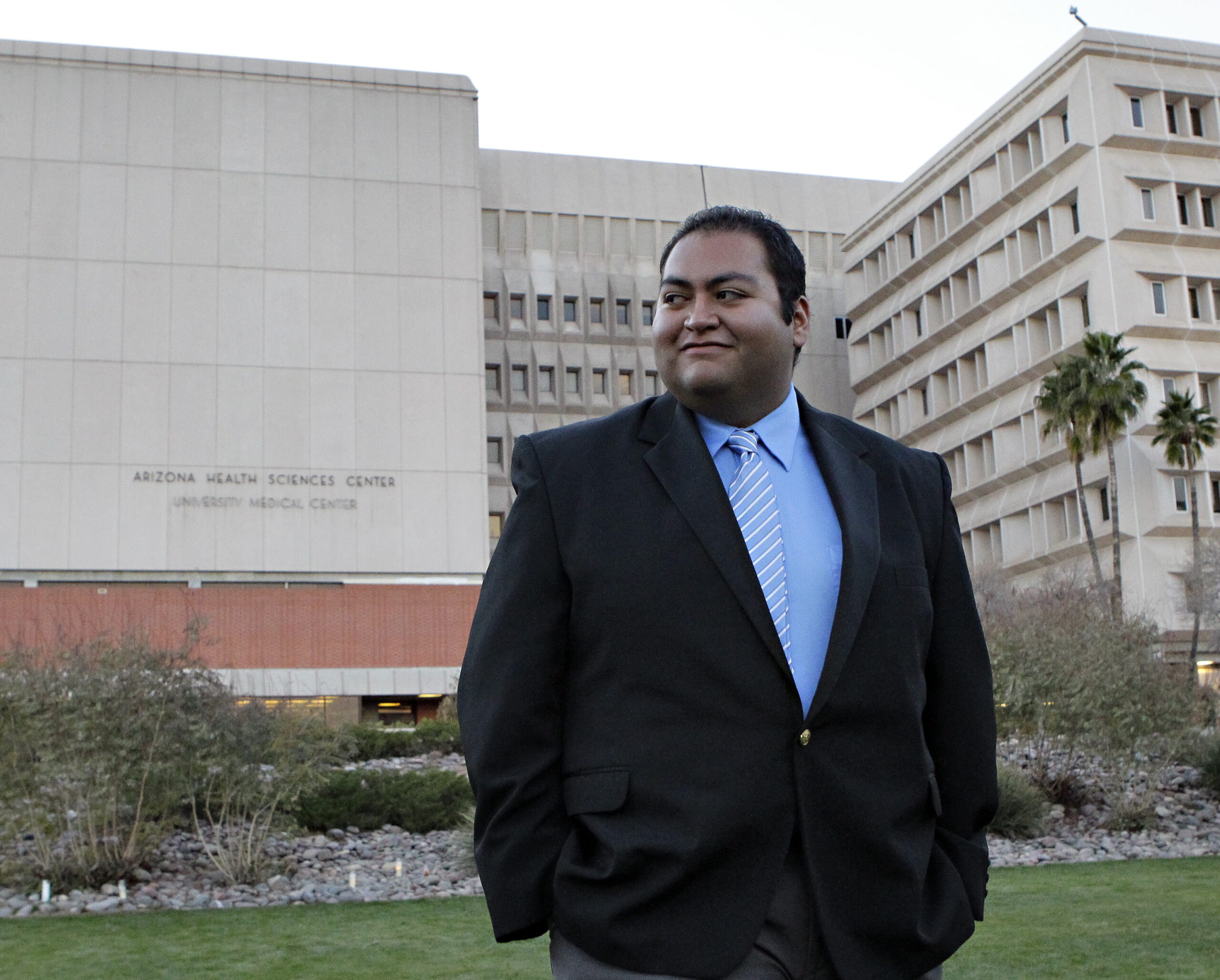
The Giffords shooting's gay, Hispanic heroDaniel Hernandez, an intern with U.S. Rep. Gabrielle Giffords, D-Ariz., walks across the lawn outside University Hospital Sunday, Jan. 9, 2011 in Tucson, Ariz. Hernandez attended to Giffords and others immediately after Giffords was shot in the head a day earlier during a speech at a local supermarket. (AP Photo/Matt York)(Credit: AP)

It didn’t take long after 20-year-old political intern Daniel Hernandez emerged as the hero of Saturday’s mass shooting in Arizona for the cynics to figure out the angle. As a poster on Free Republic remarked, “Look shortly for the leftist media to push the ‘Gay, Hispanic-American Intern saving the Liberal Congresswoman’s life from the Tea Party’ angle.” Well, Freepers, here it is!

It’s not quite that simple, of course. However we try to understand the causes of the tragedy in Arizona and the political rhetoric of violence, it seems clear that there’s considerably more to the disturbing story of shooting suspect Jared Lee Loughner than can be explained by pointing to a few wry Sarah Palin quips. And if simply being gay and Latino were grounds for heroism, Ricky Martin’s face would be on the $10 bill.

Daniel Hernandez is, by any measure, an extraordinary young man. He had been interning in Gabrielle Giffords’ office only five days when an event at a local Safeway thrust him into the international spotlight for his quick thinking, bravery and competence in the wake of unimaginable violence. On the “Today” show Monday, Matt Lauer explained how Hernandez drew upon his high school training as a certified nursing assistant to check on the pulses of other shooting victims before noticing the severity of Giffords’ wounds and, as he puts it, prioritizing her. He put her upright and held her in his lap as he applied pressure to staunch the blood. “I could tell she had a severe gunshot,” he said. “I just tried to do my best until emergency medical services could arrive. My focus was on making sure I was doing everything I could to take care of her.” Even when the ambulance arrived, he stayed with her, because “I saw my job then as not taking care of her medical needs but taking care of her emotional needs. I tried to comfort her and make sure she knew she wasn’t alone. I let her know I was going to try to contact her parents and her husband.”

In the two days since the shooting, Hernandez has emerged in interviews as a graceful presence with a no doubt promising future, with considerably much more going for him than his status as a minority. So why should the sexual orientation of this eminently competent, compassionate person keep coming up in this tale? Why is his ethnicity, and the fact that he grew up speaking Spanish and attending dual language schools, of any consequence?  Hernandez never asked to be the face of a movement. He doesn’t represent any one group any more than Jared Lee Loughner is your typical white guy. And that’s exactly why it matters.

It matters because guys like Arizona Sen. John McCain, who described the repeal of “don’t ask, don’t tell” as “a very sad day,” still think that orientation has an effect on whether or not a person can ably serve in the military. It matters because the notion that two people of the same sex can love each other and build a life together is still considered in many parts of the country, including Arizona, a threat to what is laughably referred to as “traditional marriage” — as if heterosexuals have really mopped up the floor with this whole commitment thing. It matters because last week, when Arizona banned a Tucson district’s Mexican-American studies program,  state’s Attorney General Tom Horne referred to it as “propagandizing and brainwashing.” It matters because just last year Arizona enacted a law that would not merely allow but require immigration officials to determine the immigration status of anyone “where reasonable suspicion exists” that the person might be in the country illegally. And “reasonable suspicion,” as many civil libertarians pointed out, might just boil down to having a darker shade of skin or speaking Spanish.

That’s just Hernandez’s home of Arizona. And though Pima County Sheriff Clarence Dupnik scathingly referred to his state as “a mecca for racism and bigotry,” violence, racism and bigotry aren’t confined to any one ZIP code — they exist all over this great land of ours.  They exist just as surely as Hernandez shows that kindness and bravery are alive and well in Arizona.

It’s still far too easy for a small-minded yahoo to champion discrimination based on orientation and race, and it’s just as easy for another small-minded yahoo somewhere else to believe the red states are indeed “meccas of racism and bigotry.” If any good can come out of something as unfathomably horrible as Saturday’s mass shooting, let it be that it shakes up a few preconceptions. That it shows the world that a hero can be gay or straight, can speak English or Spanish or both, and that stupid laws can exist in places full of good people. And anyone who has any doubt of what kind of person deserves to serve next to him in battle, or stand before their community and declare their love, or go to school, or walk down the street without being asked for paperwork needs to hear that and remember that, again and again until it sinks in. Yes, the “gay Hispanic American” saved a life on Saturday, and yes, it does matter.

Mary Elizabeth Williams

Mary Elizabeth Williams is a staff writer for Salon and the author of "Gimme Shelter: My Three Years Searching for the American Dream." Follow her on Twitter: @embeedub.

Arizona, meet yourself

Is the state still in denial on the anniversary of the Tucson shootings that killed six?

  • more
    • All Share Services

Arizona, meet yourself One year ago in Tucson

When folklorist James “Big Jim” Griffith launched Tucson Meet Yourself, a folk traditions festival in 1974, he sought to gather the loose ends of the burgeoning southwestern city in a celebration of its diversity and mutual interests.  The downtown festival flourishes a generation later; but large parts of the greater city of Tucson, defined by many for its fraying edges of suburban desert sprawl and strip malls, have also unraveled into transient, segregated and anonymous enclaves where few people will know or ever meet each other.

In 2009, a study commissioned by the Center for the Future of Arizona found that only 12 percent of surveyed residents in the state agreed that “people in our communities care about each other.”That all changed, at least for a while, on January 8th, 2011, when 22-year-old Jared Lee Loughner stepped out of a taxi in front of a Safeway supermarket on the northwest suburban edge of the city and unloaded an estimated 32-rounds of bullets from an extended magazine clip once banned under the Violent Crime and Control Law Enforcement Act.  The story of his derangement is well known now.  His target was 41-year-old US Rep. Gabby Giffords, who he managed to shoot in the head; Loughner killed six people and injured 18 other citizens before he was wrestled to the ground and disarmed.

Along with the lost lives of an unusually diverse group of citizens, including federal Judge John Roll, congressional aide Gabe Zimmerman, nine-year-old Christina-Taylor Green, and retirees Dorothy “Dot” Morris, Phyllis Schneck and Dorwan Stoddard, Loughner also managed to shatter one of the last remnants of trust in the public commons for my hometown.The extraordinary heroism on January 8th, including the life-saving role by Giffords intern Daniel Hernandez, bolstered the city–and the nation–with a sense of resiliency and bravery in a moment of sheer disbelief.

Memorials grew at the supermarket and at the University of Arizona hospital; testimonies flowed.  Neighbors met and chatted.  Committees for civility emerged.  President Obama soon arrived in Tucson and poignantly addressed a packed arena under the banner, “together we thrive.”One year later, Rep. Giffords will miraculously join Tucsonans on this Sunday for a special candlelight memorial to the victims, as we once again grapple with the still unfinished process of healing and finding some meaning in the fallout of a tragedy.

When we wake up on Monday morning, the real challenge will be whether Tucson, Arizona–and the nation–will still to rise to meet ourselves as neighbors and effectively work to prevent the next tragedy from finding its all-too-easy expression through the barrel of the gun, or recoil back into the divided enclaves of denial and distrust that nurtured the very landscape of this tragedy.

2011 has not exactly been a year to “thrive together” in Arizona.  Nor were the Safeway victims the only casualties of derangement and hatred in our state’s borderlands of denial.

Only a month after Loughner’s assault, an Arizona jury gave anti-immigrant militia wanna-beShawna Forde the death penalty for her role in the murder of nine-year-old Brisenia Flores and her father in a botched vigilante-inspired robbery south of Tucson.  In July, a Maricopa County Superior Court justice sentenced Phoenix resident Gary Thomas Kelley to 20 years in prison for the murder of 3rd-generation Arizona Juan Varela, after an allegedly drunken Kelley objected to protests against Arizona’s controversial SB 1070 immigration law and threatened Varela to “go back to Mexico” or die.

In September, Attorney General Tom Horne stunned observers at a conference on the state’s ban on the teaching of Mexican American Studies, as he invoked one of the bloodiest episodes in ancient Roman history and demanded that Tucson’s nationally acclaimed Ethnic Studies program “be destroyed.”  Arizona state superintendent John Huppenthal followed up Horne’s harrowing pronouncement by referring to Mexican American children in Tucson as “Hitler youth.”

A week after Giffords made a dramatic return to the floor of Congress in the debt ceiling vote this summer, one of the most chilling reminders of Tucson’s denial of its open wound took place at a Tucson Unified School Board meeting in August.  A self-proclaimed Tea Party member, who had actively circulated a conspiracy video on Facebook that Giffords’ attempted murder was set up by the Department of Homeland Security, unleashed an inflammatory tirade of a coming civil war and bloodshed over Ethnic Studies in Tucson.

None of these incidents, outside of the Forde murders, garnered any national media attention or even much local discussion, as if a crisis is never a crisis until it is validated by disaster.  A prescient admonition by one of Loughner’s fellow students at Pima Community College, who noted his “seriously disruptive” and “scary” behavior in class, remains a cautionary reminder that “until he does something bad, you can’t do anything about him.”

No one has probed the terrain around the Tucson shooting better than author and journalist Tom Zoellner. A 5th-generation Arizonan, a confidant of Giffords and a virtual neighbor of the troubled Loughner, Zoellner reluctantly returned to his hometown soon after the Safeway tragedy.  In his new book, “A Safeway in Arizona: What the Gabrielle Giffords Shooting Tells Us About the Grand Canyon State and Life in America,“ Zoellner set out to transcend the endless political banter over blame and explores the social contexts underscoring how Giffords’ act of democratic participation–”reaching out to strangers at the fringe of a Safeway”–could lead to one of the most disturbing assassination attempts in recent history.  In the process, Zoellner asks a lot of questions most Arizonans would prefer to ignore; for starters, given Loughner’s abundant trail of erratic and violent flare ups, including his suspension from Pima Community College for unruly behavior, would a simple gun law requiring a one-hour safety training prior to purchase have prevented his access to a semi-automatic weapon?

Zoellner notes that while the Tea Party-led legislature managed to pass a law declaring the Colt Single Action Army Revolver the state gun in the first session after the Giffords shooting, it also cut $510 million from the state health care budget, including mental health services.

To place all of the blame on one person, mental health care expert Dan Ranieri tells Zoellner, is “so limiting, so naive and almost condescending.” Such a sweeping dismissal, Ranieri concludes, “absolves people of their responsibilities.”But asking who is responsible for such a horrendous crime by a young man medically diagnosed with schizophrenia is a risky endeavor in the politically charged debates over gun laws and lobbies, mental health care and ethnic tension, and the still small possibility of public trust and “communities that care about each other” in 2012.

As I wrote on the day of the tragic killings last year, I cut my political teeth as a 17-year-old intern with legendary Arizona Congressman Rep. Morris Udall, who defied liberal Democrats with his opposition to gun control. Udall told a Harvard crowd during his presidential campaign in 1976: “I don’t claim total courage; I don’t claim total wisdom.”

As Arizonans, I wonder if we truly won’t meet ourselves until we find both the courage and wisdom to end our denial of a still festering crisis.

Continue Reading Close

Jeff Biggers, the author most recently of "Reckoning at Eagle Creek: The Secret Legacy of Coal in the Heartland," is currently at work on a new book on Arizona politics and history.

Gabby Giffords’ inspiring first interview

The Arizona congresswoman sits down with Diane Sawyer 10 months after the horrific January shooting VIDEO

  • more
    • All Share Services

Gabby Giffords' inspiring first interview (Credit: ABC News)

It’s been 10 months since the fatal Tucson shooting that left 6 people dead and Congresswoman Gabby Giffords just barely hanging on. In the intervening time, Giffords has undergone what her doctors call a “miraculous” recovery. Diane Sawyer interviewed Giffords about her victories, her struggles and her memories for a special edition of “20/20,” which aired last night. What follows is an inspiring and heartrending show of resilience in the face of incredible challenges.

Continue Reading Close

Gabrielle Giffords returns to Capitol Hill

The Arizona shooting victim insisted on voting on the debt deal, having been dismayed by recent fierce partisanship

  • more
    • All Share Services

Gabrielle Giffords returns to Capitol HillIn this image from House Television, Rep. Gabrielle Giffords, D-Ariz., center, appears on the floor of the House of Representatives Monday, Aug. 1, 2011, in Washington. Giffords was on the floor for the first time since her shooting earlier this year, attending a vote on the debt standoff compromise. (AP Photo/House Television)(Credit: AP)

Arizona Rep. Gabrielle Giffords sent out a powerful message Monday in choosing the vote on the debt deal to mark her return to the House of Representatives for the first time since being shot in the head last January.

Both Democrats and Republicans jumped to their feet to welcome the congresswoman with a standing ovation. Although still recovering, Giffords says she felt compelled to return and vote “yes” on the debt deal (which passed the House with 269 votes).

In an official statement, Giffords emphasized the importance of the vote, while criticizing the partisan rancor that reaching a debt deal at all has involved:

“I have closely followed the debate over our debt ceiling and have been deeply disappointed at what’s going on in Washington. I strongly believe that crossing the aisle for the good of the American people is more important than party politics,” she said.

These sentiments seem especially potent from Giffords, as it was her shooting that prompted Congress members to speak out against fierce partisanship — a message Giffords realized needed refreshing in the light of budget talks.

Watch Giffords’ surprise return and warm welcome:


Continue Reading Close

Natasha Lennard covers the Occupy movement for Salon. A British-born, Brooklyn-based journalist, she has been covering Occupy Wall Street since before the first sleeping bag was unrolled in Zuccotti Park. One of the first journalists arrested at an Occupy action, she has managed to enrage Andrew Breitbart, Rush Limbaugh and Glenn Beck. You can follow her on Twitter (@natashalennard), and email her any Occupy updates/videos/ideas to natasha.lennard@gmail.com

Gabrielle Giffords makes first public appearance

Recovering congresswoman stands, waves at NASA ceremony in Houston honoring her husband

  • more
    • All Share Services

Gabrielle Giffords makes first public appearanceADDS ADDITIONAL SOURCING INFORMATION - This most recent photo of U.S. Rep. Gabrielle Giffords since she was shot, was posted to her public Facebook page by her aides early Sunday, June 12, 2011. The woman in the background is her mother Gloria Giffords. The photo was taken May 17, 2011 at TIRR Memorial Hermann Hospital in Houston, the day after the launch of space shuttle Endeavour and the day before she had her cranioplasty. Giffords could be released from a rehabilitation hospital in Houston sometime this month, a top aide says, offering the latest indication that the Arizona congresswoman is making progress in recovering from a gunshot wound to the head. (AP Photo/southwestphotobank.com, P.K. Weis) MANDATORY CREDIT(Credit: AP)

An aide to Rep. Gabrielle Giffords says she appeared in front of a crowd of hundreds at a NASA awards ceremony in Houston.

ABC News reported on its website Monday night that Giffords stood up from her wheelchair to hug and kiss her astronaut husband, Mark Kelly, after he received the Spaceflight Medal.

ABC News says the 41-year-old Democrat from Tucson, Ariz., entered the auditorium at Space Center Houston while being pushed in the wheelchair. She smiled and waved at the crowd and received a standing ovation.

Giffords spokesman C.J. Karamargin confirmed that Giffords attended the ceremony.

Giffords has been in the Houston area undergoing rehabilitation since several weeks after the Jan. 8 shooting in Tucson that left her and 12 others wounded and six people dead.

Gabrielle Giffords has deal for a memoir

Arizona Democrat will work on the book with her husband, who announced his retirement from NASA on Tuesday

  • more
    • All Share Services

Gabrielle Giffords has deal for a memoirADDS IDENTITY OF WOMAN AT RIGHT - This, most recent photo of Rep. Gabrielle Giffords since she was shot, was posted to her public Facebook page by her aides Sunday morning June 12, 2011. The woman in the background is her mother Gloria Giffords. The photo was taken May 17, 2011 at TIRR Memorial Hermann Hospital, the day after the launch of Endeavour and the day before she had her cranioplasty.Giffords could be released from a rehabilitation hospital in Houston sometime this month, a top aide says, offering the latest indication that the Arizona congresswoman is making progress in recovering from a gunshot wound to the head. (AP Photo/Giffords Campaign - P.K. Weis)(Credit: AP)

The world has only begun to learn about Rep. Gabrielle Giffords.

The Arizona Democrat and her husband, astronaut and Navy captain Mark Kelly, are working on a memoir that Scribner will publish at a date to be determined. The book, currently untitled, will be an intimate chronicle of everything from their careers and courtship to the Jan. 8 tragedy when a gunman shot Giffords in the head during a political event in Tucson, Ariz. Six people were killed in the attack and 12 others besides the congresswoman were wounded.

“Since Jan. 8, it’s been really touching to us to see how much support there is for Gabby and her recovery, and how much interest there is in how she’s doing and her story,” Kelly, who on Tuesday announced his retirement from the Navy and NASA, told The Associated Press during a recent interview from Texas.

“After thinking about it, and talking about it, we decided it was the right thing to do to put our words and our voices on paper and tell our story from our point of view.”

The 47-year-old Kelly most recently was commander of the space shuttle Endeavour’s final mission, which ended June 1. His retirement, which comes as NASA ends its space shuttle program, is effective Oct. 1.

“As life takes unexpected turns we frequently come to a crossroads. I am at this point today,” Kelly said in a statement posted Tuesday on his Facebook page. “Gabrielle is working hard every day on her mission of recovery. I want to be by her side.”

Giffords, 41, was released from a Houston hospital last week and is set to start outpatient therapy. She had been in the rehab facility since late January, a few weeks after the shooting, and is now living with Kelly at his home in League City, a town 26 miles south of Houston. She will continue outpatient therapy at TIRR Memorial Hermann, the same hospital where she underwent rehabilitation.

Kelly and Giffords are collaborating with author Jeffrey Zaslow, who worked on Randy Pausch’s million-selling “The Last Lecture” and Capt. Chesley “Sully” Sullenberger’s “Highest Duty.” Kelly praised Zaslow as a “good storyteller” and “the best writer” for the kind of book they wanted. Zaslow will interview friends, family members and colleagues of Kelly and Giffords.

“There are details of our personal lives together that I’d say I can count on one hand the people who know them. In some cases, it’s just Gabby and I (who know the details),” said Kelly, who met Giffords in 2003 and married her in 2007. Before the shooting, they had maintained independent lives, Kelly based in Houston and Giffords in Tucson.

Giffords will focus on her recovery, but Kelly said that the book will be part of that process and that Giffords will provide details of what “she remembers after Jan. 8 and her story before that.” While Kelly will be “the primary collaborator,” he said Giffords will be a “big part of this.” Giffords has been struggling to relearn how to speak and walk, and will be assisted by a 24-hour home health provider, according to the hospital.

For the book deal, Kelly and Giffords were represented by Washington attorney Robert Barnett, whose clients include President Obama and Secretary of State Hillary Rodham Clinton. The memoir will be edited at Scribner by executive vice president and publisher Susan Moldow, and senior vice president and editor-in-chief Nan Graham.

“I really felt a connection with them and I knew Gabby would, too,” Kelly said. “Gabby is very pro-women and she always has been. And I knew after meeting Susan and Nan that they were definitely the right people to work with.”

Because of rules covering members of the House of Representatives, Giffords will receive no advance and the deal must be cleared by the House ethics committee. A portion of the authors’ net proceeds will be donated to charities that benefit Tucson and Arizona.

Scribner is an imprint of Simon & Schuster Inc.

Continue Reading Close

Page 1 of 21 in Gabrielle Giffords