I've never liked downhill skiing. The skier's labors are as futile as those of Sisyphus -- the same pointless up and down on the side of a hill -- only they're done for fun, the ennobling sense of tragedy thus sacrificed on the altar of frivolity. And this, in freezing cold weather. No wonder the sport leaves me as glum as a boulder. But my wife loves skiing and I love her and she had been planning this holiday with friends for months. So the cozy domestic routine had to be interrupted, my writing studio in the backyard boarded up, my current play put on hold and barbaric skiing in the Rockies endured for ten days.
By the third day, I had managed to ease myself out of my wife's icy boot camp of pleasure, waving her and our friends on, and I had retreated to a café bearing the name Shangri-La. It was the highest resting place in the resort, perched atop a bluff just below the top ski lift. The view from its terrace was splendid and the coffee and sandwiches were passable. I found myself a warm, sunny corner and settled down with a book, taking breaks to enjoy the alpine panorama. It was there, incredulous, that I heard for the second time of Abdikarim Ghedi Hashi.
I was reading. A group of skiers gathered at a picnic table not far from my chair. They were in high spirits. I didn't pay them much attention until I heard a young man say, "Did you hear about the guy who was trapped in the can all night?"
His friends seemed to think it was the start of a joke. I pricked up my ears.
"No, I'm serious," the young man continued. "A guy two days ago fell through the hole in the shithouse and spent the whole night there."
The group loudly expressed disbelief and hilarity.
"I swear I'm not joking. He fell through the hole and spent the whole fucking night in the septic tank."
Howls and cackles of laughter.
"Where'd this happen?" a sceptical voice cried.
"Just over there." The young man pointed. The restrooms were not attached to the café. They were directly opposite, across a flat bit of piste. "It was the end of the day and no one heard him shouting."
"Did he hurt himself?" someone thought to ask.
"No. He just spent a miserable night in a swimming pool of piss and shit." The young man couldn't stifle his mirth any longer and burst out laughing. He controlled himself. "They found him in the morning. The ski patrol pulled him out, wrapped him in blankets and brought him down the mountain on a sled."
Their faces were red and they had tears in their eyes. Their laughter boomed across the vast, sunlit space beyond the terrace, rolling down the side of the mountain. The laughter of young gods.
They eventually settled down to their hot chocolates and sandwiches, though the occasional interjection -- "I wonder what they did with the blankets?" -- set them off again.
As they were leaving, I signaled to the teller of the tale. "You didn't catch the name of the man who had that accident, did you?" I asked.
He shook his head. "No, I didn't."
I went to investigate the restrooms. There were two doors, the one on the left being the men's. Inside, the sink and two urinals were widely spaced to accommodate skiers lumbering about in their boots. A wide door gave onto the large cubicle. The toilet was a long bench made of compressed board that ran the length of the back wall. In the middle was the plastic toilet lid and seat. I lifted them. They fell back easily on their hinges. The hole was larger than I expected, the seat overlapping the wood rim by no more than an inch. Still, not a big hole. I looked down. The smell didn't come through strongly because of the cold air, but the mound of soiled toilet paper and excrement glowed in the penumbra. I couldn't tell how big the tank was, or how deep. I looked at the hole again. Could a person really accidentally fall through it? It seemed scarcely believable.
The restroom didn't have windows. There was no natural light, only that coming from two light fixtures on the ceiling, one in the cubicle and one beyond, where the sink and urinals were. Compared to the shattering light outside, the fixtures shone weakly, giving off a diluted, yellowish light. Stepping outside, I noticed the small panel attached to the roof of the restroom. A solar panel.
I went back to the café. When there was a lull in traffic, I approached the cashier. "Excuse me, the man who had the accident two days ago, who spent the night . . ." I pointed toward the restrooms.
She nodded. "Yeah?"
"What was his name?"
"I don't know."
"You didn't see him?"
"No, I wasn't working that day."
A co-worker came up. "I saw him. I was on the lift coming up for my shift. The ski patrol was taking him down in a sled pulled by a skidoo."
"Did he have brown skin? I mean more than just a tan."
"Couldn't tell you. He was all wrapped up in blankets."
"Of course. Something else: are the lights in the restroom turned off at night?"
"They're never turned off. They're solar powered and it's better for the battery if the charge goes up and down."
"Do they stay bright all night?"
"No, they start to dim. It's not a big battery."
"I see. So, tell me, how could I find the man's name?"
"You could talk to the ski patrol office," said the cashier. "Do you have their number?"
She let me use the phone and I called. The man who answered couldn't remember offhand. He looked through some papers. "It was something complicated," he said "Here we go. His name was Ab -- di -- " He was working his way syllable by syllable.
"Abdikarim Ghedi Hashi," I interrupted him.
"That's right. Not your usual skier name. D'you know him?"
"No, but I've heard of him. Is he all right?"
"Yeah. They had a look at him at the hospital. He got cold, but he's fine."
"Was he angry?"
"No. I mean, he was distressed, but I wouldn't say he was angry. He said it was an accident. Accidents happen. Mind you, this was a real freak one."
"Where is he now?"
"Don't know. He's not staying here, I know that. After the hospital we drove him to a motel in town."
"Do you know which one?"
"I can find out. Give me a minute."
I wrote the name of the motel down, hung up and returned to my seat on the terrace for a think. Accidents happen, they do, but even freak ones have their limits. Because the thing was, two winters ago, at a different resort in British Columbia, on another of my wife's skiing holidays, I'd heard the same story. A short article in the local paper had caught my eye. A man had accidentally fallen through the hole of a toilet at a café on the slopes, had spent the night in the septic tank, had been rescued in the morning. He'd told the reporter that the quality of the light in the toilet had struck him. And another detail had stayed with me: the man was a Somali-Canadian by the name of Abdikarim Ghedi Hashi.
Later that afternoon, after the skiing day was over, I took a moment to call his motel. He was still there. The receptionist put me through to his room.
"Hello?" A soft, accented voice.
"Is this Mr. Hashi?"
"Yes, it is."
"Mr. Hashi, I was sorry to hear about your accident. I hope you're feeling better."
"I am, thank you."
"I'm glad to hear that. I was wondering if we could meet to talk about it?"
"What is there to talk about? It was an accident."
"I'm curious, that's all. I'm a writer. And I was in Somalia briefly, years ago."
"Are you a journalist?" There was suspicion in his voice.
"No, not at all. I write plays. I was in the north of Somalia, a town called Hargeisa. I traveled there by bus from Ethiopia. It was in my hardcore backpacking days. Beautiful country."
"I've never been to Hargeisa. My family was from Mogadishu."
"Well, there wasn't much to Hargeisa itself, I have to say."
"There's not much to Mogadishu, not now. Civil war does a town no favors."
What did Hargeisa no favors was dusty, grinding poverty. I'd found nothing to do there but poke around a few mosques, wander around a zoo that baked in the sun and sit at a tea stall in the market, drinking tea and being stared at by everyone.
"Can I invite you for a tea or a coffee? I could meet you at your motel tomorrow morning."
He agreed, with politeness that might have been reluctance. The next morning, I drove to the small town next to the resort. I found his modest, roadside motel easily. It was a cheap way to have a ski holiday, staying in town and relying on the shuttle. I called him from the reception. He came over promptly, clutching himself in the cold air in his blue winter coat. We shook hands. He was small and slim and had a pleasant face, with a goatee and a bald, slightly bulbous forehead. He was in his mid-thirties perhaps. I proposed that we go over to the diner that was next to the motel. We walked over.
I had coffee. After some persuasion, he ordered a small fruit salad. We chatted, circling around the accident. He told me a little about himself. He'd come to Canada via a refugee camp in Ethiopia, sponsored by a charity, six years in all it had taken him. He'd ended up in Calgary, had studied this, worked there, and so on. He'd taken up skiing, though he wasn't very good at it, he said.
"So how exactly did it happen?" I finally asked.
He looked away. "I needed to urinate. The ski boots are so big and heavy. I removed them and climbed onto the bench so that I wouldn't get my socks wet in the melted snow on the floor. But I didn't want to make a mess. I lifted the toilet seat. That's when I slipped. It happened so quickly. It was an accident."
I thought to myself, "You slipped with both feet. Into that tiny hole? You didn't manage to catch yourself with your arms or any other part of your body? You fell through as straight as a diver? And it's happened to you twice, and both times at the end of the day, when no one was around?" I didn't let on that I knew he'd had this "accident" once before. He was a very small man. Now that he had removed his coat, I could see that clearly. Still, the incident beggared belief. It was so absurdly implausible. But he had a quiet, mournful dignity. He spoke earnestly. Perhaps he was just a tiny, clumsy man, hurrying too much because he was tired and because he badly needed to pee. Accidents do happen. My heart sank at my disbelief. I wanted to believe him. "You couldn't climb out?"
"I couldn't see a way."
"No one heard your cries for help?"
"No one."
"What did you do all night?"
"Well, I couldn't sleep. The filth came up past my knees and there was nowhere to sit. So I leaned against the wall and I looked at the round hole above my head and the night went by very slowly."
"And you were rescued in the morning?"
"Yes, a man's head appeared."
What more was there to say? We finished up. He had three more days of skiing, he told me. He took lessons every afternoon. He was getting better.
We were in front of the motel. We had shaken hands in farewell and I had moved back a few steps towards my car. Casually, I asked him if he was here with his family. I only asked so that I might wish them well. I thought that would please him, me wishing his family well. Instead he came up to me, eyes staring hard, and it was with shock that I realized that he was upset. When he spoke, it was with great feeling.
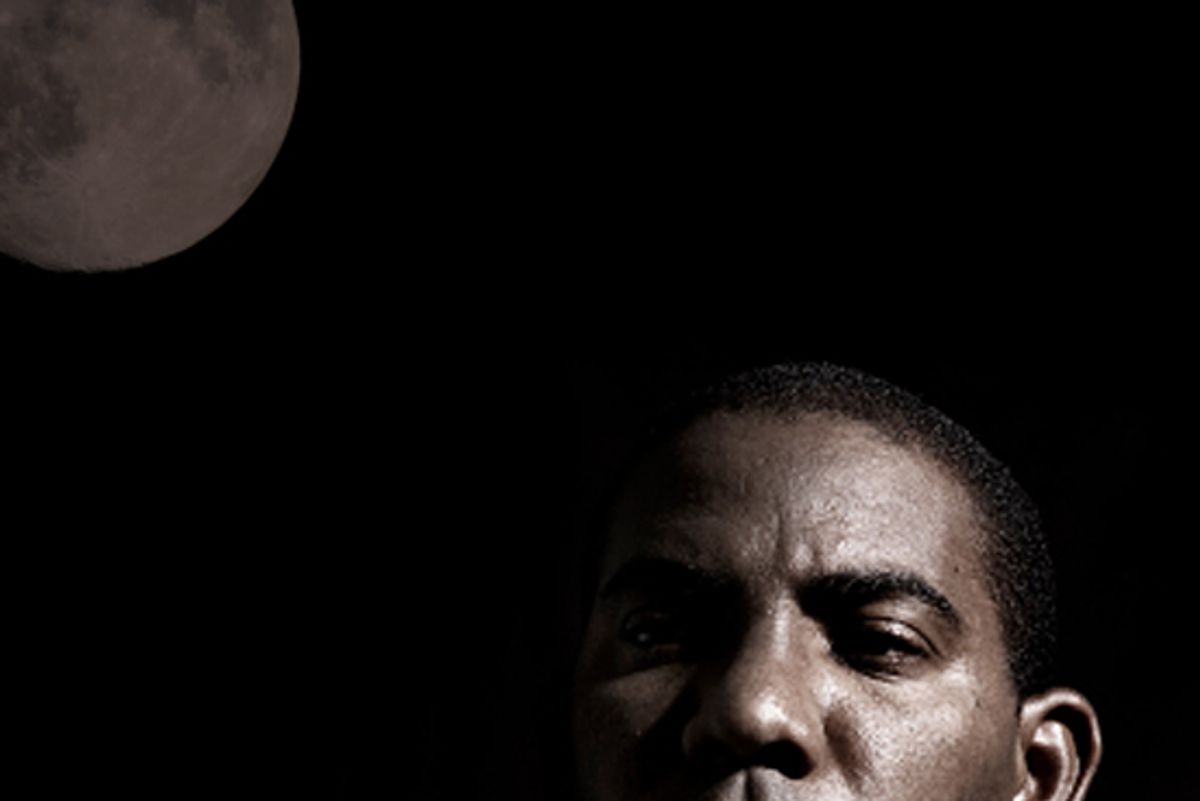
"I remember something from my night in that stinking pit of filth," he said. "The hole above me, the toilet hole, the way the light was shining through it, it reminded me of full moons over the ocean in Mogadishu when I was a child. My grandmother used to tell me the moon was a hole in the night sky and that's where God came in. She would hold me in her arms and we'd look at the moon together. I kept hoping to catch God sneaking into the world. I loved those moments with my grandmother. It's the last time I remember being happy. You ask about my family? I have no family. They all died in Mogadishu in the civil war, all of them. Goodbye. Thank you for the fruit salad."
And with that he turned around and walked back to his room. I watched him go. Then I drove back to the resort, put on those damn ski boots and went off to find my wife.
Reprinted from the book "Freedom" by Amnesty International USA. Copyright © 2011 by Amnesty International USA. Published by Broadway, a division of Random House, Inc.
Shares