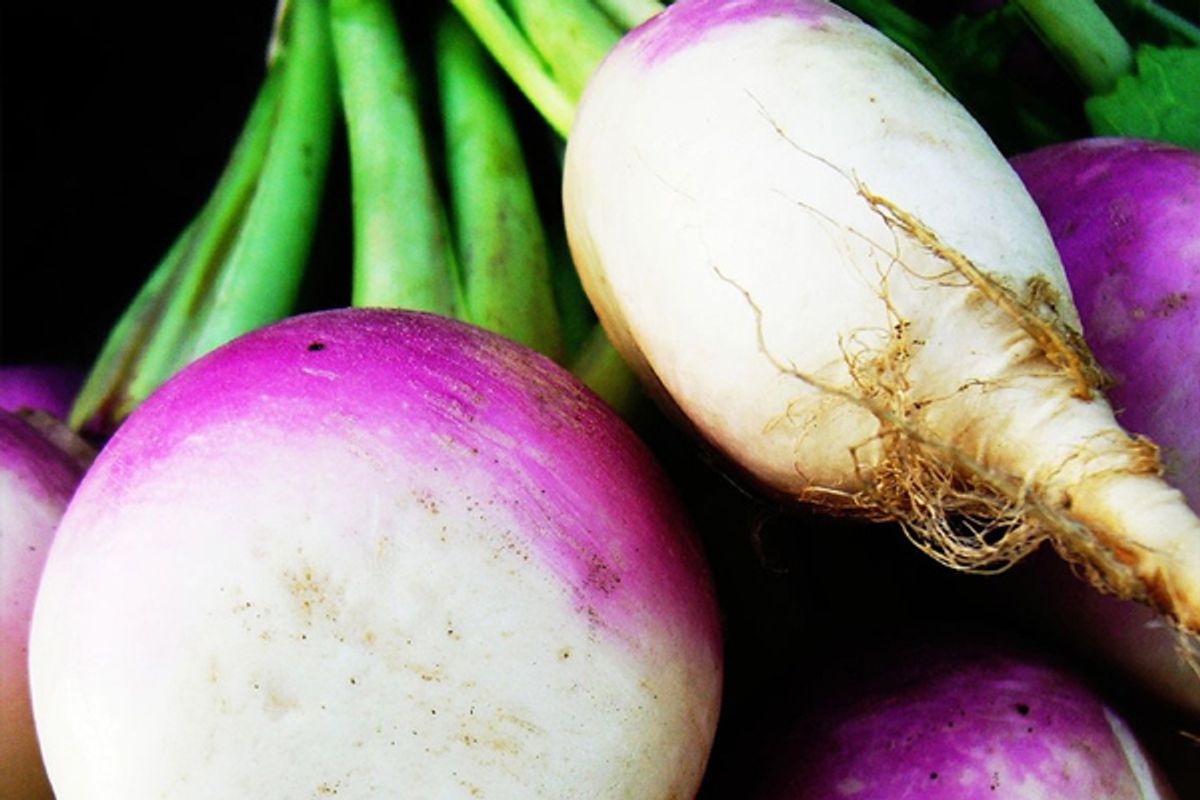
My special ladyfriend is fond of repeating something she heard once: that the two signs of senility in men are comparison shopping and pickling. And despite the fact that I now live in Brooklyn, the Look-At-Me-I'm-Pickling capital of the developed world, who can honestly be excited about senility and sauerkraut?
So it's a mystery even to me that I curled up in bed one night with Sandor Katz's wildly influential pickling how-to Wild Fermentation, aka The Guide to Living Comfortably with Memory Loss. And I woke up the next morning so excited to shred and salt turnips for an unusual sauerkraut that I was there, in my kitchen, doing it in my shorts. Pants would come later. That is probably not a good sign. But the results, I can say after a healthy munch this morning, are definitely worth it.
Katz --in a fascinating story on him by Burkhard Bilger in the New Yorker -- describes the friendship we have with bacteria, and nowhere is that more clear in our diets than in intentionally fermented foods. Before you make the gross-face at the f-word, keep in mind that these foods include beer, wine, cheeses, yogurt (lovely, lovely yogurt), dry sausages, bread and of course pickles.
Not only do friendly bacteria protect these foods from spoilage, but they do magical things to flavor and texture. As we saw last week, they create the full, rich, custard-like body of yogurt out of liquid milk. They give off lactic acid, which gives us the familiar yogurty tang. And in many foods, they break down proteins into amino acids, amino acids that we then perceive as the deep, complex, meaty, satisfying taste of umami.
And that is why I am writing to you today about turnip sauerkraut, which develops that umami in spades. I first tasted this years ago, at a fantastic New York restaurant called the Modern, which, true to its name (and its location inside the Museum of Modern Art), is a sleek restaurant, hard lines and modernist design. But the food at the bar, while gorgeous and refined, is often inspired by the rustic joys of chef Gabriel Kreuther's native Alsace, the part of France that one might mistake for Germany. He serves turnip sauerkraut (or choucroute, as the French call it) simply, lightly braised to soften the flavors, and places it alongside sausage. It's one of the most magical things I've ever had.
The turnipkraut (technically "sauerrüben") doesn't quite develop the same acidic tang as cabbage does in sauerkraut, but after a couple weeks, there is definitely some brightness there. It keeps a little bit of its pungent, funky mustardy bite, but then the flavor rounds out and bounces around, tasting one second like nice cheese, another like beer, a third a little bit like broccoli, a touch of pleasant bitterness and all underlined by that wonderful, lingering umami.
And it's tremendously easy to make, because really, it's the bacteria that does all the work. You just shred it, sprinkle some salt, press it down and hang out for a couple of weeks. Give it a try, and see if you don't start wondering what you'll pickle next. And don't forget to put on some pants.
Turnip sauerkraut
Adapted from Sandor Katz's Wild Fermentation
One of the fun things about making pickles of this sort is that their flavors and depth will evolve as you let them ferment. Try tasting it starting from a few days or a week into the process, and watch how it develops. Once it's at the point where you know you won't want it to go much further, you should pop it in the fridge. Or cook it, and eat it soon.
Also, a note on usage: this stuff is still nice and crunchy and salty out of the pickling pot, but if you like, you can give it a quick rinse in fresh water and squeeze it out to cut down on the salt. Or you can simmer it in water, wine, stock or beer until it's tender to serve as a lovely side to sausages, smoked meat or wherever your mind takes you.
Ingredients
Turnips -- weigh them
1½ tablespoons of Diamond Crystal kosher salt per pound of turnips, or slightly less if using Morton's (if you're using sea or pickling salt, cut it to 2 teaspoons per pound of turnips; avoid iodized salt, which may inhibit the friendly bacteria)
Equipment: a straight-sided crock, a plate that fits in the crock, a weight that will fit on the plate, like a clean jar filled with water, and a towel that can cover all of this (don't use metal for any of this stuff, which might react with the acid that the pickle produces)
Directions
- Clean your gear and hands. Katz's book is inspiring and empowering; where appropriate he punctures the myth that all forms of fermentation need to be done with maniacally sterilized tools in lab settings. He gets you to trust in the friendly bacteria floating all around you, but urges common sense: Make sure you wash you hands well and your equipment is clean.
- Peel and shred the turnips, using the large holes on a standard box grater. As you're shredding, add some in layers to the crock (honestly, I just use one of those big 2-quart Pyrex measuring cup things), sprinkling the salt on in between layers; try to season it evenly, but don't worry too much about it. Give it a brief stir to even it out.
- Now place the plate on top of the salty turnip, and press down on it to make sure it's making contact and squeezing the turnip a little bit. Place the weight on top of the plate, and give it another good press or two. Cover the whole thing with the towel to protect it from dust, and set it in a cool, darkish corner.
- For the first few days, give the weight/plate a good press or two every few hours, to help expel more brine. The point is to keep the vegetable submerged under the brine that the salt will draw out; as long as it's under brine, mold won't get to it, and our bacterial friends can get to work. It'll bubble a little bit as it ferments. If there is some scummy-looking mold that forms on the surface, just scoop it off. No problem.
- And that's it! Now it's just time -- you can taste and enjoy the turnip at any point, but I find that it starts to develop some interesting flavor at about a week, and starts to get really complex at about two weeks, but that all varies with temperature, etc. (The warmer it is, the faster it ferments.)
For advanced turnipkrauters, Katz also suggests grating other vegetables --carrots, cabbage, etc. -- into the mix for flavor, or using herbs or spices of your choice. I like it plain, but give it a whirl!
Shares