
Terrorism

The vindication of Dick Cheney

Obama has won the War on Terror debate -- for the American Right. And they're quite appreciative

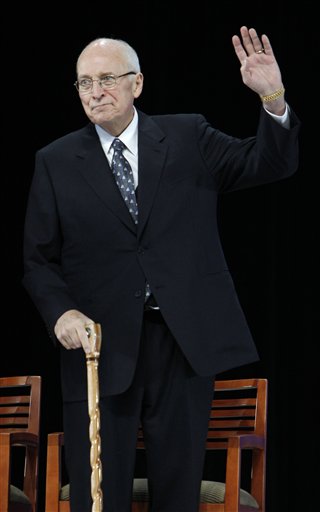
Former Vice President Dick Cheney waves during the groundbreaking ceremony for the President George W. Bush Presidential Center in Dallas, Tuesday, Nov. 16, 2010. (AP Photo/LM Otero)(Credit: AP)

(updated below – Update II – Update III)

In the early months of Obama’s presidency, the American Right did to him what they do to every Democratic politician:  they accused him of being soft on defense (specifically “soft on Terror”) and leaving the nation weak and vulnerable to attack.  But that tactic quickly became untenable as everyone (other than his hardest-core followers) was forced to acknowledge that Obama was embracing and even expanding — rather than reversing — the core Bush/Cheney approach to Terrorism.  As a result, leading right-wing figures began lavishing Obama with praise — and claiming vindication — based on Obama’s switch from harsh critic of those policies (as a candidate) to their leading advocate (once in power).

As early as May, 2009, former Bush OLC lawyer Jack Goldsmith wrote in The New Republic that Obama was not only continuing Bush/Cheney Terrorism policies, but was strengthening them — both because he was causing them to be codified in law and, more important, converting those policies from right-wing dogma into harmonious bipartisan consensus.  Obama’s decision “to continue core Bush terrorism policies is like Nixon going to China,” Goldsmith wrote.  Last October, former Bush NSA and CIA Director Michael Hayden — one of the most ideological Bush officials, whose confirmation as CIA chief was opposed by then-Sen. Obama on the ground he had overseen the illegal NSA spying program — gushed with praise for Obama: “there’s been a powerful continuity between the 43rd and the 44th president.”  James Jay Carafano, a homeland-security expert at the Heritage Foundation, told The New York Times‘ Peter Baker last January: “I don’t think it’s even fair to call it Bush Lite.  It’s Bush.  It’s really, really hard to find a difference that’s meaningful and not atmospheric.

Those are the nation’s most extreme conservatives praising Obama’s Terrorism policies.  And now Dick Cheney himself — who once led the “soft on Terror” attacks — is sounding the same theme.  In an interview last night with NBC News, Cheney praised Obama for continuing his and Bush’s core approach to Terrorism:

He obviously has been through the fires of becoming President and having to make decisions and live with the consequences. And it’s different than being a candidate. When he was candidate he was all for closing Gitmo. He was very critical of what we’d done on the counterterrorism area to protect America from further attack and so forth. . . .

I think he’s — in terms of a lot of the terrorism policies — the early talk, for example, about prosecuting people in the CIA who’ve been carrying out our policies — all of that’s fallen by the wayside. I think he’s learned that what we did was far more appropriate than he ever gave us credit for while he was a candidate. So I think he’s learned from experience.

Cheney was then specifically asked whether he stood by his early attacks on Obama’s national security policies — “You said you believe President Obama has made America less safe. That he’s actually raised the risk of attack. Do you still feel that way?” — and Cheney, not exactly known for changing his mind, essentially said that, thanks to Obama’s continuity, he now does not:

Well, when I made that comment, I was concerned that the counterterrorism policies that we’d put in place after 9/11 that had kept the nation safe for over seven years were being sort of rapidly discarded. Or he was going to attempt to discard them. . . . As I say, I think he’s found it necessary to be more sympathetic to the kinds of things we did.

It overstates the case to say there are no differences.  There were some: Obama formally ended the “enhanced interrogation program” (the authorization for which had been withdrawn when he took office); banned CIA black sites (which were empty when he took office); and has not invoked the Article II lawbreaking theories of Bush’s first term (Bush largely abandoned them as well in his second term as Congress began legalizing his programs).  And there is a more conciliatory tone, and some greater technocratic efficiency, in some foreign policy pronouncements.  But the crux of Bush/Cheney radicalism — the mindset and policies that caused much of the controversy — continues and has even been strengthened.  Gen. Hayden put it best, as quoted by The Washington Times:

“You’ve got state secrets, targeted killings, indefinite detention, renditions, the opposition to extending the right of habeas corpus to prisoners at Bagram [in Afghanistan],” Mr. Hayden said, listing the continuities. “And although it is slightly different, Obama has been as aggressive as President Bush in defending prerogatives about who he has to inform in Congress for executive covert action.”

And that list, impressive though it is, doesn’t even include the due-process-free assassination hit lists of American citizens, the sweeping executive power and secrecy theories used to justify it, the multi-tiered, “state-always-wins” justice system the Obama DOJ concocted for detainees, the vastly more aggressive war on whistleblowers and press freedoms, or the new presidential immunity doctrines his DOJ has invented.  Critically, this continuity extends beyond specific policies into the underlying sloganeering mentality in which they’re based:  we’re in a Global War; the whole Earth is the Battlefield; the Terrorists want to kill us because they’re intrinsically Evil (not in reaction to anything we do); we’re justified in doing anything and everything to eradicate Them; the President’s overarching obligation (contrary to his Constitutional oath) is to keep us Safe; this should all be kept secret from us; we can’t be bothered with obsolete dogma like Due Process and Warrants, etc. etc.

Aside from the repressiveness of the policies themselves, there are three highly significant and enduring harms from Obama’s behavior.  First, it creates the impression that Republicans were right all along in the Bush-era War on Terror debates and Democratic critics were wrong.  The same theme is constantly sounded by conservatives who point out Obama’s continuation of these policies:  that he criticized those policies as a candidate out of ignorance and partisan advantage, but once he became President, he realized they were right as a result of accessing the relevant classified information and needing to keep the country safe from the Terrorist threat.  Goldsmith, for instance, claimed Obama changed his mind about these matters “after absorbing the classified intelligence and considering the various options.”  GOP Sen. Susan Collins told the NYT‘s Baker that Obama “is finding that many of those policies were better-thought-out than they realized.”  Cheney boasted that Obama “obviously has been through the fires of becoming President and having to make decisions and live with the consequences.”  Predictably — and understandably — here’s the headline Cheney’s interview generated in The Hill this morning:


This has settled in as orthodoxy:  one could criticize Bush/Cheney Terrorism policies only out of ignorance and/or being free of the solemn obligation to Keep America Safe.

Second, Obama has single-handedly eliminated virtually all mainstream debate over these War on Terror policies.  At least during the Bush years, we had one party which steadfastly supported them but one party which claimed (albeit not very persuasively) to vehemently oppose them.  At least there was a pretense of vigorous debate over their legality, morality, efficacy, and compatibility with our national values.

Those debates are no more.  Even the hardest-core right-wing polemicists — Gen. Hayden, the Heritage Foundation, Dick Cheney — now praise Obama’s actions in these areas.  Opposition from national Democrats has faded away to almost complete nonexistence now that it’s a Democratic President doing these things.   What was once viewed as the signature of Bush/Cheney radicalism is now official, bipartisan Washington consensus: the policies equally of both parties and all Serious people.  Thanks to Barack Obama, this architecture is firmly embedded in place and invulnerable to meaningful political challenge.

Third, Obama’s embrace of these policies has completely rehabilitated the reputations and standing of the Bush officials responsible for them.  Yesterday, J. Gerald Herbert — a long-time DOJ official — told The Raw Story that Obama’s refusal to investigate or prosecute Bush era crimes is both a violation of DOJ’s duties and sets a “dangerous precedent” by vesting lawbreaking elites with immunity.  The active protection of torturers and other high-level lawbreakers both signals that they did nothing seriously wrong and, independently, ensures that such conduct will be repeated in the future. 

But Obama’s impact in this area extends far beyond that.  Dick Cheney is not only free of ignominy, but can run around claiming vindication from Obama’s actions because he’s right.  The American Right constantly said during the Bush years that any President who knew what Bush knew and was faced with the duty of keeping the country safe would do the same thing.  Obama has provided the best possible evidence imaginable to prove those claims true. 

Conservatives would love to bash Obama for being weak on Terrorism so that, in the event of another attack, they can blame him (and Cheney, in last night’s interview, left open that possibility by suggesting Obama may suffer from unknown failures).  If it were at all possible, they’d be out accusing him of abandoning critical programs that Keep us Safe; that’s what they do best.  But they cannot with a straight face claim that Obama has abandoned their core approach, so they do the only thing they can do:  acknowledge that he has continued and strengthened it and point out that it proves they were right — and he was wrong — all along.   If Obama has indeed changed his mind over the last two years as a result of all the Secret Scary Things he’s seen as President, then I genuinely believe that he and the Democratic Party owe a heartfelt, public apology to Bush, Cheney and the GOP for all the harsh insults they spewed about them for years based on policies that they are now themselves aggressively continuing.

Obama has won the War on Terror debate — for the American Right.  And as Dick Cheney’s interview last night demonstrates, they’re every bit as appreciative as they should be.


UPDATE:  The Council on American-Islamic Relations today sued the Obama administration on behalf of Gulet Mohamed, demanding that they allow the American teenager back into his own country.  The background on this travesty is here.


UPDATE II:  In Qatar on Monday, the investigative journalist Seymour Hersh delivered a speech “expressing his disappointment with President Barack Obama and his dissatisfaction with the direction of U.S. foreign policy”; echoing these former Bush officials, Hersh “said he was writing a book on what he called the ‘Cheney-Bush years’ and saw little difference between that period and the Obama administration.”  He added that “U.S. foreign policy had been hijacked by a cabal of neoconservative ‘crusaders’ in the former vice president’s office and now in the special operations community.”  For his efforts, Hersh was promptly mocked by Foreign Policy‘s Blake Hounshell, who scoffed at Hersh’s “rambling, conspiracy-laden diatribe” without contesting a single claim, but he need not engage the substance of Hersh’s statements, because — unlike Hersh — both Hounshell and Foreign Policy are Deeply and Profoundly Serious.


UPDATE III:  At a preliminary hearing today on Gulet Mohamed’s emergency petition to be removed from the no-fly list so that he can return back home to his country, the federal judge assigned to the case “said Mohamed’s inability to return to the U.S. appears to be a ‘clear violation’ of his rights” and “that this individual, absent some extraordinary circumstance, would have an absolute right to re-enter the United States.”  Those insisting that it’s terribly unfair to compare the Bush/Cheney Terrorism policies to Obama’s, or that Obama is justified in doing what he’s doing, should explain that to Gulet Mohamed (once he’s released from lawless detention) and to his family.

Glenn Greenwald

Follow Glenn Greenwald on Twitter: @ggreenwald.

Behind the underwear bomb

The latest airplane terror plot wouldn't have been foiled without airport security -- but not the kind we all know

Travelers line up at a TSA checkpoint at Los Angeles International Airport. (Credit: Reuters/Danny Moloshok)
Another deadly plot taken down in the planning stages. This time, thanks to the work of a CIA double agent, officials were able to infiltrate a Yemen-based al-Qaida plot to destroy a U.S.-bound jetliner using a nearly undetectable underwear bomb.The moral of the story: Airport security works!Am I being facetious?  Not necessarily.  It depends on your definition of airport security.

In my mind, the key to keeping airplanes safe is, and always has been, stopping acts of sabotage while they are still in the planning stages. Here in the age of the TSA checkpoint, with its toothpaste confiscations and obsession with pointy objects, we tend not to think this way, preoccupied instead with a kind of airport Kabuki — the tedious, fanatical screening of passengers and their carry-ons. Real airport security takes place offstage, as it were. It is the job of the folks at the CIA and the FBI, working together with foreign authorities. And while TSA has an important role here too, we can do without the spectacle of airport guards rifling through innocent people’s bags in a pathological hunt for what are effectively harmless items.

The concourse checkpoint needs to be there.  Just the same, chances are good that once an adversary has made it to the airport, he or she has engineered a way to outwit the system.  And spend as we might, there will always be a way to outwit the system.  ”Even if our technology is good enough to spot it,” said California Rep. Adam Schiff, commenting on the news of the latest underwear plot, “technology is still in human hands and we are inherently fallible.”

That’s one of the smartest things I’ve heard a politician utter in some time.

Getting a handle on this takes us all the way back to Sept. 11, 2001, the day that everything, and yet really nothing, changed.  I’ve said this before, but it bears repeating: Conventional wisdom holds that the 19 hijackers exploited a weakness in airport security by smuggling box cutters onto four Boeing jetliners. But conventional wisdom is wrong. What the men actually exploited was a weakness in our mind-set — a set of presumptions based on the decades-long track record of hijackings and how they were expected to unfold. (In prior years, a hijacking meant a diversion, perhaps to Havana or Beirut, with hostage negotiations and standoffs; crews were accordingly trained in the concept of “passive resistance.”) The presence of box cutters on 9/11 was merely incidental. The men could have used almost anything — a deadly sharp can be fashioned from a broken first-class dinner plate or a ballpoint pen — particularly when coupled with the bluff of having a bomb. The success of their plan relied not on hardware but on the element of surprise. It wasn’t a failure of airport security that allowed those men to hatch their takeover scheme. It was a failure of national security — a breakdown of communication and oversight at the FBI and CIA level.

To put it succinctly: The success of the 9/11 attacks had almost nothing to do with airport security at all — a great and painful irony, of course, to any passenger forced to endure the checkpoint rigmarole in 2012.

Not that frontline guards don’t play a deterrent role.  And, in the opinions of some, the plot uncovered in Yemen underscores the value of full-body scanners — those controversial walk-through machines that allow guards to look beneath a passenger’s clothing. It’s a compelling argument, but the way in which these scanners have — and have not — been deployed is apt to make some of us cynical. For instance, the vast majority of body scanners are found at U.S. domestic airports. Overseas, where a bomb is far likelier to originate, they are rare. Is this really about safety, we wonder, or is it about billions of dollars going into the coffers of the companies contracted to build these machines?

And although the scanners are effective, where does the arms race end?  Not long ago, the idea that passengers would be marched through body scanners and photographed naked before being allowed to board an airplane, would have seemed outrageous. Yet here we are. What might be next?  The stubborn truth is, we can turn airports into fortresses if we want (in some respects we’re well along that path), yet we’ll never be entirely safe. Airport screening alone, no matter how thorough, how expensive, and how technologically advanced, will never defeat a relentless enough, resourceful enough adversary intent on downing a plane.

That isn’t capitulation, it’s reality.  And acknowledging this reality would go a long way toward warding off panic and overreaction when the next successful attack occurs.

Regrettably, too, we often forget that commercial air travel has long been a target of terrorist extremists.  The 1970s and 1980s in particular were, as I like to describe them, a Golden Age of Air Crimes, comparatively rife with bombings, hijackings and other deadly assaults against airplanes and airports. Over one five-year span between 1985 and 1989 we can count at least six high-profile terrorist attacks, including the horrific bombings of Pan Am 103 and UTA 772; the bombing of an Air India 747 over the North Atlantic that killed 329 people; and the incredible saga of TWA Flight 847.  And let’s not forget what might have been, such as the so-called “Project Bojinka,” the 1994 scheme masterminded by Ramzi Yousef (nephew of Kalid Sheikh Mohammad), in which impossible-to-detect (at the time) liquid explosives were to be used to simultaneously destroy a dozen U.S. airliners over the Pacific Ocean. Fortunately the plot unraveled and Yousef was arrested.

While we can argue, quite persuasively, that many of the current-day security measures have done little if anything to make us safer, we’ve nevertheless introduced measures that have been useful and effective, from explosives screening of checked luggage to the sorts of trans-border partnerships that broke up the most recent plot from Yemen. Whether in spite of, or because of, the attention we’ve lavished on All Things Terrorism, the past decade has seen fewer attacks against commercial air travel than any since the 1950s.What we need to remember, though, is that our success has had more to do with the security measures we don’t see than those taking place in plain view. And if our luck is to hold, we need to better rationalize and streamline our entire approach to airport security. For instance, if we’re going to have those body scanners, let’s put them where they’re needed. If this requires negotiating with foreign authorities whose airports are beyond TSA’s jurisdiction, so be it. Meanwhile, here at home, TSA’s one-size-fits-all approach, in which every single person who flies is seen as a potential threat, is simply unsustainable in a country where close to 2 million people fly daily. Things like taking snow globes from children, haggling over tiny container sizes, or confiscating a dessert fork from a uniformed, on-duty airline pilot (it happened to me) serve no useful purpose whatsoever. On the contrary, they divert valuable time and resources away from the things that could make us safer.  Let’s scale back that concourse Kabuki and retrain guards in the finer points of a more sensible, risk-based assessment of passengers and their belongings.

And lastly, if only as an aside, let’s behold for a moment the term “underwear bomb.”  That was the operative phrase in literally hundreds of articles and broadcasts over the past several days, and nowhere did it raise a snicker.  What does it say about our country, I wonder, that such a preposterous expression is instantly understood and effectively taken for granted?

Strange times indeed.

Continue Reading Close

Hiding 9/11′s last secrets

The military tribunal for Khalid Sheikh Mohammed means the American people will never know what drove him to terror

(Credit: Reuters//Brennan Linsley)

After a Navy SEAL team killed Osama bin Laden at his Pakistan hideout a year ago this week, it flew his body to the Arabian Sea, weighted it down, and slid it silently off an aircraft carrier into the watery depths.

For many Americans, the secret raid provided a measure of revenge and catharsis for the strikes of Sept. 11, 2001. But it didn’t provide the kind of justice and official reckoning that the country needs to gain real closure. Now the government has a chance to achieve that through a full, fair and open trial of Khalid Sheikh Mohammed and four co-defendants, so the world can finally see the evidence against him as the true architect of the attacks on New York and Washington. The trial kickoff — an arraignment for the men — is scheduled for this Saturday at the U.S.-run detention facility in Guantanamo Bay, Cuba.

This should be our Nuremburg, the defining trial of the 9/11 era and a fitting coda to it.

Unfortunately, the U.S. government appears to be on the verge of squandering this opportunity, and with it, the best, and perhaps only, chance for the public to understand not only how the attacks came to be, but why Mohammed waged a relentless war against America and how we might stop the next would-be terrorist mastermind.

The problems lie within the reformed military-tribunal system that the Obama administration put in place after losing its fight for a civilian trial in New York. Political compromises have resulted in a flawed military commissions process that from outward appearances is not only rigged against the defense, but hyper-choreographed, censored and hermetically sealed.

“The process is designed to achieve a conviction, and to do it with as little revelation as humanly possible, but with the veneer of due process and justice,’’ said one participant who said restrictive gag orders prohibited him from talking publicly. “You’re talking about the most heinous crime ever, and we’re going to afford them less due process, less discovery, less of everything than we would the guy who shoplifted a pack of gum from CVS.’’

Obama administration officials say their reformed military commissions system is a vast improvement over the Bush administration’s version, which Obama moved to shut down on his first day in office in 2009.

Defense lawyers disagree, and insist they have been hamstrung in their efforts to mount the kind of aggressive defense needed to do their jobs including full and unfettered access to evidence, witnesses and even the accused themselves.

Four of the five legal teams had so few of their key players in place in recent months that they did not file the “mitigation submissions’’ that the government said it needed to decide which of the five men should face the death penalty and other key issues, such as whether to try them together or individually. They recently filed motions asking that the charges be thrown out because of fatal flaws in the system, which they say make it impossible for them to defend their clients.

“It’s window dressing,’’ Mohammed’s defense lawyer, David Nevin, said of the government’s improvements. “I am not all satisfied that it is a fair process. In fact, it is not a fair process.’’

Many of the defense lawyers have quit out of frustration or for other personal reasons stemming from the many delays in the process. Only a few have been there long enough to even begin to understand their clients’ case, not to mention the convoluted military commission process.

And they say they will be unable to effectively challenge confessions obtained when their clients were coercively interrogated in the CIA’s black site prisons, if they can broach the subject at all. This is important for the four men accused of helping Mohammed with the logistics of the plot. Several claim they have been wrongly accused, tortured into confessing, or both.

It is also important with regard to Mohammed, who confessed to dozens of plots while being waterboarded 183 times, and has said he may plead guilty even before the trial begins. Few U.S. counterterrorism officials believe all of his often boastful confessions, and it is important for the public to hear what, exactly, evidence the government has with regard to what he did and didn’t do, and whom he might have been protecting.

The team of Defense and Justice Department officials overseeing the military commission process, and the presiding judge, should quickly address the defense lawyers’ complaints, or a proceeding that some call “The Trial of the Century’’ will be delayed further by legal wrangling — and forever tainted by accusations of being unfair.

A full, fair and transparent trial, above all, will benefit the public. There is much the public doesn’t know about Mohammed, including the details of how he devised the plot, convinced bin Laden to let him do it and then orchestrated it “from A to Z,’’ to use his own words. It was Mohammed who masterminded dozens of other plots and attacks, some while staying a step ahead of the largest-ever criminal manhunt.

Mohammed, not bin Laden, was the one who traveled the world as a kind of “Johnny Appleseed’’ of terrorism, establishing alliances and creating a network of cells and lieutenants that in some cases remains today. And it was Mohammed who personally recruited young jihadist prospects much like a baseball scout, many of them Westerners, tapping into their grievances to turn them to his cause.

The U.S. government has kept the details of what Mohammed did — and how and why he did it — hidden in its most classified files since his capture in Pakistan nine years ago. The government should set the record straight on that, because there is an important lesson to be learned from the largely untold tale of Khalid Sheikh Mohammed: It isn’t some monolithic group like al-Qaida that poses a continuing threat, it’s the one intelligent and energetic person who can emerge from nowhere and orchestrate a 9/11 while the world focuses elsewhere.

To that end, the government should declassify as much evidence as possible, and explain how it obtained it. It should call numerous witnesses to testify, especially since the one who has been publicly identified, Majid Khan, claims he was tortured while in CIA custody overseas.

Instead of limiting access to a few closed-circuit TVs, it should consider televising the proceedings. It should ensure that censorship is minimized, and used only to protect intelligence sources and methods, not to save the government from embarrassment. And it should let Mohammed and the others testify at length on their behalf if they so desire.

By doing so, the Obama administration will be able to say it did its best to put on the kind of civilian trial it has wanted all along, and one with a similar outcome to that of the al Qaida members charged with blowing up two U.S. embassies in Africa in 1998.

Those of us who witnessed that trial in Manhattan in 2001 saw the defendants squirm in their chairs as prosecutors introduced mountains of evidence against them. We saw eyewitnesses point the finger at the accused, and surviving victims glare at them from the pews.

We heard from the terrorists themselves, and learned a lot about why they did it, about how terrorist networks operate and about what might be done to stop people like them. And when the jury convicted them, there was no question that justice was done.

Continue Reading Close

Josh Meyer is the author, with Terry McDermott, of the new book, "The Hunt for KSM: Inside the Pursuit and Takedown of the Real 9/11 Mastermind, Khalid Sheikh Mohammed.’’

FBI heroically locks up ridiculous anarchists on May Day

Feds stop inept radicals from carrying out a plot feds helped them conceive and carry out

U.S. Attorney Steven Dettelbach, left, and FBI special agent in charge Stephen Anthony walk past a map showing the location of a bridge on Ohio Rt. 82. Five men, pictured on the wall behind the map, have been arrested for conspiring to blow up the bridge. (Credit: AP/Mark Duncan)

Happy May Day, fellow travelers! If you’re not currently disrupting capitalism and/or having your wrists zip-tied for exercising your right to freely assemble, you probably read about the Federal Bureau of Investigation’s latest, not-at-all suspiciously timed terror sting. The Bureau, in an inspired bit of early-20th century nostalgia, has railroaded a bunch of dangerous anarchists. (Or “dangerous” “anarchists.”) America will not waver in the face of the Galleanist threat!

Five young men from Cleveland are now in jail, accused of plotting to “blow up a bridge in the Cleveland area,” according to the FBI’s triumphant press release/criminal complaint. As is always the case with FBI terror stings, the “sting” part involved the bureau’s informant/agent provocateur mostly inventing the plot the accused have now been arrested for. In this case, the five planned to detonate smoke bombs as a distraction as they “topple[d] financial institution signs atop high rise buildings in downtown Cleveland.” But the informant (as usual, a sketchy unnamed character with a checkered past) strongly pushed the group to seriously consider different, more extreme plots. At the end, some or all of them were going to plant C-4 on the Route 82 Brecksville-Northfield High Level Bridge over the Cuyahoga Valley National Park.

So what was initially a political action aimed at financial institutions somehow morphed into a supposed attempt to destroy or damage a piece of publicly owned infrastructure in a national park. Anarchists sure do hate bridges, and parks, I guess. (No parliament of men has the authority to designate which spaces are “national parks”! The whole world is the worker’s national park!)

The FBI’s affadavit suggests that there was never actually a serious “plot.” The gang tossed around the idea of “taking out” a bridge in order to stop people from getting to work, but they also thought maybe they could use their (pretend) C4 on a Klan rally, or a neo-Nazi organization, or an oil well, or the Federal Reserve Bank. They eventually decided to maybe sink a ship. All of their many plans were super serious and well-thought out. (“To prevent capture, he suggested getting tacks that they could throw out of the back of a car if they get in a chase.”) Eventually they settled on the bridge thing, sort of, and bought fake IEDs from the guy they already suspected was a cop.

In other words, these are a bunch of dumbasses even by the standards of amateur “black bloc” dumbasses. Do you know how I know these morons weren’t serious? They planned to download the Anarchist Cookbook and follow its notoriously awful instructions. Every experienced anarchist knows that the Feds have a mole in your group house, but these guys were mainly concerned with having someone’s “hacker friend” explain to them how bitcoins work. Without the FBI’s intervention the most damage these idiots would’ve ever caused is a broken Starbucks window. So thank god they’re off the streets, and congrats to the FBI for getting this tale of dangerous, bomb-planting anarchists onto the news broadcasts on the day of Occupy’s big May Day action.

(At least the Feds are branching out from only targeting Muslims in these ridiculous “stings.” Some day all Americans, regardless of creed or color, will have their circle of friends secretly infiltrated by a paid informant.)

Continue Reading Close
Alex Pareene

Alex Pareene writes about politics for Salon and is the author of "The Rude Guide to Mitt." Email him at apareene@salon.com and follow him on Twitter @pareene

“Oklahoma City”: The Bubba job

Two seasoned journalists explore the disturbing, unanswered questions about the Oklahoma City bombing of 1995

Debris hangs from the front of the federal building after a 1200 pound car bomb blew off the north side of the building in downtown Oklahoma City April 19 (Credit: © Jeff Mitchell Us / Reuters)

In the hours after the 1995 bombing of the Murrah Federal Building in Oklahoma City, cable news breathlessly reported that authorities were searching for three Middle Eastern men supposedly seen fleeing the scene. True, this was just two years after the bombing of the World Trade Center by a Islamist cell led by Ramzi Yousef, but even so, the notion that foreign terrorists would target an ordinary office building in the middle of flyover country was far-fetched. Yet not as far-fetched, it seems, as the idea that Americans would do it, and end up killing 168 of their fellow citizens, 19 of them little children.

An FBI agent from Dallas, Danny Coulson, knew better. As Andrew Gumbel and Roger Charles relate in their impressive new book, “Oklahoma City: What the Investigation Missed — and Why It Still Matters,” Coulson jumped in his car and headed to Oklahoma City as soon as he heard about the bombing, fielding a call from a CBS correspondent along the way. She told him “everybody in Washington” said the perpetrators were Middle Eastern, but he said no way. “It’s a Bubba job,” he told her. “It’s Bubbas.”

It was Bubbas. But how many of them? Timothy McVeigh was convicted on 11 counts of murder and conspiracy and was executed for his role in the crime. Terry Nichols, who helped McVeigh construct the truck bomb, is still in federal prison serving a sentence of life without parole. A third conspirator, Mike Fortier, received a reduced sentence (and immunity for his wife, Lori) in exchange for testifying against the other two. Officially, these are all the parties responsible for the bombing, the most devastating act of terrorism committed in this country until 9/11. But many, many people are not satisfied with the official account.

Of course, a lot of these malcontents are cranks, offering paint-by-numbers scenarios in which 1) the attack really was “Middle Eastern” after all and 2) the government rigged the whole thing in order to discredit the right-wing militia movement to which McVeigh and Nichols belonged. Gumbel, an investigative journalist, and Charles, a former Marine Corps lieutenant colonel who consults with national news organizations on military and national intelligence stories, are obliged to distinguish themselves from such fantasists. Nevertheless, they assert, there are good reasons to feel “skeptical that all the perpetrators have been caught,” a sentiment they say is shared by many of their sources both outside the government and within it.

Their argument, unlike other conspiracy theories about Oklahoma City, is not outlandish. Gumbel and Charles (who also worked as an evidence analyst for McVeigh’s defense team) suspect that McVeigh had other accomplices in planning the attack, in assembling the materials for the bomb and in planting it on April 19. This help came from several nodes in a loose network of right-wing extremists — gun nuts, would-be-revolutionaries and separatist Christian sects — who have never been fully investigated or called to account.

Not a fanciful change, but at the same time a bold one, given that the multi-agency federal investigation collected a Brobdingnagian quantity of evidence: 13 million hotel and motel records, 6 million truck rental records, 28,000 interviews — an estimated 1 billion pieces of information. Yet for all this exhaustiveness, certain promising trails in the investigation went largely unexplored: over 1,000 latent fingerprints found in McVeigh’s car and motel room, for example, as well as his links to a gang of bank robbers belonging to the Aryan Republican Army, a rich gun dealer and a creepy fundamentalist compound called Elohim City.

The authors believe that federal agencies, shamed and stinging after bloody clashes with right-wing militants at Waco and Ruby Ridge, preferred not to mess with leads that might end in further confrontations. The prosecution concurred, having tried and failed in an earlier sedition trial against similar militants. They felt they’d learned not to test a jury’s ability to follow complex conspiratorial narratives with too many characters, or that asked it to believe that trash-talking backwoods paranoids could pose a serious threat to the U.S government.

“Oklahoma City” compiles a hefty collection of those unplumbed leads, some of it gleaned from newly released files and a jailhouse interview with Nichols that, they report, went into “great detail.” Given the milieus McVeigh and Nichols frequented, there are enough freak-show touches to keep an FX drama stocked for three seasons: a double-wide trailer full of snakes, a neo-Nazi with a secret life as a cross-dresser, a hot blonde with a swastika tattoo who agreed to act as an informant for the Bureau of Alcohol, Tobacco and Firearms, and so on. The authors refrain from milking this material for all its lurid charm, but somehow their deadpan delivery only makes it more grotesque.

They have excellent reasons for not treating this pack of alienated misfits as merely contemptible. As Gumbel and Rogers point out, McVeigh and many of his pals were veterans whose Gulf War battlefield experience left them with both military skills and emotional damage. “It is not difficult to see,” they write, “how new McVeighs could emerge from the wars in Iraq and Afghanistan, the lingering devastation of the 2008 economic meltdown and the anti-establishment rage embodied by everyone from the Tea Party and Occupy Wall Street to the violent racists threatening to put a bullet in the brain of America’s first black president.”

The book does suffer a bit from its authors’ submersion in the story. The narrative thread — so necessary for readers whose memories of the attack and investigation have faded — occasionally gets lost as they jump around chronologically to demonstrate the shakiness of some points in the government’s version of the story. Still, it’s shocking to learn that over two dozen eyewitnesses reported having seen McVeigh with at least one other person on the morning of the bombing, contradicting the prosecution’s assertion that he acted alone on that day. Eyewitness testimony is notoriously unreliable, but that’s a lot of people, and the ones the authors describe in detail had direct, highly memorable encounters with the bomber(s).

Perhaps the most persuasive aspect of “Oklahoma City” is its refusal of paranoia. The typical crackpot conspiracy theory relies on a masterly, Luciferian characterization of the conspirators, who are invariably depicted as puppet masters capable of pulling off elaborate illusions, feints and coverups without a hitch. As Gumbel and Rogers tell it, the bombing investigation fell short of discovering the truth because of sloppiness, failure of will, self-serving intra-office politics and, above all, idiotic and obstructive turf wars among law enforcement agencies. Now, that sounds more like the government that left us vulnerable six years later and that may well let us down again.

Continue Reading Close
Laura Miller

Laura Miller is a senior writer for Salon. She is the author of "The Magician's Book: A Skeptic's Adventures in Narnia" and has a Web site, magiciansbook.com.

Mass killer’s American pen pal

23-year-old from Massachusetts outs himself as fan during trial: "I dream of meeting Breivik"

This story originally appeared on Spiegel Online.

OSLO — The young man has black hair and a piercing gaze, and poses with his arms behind his back. He wants to appear decisive and courageous for the photographer. His parents and friends have tried to dissuade him from taking this step, says Kevin Forts from Worcester, Mass.. “But I want to, so that I can represent the views of Anders Breivik that have otherwise been demonized by the mass media,” the 23-year-old told* reporters from the Norwegian tabloid VG, the country’s most-read newspaper.

In a major story the newspaper reveals that Forts shares the views of mass murderer Anders Behring Breivik. “I represent a nationalist alternative, just like Breivik,” he says. Forts writes letters to the assassin and exchanges ideas with him. As proof he shows off one letter the mass murderer wrote him from his prison cell.

Breivik praises the somewhat haggard-looking American. VG quotes from the letter Breivik reportedly sent to Forts, in which he writes: “I have received letters from supporters in 20 countries, but you appear to be someone who can write well. Yes, I am absolutely interested in discussing ideological issues with you and am thinking about how we can work together.”

It could be a craving for attention that is now pushing the young American into the public eye. Since the attacks of July 22, 2011, the right-wing, anti-Islam scene has largely retreated from the digital public sphere. Its protagonists, who until then had used the Internet for regular exchanges, have rushed to distance themselves from Breivik’s acts. Chief among them is Fjordman, a Norwegian blogger, who until the killings had regularly exchanged ideas with Breivik and is considered to be a kind of ideological mentor to him. “It should be painfully obvious by now that Breivik does not care for anything greater than himself,” the anti-Islam author wrote in his blog of the ongoing trial this week.

Most are distancing themselves from Breivik, but not Kevin Forts. In a video of the interview posted on the VG website on Wednesday in which he explained why he is defending the murders, Forts said: “I believe it demonstrates a sense of nationalism and a moral conscience. He’s fighting against cultural Marxism and the Islamization of Norway and he found that the most rational way to accomplish that was through terrorist actions on Utøya and in Oslo.”

When asked how one could defend the murder of inncoent children, Forts added: “Because I believe that he used it as an unprecedented attack. I don’t believe that it should occur again, but I do believe that it was atrocious but necessary in that it has raised awareness for it and Breivik did that with the executions.”

Forts says he believes Breivik is a “nationalist and a patriot and not the terrorist neo-Nazi that the media portrays him to be.” He continues by saying, “Now, all you see is the shock and the gore on Utøya and in Oslo, but you do not see the actual political ramifications that will come true in the future. I believe that, at that point, it will be impossible to hate Breivik, and you will see that he was actually acting in a matter of preemptive war.”

Forts’ devotion shocks even Breivik himself, who believed that the brutality of his acts had outworn his welcome among his peers.

A Crusader Against Islam

But the motives, at least, of the mass murderer have met with approval in certain radical scenes in Europe and the U.S. “We are witnessing how a second right-wing scene develops,” says Daniel Poohl, editor-in-chief of the anti-racist Internet magazine Expo, which was founded by the late Swedish thriller writer Stieg Larsson. Poohl is certain that Breivik’s views about the threat of Islam have a large number of sympathizers.

“In the last five years I have observed extremism of two kinds,” he says. “First, there are the traditional, organized far-right parties like the NPD in Germany. And there are also extremists, who hate Islam and see the world in danger.”

Anders Breivik belongs to the second category. He has boasted that as a “crusader” against Islam, he is fighting immigrants who infiltrate Western nations where they would soon gain power, with support from multiculturalists in the left-leaning parties in government, such as the Labour Party of Norway. Breivik reportedly developed his nationalism during the war in Yugoslavia, where he claims to have known Serbian nationalists who framed the civil war in the former Yugoslavia as a fight between Christianity and Islam.

“Breivik is proof that the anti-Islam movement can radicalize people,” says Poohl. “I fear that in the next five years it will come to a head.” He says he cannot estimate how big this scene is. As one indication, Poohl points to the comments from Breivik about the degree of sympathy he has received from people.

Letters Full of Support

In the second psychological report on Breivik, Terje Tørrissen, one of the two experts commissioned to determine whether the killer is mentally fit to stand trial, stated that the mass murderer had received more than 100 letters of support from Sweden, Russia, Germany and Britain. “These letters are full of support and they contain the same political views held by the defendant,” according to the newspaper VG, which cited the secret reports. Tørrissen quoted Breivik as saying: “I welcome these letters from people who share the same opinion and with whom I can work together in the future.”

Talking to the psychiatrist, Breivik enthused about a network of militant nationalists that he wants to operate from his jail cell. Tørrissen reported that the letter writers “use the same language, the same terminology as Breivik. And some say they have been inspired by him and will be more extreme.”

During the third day of the trial, Breivik refused to answer detailed questions from public prosecutor Inga Bejer Engh. She had sought to question him about his contacts to other militant nationalists and his supposed Knights Templar network. Breivik is also believed to have met in Liberia with a Serbian nationalist who is wanted on war crimes charges. “I do not wish to comment on Liberia,” 33-year-old Breivik said several times. “You’ll have to skip it.”

During his testimony, Breivik looked exhausted and also a bit resigned. “I hope you will put less weight on ridiculing me and focus more on the issue,” he told the court. He said the public prosecutor was merely seeking to sow doubts about the existence of the Knights Templar. The mass murderer said he viewed his 1,500-page manifesto to be a “terror school.” He also said one didn’t need to be particularly talented to carry out attacks like those conducted in the Oslo government district and on Utøya island.

On the third day of his trial, Breivik found no sympathy from the public, and he can only be certain of a single, unshakable supporter at his side. His American pen pal Kevin Forts provided a quote that has generated angry reactions: “I dream of one day meeting Breivik or talking to him on the phone.”

* Full disclosure: Please note that a few of the quotes in this story have been translated from Norwegian into English. Others have been taken directly from video of the interview posted on the VG website.

Continue Reading Close

Page 1 of 159 in Terrorism

www.salon.com/topic/terrorism/