After the dinner: Three key facts about U.S.-China relations

Why Hu Jintao's visit to the White House really matters

Topics: China, War Room, Barack Obama,

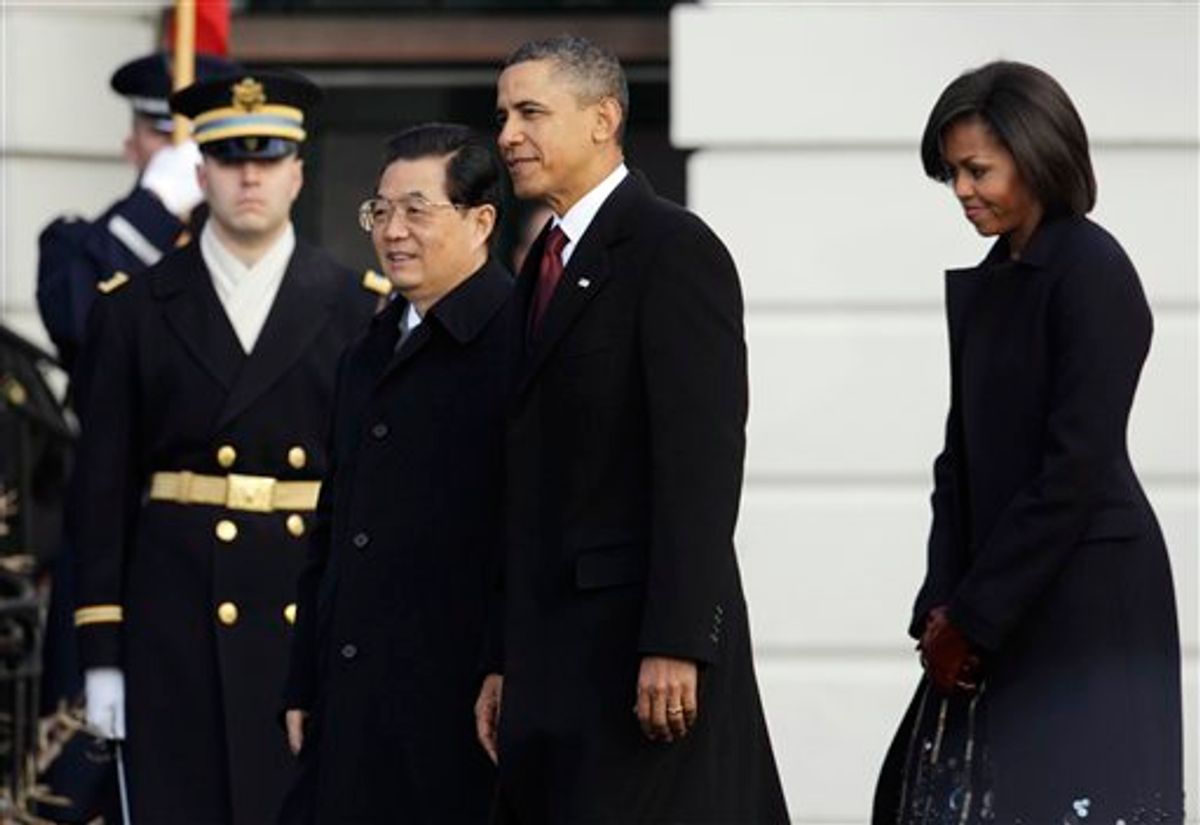
After the dinner: Three key facts about U.S.-China relationsPresident Barack Obama and first lady Michelle Obama welcome China's President Hu Jintao during a state arrival on the South Lawn of the White House in Washington, Wednesday, Jan. 19, 2011. (AP Photo/Charles Dharapak) (Credit: AP)

Hu Jintao arrived in America on Tuesday night and headed straight to a private White House dinner. Over the next week, his American hosts will treat the Chinese president to tours of New York and a Chinese-owned auto factory in Chicago. There’s also the very ceremonious state dinner and even more ceremonious 21-gun salute. These luxuries are a marked departure from the last welcome a Chinese president received in Washington: a working lunch with the Bush administration.

At a Wednesday afternoon press conference, Barack Obama and Hu stood together as equals — rulers of the largest and second largest economies in the world, respectively. And economists speculate that that ranking might flip sometime in the next few years. So, China is something to be taken seriously.

But what does Hu’s stateside trip really mean, and what will it accomplish?  Here are three key things to know:

1. China’s economy is doing very well. In his speeches, Hu is quick to acknowledge how similar the United States and China are as countries. But the narrative of the past few years suggests that China already has the upper hand. The United States is facing growing debt while China enjoyed a $183 billion trade surplus in 2010. In the same year, China’s economy grew 10 percent, while the US barely eeked out 3 percent. If you’re having a hard time visualizing what that growth looks like, check out this (very steep) graph.

2. China is not the best place in the world to be a human and also have rights. In the days leading up to Hu’s arrival, Secretary of State Hillary Clinton gave a speech emphasizing the differences between the two countries, citing China’s teatment of dissident writer Liu Xiaobo. China’s known violations — conflicts with Google notwithstanding — mar its image as a global power. During the press conference Wednesday, Hu echoed the claim his country has made before: that thing are getting better. China is still a developing nation, he explained, and anyway human rights in China are China’s business. Obama, for his part, expressed cautious optimism, saying “China’s peaceful rise is good for the world.”

3. The United States could benefit from a little bit of China love. Hu announced that as a gesture of good faith China had agreed to purchase $45 billion worth of American goods. We’ll see how long it lasts. What the United States and its business interests really want is for the Chinese government to strengthen its currency and loosen restrictions on foreign businesses operating within Chinese borders.

Justin Spees

Justin Spees is an editorial fellow at Salon.

Next Article

Featured Slide Shows

Gripping photos: The people of the Turkey protests (slideshow)

close X
  • Share on Twitter
  • Share on Facebook
  • Thumbnails
  • Fullscreen
  • 1 of 11
  • The protests take on a festive element as police forces move out of the park and square. Wearing a gas mask, this young man dances to traditional Turkish music in front of Taksim Square’s Ataturk Monument.

  • In Gezi Park since March 31st, this protester, originally caught off-guard by the Government’s teargas and water cannons, went out and bought a Russian army mask from WWII, preparing for what was to come.

  • This rambunctious boy seems to be enjoying the chaos. After taking this picture he threw a stone at the already destroyed building in the background.

  • Forming a line, the police face off directly with protesters in Taksim Square. After a while, they retreated and there was a general cheer – a back-and-forth dance that has been common since the beginning of this protest.

  • An elderly woman in Gezi Park reads the news. The tent community occupying the park was violently destroyed on June 16th.

  • Many different groups had set up booths to promote their cause in Taksim Square and Gezi Park. Standing in front of one, this man waves his flag while posing with conviction.

  • Many home-remedies are used to minimize the effects of tear gas. This woman has put a milky solution on her face, removing her mask after the tear gas dissipated. Before sunrise, the police came again for another round of teargasing.

  • People capitalize on the uprising -- selling flags, beer, gas masks, sky lanterns and spray paint to name just a few of the popular items.

  • On Monday morning, June 11, the police execute a strong offensive. Many plain-clothed police officers, like the ones seen here, clash with protesters in the side streets away from the main stand-off in Taksim.

  • The authorities seem to be most aggressive in the night, pushing protesters away from the square and park. After being teargassed this young woman catches her breath with other protesters on Siraselviler Street.

  • Recent Slide Shows

  • Share on Twitter
  • Share on Facebook
  • Thumbnails
  • Fullscreen
  • 1 of 11

Comments

8 Comments

Comment Preview

Your name will appear as username ( settings | log out )

You may use these HTML tags and attributes: <a href=""> <b> <em> <strong> <i> <blockquote>