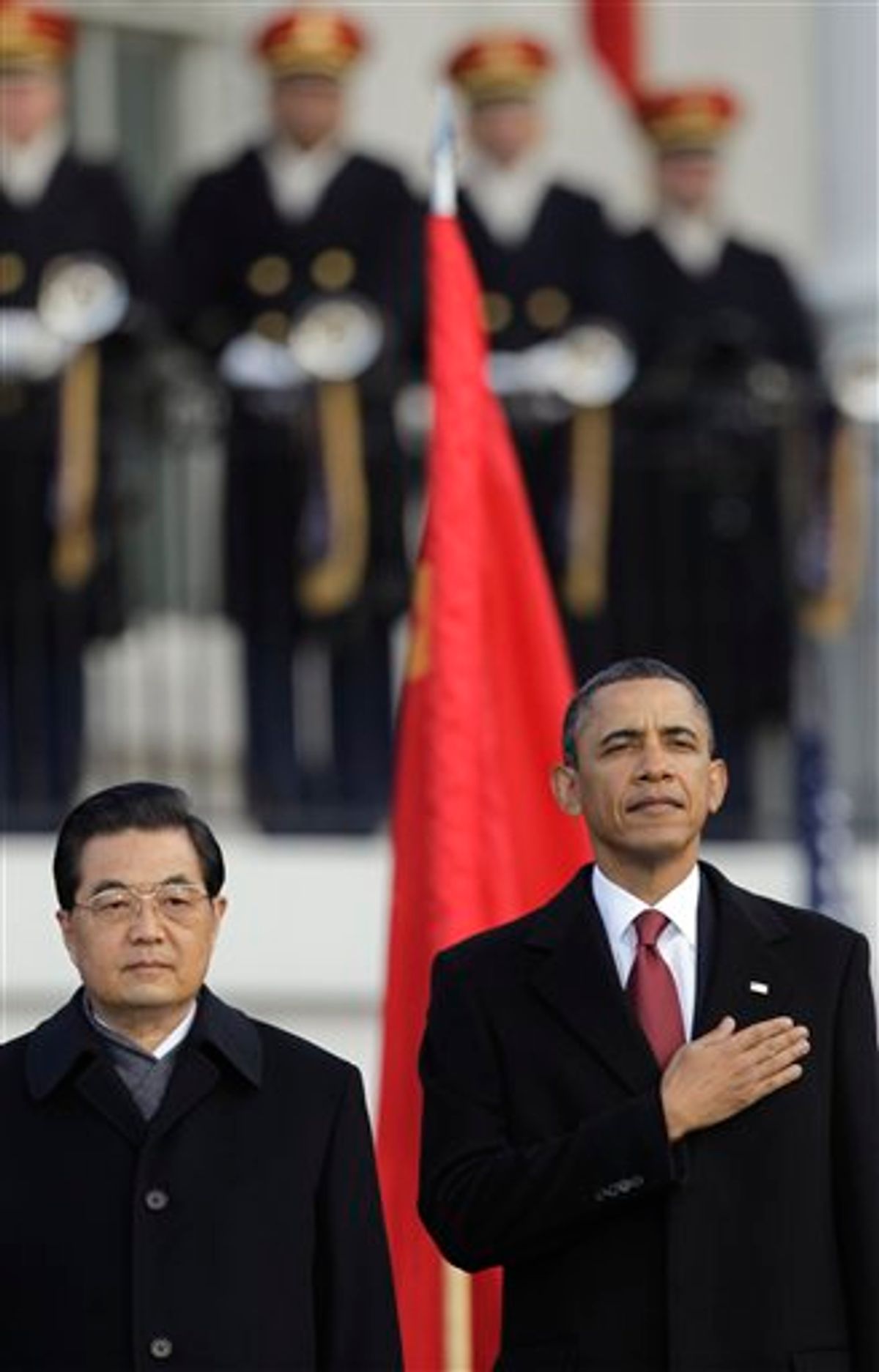
President Barack Obama is looking to assure Americans that they should not fear China's economic rise, using Chinese President Hu Jintao's high-profile state visit to announce job-creating business deals worth billions of dollars to U.S. companies.
On another big American concern, human rights, Hu conceded that "a lot still needs to be done" to improve China's record.
The business deals and Hu's human rights comments were among the highlights of a ceremony-packed day seen as key to building trust between the world's top two powers.
Five years after his last visit to the White House, one that was marred by protocol blunders, Hu was feted Wednesday with the full pomp of a state visit, including a lavish dinner with some of Washington's most powerful figures and other luminaries.
The two sides played down differences and stressed areas of cooperation, ranging from a plan to cooperate on nuclear security to an extension of the loan of two Chinese pandas to Washington's zoo.
On Thursday, Hu could face a tougher audience when he meets with U.S. lawmakers -- a few of whom skipped the dinner and have been deeply critical of China's authoritarian government.
Senate Majority Leader Harry Reid, D-Nev., called Hu "a dictator" in an interview Wednesday, although he later tried to recant the comment. In the House, several Republican lawmakers assailed the Chinese government's record on human rights, military expansion, financial strategy and weapons sales.
Later Thursday, Hu was to address trade and economic concerns at the U.S.-China Business Council in Washington.
Economic ties, long seen as a source of stability in the often rocky U.S.-China relationship, have caused friction in recent years. U.S. manufacturers assert that China undervalues its currency by as much as 40 percent, making its exports cheaper at the expense of those from the United States, contributing to high U.S. unemployment.
Obama bluntly restated that concern Wednesday, saying China's government had "intervened very forcefully" in the currency markets to the tune of $200 billion "just recently." He also highlighted intellectual property rights violations, citing Microsoft CEO Steve Ballmer as saying that only 1 customer in 10 of Microsoft products in China is actually paying for them.
But Obama also stressed the importance of the growing economic bonds between the two superpowers and said China was taking significant steps to curtail the theft of intellectual property and expand U.S. investment.
He said the newly announced business deals worth $45 billion -- which include a highly sought-after $19 billion deal for 200 Boeing airplanes -- would help create 235,000 U.S. jobs, in addition to the half-million U.S. jobs already generated by the United States' annual $100 billion in exports to China.
"I absolutely believe China's peaceful rise is good for the world, and it's good for America," Obama told a joint news conference, addressing a major concern in Beijing that the United States wants to see China's growth constrained.
"We just want to make sure that (its) rise occurs in a way that reinforces international norms, international rules, and enhances security and peace, as opposed to it being a source of conflict either in the region or around the world," Obama said.
Standing alongside one another at podiums, against a backdrop of U.S. and Chinese flags, the two leaders vowed closer cooperation on critical issues such as increasing trade and combating nuclear proliferation. But they also acknowledged their differences, especially over human rights.
Obama has faced criticism for granting the state dinner to the Chinese communist leader, whose visit comes just a month after jailed Chinese dissident Liu Xiaobo was awarded the Nobel Peace Prize. Obama won the prize the previous year.
At the news conference, Obama described the rights of freedom of speech, religion and assembly as "core views" for Americans and said he drove that home forcefully in his discussions with Hu.
Hu responded that human rights should be viewed in the context of different national circumstances but, in an unusual concession for a Chinese leader on the world stage, acknowledged, "A lot still needs to be done in China on human rights."
He said China was willing to engage in dialogue with the U.S. and other nations on the issue, but countries must exercise "the principle of noninterference in each other's internal affairs" -- hinting at China's customary resistance to debate on it.
Rights activists welcomed Hu's comments but said they needed to be backed up by action to ameliorate a host of concerns, including mass detentions without trial in China, persecution of rights activists and ethnic minorities and crackdowns on Falun Gong practitioners.
"It's good to hear him make such an acknowledgment, but they are no more than words until we see serious changes in policy and practice," said Sophie Richardson, Asia advocacy director for Human Rights Watch.
She noted that China had issued "similar rhetoric" in the past.
And China typically defines human rights in terms of improvements in quality of life such as higher incomes and better living conditions, rather than civil liberties such as freedom of speech that define such values in the West.
Shares