State of the Union

Obama’s tired “innovation” invocation

The president will hit a theme that's been used regularly in State of the Union addresses for 30 years

  • more
    • All Share Services

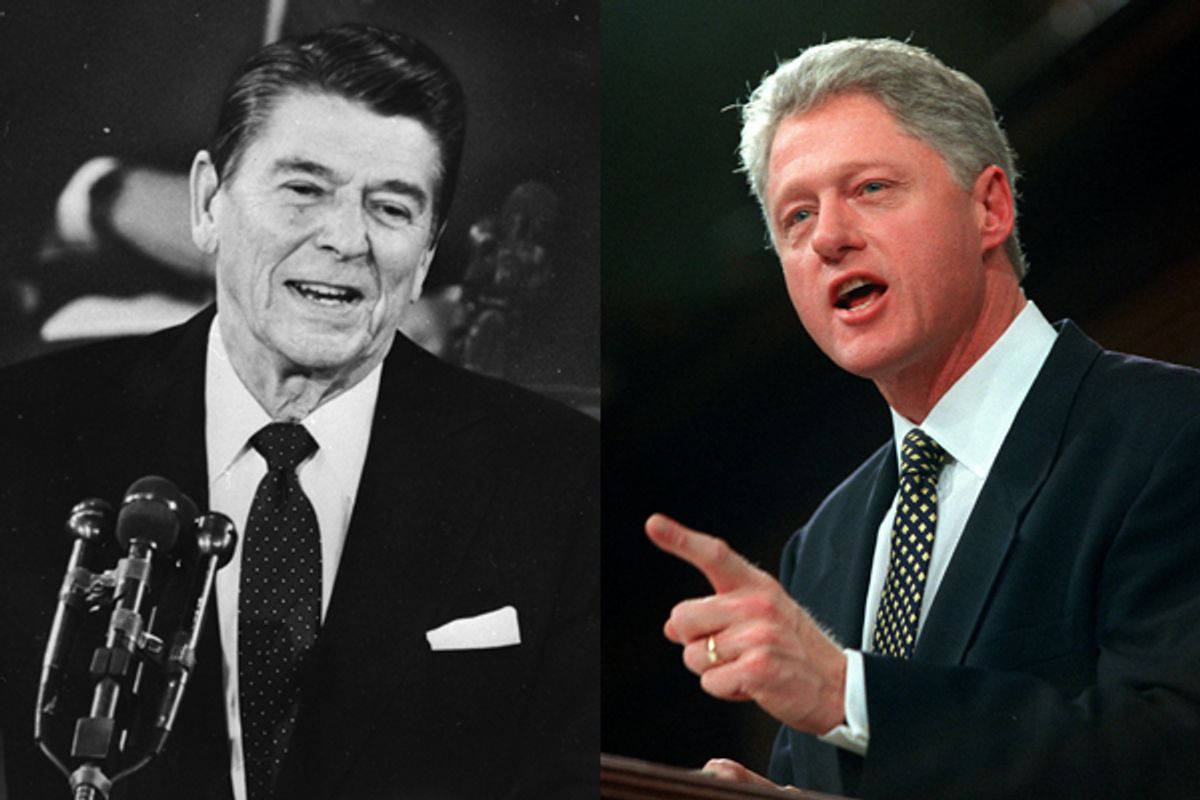
Obama's tired Former presidents Ronald Reagan and Bill Clinton giving their State of the Union addresses

Mike Allen’s Politico Playbook email played a cute trick over the weekend, offering this sneak peak of the State of the Union tonight:

“[E]ven tough debates can be conducted in a civil tone, and our differences cannot be allowed to harden into anger. To confront the great issues before us, we must act in a spirit of goodwill and respect for one another — and I will do my part. … Tonight I will set out … an agenda for a nation that competes with confidence; an agenda that will raise standards of living and generate new jobs. … Tonight I announce an American Competitiveness Initiative, to encourage innovation … “

Except that’s not from Obama’s speech tonight. That’s what George W. Bush said in 2006.

But if the previews are any indication, “innovation” will indeed be a major theme of Obama’s address. In choosing that theme, Obama is following in the path of presidents going back to Jimmy Carter, who spoke of harnessing the “American genius for innovation” in 1981.

After all, who could oppose innovation? It’s the ideal subject for bipartisan boilerplate, almost always shorn of any real policy prescriptions. Thus, it has proved irresistable to presidents and their speechwriters going back three decades.

Here’s Bush in 2006:

Clinton in 2000:

Here’s Reagan in 1983 (no video available):

To many of us now, computers, silicon chips, data processing, cybernetics, and all the other innovations of the dawning high technology age are as mystifying as the workings of the combustion engine must have been when that first Model T rattled down Main Street, U.S.A. But as surely as America’s pioneer spirit made us the industrial giant of the 20th century, the same pioneer spirit today is opening up on another vast front of opportunity, the frontier of high technology.

In conquering the frontier we cannot write off our traditional industries, but we must develop the skills and industries that will make us a pioneer of tomorrow. This administration is committed to keeping America the technological leader of the world now and into the 21st century.

And Obama himself has already been down this road. Here he is last year:

The early word is that “innovation” will be one of the five strategies laid out by Obama tonight to “win the future.”

Justin Elliott

Justin Elliott is a reporter for ProPublica. You can follow him on Twitter @ElliottJustin

LIVEBLOG: Obama calls for taxing the wealthy

In populist speech, president promises to act if Congress won't VIDEO

  • more
    • All Share Services

LIVEBLOG: Obama calls for taxing the wealthy

SNL: Michele Bachmann sequel

Once more, with reeling, as Saturday Night Live spoofs the Republican's speech

  • more
    • All Share Services

SNL: Michele Bachmann sequel

The president ignored the elephant in the room

Obama's calls for innovation are politically astute but ignore the looming problem of unemployment

  • more
    • All Share Services

The president ignored the elephant in the roomPresident Barack Obama talks with Senate Majority Leader Harry Reid of Nev., left, and Sen. Patrick Leahy, D-Vt., on Capitol Hill in Washington, Tuesday, Jan. 25, 2011, after delivering his State of the Union address. (AP Photo/Pablo Martinez Monsivais, Pool)(Credit: AP)

The President’s new emphasis on the importance of investing in education, infrastructure, and basic research in order to build the nation’s long-term competitive capacities is appropriate. For the last three decades the federal government’s spending on these three essentials has declined as a percentage of its total spending, arguably threatening America’s technological and economic leadership.

But the President’s failure to address this decoupling of American corporate profits from American jobs, and explain specifically what he’ll do to get jobs back, not only risks making his grand plans for reviving the nation’s “competitiveness” seem somewhat beside the point but also cedes to Republicans the dominant narrative.

The address he gave last night could have been given (indeed, was given) by Democrats in the 1980s when Japan seemed to threaten America’s preeminence. Bill Clinton’s 1992 campaign manifesto, “Putting People First,” laid out the case. Only now the competitive threat comes from China.


A similar call for economic patriotism and public investment emerged in the 1950s and 1960s, when the competitive threat was the Soviet Union. John F. Kennedy challenged America to get to the moon ahead of the Soviets. Before him, Republican president Dwight Eisenhower committed the nation to building the interstate highways system – forty-one thousand miles of four-lane (sometimes even six-lane) freeways to replace the old two-lane federal roads that meandered through cities and towns – in order to speed troops, tanks, and munitions across the nation in the event of war. And a National Defense Education Act to educate a generation of mathematicians and scientists to catch up with the Soviets in space.


President Obama made the parallel explicit:

Half a century ago, when the Soviets beat us into space with the launch of a satellite called Sputnik, we had no idea how we’d beat them to the moon,” he said. “But after investing in better research and education, we didn’t just surpass the Soviets’ we unleashed a wave of innovation that created new industries and millions of new jobs. This is our generation’s Sputnik moment.


Reviving these ideas, and the feelings they provoke, is politically astute. A call for national unity and economic patriotism is places the President above partisan rancor, and gives him a rationale for a strong and effective government at a time when Republicans want nothing so much as to shrink it.


But the new theme also poses a danger of appearing to ignore the elephant in the room – the nation’s continuing scourge of high unemployment that shows little sign of abating any time soon.

It’s one thing to challenge the nation to re-embark on the equivalent of a race to the moon when most people feel confident about their own family finances, but quite another when economic security is as endemic as now.

The President understandably wants Americans to feel upbeat about the economic recovery – “two years after the worst recession most of us have ever known, the stock market has come roaring back Corporate profits are up. The economy is growing again,” he said – but little of this has yet trickled down to ordinary people who continue to be plagued by a huge debt load, business’s unwillingness to create full-time jobs, and a still fragile housing market.


The Great Recession wasn’t due to America’s loss of “competitiveness” relative to the Chinese or anyone else. In fact, American corporations are now enormously competitive, now racking up some of their highest profits in history. But much of their success is occurring outside the United States. GE, whose CEO, Jeffrey Immelt, was just tapped to head Mr. Obama’s new advisory council on jobs and competitiveness, has more foreign employees than American. General Motors now sells and makes more cars in China than at home.


They and their supply-side economists say the nation got into trouble because government became too large, and the answer is therefore to cut spending, cut taxes, and shrink the deficit. The President, having apparently given up on Keynesian pump-priming, has no retort except to invest for the long term.


What the President should have done is talk frankly about the central structural flaw in the U.S. economy – the dwindling share of its gains going to the vast middle class, and the almost unprecedented concentration of income and wealth at top – in sharp contrast to the Eisenhower and Kennedy years.

Although the economy is more than twice as large as it was thirty years ago, the median wage has barely budged. Most of the gains from growth have gone to the richest Americans, whose portion of total income soared from around 9 percent in the late 1970s to 23.5 percent in 2007. Americans kept spending anyway by using their homes as ATMs but the bursting of the housing bubble put an end to that – leaving them without enough purchasing power to reboot the economy. So the central challenge is to rev up consumer spending by putting more money into the pockets average Americans.


This narrative would be politically risky (opening Mr. Obama to the charge of being a “class warrior”) but at least honest. And it would allow him to connect the dots – explaining why his new health-care law is critical to reducing medical costs for most working families, why tax reform requires cutting taxes on the middle class while raising them on the rich, why the Bush tax cuts shouldn’t be extended for the wealthy, why deficit reduction must not sacrifice education and infrastructure (both important to rebuilding middle-class prosperity) and why any cuts in Social Security or Medicare must be on the backs of the wealthy rather than average working families.

Importantly, it would give him a convincing counter-narrative to the Republican anti-government one. Government exists to protect and advance the interests of average working families. Without it, Americans have to rely mainly big and increasingly global corporations, whose only interest is making money wherever it can be made.


Continue Reading Close

Robert Reich, one of the nation’s leading experts on work and the economy, is Chancellor’s Professor of Public Policy at the Goldman School of Public Policy at the University of California at Berkeley. He has served in three national administrations, most recently as secretary of labor under President Bill Clinton. Time Magazine has named him one of the ten most effective cabinet secretaries of the last century. He has written 13 books, including his latest best-seller, “Aftershock: The Next Economy and America’s Future;” “The Work of Nations,” which has been translated into 22 languages; and his newest, an e-book, “Beyond Outrage.” His syndicated columns, television appearances, and public radio commentaries reach millions of people each week. He is also a founding editor of the American Prospect magazine, and Chairman of the citizen’s group Common Cause. His widely-read blog can be found at www.robertreich.org.

This guy really hated the State of the Union

Republican Rep. Paul Broun sat in his office calling the president a Marxist on Twitter, like a common blogger

  • more
    • All Share Services

This guy really hated the State of the UnionPaul Broun

While many members of Congress elected to watch last night’s State of the Union address while seated next to a member of the opposite party, in an awkward display of bipartisanship and civility, one House member was brave enough to watch the whole thing from his office, Tweeting fevered nonsense the whole time. That hero is Rep. Paul Broun, of Georgia.

Broun previously warned that the president was showing “signs of being Marxist,” as well as doing “exactly what Hitler did in Nazi Germany,” so really no one should be surprised that this guy was not impressed by the president’s vision of “winning the future.”

And that’s why he wrote, as the speech wrapped up, “Mr. President, you don’t believe in the Constitution. You believe in socialism.”

While there’s not really anything in the Constitution that precludes a little light Scandinavian-style socialism, Broun is a modern-day Republican moron, and so for him the “s-word” means some scary combination of the Third Reich and the Great Purge. (If you can find the passage in Obama’s relentlessly centrist address that sounds like a proposal for a Great Leap Forward, please let me know, because all I remember is the bit about cutting corporate taxes and something about smoked salmon.)

Broun is a crafty fellow — he knew that the “sit with someone from the other party” proposal was an elaborate ruse designed to oppress the opposition.

“I already believe very firmly that it is a trap and a ruse that Democrats are proposing,” Broun said. “They don’t want civility. They want silence from the Republicans. And the sitting together being kissy-kissy is just another way to try to silence Republicans, and also to show — to keep the American people from seeing how few of them there are in the U.S. House now.”

Broun says he chose to avoid the chamber and liveblog from his office “out of respect.” Respect for whichever unlucky member was assigned to sit next to one of the dumbest members of the Republican caucus, I imagine.

Continue Reading Close
Alex Pareene

Alex Pareene writes about politics for Salon and is the author of "The Rude Guide to Mitt." Email him at apareene@salon.com and follow him on Twitter @pareene

David Gergen and Ari Fleischer fight over education, jobs

Discussing Obama's State of the Union address, the two White House veterans get riled up over the jobs problem

  • more
    • All Share Services

David Gergen and Ari Fleischer fight over education, jobsDavid Gergen and Ari Fleischer face off.

If only more political debates could be based on real experience with the issues. Here are David Gergen — presidential advisor under Nixon, Ford, Reagon and Clinton — and former White House Press Secretary debating cutting education spending in the face of the nation’s jobs crisis.

Adam Clark Estes blogs the news for Salon. Email him at ace@salon.com and follow him on Twitter @adamclarkestes

Page 1 of 15 in State of the Union