Egypt’s communications ‘kill switch’
Just what Joe Lieberman wants for America?
By Dan GillmorTopics: Egyptian Protests, Entertainment News
UPDATED
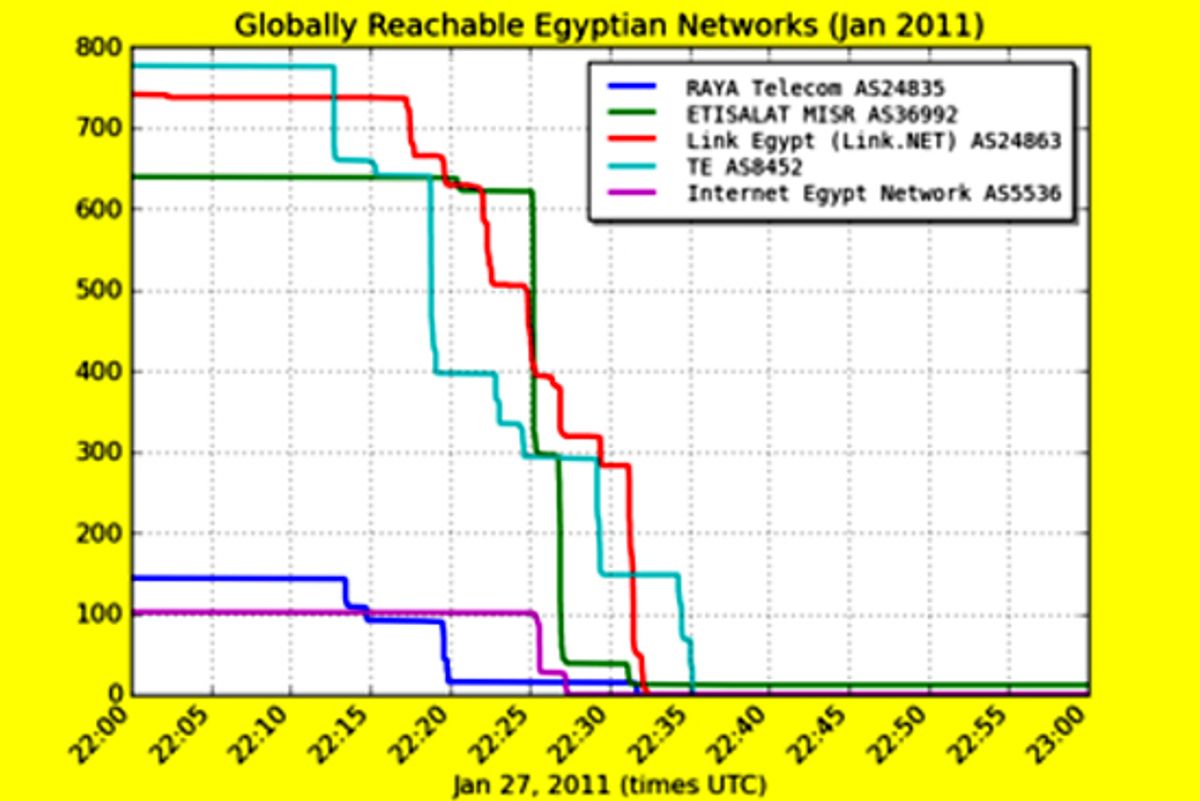
The Egyptian government’s move to shut down Internet access, among other communications, amid the escalating protests is nearly unprecedented—and it foretells a future, unless we work hard to prevent it, of centralized information control. And before we Americans get smug about our freedoms in the information sphere, we should recognize that what Egypt is doing is exactly what authoritarians in our own government want the ability to do here.
This isn’t the first time government has shut down access to the Internet during a national crisis, or ordered mobile phone companies to stop letting customers make calls and send text messages. Burma largely succeeded in closing off its media borders several years ago, and regimes around the planet have created harsh censorship systems that prevent the majority of their people from seeing information deemed unacceptable by the people in charge.
Now, the shutdown isn’t absolute. Some data is still getting in and out of Egypt, and circulating within the country. The reports are so sketchy, even from experts in the field, that it’s hard to know precisely what is happening. But Egypt’s shutdown of most communications to the outside world, and communications inside the country, is the most blatant abuse yet of this kind by a large power. And it’s Exhibit A in how the modern Internet, despite its heritage as a system where information would find its way around outages, has become increasingly vulnerable to choke points that governments and their corporate partners/subjects have become adept at using to restrict the flow of information.
The Internet isn’t the only way people use digital communications, of course. But most phone service in Egypt is mobile. So it’s trivially easy, unfortunately, to take mobile phone service off the air. In Egypt’s case, it simply ordered the providers—which operate at the government’s sufferance—to stop providing service. Vodafone and other mobile carriers, having no real alternative, complied–though we still might wish for an example of corporate guts in the face of dictatorial abuses. Oligopolies and monopolies are easy to tame.
In theory, the Internet should be a little bit harder to shut down due to its decentralized nature. In practice, as we’re seeing, the chokepoints work. A major one this time is the DNS system. This is the collection of servers that tell people, or rather their computers, requesting information from various sites on the Internet specifically where they can find it. Egypt has gateway (border) computers handling this task, and it apparently ordered most of them off-line, telling the companies providing them to stop answering requests. (More details here at GigaOm.) This is why I put “kill switch” in quotation marks; what seems to be happening is a series of government phone calls to entities that feel they have no alternative but to comply with orders, or lack the courage to challenge them. (UPDATE: Supporters of the protesters have set up dial-up lines outside the country, but this is hardly an answer to the larger problem.)
One of the most important questions yet to be answered in the Egyptian crisis is what will happen to the nation’s economy if communications are thoroughly restricted over a long period of time. It may not be a coincidence that the government shut down communications on the eve of the Muslim Sabbath; people are doing some business today in Cairo and other cities, but not as much as they’d normally be doing tomorrow and in the coming days. Egypt’s economy is not the most modern in the world, but it’s fair to say that its digital component has been growing rapidly.
This is one of the questions Americans (and others in highly developed nations) should be asking themselves, especially given the desire among some in government to have “kill switch” capabilities for the Internet here. As CNET reported several days ago, a much-derided plan floated by—unsurprisingly—US Sen. Joe Lieberman looks like it’s getting new life in Congress. Among the more alarming elements of the proposed legislation is that it removes judicial review from executive decisions.
(UPDATE: Talking Points Memo disputes the CNET story, saying among other things that there would be judicial review. But the TPM piece isn’t entirely clear, either, on several issues. The Obama administration has already used questionable tactics to take down websites based solely on allegations, not proof, of activities the entertainment industry claims to be illegal. And Congress may soon push through an outrageously anti-freedom bill that would give the executive the authority to order US network companies to shut down access to foreign sites it deems unacceptable. Add these examples, among others, to the ongoing campaign against WikiLeaks, and it’s entirely clear that government and corporate interests in America are ardent to put some kind of lid on our Internet freedom.)
America’s battle over “network neutrality” has been an argument over whether our broadband duopoly—phone and cable companies that provide almost all access in most communities—should have the right to decide what information gets delivered at what speed to customers. Not enough attention has been given to another element of the duopoly control: the ease with which government, given the legal tools (not that recent governments have cared much for legalities), could order a shutdown.
Other kinds of centralization are proceeding, meanwhile. As Andrew Blum writes at the Atlantic magazine, Google and Verizon recently bought some real estate containing two of the most important network operating centers in the world. Can we trust them, as their ties to government grow stronger all the time? The answer is obvious.
What’s becoming increasingly clear is the need to create new ways to route around censorship. The Internet still does a decent job of this in many circumstances, but not all. As governments and their corporate handmaidens race to lock down a medium they desperately want to control, the rest of us need to get on with the job of A) fighting to keep the medium free of their interference; and B) working on new technologies and systems that defy central control.
Egypt is a wake-up call. Are we hearing it?
(Apologies for the typos that appeared in the first version of the story. Due to an injury I’m using voice dictation software, and while it’s good it’s not perfect. Many thanks to @PKtm on Twitter for pointing out several of the typos.)
A longtime participant in the tech and media worlds, Dan Gillmor is director of the Knight Center for Digital Media Entrepreneurship at Arizona State University's Walter Cronkite School of Journalism & Mass Communication. Follow Dan on Twitter: @dangillmor. More about Dan here. More Dan Gillmor.
You Might Also Like
More Related Stories
-
Country music has always been feminist, even if Taylor Swift isn't
-
John Horne Burns: The writer Hemingway and Vidal envied
-
John Mayer offers up "Paper Doll" as your new Prancercise jam
-
There are no unicorns in North Korea
-
Is Cindy McCain actually a gay "hero"?
-
On "The Bridge," normal is dangerous
-
Ai Weiwei on his incarceration: "They never looked away from me, 24 hours a day”
-
Is there a "liberal bias" in academia?
-
Dan Harmon apologizes for comparing "Community's" season 4 to rape
-
Former intern sues Atlantic Records
-
All about Kaidence, the reported name of Kanye West and Kim Kardashian's baby
-
Exclusive clip from "How to Make Money Selling Drugs"
-
Vice apologizes, pulls suicide-glorifying photo spread from Web
-
What "The Bling Ring" gets wrong about Valley girls
-
Must-see morning clip: "The Daily Show" on the return of Sarah Palin
-
Lil Wayne dances on top of American flag in new music video
-
Charles Saatchi cautioned over assault on wife
-
From "Bling Ring" to Oprah, "The Secret" lives on
-
A head trip to a haunted recording studio
-
Vice re-creates female authors' suicides for maximum trolling
-
Kanye West's sex problem
Featured Slide Shows
Gripping photos: The people of the Turkey protests (slideshow)
close X- Share on Twitter
- Share on Facebook
- Thumbnails
- Fullscreen
- 1 of 11
- Previous
- Next
-
The protests take on a festive element as police forces move out of the park and square. Wearing a gas mask, this young man dances to traditional Turkish music in front of Taksim Square’s Ataturk Monument.
-
In Gezi Park since March 31st, this protester, originally caught off-guard by the Government’s teargas and water cannons, went out and bought a Russian army mask from WWII, preparing for what was to come.
-
This rambunctious boy seems to be enjoying the chaos. After taking this picture he threw a stone at the already destroyed building in the background.
-
Forming a line, the police face off directly with protesters in Taksim Square. After a while, they retreated and there was a general cheer – a back-and-forth dance that has been common since the beginning of this protest.
-
An elderly woman in Gezi Park reads the news. The tent community occupying the park was violently destroyed on June 16th.
-
Many different groups had set up booths to promote their cause in Taksim Square and Gezi Park. Standing in front of one, this man waves his flag while posing with conviction.
-
Many home-remedies are used to minimize the effects of tear gas. This woman has put a milky solution on her face, removing her mask after the tear gas dissipated. Before sunrise, the police came again for another round of teargasing.
-
People capitalize on the uprising -- selling flags, beer, gas masks, sky lanterns and spray paint to name just a few of the popular items.
-
On Monday morning, June 11, the police execute a strong offensive. Many plain-clothed police officers, like the ones seen here, clash with protesters in the side streets away from the main stand-off in Taksim.
-
The authorities seem to be most aggressive in the night, pushing protesters away from the square and park. After being teargassed this young woman catches her breath with other protesters on Siraselviler Street.
-
Recent Slide Shows
-
Gripping photos: The people of the Turkey protests (slideshow)
-
The week in 10 pics
-
Photos: Turmoil and tear gas in Instanbul's Gezi Park - Slideshow
-
10 summer food festivals worth the pit stop
-
- Share on Twitter
- Share on Facebook
- Thumbnails
- Fullscreen
- 1 of 11
- Previous
- Next
-
The week in 10 pics
-
10 summer food festivals worth the pit stop
-
The week in 10 pics
-
The week in 10 pics
-
9 amazing drive-in movie theaters still standing
-
The week in 10 pics
-
The week in 10 pics
-
The week in 10 pics
-
The week in 10 pics
-
The week in 10 pics
-
The week in 10 pics
-
Netflix's April Fools' Day categories
-
The week in 10 pics
-
The week in 10 pics
-
The week in 10 pics
Related Videos
More Related Stories
-
Country music has always been feminist, even if Taylor Swift isn't
-
John Horne Burns: The writer Hemingway and Vidal envied
-
John Mayer offers up "Paper Doll" as your new Prancercise jam
-
There are no unicorns in North Korea
-
Is Cindy McCain actually a gay "hero"?
-
On "The Bridge," normal is dangerous
-
Ai Weiwei on his incarceration: "They never looked away from me, 24 hours a day”
-
Is there a "liberal bias" in academia?
-
Dan Harmon apologizes for comparing "Community's" season 4 to rape
-
Former intern sues Atlantic Records
-
All about Kaidence, the reported name of Kanye West and Kim Kardashian's baby
-
Exclusive clip from "How to Make Money Selling Drugs"
-
Vice apologizes, pulls suicide-glorifying photo spread from Web
-
What "The Bling Ring" gets wrong about Valley girls
-
Must-see morning clip: "The Daily Show" on the return of Sarah Palin
-
Lil Wayne dances on top of American flag in new music video
-
Charles Saatchi cautioned over assault on wife
-
From "Bling Ring" to Oprah, "The Secret" lives on
-
A head trip to a haunted recording studio
-
Vice re-creates female authors' suicides for maximum trolling
-
Kanye West's sex problem
Most Read
-
Why Sarah Palin actually matters again Joan Walsh
-
GOP plan to appeal to millennials: "Make abortion funny" Alex Seitz-Wald
-
Why didn't anyone help? Mary Elizabeth Williams
-
Lynda Obst: Hollywood's completely broken Lynda Obst
-
To my daughter on Father's Day: Sorry I used to be a sexist Mo Elleithee
-
Rahm Emanuel is losing control of his city Mark Guarino
-
The best of Tumblr porn Tracy Clark-Flory
-
TSA agent allegedly tells teenage girl to "cover herself" Mary Elizabeth Williams
-
Museum that discriminates against people says it is being discriminated against Katie Mcdonough
-
Study: Reading novels makes us better thinkers Tom Jacobs, Pacific Standard

Popular on Reddit
links from salon.com

2985 points2986 points2987 points | 439 comments

265 points266 points267 points | 6 comments

62 points63 points64 points | 19 comments


Comments
15 Comments