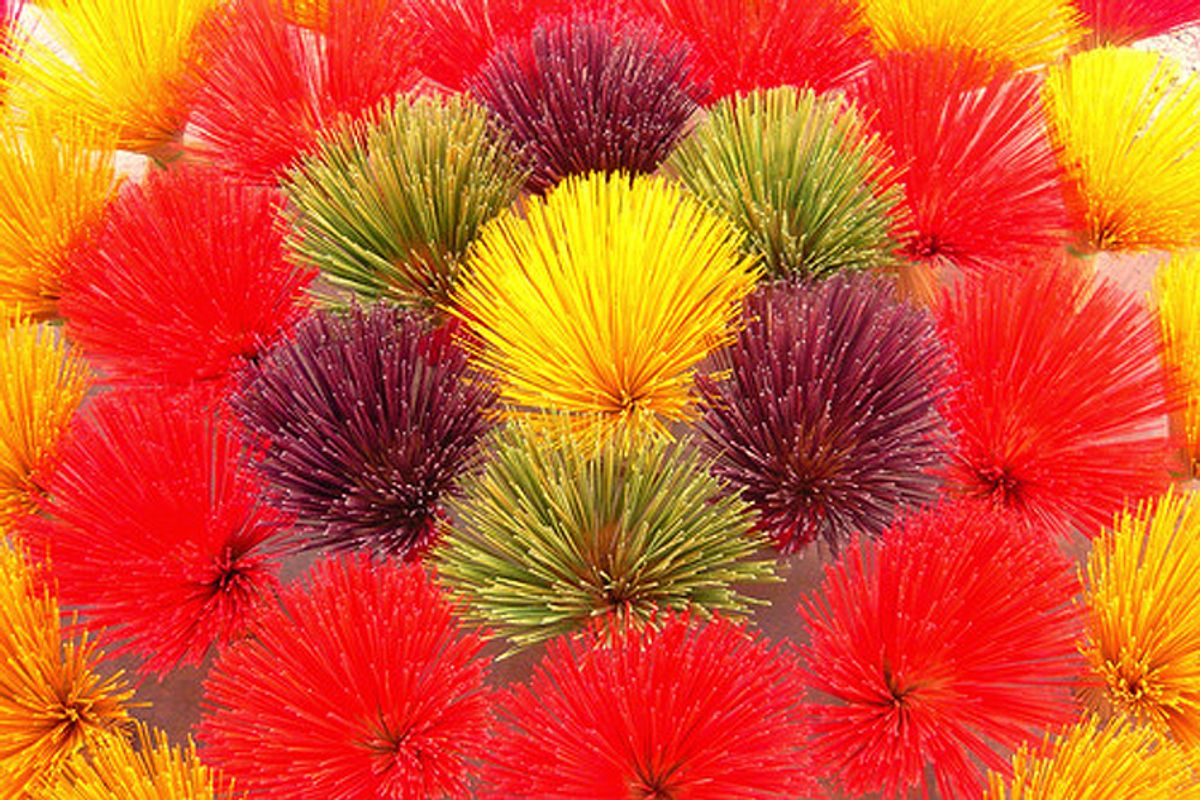
Slide show: From glass blowing in Italy to batik workshops in Senegal, these spots indulge the romance of crafting
As all kindergarten teachers know, few activities bring people together in a state of zen-like contentment like sitting in a circle making things with our own two hands. No matter how exotic the locale, when we travel, it is this kind of basic human moment that sticks with us the most. Over the past decade, savvy communities of artisans around the world have discovered that burnt-out post-industrial travelers are interested not only in buying handmade crafts, but also in learning to make them. This is good for those of us in dire need of craft therapy, but it has also turned out to be a solid model for small-scale community-based tourism.
Travel, at its best, is an exercise in wish fulfillment. In a world of mass-production, the romantic notion of escaping to a far-flung destination and making contact with a community of craftspeople using ancient techniques is a compelling fantasy. While they may not be the Arts and Crafts utopias envisioned by the likes of John Ruskin and William Morris, the good news is that places like this really do exist and the possibilities are endless: batik workshops in Senegal, pottery classes in Turkey, incense making in Vietnam, glass blowing in Italy, weaving in Guatemala, drum making in South Africa, or quilting in Alabama. This slide show pulls together 14 spots around the globe where you can travel and immerse yourself in a craft. (I know what you are going to say — there’s a place that we were crazy not to cover — please share your life-changing arts and crafts adventures in the comments.)
View the slide show
Continue Reading
More Megan Cytron
From sleeping snakes to fire-breathing goddesses, we explore natural anomalies that spawned fascinating myths
SLIDE SHOW
A note about Trazzler's slide shows: We don't do top-tens or best-of lists. Nor are we so morbid or presumptuous as to tell you where you must go before you die. The world is far too big and fascinating to encapsulate in any kind of definitive list. We simply chose the places that our writers have contributed that make us think, laugh and dream about our next adventure. Are we missing a place that you love? Visit us at
trazzler.com and click "write a trip" to add it.
Before science became humanity’s preferred method for understanding the natural world, myth and geology went hand in hand. Anyone who travels a bit is sure to run across local legends that strive to explain odd natural phenomena in fictional terms. Every single culture around the world tells these kinds of stories. There’s the Chimera of Turkey (methane gas vents in the side of a mountain rendered by Homer as a fire-breathing “lion-fronted, snake behind, goat in the middle” creature); the fire-belching goddess Pele living in Hawaii’s Kilauea crater; or the story of a pair of mountains that split due to irreconcilable differences (Mount Rainier took off in the heat of an argument packing up all the prettiest wildflowers).
Now that we have some grip on the basic laws of nature, even scientists are taking a closer look at legends as a serious source of information on real natural events: comets, volcanic eruptions, tsunamis, earthquakes and weather patterns. Disciplinary mashups like archaeoastronomy and geomythology have emerged to try to retrieve buried, culturally encoded information from fictionalized oral traditions. As Einstein stated again and again, imagination is, after all, at the center of scientific exploration. The creative capacity of storytellers to use their topographical surroundings to explain and entertain is boundless — and although the stories produced are radically different, the urge to tell them is a cultural constant across civilizations. These 12 legendary places run the gamut from a spider lady’s desert platform for yarn-bombing the universe to a giant’s stepping stones across the cold Atlantic to an island formed from the scaly remains of squabbling dragons.
Have you come across any good legends about geological anomalies in your travels? Share them with us in the comments. Find more legendary places on Trazzler.
View the slide show
Continue Reading
More Megan Cytron
From Roman crypts to Incan mummies, these creepy sites will satisfy your taste for the macabre
SLIDE SHOW
A note about Trazzler's slide shows: We don't do top-tens or best-of lists. Nor are we so morbid or presumptuous as to tell you where you must go before you die. The world is far too big and fascinating to encapsulate in any kind of definitive list. We simply chose the places that our writers have contributed that make us think, laugh and dream about our next adventure. Are we missing a place that you love? Visit us at
Trazzler.comand click "write a trip" to add it.
Let’s start from the premise that the tourism industry is, quite frequently, a freak show. And not just on Halloween … plenty of places keep it surreal all year round. Why? Luring people into your temple, museum, medical school, church or crypt isn’t as easy as you might think. You need a hook.
While severed body parts and corpses may not have a tourist-brochure ring, gore sells. Catholic churches have been collecting bodies and relics for pilgrims to visit for centuries. Little bits of the Buddha are scattered in shrines around the globe. Medical curiosities and oddities fill glass cases and jars in museum sideshows.
On occasion, one man’s stack of musty bones cluttering up a catacomb becomes another’s creative medium, a macabre opportunity to recycle earthly remains into visionary art. Visiting one such place, the Capuchin Crypt in Rome, certainly made an impression on Mark Twain, who described it with delicious detail in his travelogue “Innocents Abroad”: “On the wall were elaborate frescoes, whose curving vines were made of knotted human vertebrae; whose delicate tendrils were made of sinews and tendons; whose flowers were formed of knee-caps and toe-nails.” “What you are now, we used to be. What we are now, you will be,” a plaque on the crypt ominously announces in five languages.
So much of the tourism industry is destructive, but these grotesque places do no harm. In fact, dead folks may just be the ultimate eco-friendly, renewable resource — call them relics, taxidermy, ossuaries, medical oddities, or just a good story of legendary dismemberment — these 14 morbid spots keep the curious coming back.
Have you run across a displaced appendage or skeletal remains in your travels? Let’s reassemble them in the comments. You can find more macabre sites on Trazzler.
View the slide show
Continue Reading
More Megan Cytron
From Lenin's solemn mausoleum to Wilde's lipsticked tomb, we visit the resting places of fascinating luminaries
SLIDE SHOW
A note about Trazzler's slide shows: We don't do top-tens or best-of lists. Nor are we so morbid or presumptuous as to tell you where you must go before you die. The world is far too big and fascinating to encapsulate in any kind of definitive list. We simply chose the places that our writers have contributed that make us think, laugh and dream about our next adventure. Are we missing a place that you love? Visit us at
trazzler.com and click "write a trip" to add it.
The rich, the famous, the powerful, the fabulously talented … so hard for mere mortals to mingle with in life, so easy to linger with in death. Making a pilgrimage to a famous grave can be an odd experience, particularly when it isn’t where you might expect. Who would think to look for James Joyce and Jorge Luis Borges in Switzerland — or F. Scott Fitzgerald among the strip-mall hell of suburban D.C.? Death just happens. Those on the brink of death can get caught unawares, left to spend eternity in a place they scarcely knew or were just passing through, or be forcibly brought back home by family after a long escape (like poor Charlie Parker, who ended up back in Kansas against his wishes).
Irony, apparently, isn’t just for the living. While Fitzgerald’s gravestone is an austere afterthought, the man who wrote about turning to dirt on someone’s boot soles, Walt Whitman, commissioned an expensive granite mausoleum before his death. It’s no surprise that the poet spent his final years reworking his magnum opus “Leaves of Grass” for the umpteenth time, but the fact that he did so while also carefully overseeing the construction of his own tomb feels like quite a departure for the man who philosophized about the soul and vowed to “make poems of my body and of mortality.”
As in life, after death, everyone seems to want a piece of what fame can bring. Cities fight over the remains of native sons. A few years back, a Philly Poe scholar went so far as to encourage local fans to “drive down I-95 and appropriate a body from a certain Baltimore cemetery” to set things right. Seville, Spain and Santo Domingo, D.R., have been sniping for centuries over which city’s cathedral houses Christopher Columbus’ bones. There are certain places, like the cemeteries of Paris or Hollywood, so jampacked with dead VIPs that a whole tourism industry and series of rituals has sprung up around visiting the tombs.
Contemplating a grave certain doesn’t provide the carefully curated experience of a person’s life that meandering through his home might. It can, however, reveal a messier truth about how he is remembered and honored by people living today. Have you ever felt inspired to visit the grave of someone you knew only from his or her life’s work? Have you discovered a famous person’s place of rest in an unexpected place? Share your macabre travel tales in the comments. You can find more travel-worthy cemeteries and graves on Trazzler.
View the slide show
Continue Reading
More Megan Cytron
From kosher cuts in NYC to French dips in L.A., the best places to sate your craving for our nation's favorite food
SLIDE SHOW
A note about Trazzler's slideshows: We don't do top-tens or best-of lists. Nor are we so morbid or presumptuous as to tell you where you must go before you die. The world is far too big and fascinating to encapsulate in any kind of definitive list. We simply chose the places that our writers have contributed that make us think, laugh and dream about our next adventure. Are we missing a place that you love? Visit us at
trazzler.com and click "write a trip" to add it.
So many are fond of misguided generalizations, calling America a Christian nation, a zombie nation, a TV nation … but it was chef and food writer James Beard who hit the nail on the head: America is a sandwich nation.
Sandwiches are the food of the people — cheap, nutritious, easy to assemble in large quantities — what better vehicle for delivering the flavors of a regionally and ethnically diverse nation to people on the move?
The only thing aristocratic about sandwiches is the name — borrowed from John Montagu, the fourth Earl of Sandwich, a rather unenlightened Enlightenment-era figure who most certainly did not pioneer the concept of placing delectable morsels between two pieces of bread. He may, however, have had a penchant for snacking combined with an aversion to getting his fingers dirty — and he did play some part in making sandwiches trendy for the first time.
It was during the industrial revolution that the sandwich took off as a portable and easy-to-eat meal for workers. In America, wave after wave of new arrivals reinterpreted the form. Thanks to them, today there are sandwiches that add up to far more than the sum of their parts. A symbol of local identity and heritage, the most beloved among them inspire loyalty, passion and a cultlike following.
Sandwiches matter. When election season rolls around, candidates invariably hit sandwich shops across the country looking to buff up their populist cred, while being careful to avoid missteps like John Kerry’s devastating 2004 “Swiss cheese incident” at the temple of cheesesteaks, Pat’s in Philadelphia (food critic Craig LaBan predicted that requesting the wrong cheese would “doom his candidacy” in Philly — quite the exaggeration, but the story of his cultural faux pas did spread like wildfire).
Attention fanatics: As the member of a clan of sandwich obsessives, I am well aware that putting together a slideshow like this is a treacherous endeavor. More than a “best of,” this list is an exploration of the beauty of the sandwich — a mere point of departure. (I left off hot dogs, didn’t venture outside of the U.S., choose only one hamburger, and one barbecue joint — each is more than worthy of a slideshow of its own.) Let’s talk about the sandwiches we love in the comments (we’ll add them to our new Trazzler iPhone app so we find local writers to cover these local institutions). You can find many more sandwiches on Trazzler.
View the slide show
Continue Reading
More Megan Cytron
From Gettysburg to Omaha beach, these bloody spots help foster a concrete understanding of historical events
SLIDE SHOW
A note about Trazzler's slideshows: we don't do top-tens or best-of lists. Nor are we so morbid or presumptuous as to tell you where you must go before you die. The world is far too big and fascinating to encapsulate in any kind of definitive list. We simply chose the places that our writers have contributed that make us think, laugh, and dream about our next adventure. Are we missing a place that you love? Visit us at
trazzler.com and click "write a trip" to add it.
Witnessing the battle at Chancellorsville, Whitman wrote about the haunting beauty of nature juxtaposed with terrible suffering: “Amid the woods, that scene of flitting souls — amid the crack and crash and yelling sounds — the impalpable perfume of the woods — and yet the pungent, stifling smoke — the radiance of the moon.” In the absence of politically motivated shrines, nostalgic reenactors or Walmart parking lots, the battlefields of the past tend to be peaceful places of contemplation — blank, benign spaces where we are required to re-create this stark juxtaposition, filling in the horror and conjuring up the history with our imagination.
Does visiting a battlefield make war “real” for those who have never experienced it — I don’t think so. It does, however, give us a deeper and more concrete understanding of historical events as physical experiences, rather than academic esoterica, allowing us to contemplate the terrain, the terrible logistics of war, and the tactics employed by the winners and losers. While we can’t feel the wounds, we can sense the scars and wonder how it must have been.
You can find more places related to wars on Trazzler.
View the slide show
Continue Reading
More Megan Cytron