Auto Industry
“Punching Out”: The last days of a Detroit auto plant
A new book chronicles the dismantling of a hulking factory -- and the workers it leaves behind
"Punching Out" by Paul Clemens In the early 1950s, my friend Marty Glaberman wrote a pamphlet called “Punching Out,” reflecting on his experience of working in the auto factories of Detroit. Marty later became a professor of labor history at Wayne State University. But when you talked to him or read his writings, it was always clear that he’d gotten the better part of his education from his decades “on the line” — participating in the constant struggle of workers to retain their humanity as they coped with the unrelenting pace of the assembly line. That was what he tried to convey in “Punching Out”: the vitality of the working-class community that emerged on the shop floor. In Detroit’s factories, people were creating not just cars, but a way of life.
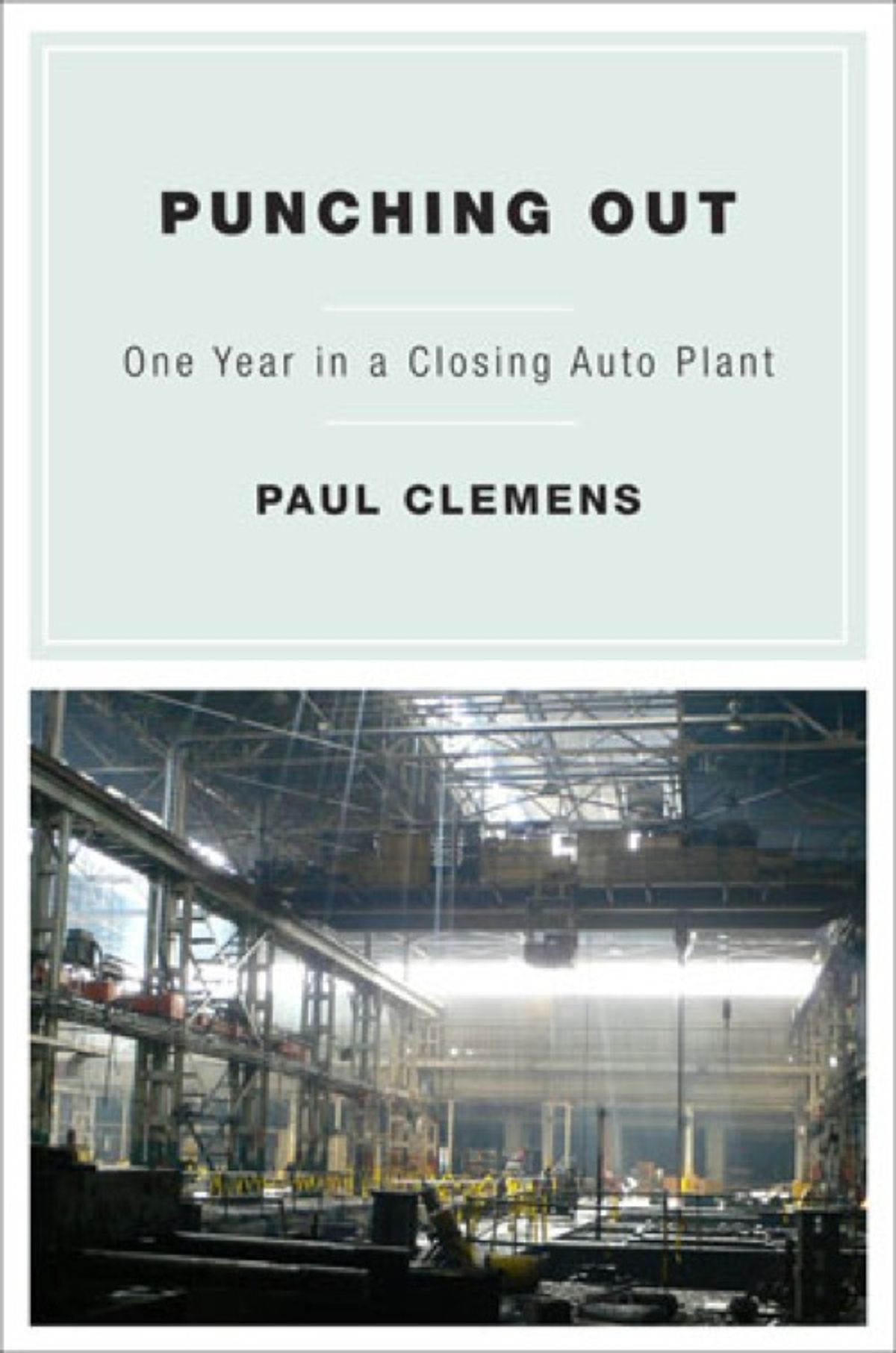
When Marty died, 10 years ago, the city of Detroit was already in bad shape — factories closing, people leaving, abandoned buildings going up in flames each Halloween in a grim festival of urban self-destruction. As it happens, Paul Clemens has given his new book “Punching Out” — which follows the dismantling of a Detroit auto factory — the same title as Marty’s essay from six decades ago. Evidently this is a coincidence; there are no references in the text to suggest otherwise. But either way, the echo is meaningful, for Clemens is writing about the destruction of both a workplace and a social world.
The workplace in question was the Liberty Motors plant of the Budd Co. , one of the oldest factories serving Detroit’s auto industry, opened in 1919. It stamped out the roofs, doors, tailgates and so forth that were then assembled into cars elsewhere. It changed hands in the 1970s and ended up as part of the German steel concern ThyssenKrupp. At its peak, 10,000 people were employed at the plant; by 2006, when it shut down, there were about 350 workers. A typical product of three decades of deindustrialization, then. As Clemens writes, the United States now has “more people dealing cards in casinos than running lathes, and almost three times as many security guards as machinists.”
But “Punching Out” is not a retelling of the story of that decline. Instead, it is an account of what comes afterward — when the workers have been let go, the security guards posted to keep property from being stolen or destroyed, and crews brought in to dismantle the machinery and send it elsewhere (in this case, to Mexico, where a new factory is opening). The author gained access to the inside of the plant — wandering around its “eighty-six empty acres in the center of the city of Detroit” — during the long months it took to break it down. The executives of the ThyssenKrupp corporation weren’t helpful, but he became friendly with the guys doing the work, and his narrative is a blend of impressions from talking to them and what he could learn about the place from poking around in the ruins.
At times, “Punching Out” feels like a book in search of a thesis to pull it together, and Clemens admits as much. He is keen to avoid indulging in melancholy prose-poetry or cheap philosophizing about the “creative destruction” of postindustrial society. The real vigor of the book comes from its character sketches of the men who shrug off the label “vultures” as they go about their jobs.
In my friend Marty’s day, the factories ran constantly. You’d “punch out” at the end of a shift, but somebody else was walking in. Clemens calls his book the story of “the American working class mopping up after itself.” And then the lights go out. Nowadays what’s open all the time is the casino, where nothing is made, and scarcely anyone leaves as a winner.
Editor’s note: Marty Glaberman’s essay “Punching Out” is collected in this volume.
Scott McLemee, a contributing editor at Lingua Franca, writes regularly for Salon. More Scott McLemee.
Films in Progress: Detropia
Oscar-nominated directors are seeking help to release their new film independently. Check out this exclusive clip
No city has experienced the highs and lows of capitalism like Detroit. So what does it mean to the country when the most epic of epicenters of American industrial might falls to its knees? And can it rise again? “Detropia” is a haunting portrait of a city on the brink of collapse, told by a chorus of weary but optimistic citizens who have no plans to join the hundreds of thousands who have already defected for easier corners of the country. “Detropia,” which won the editing award at the 2012 Sundance Film Festival, will make its way into movie theaters this fall … with your help. Dissatisfied with the limitations of traditional distributors, award-winning filmmakers Heidi Ewing and Rachel Grady have launched their first-ever Kickstarter campaign to raise distribution funds to take the film far and wide in the fall.
Continue Reading CloseMitt Romney driving uphill in Michigan
Another month of great numbers for car-makers exposes Romney's failed message on interventionism
A Chrysler dealership in San Jose, Calif. (Credit: AP/Paul Sakuma) Dueling pundits, start your engines: The auto industry kicked off 2012 with a turbo-powered roar, and Democrats won’t wait long to make hay out of the impressive numbers. The question of the day: How will the GOP respond to one of the most successful displays of forceful government intervention in the economy the U.S. has witnessed in decades?
The numbers are hard to argue with: After the major automakers released their January sales figures, Autodata Corp. estimated cars raced out of lots at an annualized sales rate of 14.18 million vehicles for 2012. That’s the best month of sales — excluding August 2009′s Cash-for-Clunkers — since April 2008. GDP forecasters are likely rejiggering their first-quarter estimates even now.
Continue Reading Close
Andrew Leonard is a staff writer at Salon. On Twitter, @koxinga21. More Andrew Leonard.
How Ford built the ultimate lemon
A look at the design and promotion that went into the company's biggest flop: the Edsel

The purpose of this piece is less about the actual history of the Edsel and more about the design and promotion of the car. I’ve always thought that it was one of the most outrageous looking automobiles to ever roll off an assembly line, and the name “Edsel” (Henry Ford’s son) hardly does a lyrical dance off one’s lips… What also intrigues me is how much money and effort was spent on the beast and how terribly wrong everything seemed to go. To help put things in perspective, I’ve included a good postmortem analysis from a 1959 article in Business Week below.
“Revenge of the Electric Car”: Why the automakers went green
Former gadfly Chris Paine goes inside the car industry for the cutthroat drama of "Revenge of the Electric Car"
Never let it be said that activist documentaries don’t make a difference, even if the difference they make is never predictable. Filmmaker Chris Paine began as a gadfly outsider to the auto industry, capturing a distinctive strain of eco-grass-roots rage in his 2006 “Who Killed the Electric Car?,” which explored the short and unhappy life of the EV1, General Motors’ late-’90s all-electric vehicle. By 2004, G.M. had reclaimed and destroyed virtually all the EV1′s it had manufactured — they were leased to consumers, rather than sold — and the plug-in automobile, a long-cherished dream of environmentalists, seemed permanently entombed under parking lots full of Hummers and Escalades.
Continue Reading CloseToyota Venza’s anti-hipster commercials
After years of trying to sell us cars to make us feel younger, advertisers are trying to turn old into the new cool
Who wants to be a cool kid? Car commercials typically come in two types: those marketed to “family adults” and those marketed to “mid-life crisis adults.” The first type of commercial will usually show a mother and father smoothly careening down a country road in their SUV, their 2.5 kids placid and safe in the backseat. Maybe they end up on a beach and take out their surfboards? Or at home, climbing out of their four-door Sedan. And the tagline will be something along the lines of “Life is full of surprises. Your car shouldn’t be one of them.”
Continue Reading CloseDrew Grant is a staff writer for Salon. Follow her on Twitter at @videodrew. More Drew Grant.
Page 1 of 20 in Auto Industry


