As the events in Egypt unfold in real time, figuring out the timeline of the unrest becomes challenge. We hope this is helpful.
A timeline of major events that have occurred since the protests began:
Monday, January 24:
A number of activist groups, most of them centered around youth, use the internet to organize a day of protests in Egypt (The Gaurdian)
Tuesday, January 25:
Thousands of demonstrators begin protesting in Cairo while police respond with water cannons and batons (Huffington Post)
Thursday, January 27:
Mohamed ElBareidi, the Nobel Prize-winning reform advocate, returns to Egypt, energizing protestors who see him as a leader and possible successor to Mubarak (CBC News)
Friday, January 28:
Egyptian government disables social networking sites in an attempt to quash organization (One World See)
In response to protesters' planned “Day of Anger” Mubarak enlists the Egyptian army to keep order and demands a curfew from 6 PM to 7 AM that is roundly ignored as protests swell to the largest numbers yet (Al-Jazeera)
Mubarak makes his first public appearance since the protests began, promising reform and dismissing his cabinet, but making no indication that he will step down (VOA News)
Sunday, January 30:
After providing constant coverage of the protests, the Cairo branch of Al-Jazeera is shut down and the news organizations license to broadcast in the state is revoked (WorldScreen)
Mubarak appoints intelligence chief Omar Suleiman to be his Vice President, the first time he has one during his 30 year reign (Sky News)
Monday, January 31:
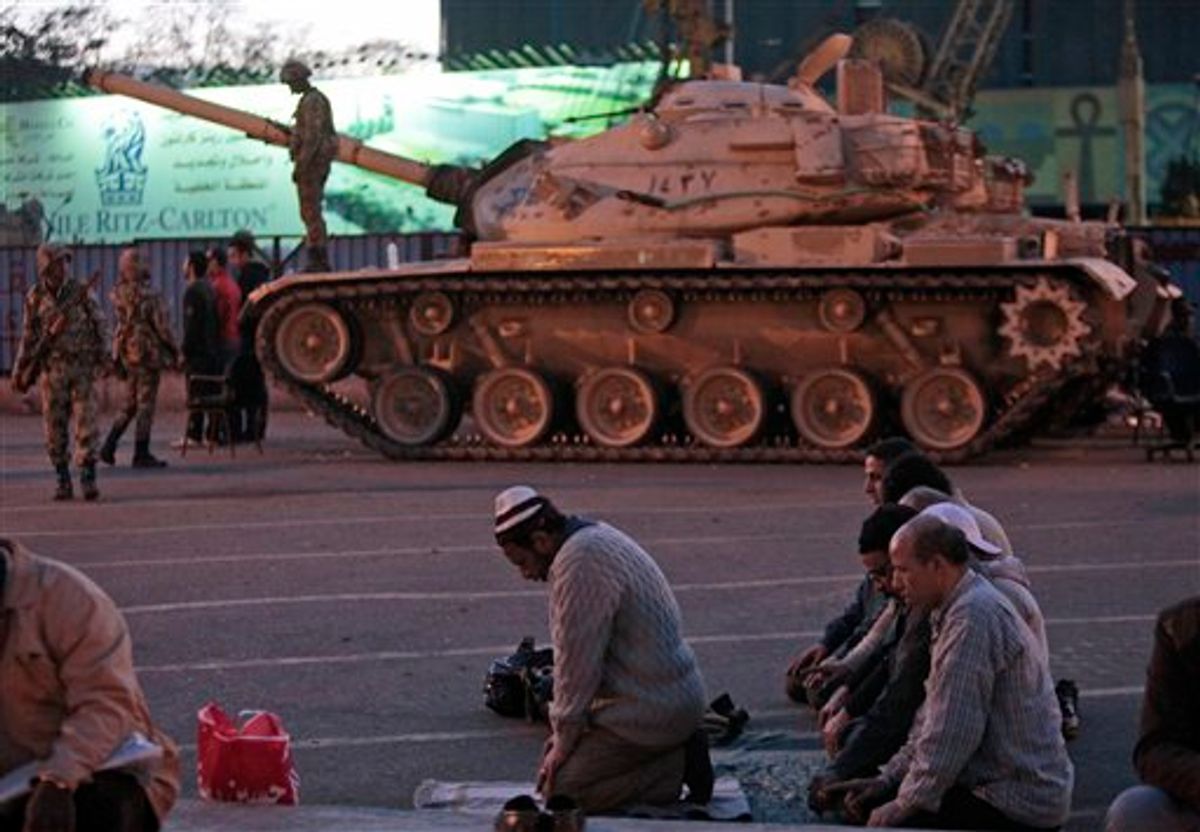
Egyptian army says that because its job is to secure the peace of its citizens it will not harm the protesters (New York Times)
Tuesday, February 1:
Mubarak announces on television that he will not seek reelection and will push forward constitutional reforms, but protesters aren't satisfied, demanding instead his immediate resignation (Wall Street Journal)
Wednesday, February 2:
Fighting breaks out as pro-government groups attack the protestors. These groups appear to be professionally organized and some are carrying police identification. The army stands by and puts out fires as they are ignited by molotov cocktails (New York Times)
Thursday, February 3:
The Muslim Brotherhood releases a statement to Al Jazeera saying "We demand that this regime is overthrown and we demand the formation of a national unity government for all the factions." (Reuters)
When did Hosni Mubarak emerge in Egypt as a force of oppression?
- After the assassination of Anwar El-Sadat brought Mubarak to power in 1981, he immediately imposed a state of Emergency Law to restore order in Egypt. He has never lifted the state, claiming doing so would leave Egypt vulnerable to the Muslim Brotherhood (STL Today)
- The Egyptian population withdrew their support for Mubarak in the late 90s when Egyptian dominance in the Middle East began to fall off (NPR)
When will the protests end?
- At this point it's anybody's guess, protesters are showing no sign of wearing down (VOA News)
- The formal entry of the Muslim Brotherhood into the protests has in fact strengthened the resolve of the protesters -- most of whom are younger and less organized (Associated Press)
- World leaders have been wishy-washy about Egypt, calling for a peaceful transition to Democracy, indicating they have no clear prediction on what is going to happen (Metro)
Shares