
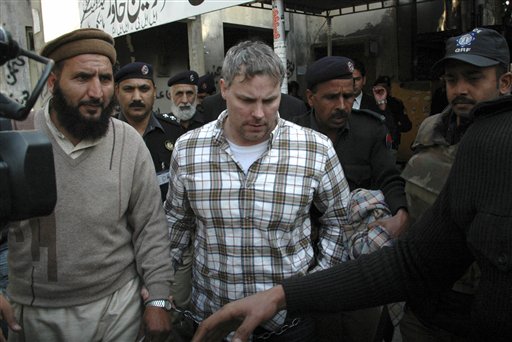

(updated below – Update II – Update III [Tues.] – Update IV [Tues.])
Earlier today, I wrote in detail about new developments in the case of Raymond Davis, the former Special Forces soldier who shot and killed two Pakistanis on January 27, sparking a diplomatic conflict between the U.S. (which is demanding that he be released on the ground of ”diplomatic immunity”) and Pakistan (whose population is demanding justice and insisting that he was no “diplomat”). But I want to flag this new story separately because it’s really quite amazing and revealing.
Yesterday, as I noted earlier, The Guardian reported that Davis — despite Obama’s description of him as “our diplomat in Pakistan” — actually works for the CIA, and further noted that Pakistani officials believe he worked with Blackwater. When reporting that, The Guardian noted that many American media outlets had learned of this fact but deliberately concealed it — because the U.S. Government told them to: ”A number of US media outlets learned about Davis’s CIA role but have kept it under wraps at the request of the Obama administration.”
Now it turns out that The New York Times — by its own shameless admission — was one of those self-censoring, obedient media outlets. Now that The Guardian published its story last night, the NYT just now published a lengthy article detailing Davis’ work — headlined: ”American Held in Pakistan Shootings Worked With the C.I.A.” — and provides a few more details:
The American arrested in Pakistan after shooting two men at a crowded traffic stop was part of a covert, C.I.A.-led team of operatives conducting surveillance on militant groups deep inside the country, according to American government officials. . . . Mr. Davis has worked for years as a C.I.A. contractor, including time at Blackwater Worldwide, the controversial private security firm (now called Xe) that Pakistanis have long viewed as symbolizing a culture of American gun slinging overseas.
But what’s most significant is the paper’s explanation for why they’re sharing this information with their readers only now:
The New York Times had agreed to temporarily withhold information about Mr. Davis’s ties to the agency at the request of the Obama administration, which argued that disclosure of his specific job would put his life at risk. Several foreign news organizations have disclosed some aspects of Mr. Davis’s work with the C.I.A.. On Monday, American officials lifted their request to withhold publication, though George Little, a C.I.A. spokesman, declined any further comment.
In other words, the NYT knew about Davis’ work for the CIA (and Blackwater) but concealed it because the U.S. Government told it to. Now that The Guardian and other foreign papers reported it, the U.S. Government gave permission to the NYT to report this, so now that they have government license, they do so — only after it’s already been reported by other newspapers which don’t take orders from the U.S. Government.
It’s one thing for a newspaper to withhold information because they believe its disclosure would endanger lives. But here, the U.S. Government has spent weeks making public statements that were misleading in the extreme — Obama’s calling Davis “our diplomat in Pakistan” — while the NYT deliberately concealed facts undermining those government claims because government officials told them to do so. That’s called being an active enabler of government propaganda. While working for the CIA doesn’t preclude holding “diplomatic immunity,” it’s certainly relevant to the dispute between the two countries and the picture being painted by Obama officials. Moreover, since there is no declared war in Pakistan, this incident — as the NYT puts it today — “inadvertently pulled back the curtain on a web of covert American operations inside Pakistan, part of a secret war run by the C.I.A. ” That alone makes Davis’ work not just newsworthy, but crucial.
Worse still, the NYT has repeatedly disseminated U.S. Government claims — and even offered its own misleading descriptions –without bothering to include these highly relevant facts. See, for instance, its February 12 report (“The State Department has repeatedly said that he is protected by diplomatic immunity under the Vienna Convention and must be released immediately”); this February 8 article (referring to “the mystery about what Mr. Davis was doing with this inventory of gadgets“; noting ”the Pakistani press, dwelling on the items in Mr. Davis’s possession and his various identity cards, has been filled with speculation about his specific duties, which American officials would not discuss“; and claiming: ”Mr. Davis’s jobs have been loosely defined by American officials as ‘security’ or ‘technical,’ though his duties were known only to his immediate superiors“); and this February 15 report (passing on the demands of Obama and Sen. John Kerry for Davis’ release as a “diplomat” without mentioning his CIA work). They’re inserting into their stories misleading government claims, and condescendingly summarizing Pakistani “speculation” about Davis’ work, all while knowing the truth but not reporting it.
Following the dictates of the U.S. Government for what they can and cannot publish is, of course, anything but new for the New York Times. In his lengthy recent article on WikiLeaks and Julian Assange, NYT Executive Editor Bill Keller tried to show how independent his newspaper is by boasting that they published their story of the Bush NSA program even though he has “vivid memories of sitting in the Oval Office as President George W. Bush tried to persuade [him] and the paper’s publisher to withhold the eavesdropping story”; Keller neglected to mention that the paper learned about the illegal program in mid-2004, but followed Bush’s orders to conceal it from the public for over a year — until after Bush was safely re-elected.
And recently in a BBC interview, Keller boasted that — unlike WikiLeaks — the Paper of Record had earned the praise of the U.S. Government for withholding materials which the Obama administration wanted withheld, causing Keller’s fellow guest — former British Ambassador to the U.N. Carne Ross — to exclaim: ”It’s extraordinary that the New York Times is clearing what it says about this with the U.S. Government.” The BBC host could also barely hide his shock and contempt at Keller’s proud admission:
HOST (incredulously): Just to be clear, Bill Keller, are you saying that you sort of go to the Government in advance and say: “What about this, that and the other, is it all right to do this and all right to do that,” and you get clearance, then?
Obviously, that’s exactly what The New York Times does. Allowing the U.S. Government to run around affirmatively depicting Davis as some sort of Holbrooke-like “diplomat” — all while the paper uncritically prints those claims and yet conceals highly relevant information about Davis because the Obama administration told it to — would be humiliating for any outlet devoted to adversarial journalism to have to admit. But it will have no such effect on The New York Times. With some noble exceptions, loyally serving government dictates is, like so many American establishment media outlets, what they do; it’s their function: hence the name “establishment media.”
UPDATE: From a few people in comments (and via email), there are several objections/dissents to some of the arguments here. My responses to them are here.
UPDATE II: At his news conference last week, this is what President Obama said about the Davis situation:
With respect to Mr. Davis, our diplomat in Pakistan, we’ve got a very simple principle here that every country in the world that is party to the Vienna Convention on Diplomatic Relations has upheld in the past and should uphold in the future. And that is if — if our diplomats are in another country, then they are not subject to that country’s local prosecution.
This is how the New York Times characterized that statement: ”Without describing Mr. Davis’s mission or intelligence affiliation, President Obama last week made a public plea for his release.”
It’s one thing for a newspaper to withhold information because it genuinely believes its publication will endanger lives (and I’d love to hear the explanation about why this would). But this situation goes far beyond that. The NYT was regularly printing government claims like the one above (“our diplomat in Pakistan”) which were at best misleading and likely false, and also including their own misleading claims in these stories (“the mystery about what Mr. Davis was doing with this inventory of gadgets”). But they had information in their possession — and concealed it — which undermined (if not entirely negated) the truth of these statements.
There’s a big difference between simply withholding information to protect lives and actively enabling and publishing misleading propaganda. More to the point, there is simply no justification — none — for a newspaper to allow government officials to run around misleading the public, and to print those misleading statements, all while concealing information (at the Government’s request) which reveal those claims to be factually dubious.
UPDATE III: About my argument here, NYU Journalism Professor Jay Rosen writes:
 Rosen has repeatedly made the insightful point that one of WikiLeaks’ most unique attributes is that it is one of the world’s only “stateless” news organizations: meaning it has no nationalistic allegiance to (or physical location in) any particular nation and thus is not subject to (or constrained by) the laws, dictates, or agendas of any government. That “stateless” attribute precludes its concealing newsworthy information in order to accommodate governments to which it is loyal. Relatedly, Rosen — when explaining why WikiLeaks came to exist — recently said this: ”The watchdog press died, and what we have is WikiLeaks instead.” This latest episode nicely illustrates the truth of both of those observations, and underscores why the WikiLeaks model is such a vital antidote to the endlessly cooperative government/media consortium.
UPDATE IV: For Yahoo News!, Michael Calderone examines this controversy, notes that Obama officials made the same arguments to The Guardian about why Davis’ CIA connection should be concealed, and includes this explanation from Guardian editors as to why they nonetheless reported it:
[Guardian Deputy Editor Ian] Katz noted that two senior Pakistan government sources officially confirmed that Davis was a CIA operative and explained in an email why it was relevant to report.
“We believe Davis’s role in Pakistan is unavoidably connected with both the legal case surrounding him and with the U.S. government’s attempts to seek his release,” Katz said. “And since Davis is already widely assumed in Pakistan to have links to U.S. intelligence, we did not accept that disclosing his CIA role would expose him to increased risk.”
Calderone also quotes AP executives as acknowledging that they “found out Davis was working for the CIA ‘immediately after the shootings‘” yet nonetheless concealed that from their readership even as Obama officials ran around making misleading statements about Davis’ work (statements which AP dutifully reported). Whatever that behavior is, it isn’t journalism.
