2010 Census

One in 4 U.S. counties are dying says Census

A record number of communities are experiencing more deaths than births in the United States

  • more
    • All Share Services

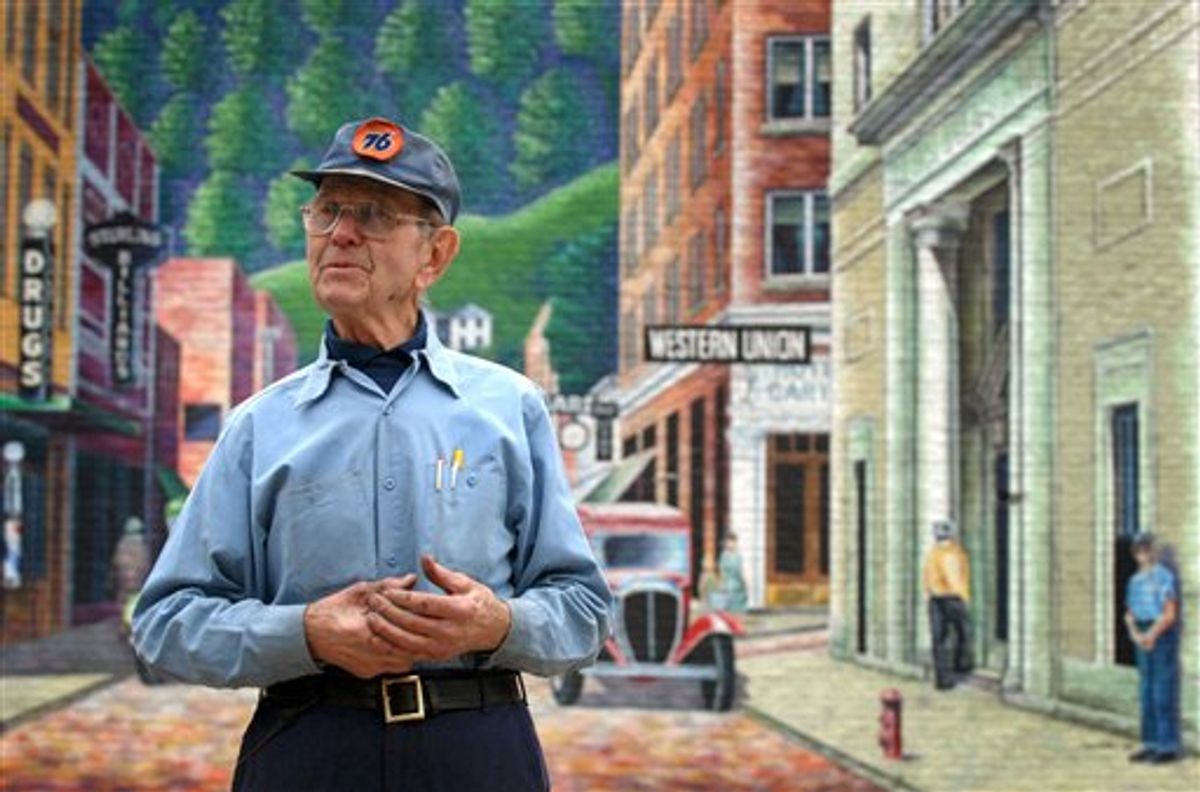
One in 4 U.S. counties are dying says CensusEd Shepard, 87, who runs a full service gas station in Welch, W.Va., is seen in the Feb. 9, 2011, photo. His gas station is the last of the dozen full service stations that used to service the town of Welch. According to the 2010 census, Welch also experienced more deaths than births. Shepard laments a prosperous era gone by when shoppers lined the streets and government lent a helping hand. Now, here as in one-fourth of all U.S. counties, West Virginia's graying residents are slowly dying off. (AP Photo/Jon C. Hancock)(Credit: AP)

Nestled within America’s once-thriving coal country, 87-year-old Ed Shepard laments a prosperous era gone by, when shoppers lined the streets and government lent a helping hand. Now, here as in one-fourth of all U.S. counties, West Virginia’s graying residents are slowly dying off.

Hit by an aging population and a poor economy, a near-record number of U.S. counties are experiencing more deaths than births in their communities, a phenomenon demographers call “natural decrease.”

Years in the making, the problem is spreading amid a prolonged job slump and a push by Republicans in Congress to downsize government and federal spending.

Local businesses in Welch began to shutter after U.S. Steel departed McDowell County, which sits near Interstate 77, once referred to as the “Hillbilly Highway” because it promised a way to jobs in the South. Young adults who manage to attend college — the high-school dropout rate is 28 percent, compared with about 8 percent nationwide — can’t wait to leave. For some reason, the fish in nearby Elkhorn Creek left too.

“There’s no reason for you to come to Welch,” says Shepard, wearing a Union 76 cap at a makeshift auto shop he still runs after six decades. “This is nothing but a damn ghost town in a welfare county.”

——

In all, roughly 760 of the nation’s 3,142 counties are fading away, stretching from industrial areas near Pittsburgh and Cleveland to the vineyards outside San Francisco to the rural areas of east Texas and the Great Plains. Once-booming housing areas, such as retirement communities in Florida, have not been immune.

West Virginia was the first to experience natural decrease statewide over the last decade, with Maine, Pennsylvania and Vermont close to following suit, according to the latest census figures. As a nation, the U.S. population grew by just 9.7 percent since 2000, the lowest decennial rate since the Great Depression.

“Natural decrease is an important but not widely appreciated demographic phenomenon that is reshaping our communities in both rural and urban cores of large metro areas,” said Kenneth Johnson, a sociology professor and demographer at the University of New Hampshire’s Carsey Institute who analyzed the census numbers.

Johnson said common threads among the dying counties are older whites who are no longer having children, and an exodus of young adults who find little promise in the region and seek jobs elsewhere. The places also have fewer Hispanic immigrants, who on average are younger and tend to have more children than other groups.

“The downturn in the U.S. economy is only exacerbating the problem,” said Johnson, whose research paper is being published next month in the journal Rural Sociology. “In some cases, the only thing that can pull an area out is an influx of young Hispanic immigrants or new economic development.”

——

The predicament is starkest in places like Welch. In the 1960s, McDowell County ranked tops in the U.S. in coal production. Even as it began to stumble, President John F. Kennedy took notice and pushed federal aid to the region. McDowell residents were the first to get federal food stamps when they were rolled out in the Kennedy administration.

After U.S. Steel sold the last of its mining operations by 2003, folks in southern West Virginia began counting on new highway projects to prop up the long-struggling area.

“One of the promises we’re waiting to come is the highway,” said Carolyn Falin, an assistant schools superintendent in McDowell County.

From the east, the Coalfields Expressway would bypass the many two-lane, truck-clogged roads zigzagging through the mountainous region. It would link a freeway to the Virginia state line 65 miles to the southwest. So far, only a few miles are open. Design work on most of it hasn’t been finished.

From the west, a 95-mile King Coal Highway is also envisioned, with some bridge work and a few miles now under construction.

Shepard, who walks to work from a nearby apartment, watched the county’s population plummet 80 percent after U.S. Steel’s exit. Even with the recent opening of a federal prison, Shepard bemoans the area’s decline, including the end of “20 years of the best fishing you ever saw.”

Nowadays, he says, “you can fish but you won’t catch any trout. It’s like the coal mines. It’s all gone.”

Recently the U.S. Senate rejected a $900,000 appropriation for a proposed interchange of the King Coal Highway and the Coalfields Expressway near Welch.

——

Dying counties in the U.S. were rare until the 1960s, when the baby boom ended. By 1973, as farming communities declined, roughly 515 counties — mostly in the Great Plains — reported natural decrease. The phenomenon then began to show up in industrial regions, such as upstate New York and California. Natural decrease peaked in 2002 at a record 985, or 1 in 3 counties, before increasing births and an influx of Hispanic immigration helped add to county populations during the housing boom.

Following the recent recession, birth rates have dropped to the lowest in a century. Preliminary census numbers for 2007-09 now show that the number of dying counties is back on the upswing. Recent additions include Pittsburgh and its surrounding counties.

James Follain, senior fellow and economist at the Nelson A. Rockefeller Institute of Government at the University of Albany, said a new kind of declining city may be emerging in the wake of the housing bust — metropolitan areas that rapidly overbuilt earlier in the decade and then suffered massive foreclosures.

He cited as examples Las Vegas, Miami, parts of Arizona, and Stockton, Modesto, Fresno and Riverside in California. Like traditional ghost towns, Follain says, portions of these areas could spiral down from persistent loss of jobs and population and lose their reason for being.

Follain also pointed to a tighter fiscal environment in Washington that will limit help to troubled areas. The Obama administration announced this month it would shrink the government’s role in the mortgage system to reduce taxpayer exposure to risk. House Republicans also are pushing federal spending cuts of more than $61 billion, even if it means reducing jobs.

“It’s going to be a very slow recovery,” Follain said.

——

Not all U.S. areas are declining. Most places with the fastest growth since 2000 were able to retain or attract college graduates and young professionals who came for jobs and later started families. Metro areas with diversified economies such as Austin, Texas, Raleigh, N.C., and Portland, Ore., all saw gains in college graduates; other places seeing gains or reduced losses in young adults, such as Washington, D.C., Boston and San Francisco, have burgeoning biotech industries.

In West Virginia, more than 40 of its 55 counties had natural decrease over the past decade. Yet the state still gained population overall, and averted a loss of a U.S. House of Representatives seat based on the 2010 census.

It wasn’t because of a last-minute turnaround. Most of West Virginia’s population gains are new residents spilling over into the eastern part of the state from the blossoming Washington-Baltimore metropolitan area. The three counties on the Maryland line — Morgan, Berkeley and Jefferson — each had substantial increases.

It’s a different story in West Virginia’s northern panhandle, along the edge of Pennsylvania near Pittsburgh.

On a recent afternoon, a group of students mingled during a cigarette break at West Virginia Northern Community College in Wheeling and chatted about their futures. “It’s not that bad an area,” said Demetrius Paige, 19, but there are “not a lot of jobs.” He plans to leave within six years.

Kayla Murphy, 19, of Moundsville wants to stay in the state and become a nurse to help children like her brother, who has celiac disease and diabetes. She says moving out is the only real option for career-oriented people. They include her boyfriend, who left for Wisconsin to teach history.

“You have to,” Murphy said. “Working at McDonald’s isn’t cool.”

Yen reported from Washington.

O’Donnell, Bachmann, Palin failures point to growing crazy fatigue

Exploitation of liberal-scaring culture war heroines growing less profitable every day

  • more
    • All Share Services

O'Donnell, Bachmann, Palin failures point to growing crazy fatigue

The liberal media will never lose their obsession with the photogenic crazies of the conservative movement, but there are a few hints (enough for a trend piece) that the public at large is getting a bit sick of them. (The outlier is Rick Perry’s poll numbers.)

The Newsweek Michele Bachman cover posted newsstand sales no higher than most other Newsweek covers. The “crazy eyes” cover moved 47,225 copies, according to Newsweek, though AdWeek says other industry sources say it sold somewhere between 35,000 and 48,000. Is that good? Well, “the magazine’s single copy sales averaged 46,561 per issue in the first half of 2011.”

We are talking only about newsstand sales, not total circulation, but this does mean that Bachmann’s incredibly controversial and very buzzy crazy eyes did not “move the needle,” as annoying people say. Of course, the actual article about Bachmann, inside of the eye-grabbing cover, was pretty bland. But since when does the quality of the journalism have anything to do with newsstand sales?

(Ad pages are also down, but that doesn’t have much to do with Bachmann.)

Meanwhile, Christine O’Donnell, the famous non-witch who lost a Senate race after improbably winning a GOP primary, is traveling the country promoting her inevitable book about the time she didn’t win an election. According to Fort Myers News Press (via Wonkette) the tour is not drawing massive crowds, even in conservative Naples, Florida.

Still, O’Donnell took the turnout of five people — members of the media outnumbered customers — at Barnes & Noble in stride.

“God bless you, Tom,” she told Tom Bruzzesi of Fort Myers, who said he’s launching his own presidential campaign.

“I like her,” Bruzzesi said. “She’s kind of a rogue like me.”

“Thank you for coming out today,” O’Donnell said to Louise Campo of Naples. “She interests me. She’s very conservative,” Campo said.

O’Donnell, a Christian, then politely turned down a request from a young man who asked her to sign his book on demonology instead of a copy of her book.

Well, that’ll happen. As Keith Olbermann reported last night, the book as thus far sold 2,200 copies, 1,500 of which went to O’Donnell supporters in Delaware:

This after a publicity blitz that notably included kicking herself off of Piers Morgan’s CNN show. (And now O’Donnell’s been disinvited, again, from a Tea Party Rally that is supposed to feature Sarah Palin.)

All this after Sarah Palin — the barometer of how America is receiving vacuous avatars of cultural resentment masquerading as Republican politicians — saw her much ballyhooed documentary open to weak numbers and quickly end up on DVD.

The last use any of these people have is as boogeymen with which to terrify liberals.

(Except for Rick Perry. That crazy corrupt jerk could end up president if we’re not careful.)

Continue Reading Close
Alex Pareene

Alex Pareene writes about politics for Salon and is the author of "The Rude Guide to Mitt." Email him at apareene@salon.com and follow him on Twitter @pareene

Sad Tea Party freshman hates his stupid new job

Rep. Steve Southerland wishes he'd never gotten elected to Congress -- he only makes six figures!

  • more
    • All Share Services

Sad Tea Party freshman hates his stupid new jobRep. Steve Southerland

From Dave Weigel comes the sad tale of Rep. Steve Southerland, a “tea party” freshman representing Florida’s 2nd District. Southerland learned the hard way that being a congressman is not all fun and games. He barely earns enough to get by!

He said his $174,000 salary is not so much, considering the hours a member of the House puts in, and that he had to sever ties with his family business in Panama City. Southerland also said there are no instant pensions or free health insurance, as some of his constituents often ask him about in Congress.

Median income in Southerland’s district: $34,718.

(And the health insurance isn’t “free,” but it is high-quality group private insurance with relatively cheap plans subsidized by Southerland’s employer, the federal government. And he’ll qualify for the pension in a couple of years, if he’s reelected.)

He’s also upset that he isn’t allowed to run his family business while serving as a congressman. There was apparently an actual civics teacher in attendance, to laugh at him:

Marty Monroe, a “recovering civics teacher” visiting her parents at Westminster Oaks, was unsympathetic.

“Why didn’t he know that going in, about conflicts of interests? Would you want members to be also running a business on the side?” Monroe said.

And finally, Southerland is upset that people want to hurt him:

“And by the way, did I mention? They’re shooting at us. There is law-enforcement security in this room right now, and why is that?” Southerland told about 125 people in an auditorium at the Westminster Oaks retirement community.

This I do feel bad about. I mean, it must be awful to be surrounded by armed guards because a certain political movement whipped up a nationwide atmosphere of apocalyptic paranoia and deep loathing of the supposedly tyrannical federal government. I really wish we knew which political party had enabled and encouraged that sort of thing! I remember that whichever one it was had a lot of guns and enjoyed showing them off. (Was it the League of Women Voters?)

So, all in all, seems like this Southerland guy hates his stupid job, being a congressman.

Setup: “If you think this job pays too much, with those kinds of risks and cutting me off from my family business, I’ll just tell you: This job don’t mean that much to me. I had a good life in Panama City.”

Punch line: “He’s running for a second term”

Continue Reading Close
Alex Pareene

Alex Pareene writes about politics for Salon and is the author of "The Rude Guide to Mitt." Email him at apareene@salon.com and follow him on Twitter @pareene

Detroit’s population plummets 25 percent in a decade

City's recorded a net loss of 65 inhabitants per day in the past decade, according to Census data

  • more
    • All Share Services

Detroit's population plummets 25 percent in a decade

New census data shows that Detroit’s population dropped 25 percent in the last decade, with the city losing more than 237,000 people. That figure translates into a exodus of 65 residents per day over 10 years, according to The Detroit News

A significant drop was expected, but U.S. Census Bureau statistics released Tuesday caught some experts off-guard.

The data shows Detroit’s population fell from 951,270 in 2000, to 713,777 in 2010. State demographer Ken Darga says that’s “considerably lower” than the Census Bureau estimate released last year.

The data reflects the exodus of city residents to the suburbs and the auto industry’s steady decline. The Motor City’s population peaked at 1.8 million in 1950, when it ranked fifth nationally.

Gov. Rick Snyder says the numbers “clearly show how crucial it is to reinvent Michigan” and that the state can no longer “cling to the old ways of doing business.”

Census shows population center moving out of Midwest

U.S. census shows growing populations in the West and South, which could shift the heartland out of the Midwest

  • more
    • All Share Services

Census shows population center moving out of MidwestEd Shepard, 87, who runs a full service gas station in Welch, W.Va., is seen in the Feb. 9, 2011, photo. His gas station is the last of the dozen full service stations that used to service the town of Welch. According to the 2010 census, Welch also experienced more deaths than births. Shepard laments a prosperous era gone by when shoppers lined the streets and government lent a helping hand. Now, here as in one-fourth of all U.S. counties, West Virginia's graying residents are slowly dying off. (AP Photo/Jon C. Hancock)(Credit: AP)

America’s population center is edging away from the Midwest, pulled by Hispanic growth in the Southwest, according to census figures. The historic shift is changing the nation’s politics and even the traditional notion of the country’s heartland — long the symbol of mainstream American beliefs and culture.

The West is now home to the four fastest-growing states — Nevada, Arizona, Utah and Idaho — and has surpassed the Midwest in population, according to 2010 figures. California and Texas added to the southwestern population tilt, making up more than one-fourth of the nation’s total gains since 2000.

When the Census Bureau announces a new mean center of population next month, geographers believe it will be placed in or around Texas County, Mo., southwest of the present location in Phelps County, Mo. That would put it on a path to leave the region by midcentury.

“The geography is clearly shifting, with the West beginning to emerge as America’s new heartland,” said Robert Lang, a sociology professor at the University of Nevada-Las Vegas who regularly crunches data to determine the nation’s center. “It’s a pace-setting region that is dominant in population growth but also as a swing point in American politics.”

The last time the U.S. center fell outside the Midwest was 1850, in the eastern territory now known as West Virginia. Its later move to the Midwest bolstered the region as the nation’s cultural heartland in the 20th century, central to U.S. farming and Rust Belt manufacturing sites.

In the 1960s, “Will it play in Peoria?” was a common phrase that coincided with the U.S. center’s location in Illinois. It was a measure of whether a politician or consumer product could appeal to mainstream Americans with traits associated with Midwesterners, such as stability and caution.

But over the last decade, the Phoenix suburb of Peoria, Ariz., soared past its namesake Peoria, Ill., in population size. Democrat Barack Obama in 2008 successfully made the Republican-leaning Mountain West a key component to winning elections, with Colorado, Nevada and New Mexico now considered swing states.

With Arizona on track to surpass Ohio in electoral votes by midcentury, based on projected growth, issues important to the West, such as Arizona’s sharp debate over immigration, gain in political significance.

The Census Bureau calculates the mean U.S. center every 10 years based on its national head count. The center represents the middle point of the nation’s population distribution — the geographic point at which the country would balance if each of its 308.7 million residents weighed the same.

The latest 2010 figures show a loss of House seats for states including Missouri and some of those east of it, primarily in the Midwest’s declining Rust Belt. Eight of the 12 pickups in House seats occur in states west of Missouri, with Florida (with 2 new seats), Georgia and South Carolina in the Southeast being the exceptions.

The fastest U.S. growth is occurring in the Mountain West, which includes Arizona, Colorado, Idaho, Montana, Nevada, New Mexico, Utah and Wyoming. As California’s growth slows, many of the Mountain state arrivals are Hispanic immigrants seeking jobs and affordable family living. Hispanics tend to lean Democratic when voting.

Among census findings:

–In Arizona, which gains a House seat, Hispanics accounted for roughly half of the state’s population increase since 2000, according to census estimates. Arizona has picked up at least one House seat every decade since 1950; its total seats could outnumber Ohio’s as early as 2040 — so long as anti-immigration sentiment and recent mortgage foreclosures don’t curtail its long-term growth.

–In seven of the eight Mountain states, Hispanics accounted for nearly 50 percent or more of the population gains among children under 18. Montana, which had a population loss of children, was the exception.

–The Western U.S. grew 13.8 percent from 2000 to 71.9 million people, surpassing the Midwest as the second most populous region. The Midwest rose 3.9 percent and the Northeast gained 3.2 percent. The West’s growth rate is nearly equal to the South’s, which rose 14.3 percent to 114.6 million on the Sun Belt strength of Texas and Florida.

–California, which failed to add a House seat for the first time in its history, would have lost population if it weren’t for growth among Hispanics and other minorities, according to 2010 figures released Tuesday. Los Angeles posted a gain over the past decade of just under 100,000 people, its smallest numerical growth since 1890-1900, as many of its Hispanic residents moved elsewhere. The state, the nation’s largest with 37.3 million, continues to grow primarily from immigration and births.

“Instead of serving as the migration magnet of the West, California has become the anchor for an expanding Western region,” said William Frey, a demographer at Brookings Institution who reviewed the census numbers. “The old phrase, ‘Go West, young man’ has now turned to ‘Eastward ho’ for California’s young residents, recent immigrants and retirees as they spill into neighboring states. It may never again gain another congressional seat.”

Historically, the first center of population in 1790 resided in Kent County, Md., 23 miles east of Baltimore, the fulcrum between Pennsylvania and New York in the North and slave states in the South. It moved west through West Virginia amid the rise of steamboat travel and development of the nation’s first railroads in the 1820s.

The U.S. center stayed put in Indiana from 1890-1940, largely stalled by a wave of European immigrants to the Northeast and then the Great Depression. It made big strides in Illinois in the 1950s as California boomed and Alaska and Hawaii gained statehood, before taking on a southwesterly path.

Missouri has been at the U.S. center since 1980.

State officials are tentatively planning for a commemorative marker in Texas County or its vicinity. Texas County boasts 26,000 residents, with whites making up 92 percent of the population, compared with roughly 65 percent for the country. Blacks make up 3.3 percent and Hispanics 1.6 percent.

“I think it’s appropriate that people in the county get some recognition,” said Brad Gentry, 48, of Houston, Mo., who publishes the weekly paper in Texas County. “It’s primarily agriculture, and we have a lot of retirees. Despite a high rate of poverty, people are resilient and make things work — even if they are pretty disillusioned by the political process that has bogged down Washington.”

——

Online:

Census website: http://www.census.gov

Continue Reading Close

Five House members who should be reapportioned away

With a number of states set to lose seats following the Census, here's a look at who should go

  • more
    • All Share Services

Five House members who should be reapportioned awayRep. Jean Schmidt, Rep. Aaron Schock and Rep. Steve King.

Today, the U.S. Census Bureau will deliver its report to the president, and we’ll learn which states will gain and lose U.S. House seats and electoral votes. The news is expected to be bad for Democrats, even before the redistricting wars begin.*

But even if Barack Obama loses a couple of electoral votes, we could still try to make the best of a bad situation. Let’s look at the states that are destined to lose a congressional seat or two, and fantasize about which current representatives we’d most like to see apportioned into retirement.

First, Minnesota will not lose a district, so Michele Bachmann is safe. Sorry!

1. Steve King, R-Iowa

Iowa is projected to lose one seat, and while that won’t affect its stranglehold on the presidential nomination process, it might rid America of the one Iowa export even more offensive to thinking people than ethanol fuel. Steve King, proven by science to be the craziest congressman in the House, represents a sparsely populated but incredibly Republican district. No one would really miss the guy who was the sole vote against a plaque honoring the slaves who built the Capitol, right?

2 Jean Schmidt, R-Ohio

While it’s tempting to wish for John Boehner to go crying into that good night, Jean Schmidt is a complete nightmare of a person. Whether she’s discussing abortion with 6-year-olds, calling Jack Murtha a coward, or whispering sweet nothings to birthers, Jean Schmidt is easily Ohio’s worst representative. But Ohio’s losing two seats, so Boehner can go, too.

3. Aaron Schock, R-Ill.

Schock is America’s hottest and youngest member of Congress, and boy does this guy love to torture people! (We’d also be fine with losing idiot climate change denialist John Shimkus.)

4. Charles Boustany, R-La.

Louisiana’s set to lose a seat, and while no one in its delegation is even close to Steve King-level bad, Charles Boustany is on the record questioning whether the president was born in the United States. (He later retracted his statement. So he can get a pass and they can take Steve Scalise instead.)

5. Anthony Weiner, D-N.Y.

New York’s set to lose two seats. Peter King’s probably safe, so let’s just go with what would be the funniest outcome: a loss for ambitious attention-addict Anthony Weiner.

*(And the deck is already stacked against them. While the House is vastly more small-d democratic than the Senate, limits on its size and the fact that districts are generally designed to be “relatively compact” and “contiguous” means the system is broadly unfriendly to Democrats, who tend to cluster in urban areas and produce incredibly “safe” seats, while Republicans spread out and produce many more less-homogeneous but mostly Republican districts.)

Continue Reading Close
Alex Pareene

Alex Pareene writes about politics for Salon and is the author of "The Rude Guide to Mitt." Email him at apareene@salon.com and follow him on Twitter @pareene

Page 1 of 4 in 2010 Census