Salon Home
Topic

Budget Showdown

Wednesday, Mar 2, 2011 4:51 PM UTC2011-03-02T16:51:00Zl, M j, Y g:i A T

Where was Obama in Round 1 of the budget fight?

As a two-week spending bill sailed through Congress, the White House hardly made a move. That must change

Barack Obama

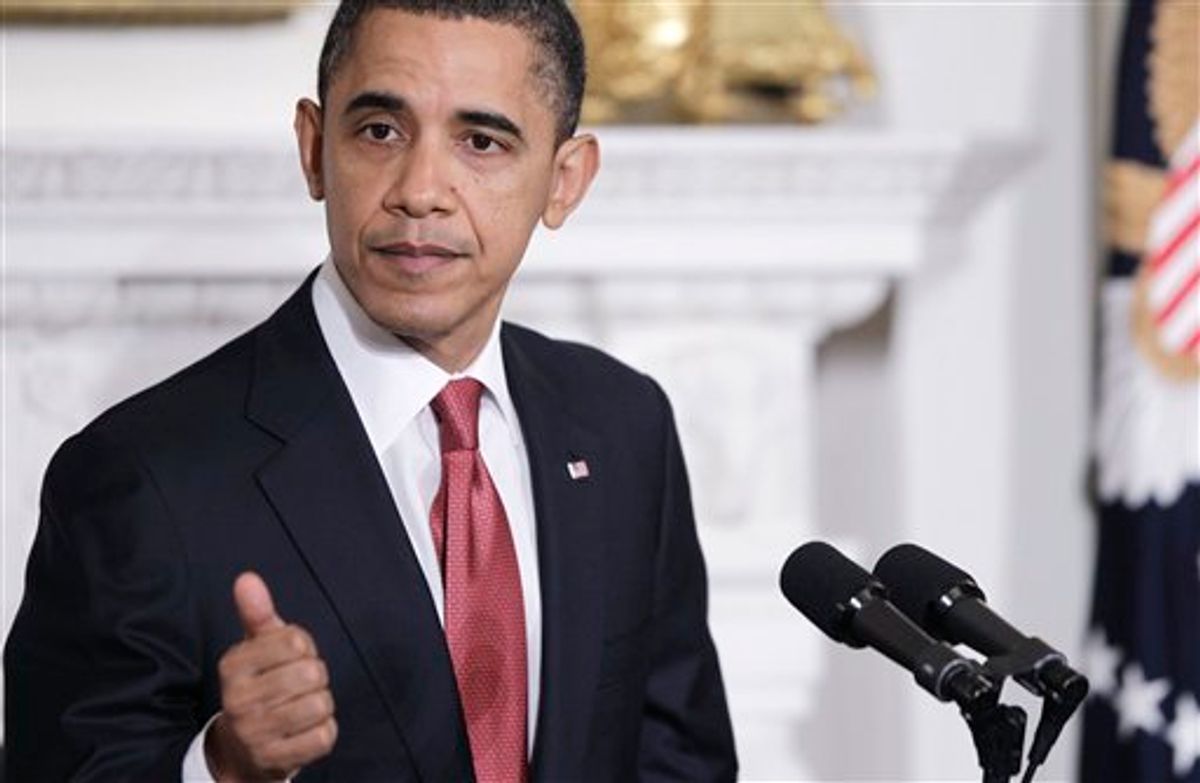
President Barack Obama speaks during a bi-partisan meeting of governors in the State Dining Room of the White House in Washington, Monday, Feb. 28, 2011. (AP Photo/Charles Dharapak) (Credit: AP)

With broad Democratic support, the House overwhelming passed a two-week stopgap spending plan cutting $4 billion from the federal budget. The Senate overwhelmingly passed the measure Wednesday morning, 91-9, and there are no signs that the White House plans to object.

On Monday, before either the House or Senate had voted, Politico’s Jonathan Allen had already declared Republicans the victors in Round 1 of the budget fight.

Democrats threw in the towel Friday, just two days after delivering a chest-thumping rejection of the GOP plan to forestall a government shutdown for two weeks.

In doing so, they handed Republicans a technical knockout in the first in a series of epic budget fights. Democrats agreed to $4 billion in cuts over the first two weeks in March, a concession that may give Republicans the upper hand for the time being as the two sides try to agree on the rest of the fiscal 2011 budget and the fiscal 2012 budget and to avoid a government default that would be more serious than a short-term shutdown.

Continue Reading
Andrew Leonard

Andrew Leonard is a staff writer at Salon. On Twitter, @koxinga21.  More Andrew Leonard

Wednesday, Feb 15, 2012 8:27 PM UTC2012-02-15T20:27:00Zl, M j, Y g:i A T

House Republicans lose their will to fight

The GOP's readiness to cut a payroll tax deal reveals a political party in retreat

Eric Cantor and John Boehner

Eric Cantor and John Boehner  (Credit: AP/Charles Dharapak)

Have House Republicans lost their mojo? That’s the first conclusion that jumps to mind when attempting to read the tea leaves of the current negotiations over extending the payroll tax cut. On Tuesday, the most popular word used to describe the House GOP’s purported decision to abandon requiring spending cuts to offset the cost of another extension of the payroll tax cut was “cave.”

Ouch. A full two weeks before the ultimate deadline, Republicans are already willing to cut a deal that will add another $100 billion to the deficit. It wasn’t so long ago that these same Republicans were playing last-second brinksmanship while threatening to shut down the federal government in fervent protest of Big Government. Since when did the Tea Party become so meek?

Continue Reading
Andrew Leonard

Andrew Leonard is a staff writer at Salon. On Twitter, @koxinga21.  More Andrew Leonard

Wednesday, Dec 14, 2011 7:08 PM UTC2011-12-14T19:08:00Zl, M j, Y g:i A T

Obama’s unwinnable payroll tax cut fight

The president's political position is strong, but Democrats still have to cut a deal that won't be pretty

President Obama

President Obama  (Credit: AP/Carolyn Kaster)

With barely more than two weeks left to go in 2012, it is only fitting that Congressional Republicans and Democrats are once again engaged in doing what they do best: playing politics with the economy. The current fight over extending a payroll tax cut and unemployment benefits is just one more installment in the nation’s least favorite reality TV show: Partisan Gridlock.

Both sides more or less agree that it would be a bad idea to raise taxes and cut benefits during a weak economy — the question is what kind of pound of flesh will be extracted in exchange for a deal. Democrats want to pay for the extensions by taxing millionaires. Republicans want to pay for the measures by scooping money out of Obama’s priorities, such as health care reform, while pursuing their own agenda — gutting EPA regulations, getting the Keystone XL pipeline built, making it harder for poor women in Washington D.C. to get an abortion.

Continue Reading
Andrew Leonard

Andrew Leonard is a staff writer at Salon. On Twitter, @koxinga21.  More Andrew Leonard

Tuesday, Nov 22, 2011 6:13 PM UTC2011-11-22T18:13:00Zl, M j, Y g:i A T

The economic price of the supercommittee fail

The interests of the wealthy are protected again, at the expense of economic growth

Mervin Sealy from Hickory, North Carolina, takes part in a protest rally outside the Capitol Building in Washington, October 5, 2011.

Mervin Sealy from Hickory, North Carolina, takes part in a protest rally outside the Capitol Building in Washington, October 5, 2011.  (Credit: Jason Reed / Reuters)

On Monday, the Dow Jones industrial average fell 300 points, a plunge immediately blamed on the supercommittee’s failure to agree on a debt reduction deal. If this is true, investors were displaying a remarkable lack of attention to current events. Is there anyone on Wall Street or in Washington, D.C., or anywhere else who expected the supercommittee to succeed? Failure should already have been “priced in” by the markets. As anticlimaxes go, the only surprising thing about the supercommittee’s impotence is that anyone was surprised by it.

Continue Reading
Andrew Leonard

Andrew Leonard is a staff writer at Salon. On Twitter, @koxinga21.  More Andrew Leonard

Friday, Sep 23, 2011 7:21 PM UTC2011-09-23T19:21:00Zl, M j, Y g:i A T

Senate blocks House disaster aid bill

Relief legislation voted down after House Republicans passed offset-heavy version yesterday

Harry Reid

Senate Majority Leader Harry Reid of Nev. gestures during a news conference on Capitol Hill in Washington on Thursday, Sept. 22, 2011, to discuss FEMA funding and the Continuing Resolution to fund the government. (AP Photo/Harry Hamburg) (Credit: AP/Harry Hamburg)

The Democratic-led Senate blocked a House-passed bill on Friday that would provide disaster aid and keep government agencies open, escalating the parties’ latest showdown over spending and highlighting the raw partisan rift that has festered all year.

In a tit-for-tat battle, the Senate first used a near party-line vote of 59-36 to derail the measure from the Republican-run House. The House bill would fund federal agencies and provide $3.7 billion in disaster assistance, partly paying for that aid with cuts in two loan programs that finance technological development.

Continue Reading

  More Alan Fram

Friday, Sep 23, 2011 12:19 PM UTC2011-09-23T12:19:00Zl, M j, Y g:i A T

House passes disaster aid, but Senate Dems object

Bill adds more offsets to secure Republican passage, all but guaranteeing death in Senate

Harry Reid

Senate Majority Leader Harry Reid of Nev. gestures during a news conference on Capitol Hill in Washington on Thursday, Sept. 22, 2011, to discuss FEMA funding and the Continuing Resolution to fund the government. (AP Photo/Harry Hamburg) (Credit: AP)

With the economy sputtering, the warring factions of Congress have lurched toward gridlock over the usually noncontroversial process of approving disaster aid and keeping the government from shutting down.

The GOP-dominated House early Friday muscled through a $3.7 billion disaster aid measure along with a stopgap spending bill to keep the government running past next Friday. The narrow 219-203 tally reversed an embarrassing loss for House GOP leaders that came Wednesday at the hands of rebellious tea party Republicans.

Continue Reading

  More Andrew Taylor

Page 1 of 58 in Budget Showdown

Other News