
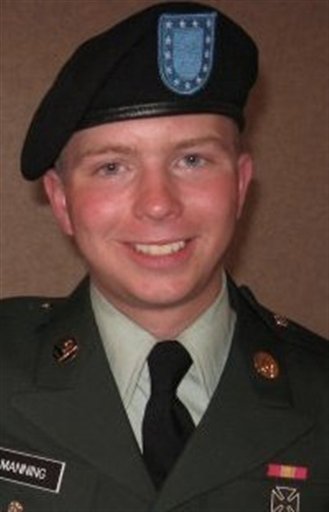

(updated below - Update II)
The U.S. Army yesterday announced that it has filed 22 additional charges against Bradley Manning, the Private accused of being the source for hundreds of thousands of documents (as well as this still-striking video) published over the last year by WikiLeaks. Most of the charges add little to the ones already filed, but the most serious new charge is for “aiding the enemy,” a capital offense under Article 104 of the Uniform Code of Military Justice. Although military prosecutors stated that they intend to seek life imprisonment rather than the death penalty for this alleged crime, the military tribunal is still empowered to sentence Manning to death if convicted.
Article 104 — which, like all provisions of the UCMJ, applies only to members of the military — is incredibly broad. Under 104(b) — almost certainly the provision to be applied — a person is guilty if he “gives intelligence to or communicates or corresponds with or holds any intercourse with the enemy, either directly or indirectly” (emphasis added), and, if convicted, “shall suffer death or such other punishment as a court-martial or military commission may direct.” The charge sheet filed by the Army is quite vague and neither indicates what specifically Manning did to violate this provision nor the identity of the “enemy” to whom he is alleged to have given intelligence. There are, as international law professor Kevin Jon Heller notes, only two possibilities, and both are disturbing in their own way.
In light of the implicit allegation that Manning transmitted this material to WikiLeaks, it is quite possible that WikiLeaks is the “enemy” referenced by Article 104, i.e., that the U.S. military now openly decrees (as opposed to secretly declaring) that the whistle-blowing group is an “enemy” of the U.S. More likely, the Army will contend that by transmitting classified documents to WikiLeaks for intended publication, Manning “indirectly” furnished those documents to Al Qaeda and the Taliban by enabling those groups to learn their contents. That would mean that it is a capital offense not only to furnish intelligence specifically and intentionally to actual enemies — the way that, say, Aldrich Ames and Robert Hanssen were convicted of passing intelligence to the Soviet Union — but also to act as a whistle-blower by leaking classified information to a newspaper with the intent that it be published to the world. Logically, if one can “aid the enemy” even by leaking to WikiLeaks, then one can also be guilty of this crime by leaking to The New York Times.
The dangers of such a theory are obvious. Indeed, even the military itself recognizes those dangers, as the Military Judges’ Handbook specifically requires that if this theory is used — that one has “aided the enemy” through “indirect” transmission via leaks to a newspaper — then it must be proven that the “communication was intended to reach the enemy.” None of the other ways of violating this provision contain an intent element; recognizing how extreme it is to prosecute someone for “aiding the enemy” who does nothing more than leak to a media outlet, this is the only means of violating Article 104 that imposes an intent requirement.
But does anyone actually believe that Manning’s intent was to ensure receipt of this material by the Taliban, as opposed to exposing for the public what he believed to be serious American wrongdoing and to trigger reforms? Indeed, in the purported chat logs between Manning and government informant Adrian Lamo, Lamo asked Manning why he didn’t sell this information to a foreign government and get rich off it, and this is how Manning replied:
because it’s public data. . . . it belongs in the public domain -information should be free – it belongs in the public domain – because another state would just take advantage of the information… try and get some edge – if its out in the open . . . it should be a public good
This prosecution theory would convert acts of whistle-blowing into a hanging offense.
Worse still, whatever Manning’s behavior was in terms of “aiding the enemy,” that exact same behavior was engaged in by The New York Times, The Guardian, and numerous other newspapers that published these classified documents and thus enabled the Taliban, Al Qaeda and all the other Enemies Du Jour to access them. As Professor Heller put it:
If Manning has aided the enemy, so has any media organization that published the information he allegedly stole. Nothing in Article 104 requires proof that the defendant illegally acquired the information that aided the enemy. As a result, if the mere act of ensuring that harmful information is published on the internet qualifies either as indirectly “giving intelligence to the enemy” (if the military can prove an enemy actually accessed the information) or as indirectly “communicating with the enemy” (because any reasonable person knows that enemies can access information on the internet), there is no relevant factual difference between Manning and a media organization that published the relevant information.
As Heller notes, since the UCMJ applies only to members of the military, newspapers (or WikiLeaks) couldn’t actually be charged under Article 104; still, “there is still something profoundly disturbing about the prospect of convicting Manning and sentencing him to life imprisonment [GG: or the death penalty] for doing exactly what media organizations did, as well.” It’s true that members of the military have legal duties that others do not have — including the duty not to leak classified information — but this incredibly expansive interpretation of what it means to “aid the enemy” dangerously encompasses all sorts of legitimate press and speech activities, especially when combined with the Obama administration’s escalating war on whistle-blowing and the journalists who expose government secrets. This is yet another step in infecting the law with doctrines of Endless War and its accompanying mentality.
* * * *
The Manning controversy tracks almost perfectly the one from 40 years ago involving Daniel Ellberg’s leak of thousands of pages of the Top Secret Pentagon Papers. Not even Manning’s most ardent defenders deny that he broke the law if he was actually the leaker (just as nobody denies that Ellsberg broke the law).
Nonetheless, the notion that Daniel Ellberg’s leak was noble and justified has become consecrated orthodoxy among most Democrats, progressives and even among the American media — because it’s very easy to cheer on challenges to authority and political power from four decades earlier, when the targets of the whistle-blowing no longer wield power. Yet even though Manning’s actions are so similar to Ellsberg’s both in intent and effect — as Ellsberg himself has repeatedly stated — the reaction to Manning is radically different: both because Manning’s actions challenge the policy of current authorities who actually wield power now and because it’s a Democratic President prosecuting him. That Ellsberg is viewed as a hero while Manning is viewed as a death-deserving villain makes no logical sense.
It’s at least intellectually coherent (though quite misguided) to see both Ellsberg and Manning as criminal demons who deserve to be locked away forever (the same things said now to condemn Manning were said back then about Ellsberg, including from the Supreme Court: “revelation of [the Pentagon Papers] will do substantial damage to public interests,” wrote Justice White. But it’s incoherent in the extreme to praise Ellsberg while condemning Manning (particularly since everything Manning is accused of leaking bears a much lower secrecy designation than the massive amounts of Top Secret material leaked by Ellsberg).
Critically, if one believes the authenticity of the purported Manning/Lamo chat log snippets selectively released by Wired, then Manning was very clear about why he decided to leak these materials: he sought to trigger worldwide reforms of government wrongdoing exposed by these documents:
Lamo: what’s your endgame plan, then?. . .
Manning: well, it was forwarded to [WikiLeaks] – and god knows what happens now – hopefully worldwide discussion, debates, and reforms – if not, than [sic] we’re doomed – as a species – i will officially give up on the society we have if nothing happens – the reaction to the [Baghdad Apache attack] video gave me immense hope; CNN’s iReport was overwhelmed; Twitter exploded – people who saw, knew there was something wrong . . . Washington Post sat on the video… David Finkel acquired a copy while embedded out here. . . . – i want people to see the truth . . . regardless of who they are . . . because without information, you cannot make informed decisions as a public.
This leaves little doubt about Manning’s motives. And there is also little doubt that Manning has achieved those ambitious and noble goals on multiple levels. Although the extent is reasonably in dispute, even WikiLeaks’ most embittered antagonists — such as New York Times Executive Editor Bill Keller — acknowledge that the release of the diplomatic cables played some role in the uprising in Tunisia, which in turn sparked similar uprisings of historic significance throughout the Middle East. From Keller:
For those who do not follow these subjects as closely, the stories are an opportunity to learn more. If a project like this makes readers pay attention, think harder, understand more clearly what is being done in their name, then we have performed a public service. And that does not count the impact of these revelations on the people most touched by them. WikiLeaks cables in which American diplomats recount the extravagant corruption of Tunisia’s rulers helped fuel a popular uprising that has overthrown the government.
Beyond that, the documents Manning is alleged to have leaked have revealed a wide range of corruption, deceit and illegality by government officials around the world. They have forced Americans to confront the realities of the wars they endlessly wage and support. And it is virtually impossible to read news articles about any significant event in the Middle East without encountering references to important information revealed by WikiLeaks documents.
In sum, if one believes the allegations and the chat logs, Manning’s actions have already led to many of the “reforms” and increased awareness he hoped to achieve. Thus do we have the strange spectacle of Americans cheering on the democratic uprisings in the Middle East and empathizing with the protesters, all while revering American political leaders who for years helped sustained the dictatorships which oppressed them and disdaining those (Manning) who may have played a role in sparking the protests. More revealingly, American political leaders responsible for grave atrocities (like this and this and this) are treated like peace-loving statesmen and honored dignitaries, while those who heroically risk their lives to expose and end that wrongdoing (Manning, and Ellsberg before him) are thrown into a cage, threatened with death, and scorned by All Decent People.
Part of what explains that is just the standard authoritarian mindset: even heinous acts committed under sanction of officialdom are treated as inherently legitimate, while those who challenge those authorities are scorned. But there’s something broader that accounts for the almost universal disdain directed at Manning: these leaks showed us the true face of American conduct in the world. Those who reveal truths which most people would prefer to ignore are typically hated, and are often those most severely punished.
* * * * *
As a reminder: Manning — convicted of nothing — continues to be held in 23-hour/day, highly repressive solitary confinement; despite protests from Amnesty International, a formal investigation by the U.N.’s top torture official, and the replacement of the brig commander, Manning has been held that way for ten straight months, with no change in sight.
UPDATE: Two briefs points to underscore the key issues here. First, Richard Nixon — when justifying the attacks on Daniel Ellsberg — denounced him for having provided ””aid and comfort to the enemy.” As usual, the more things ”change,” . . .
And then there’s this question I posed on Twitter:

UPDATE II: Lt. Col. David Coombs, Manning’s counsel, just posted the following:
Last night, PFC Manning was inexplicably stripped of all clothing by the Quantico Brig. He remained in his cell, naked, for the next seven hours. At 5:00 a.m., the Brig sounded the wake-up call for the detainees. At this point, PFC Manning was forced to stand naked at the front of his cell.
The Duty Brig Supervisor (DBS) arrived shortly after 5:00 a.m. When he arrived, PFC Manning was called to attention. The DBS walked through the facility to conduct his detainee count. Afterwards, PFC Manning was told to sit on his bed. About ten minutes later, a guard came to his cell to return his clothing.
This type of degrading treatment is inexcusable and without justification. It is an embarrassment to our military justice system and should not be tolerated. PFC Manning has been told that the same thing will happen to him again tonight. No other detainee at the Brig is forced to endure this type of isolation and humiliation.
I’m already disgusted anticipating the Obama loyalists and right-wing fanatics who will jointly defend this.
