
2012 Elections
What Chris Christie is really afraid of
He's right when he says he could win the GOP presidential nomination -- so what's holding him back from running?
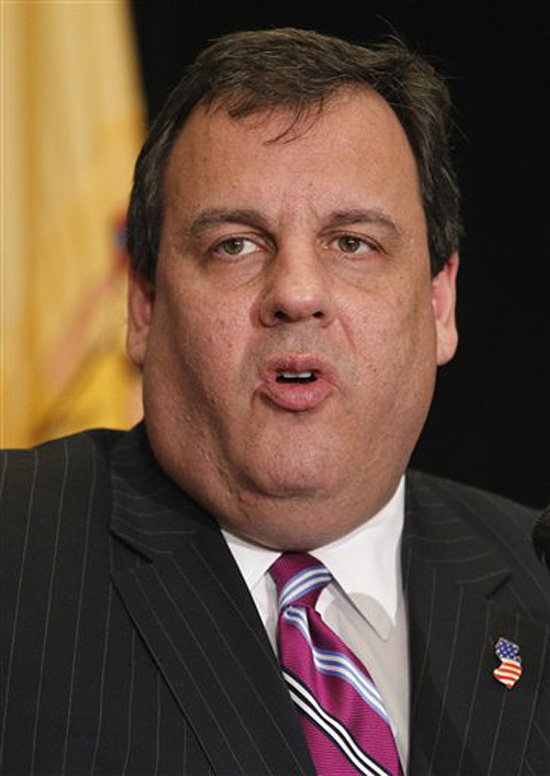
New Jersey Gov. Chris Christie speaks during the New Jersey Transportation Conference, Wednesday, March 2, 2011, in Trenton, N.J. (AP Photo/Julio Cortez)(Credit: Julio Cortez) Chris Christie is a very ambitious man whose bombastic style and war with public unions matches the mood of today’s Republican Party base almost perfectly. What’s more, the 2012 GOP presidential race is unusually late-starting — while the field that is preparing to run is exceptionally underwhelming. In other words, it’s hard to argue with Christie’s recent boast to the National Review that he sees an opening in next year’s primaries and that “I already know I can win.”
And yet, he continues to insist in unusually blunt terms that he won’t take the bait and run for president next year. I still believe there’s a circumstance under which he might yet reverse himself and enter the race, but it’s worth understanding what is likely at the heart of Christie’s absolute, adamant refusal to display even a hint of interest in the possibility of seeking higher office next year: He made that mistake once before — and it nearly cost him his career.
Back in the mid-1990s, Christie was a promising local politician in Morris County, N.J. — a bastion of suburban Republicanism. As a 31-year-old attorney making his first bid for public office, Christie teamed up with another self-styled reformer, Jack O’Keefe, to challenge the Republican incumbents in the June 1994 primary for the county’s Board of Chosen Freeholders (the equivalent of a county legislature). Freeholders are relatively obscure (although often powerful) in New Jersey politics, but the job can be a steppingstone to higher office — a seat in the state legislature or Congress, usually. (Christine Todd Whitman, a one-time freeholder in affluent Somerset County, ended up claiming a U.S. Senate nomination no other Republican wanted in 1990, then nearly beat Bill Bradley — a surprisingly strong performance that put her on course to win the governorship in 1993.)
To Christie, the main appeal of the job was its launching pad potential. He waged an aggressive — and negative — campaign; in one ad, Christie claimed that the GOP incumbents were “under investigation” for their record-keeping of closed sessions — even though they weren’t. But GOP voters bought his claim and Christie prevailed in the primary (which is tantamount to winning the general election in Morris).
As a new freeholder, Christie employed the same bull-in-a-china-shop tactics that are now making him famous as governor: grandstanding at meetings, picking fights with colleagues, and attracting outsize media attention. His brash demeanor and cockiness also made him plenty of enemies in the clubby world of Morris GOP politics. Not that Christie minded. He already had his sights set on a promotion: a seat in the state Assembly. Within months of joining the freeholder board, Christie announced his candidacy for one of two seats from the heavily Republican 25th District. It was supposed to be the next step in the up-and-comer’s inevitable climb to statewide glory. Instead, it nearly destroyed him.
For the campaign, Christie again positioned himself as a reformer. Of the two seats on the ballot, one was open and the other was held by a Republican who had been placed in office months earlier by a vote of the county GOP committee. Christie portrayed that incumbent, Anthony Bucco, a former county official more than 20 years older than him, as a consummate insider, and attacked him hard.
But it was all just too much. The freeholders Christie had ousted in ’94 decided to sue him for defamation over his ad — which, it was clear by ’95, had been false. The headlines were harmful, and many of the Morris Republicans Christie had alienated were happy to pile on. In this context, the attacks on Bucco, generally a well-liked figure in the Morris GOP, began to backfire. Republican voters began to see in Christie a young man in too much of a hurry. In the June ’95 primary, he and his running mate were trounced by a nearly 2-to-1 margin. Christie had jumped too soon — and paid the price.
And it only got worse. The defamation suit lingered until finally Christie was forced to issue a public apology. One of his boldest acts on the freeholder board — pushing for the firing of an architect for a new county jail — came back to haunt him too, when the architect filed a defamation suit of his own. A protracted debate over whether the county should be forced to pay for Christie’s defense ensued, with Christie ultimately agreeing to foot the bill himself. When he stood for reelection in 1997, the GOP primary wasn’t even close: Christie finished dead last. He was 35 and, it seemed, his hoped of political glory had been extinguished.
“In retrospect,” he told a reporter on his way out the door, “the Assembly campaign and how it was run was a mistake.”
Of course, Christie ended up catching the break of a lifetime three years later, when he raised massive money for George W. Bush’s presidential campaign and was rewarded with an appointment as U.S. attorney — an office he used to win unprecedented media attention with his pursuit of corruption cases against elected officials. By the middle of the decade, he emerged as the state GOP establishment’s “dream candidate” for governor. He passed on a 2005 bid (wisely, given how badly the national climate had turned against the GOP by Election Day), then made his move in 2009.
By all measures, Christie truly enjoys the job he has now. And, more than most politicians, he understands how easily he could lose it — and how easily he could lose everything — if the voters decide he’s in too much of a hurry to move up.
Steve Kornacki writes about politics for Salon. Reach him by email at SKornacki@salon.com and follow him on Twitter @SteveKornacki More Steve Kornacki.
Florida purging voter rolls
Governor Rick Scott moves forward with a plan to disqualify thousands of mostly Hispanic and Democratic voters
Rick Scott (Credit: Reuters/Brendan McDermid) Hated Florida Governor Rick Scott has a great idea: A big, massive purge of the state’s voter roll right before a sure-to-be-close presidential election. The governor ordered his secretary of state to compile a list of registered voters who might not be citizens, based on an unreliable and out-of-date state motor vehicle administration database. The secretary of state made a list and then realized the list was not actually very useful or accurate. Then he resigned, and now Scott is just purging away.
Continue Reading Close
Alex Pareene writes about politics for Salon and is the author of "The Rude Guide to Mitt." Email him at apareene@salon.com and follow him on Twitter @pareene More Alex Pareene.
Mitt Romney: Politics “like a sport”
What makes Mitt tick? The nominee says he likes politics because "I can't compete in competitive sports very well"
Republican presidential candidate and former Massachusetts Governor Mitt Romney gestures as he leaves a campaign event in Hillsborough, New Hampshire May 18, 2012. (Credit: Reuters/Jessica Rinaldi) Mitt Romney may have unintentionally opened a window onto his somewhat obscured motivations for running for president in an interview with the Wall Street Journal’s Peggy Noonan today, explaining that he likes sports, but isn’t very good at them, so he does politics instead.
Asked about whether he likes “the game” of politics, the presumed GOP nominee replied, “I like competition, and I think the game [of politics] is like a sport for old guys. I mean, you know, I can’t compete in competitive sports very well, but I can compete in politics, and there’s the — what was the old ABC ‘Wide World of Sports’ slogan? ‘The thrill of victory and the agony of defeat.’ The only difference is victory is still a thrill, but I don’t feel agony in loss.”
Continue Reading CloseAlex Seitz-Wald is Salon's political reporter. Email him at aseitz-wald@salon.com, and follow him on Twitter @aseitzwald. More Alex Seitz-Wald.
Trump insinuates self into Romney campaign
How a toxic attention-seeker (not Newt) will likely end up speaking at the RNC
Businessman and real estate developer Donald Trump (L) greets Mitt Romney after endorsing his candidacy for president at the Trump Hotel in Las Vegas, Nevada February 2, 2012. (Credit: Reuters/Steve Marcus) So. Donald Trump again? Are we really doing this again? I guess we are!
There were stories, recently, in the usual places, about how Trump was being seriously considered for a major speech at the Republican Convention. I did not dwell on the story much, because I assumed that these rumors were a product of Donald Trump’s prodigious vanity and powerful imagination. Ha ha ha, sure, the Republicans will definitely want the stupid make-believe TV mogul who pretends to fire people for a living, at their big party.
Continue Reading Close
Alex Pareene writes about politics for Salon and is the author of "The Rude Guide to Mitt." Email him at apareene@salon.com and follow him on Twitter @pareene More Alex Pareene.
“Battlefield Earth”: Romney vs. the Psychlos
The GOP's standard bearer calls L. Ron Hubbard's bizarro sci-fi epic his favorite novel. Is that cause for concern?
Republican presidential candidate and former Massachusetts Governor Mitt Romney reads a book to children in Manchester(Credit: Brian Snyder / Reuters) There’s a scene near the end of “Battlefield Earth,” Scientology founder L. Ron Hubbard’s 1982 science fiction epic, that may explain a bit of why Mitt Romney has said (most recently this week) that it’s his favorite novel.
Our hero, Jonnie Goodboy Tyler, has just finished taking down the Psychlo empire, which has ruled Earth for the past millennium and has dominated most of the known 16 universes for going on 300,000 years. Now Jonnie has to negotiate with the alien powers who are jockeying to fill the power vacuum left behind, and things aren’t looking so good for the human race.
Continue Reading CloseDaniel Oppenheimer's book "Turncoats: The Journey from Left to Right and How It’s Transformed America," a political and intellectual history of six prominent American intellectuals who journeyed from the left to the right of the political spectrum, will be published by Simon and Schuster More Daniel Oppenheimer.
Will Latinos elect Obama?
Hispanic voters may not be as decisive a voting bloc as everyone assumes. Just look at the swing states
(Credit: AP/Jae C. Hong) The conventional wisdom is that the growing Latino vote is key to President Obama’s reelection prospects. By all accounts, Latinos favor the president over Mitt Romney by wider margins than they favored him over John McCain in 2008, when he won two-thirds of the Hispanic vote and captured crucial swing states with large Hispanic populations, including Colorado, Nevada and Florida. Bloomberg reported this week that lower-than-average unemployment in the key battleground states “coupled with the growth of adult minority populations in those states create a higher bar” for Romney in his quest to oust the incumbent.
Continue Reading Close
Jefferson Morley is a staff writer for Salon in Washington and author of the forthcoming book, Snow-Storm in August: Washington City, Francis Scott Key, and the Forgotten Race Riot of 1835 (Nan Talese/Doubleday). More Jefferson Morley.
Page 1 of 202 in 2012 Elections