
Supreme Court
Jonah Goldberg agrees with the Westboro Church ruling except he doesn’t
America's finest columnist says "meh" to your precious "free speech"
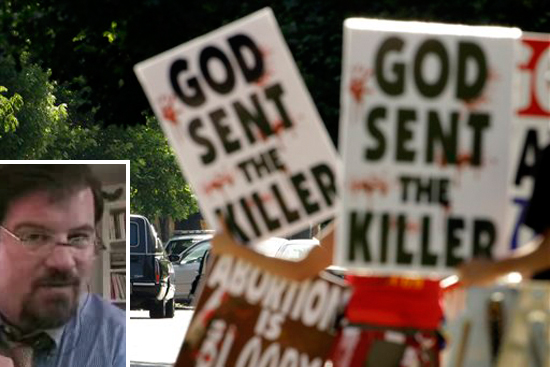
In this June 6, 2009 file photo, protesters from Rev. Fred Phelps' Westboro Baptist Church demonstrate during funeral services for Dr. George Tiller at College Hill United Methodist Church in Wichita, Kan. Inset: Jonah Goldberg Jonah Goldberg has some thoughts about Snyder v. Phelps, the Supreme Court case that determined that Fred Phelps’ Westboro Baptist Church has the right to protest outside funerals. The case was fairly open and shut — only Samuel Alito dissented, and his dissent was not that impressive — and nearly every columnist and newspaper editorial board in the nation agrees that Phelps has the right to share his objectionable speech without facing civil punishment. Jonah Goldberg thinks different, though. Sort of. Kind of.
I think the decision is a travesty. But, alas, after reading it, I also find it perfectly defensible, probably even correct.
Right. OK, well, column over. A bit short this week, but that does seem to sum it up nice—wait, I’m sorry, there’s another 650 words? But… why?
Goldberg goes on to quote various editorials about how the case is painful but correct and blah blah blah. Jonah Goldberg has no time for your pointy-headed liberal values that he says he agrees with!
These are fine expressions of general constitutional values shared by most of us. But they’re absolutely useless for figuring out how to treat speech in the real world.
Goldberg notes that many states restrict demonstrations at funerals, and no one complains, because we all agree that some speech is so bad and wrong that restricting it is OK, which is actually not really a thing that everyone agrees with. Goldberg calls Samuel Alito’s dissent “compelling,” in order to try to convince us that he read it, or read anything about the case instead of just seeing something about it on the TV, while he was waiting for “NCIS: Los Angeles” to come on. And some offensive speech is “worthwhile” and some offensive speech is “reprehensible” and it is obviously totally easy to figure out which is which because America is “serious” and it is, as always with Goldberg, a simple, stupid point, obtusely made.
This is my favorite part:
Stephen Wermiel, a professor at American University, warns, “If you start defining and banning offensive speech because someone doesn’t like it, it’s hard to draw the line, and one day you wake up and find you don’t have much protected speech.”
Meh.
That’s the entire paragraph. “Meh.”
Jonah Goldberg is “a visiting fellow at the American Enterprise Institute.”
Alex Pareene writes about politics for Salon and is the author of "The Rude Guide to Mitt." Email him at apareene@salon.com and follow him on Twitter @pareene More Alex Pareene.
John Roberts’ Gilded Age SCOTUS
Jeffrey Toobin shows how the Citizens United ruling challenged a century of efforts to rein in corporate power
John Roberts (Credit: AP/Pablo Martinez Monsivais) The most important revelation in Jeffrey Toobin’s 10,000-word New Yorker piece on Chief Justice John Roberts’ takedown of campaign finance laws in the Citizens United case is the extent to which modern conservatism is trying to restore the Gilded Age. That was a time when corporations had more rights than individuals, when a conservative Supreme Court did its best to protect those corporate rights, and wealth and corruption ran unchecked. Of course, we live in a neo-Gilded Age, when income inequality is more pronounced than at any time since the Great Depression, and the Roberts court’s decisions in the Citizens United case helps bring us all the way back to those bad old days.
Continue Reading CloseJoan Walsh is Salon's editor at large. More Joan Walsh.
Obama destroys Constitution with mild Supreme Court criticism
Conservatives and moderates declare SCOTUS-bashing to be "intimidation"
(Credit: AP) Ruth Marcus is unsettled. Maybe even queasy. There is probably some light nausea. What has her worried for the future of the nation, today? President Obama’s shameful, horrific, vicious attacks on those nice people in the Supreme Court.
Obama said that the court overturning Congress’ healthcare reform law would be a textbook example of “judicial activism” as “conservative commentators” define it: “that an unelected group of people would somehow overturn a duly constituted and passed law.” And hey, that seems like an eminently defensible and not particularly unsettling point! Conservatives made “judicial activism” into a talking point and rallying cry and defined it vaguely enough to encompass judges striking down basically any law or statute.
Continue Reading Close
Alex Pareene writes about politics for Salon and is the author of "The Rude Guide to Mitt." Email him at apareene@salon.com and follow him on Twitter @pareene More Alex Pareene.
Justices run amok: Fixing the Supreme Court
Judges on the right and left legislate from the bench. So why don't we just elect them?
Antonin Scalia, John Roberts and Clarence Thomas On Monday, we had another example of the Supreme Court’s ideological division: a 5-4 ruling, along partisan lines, giving police the right to conduct strip searches for any offense. This came on the heels of last week’s oral arguments before the Supreme Court about the constitutionality of the individual mandate provision of the Affordable Care Act, which led many observers to predict that the nation’s highest judicial body will strike down part or all of the controversial healthcare reform package. But the hearings were instructive in other ways. They showed once again that political partisanship is closely correlated to a justice’s view of the law. And they proved that the Supreme Court once again is functioning, not as a court, but as a third house of the federal legislature.
Continue Reading CloseMichael Lind’s new book, "Land of Promise: An Economic History of the United States", will be published in April and can be pre-ordered at Amazon.com. More Michael Lind.
Why I need Obamacare
I'm sick, and I will be for the rest of my life. Knowing I won't be denied the insurance I need matters
Supporters of health care reform stand in front of the Supreme Court in Washington, Wednesday, March 28, 2012, on the final day of arguments regarding the health care law signed by President Barack Obama. (AP Photo/Charles Dharapak)(Credit: AP) Dear healthy people,
It’s great that you’re deriving intellectual pleasure from debating Obamacare. I love that this theoretical dance you’re engaged in has no repercussions to you, a healthy individual. I would love to join you some evening for a spirited discussion on the pros and cons of healthcare reform. Maybe over a glass of wine? Heck — over two or three glasses of wine. I’d love to lean forward, my arched brows furrowed, my full lips purple with the stain of a good Zinfandel, and throw out statistics and well-crafted one-liners about the plight of the uninsured, the underinsured, the sick. Those poor, poor sick.
Continue Reading CloseCedar Burnett is a freelance writer and toddler wrangler living in Seattle. She is currently working on a book about living with ulcerative colitis. More Cedar Burnett.
The conservative grip on power
A ruthless GOP power grab, centered around the Supreme Court, has cemented conservative control in Washington
Clarence Thomas, George W. Bush and Antonin Scalia (Credit: AP) Writing in Salon, Natasha Lennard proposes that with the warm weather we can again expect the Occupy movement to shoot up. Arab Spring, American Spring. She’s right about one thing: Like in the decades before the Arab Spring, it has been a long, cold, American winter. In the 30 years since coming to power here, Republicans have used their initial ascent to power to seal themselves into office as tightly as the pharaohs. Smart commentators have noted how lawless the conservatives are in making substantive decisions, but that’s not the worst of it. The worst of it is how they use their tenure to make it increasingly impossible to oust them.
Continue Reading CloseLinda Hirshman is the author of “Victory: The Triumphant Gay Revolution,” forthcoming in June 2012. Follow her on Twitter @LindaHirshman1 More Linda Hirshman.
Page 1 of 102 in Supreme Court
