Fiction
“Pym”: Negroes on ice
A "blackademic" obsessed with Edgar Allan Poe mounts an expedition to Antarctica in this hilarious satire
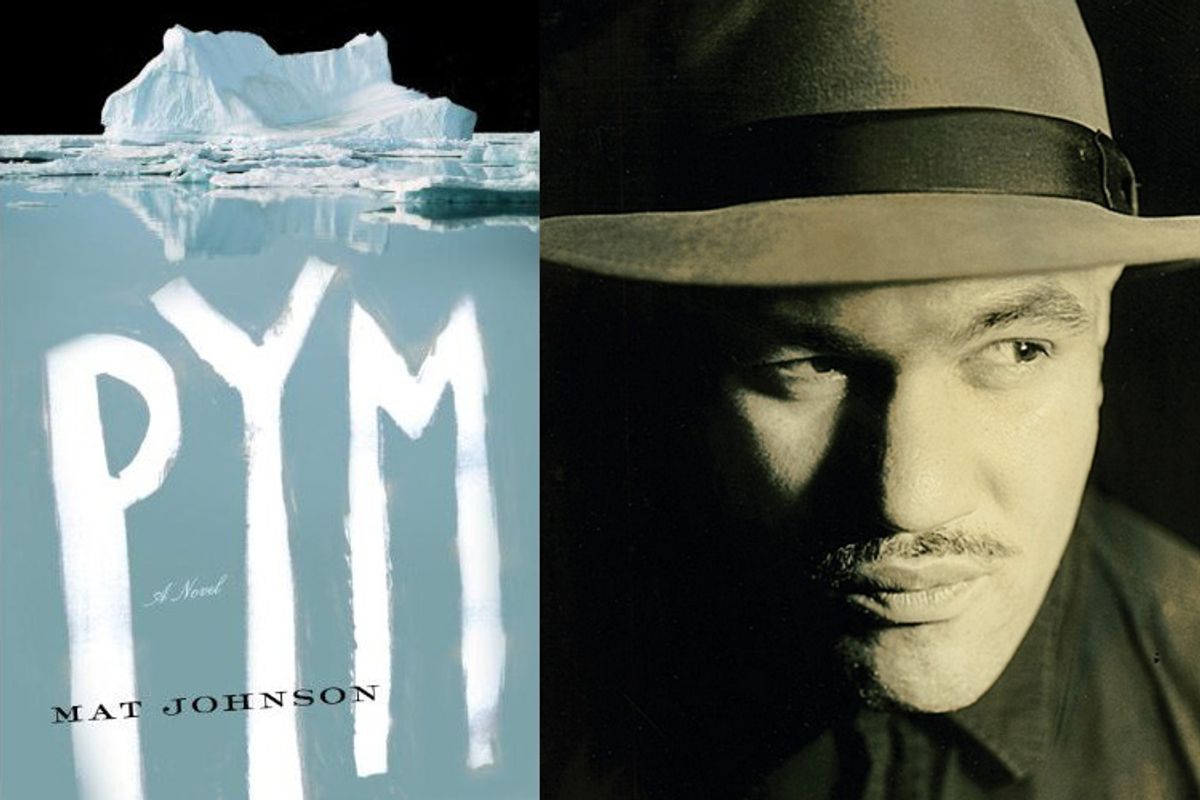
Mat Johnson “Pym,” by Mat Johnson is a blisteringly funny satire of contemporary American racial attitudes — which is quite an accomplishment when you consider that most of the novel is set in the wilds of Antarctica. It’s the story of Christopher Jaynes, a “blackademic” at a small liberal arts college in the Hudson River Valley who fails to make tenure, in part because of his refusal to sit on the Diversity Committee. “The Diversity Committee,” he explains to his successor (a “Hip-Hop Theorist”), “has one primary purpose: so that the school can say it has a diversity committee. … People find that very relaxing. It’s sort of like, if you had a fire, and instead of putting it out, you formed a fire committee.”
But the real reason why Jaynes loses his job may be his obsession with “The Narrative of Arthur Gordon Pym of Nantucket,” the only novel written by Edgar Allan Poe and surely one of the weirdest texts in the American canon. It describes the eponymous Pym’s adventures sailing the South Seas and ends, prematurely, with an enigmatic vision of a towering figure, shrouded in white, looming over a foaming cataract in Antarctica. ” ‘Pym’ that is maddening, ‘Pym’ that is brilliance, ‘Pym’ whose failures entice instead of repel,” Jaynes rhapsodizes about this strange book at the beginning of one chapter, sounding like Humbert Humbert and nearly as far gone.
Yet Jaynes can’t convince anyone else that in Poe’s ‘Pym’ he has found the key to “Whiteness, as pathology and as mindset … the primal American subconscious, the foundation on which all our visible systems and structures were built.” Accused of neglecting the beat he was hired to cover, he insists that he’s not “an apolitical coward, running away from the battle. I was running so hard toward it, I was around the world and coming back in the other direction.”
And soon he is literally going around the world. Jaynes stumbles across a manuscript that suggests that Arthur Gordon Pym really existed — which means that the island of Tsalal, a place so black even the water is colored, must exist, too. Determined to find this “great undiscovered African Diasporan homeland … a society outside of time and history,” he puts together an expedition. Its crew includes the ex-girlfriend he’s been pining after for seven years (and the slick entertainment lawyer he didn’t know she’d married), a gay couple who film their stagily heroic exploits for the Internet and his best friend, Garth, a laid-off city bus driver with a serious addiction to Little Debbie snack cakes. Their captain and leader is Jaynes’ older cousin, Booker, a civil rights movement veteran with a dog named White Folks, who meets Jaynes downtown, sitting “in the back of the room staring intently at the front door, Malcolm X style, which considering we were in an organic juice bar was a little heavy for the scene.”
The novel’s early chapters, all set in America, are clever enough that I wouldn’t have minded if Jaynes’ ship had never sailed. Tracking down the descendants of Pym’s racially ambiguous traveling companion, he stumbles across the Web page of one Mahalia Mathis, “a self-proclaimed “Singer, Actor, Poet, Novelist, Dancer, Actress and Noted Psychic Person.’” He attends a meeting of the Native American Ancestry Collective of Gary (Indiana), a confederation of wishful thinkers who, underneath their feather headdresses and buckskin, “looked like any gathering of black American folks.” He tries to talk Garth out of his devotion to billionaire artist Thomas Karvel, “The Master of Light,” whose uberkitschy paintings of English cottages look, in Jaynes’ words, “like the view up a Care Bear’s ass.” (Garth defends his taste for these narcotic scenes by protesting “I got stress!”)
Jaynes and company do finally set sail, embarking on a series of escapades that Garth summarizes as “Negroes on Ice.” Johnson’s novel evolves into a full-fledged and fiendishly inventive inversion of Poe’s, a series of bizarre encounters I can’t bring myself to spoil, each one more deliciously pointed than the last. Suffice to say that they include death-defying treks across the permafrost, underground caverns, chases, multiple betrayals and even a climactic explosion — also, be aware that matters of great import will hinge on Garth’s stash of Little Debbie cakes.
“Pym” departs from its 19th-century inspiration in more than just the way it repurposes motifs of blackness and whiteness: Unlike “The Narrative of Arthur Gordon Pym of Nantucket,” it is hilarious. (Much of this is due to Garth, who deserves a bust in the comic sidekick’s hall of fame.) It’s also a novel that doesn’t soft-pedal the bitterness instilled by slavery and its racist legacy yet avoids lapsing into bitterness itself. It is a work filled with chagrined realizations, beginning with its very premise: that a fed-up black man might find his promised land in the pages of a book by a half-crazy, pro-slavery white guy. Nothing can be truly separated from that which is conceived of as its opposite. In Johnson’s vision, the races are running away from each other so fast, they end up circling the globe and colliding again on the other side.
Laura Miller is a senior writer for Salon. She is the author of "The Magician's Book: A Skeptic's Adventures in Narnia" and has a Web site, magiciansbook.com. More Laura Miller.
50 shades of Shutterstock
Slide show: Everyone's favorite light-bondage bestseller illustrated by inexplicable stock photography SLIDE SHOW
This week, for roughly the millionth time, E.L. James’ romance-bondage trilogy “50 Shades” nabs the No. 1, 2 and 3 spots on the New York Times bestseller lists. We don’t get it either. Every page of that book, which famously began as “Twilight” fan fiction, elicits a sigh of confusion and weird secondary embarrassment. The question is: Who would read this? (The answer is: Apparently everyone.) It’s the same baffled, helpless feeling we get when we sort through stock photos on a daily basis. Stock photos – which have been the subject of recent outstanding Internet satire – are used by this site, and many others, to illustrate our flood of content. Many are plain and simple, but a good portion are flat-out mind-blowing. Why did anyone think that photo was a good idea? It only made sense to join these forces. And so, we present to you passages from the most head-scratching bestseller of our time, illustrated with the assistance of inexplicable stock photography.
Megaphone by Natalie Bakopoulos
Miracles happen, even in an Athens crippled by a garbage strike, to a young mother unsure of her ability to love
(Credit: iStockphoto/caracterdesign) It’s the third week of the garbage strike and Athens has begun to smell. Bright-colored trash bags fill the curbs and alleyways, and we have learned to step over the rubbish and avoid the blocks that had become unnavigable. We know which stretches are particularly foul — a stretch along Mavili Square, or the entire top end of Monastiraki. Odos Athinas is a sea of trash, and Omonia is ghastly but we don’t go there anyway. May has gone from unseasonably cool to raging hot, and the garbage seems to be melting. In front of the museum it’s like yet another installation project. When I arrive each morning I want to wretch.
Continue Reading CloseNatalie Bakopoulos's first novel, "The Green Shore," will be published by Simon & Schuster in June 2012. Her work has appeared in Tin House, Ninth Letter, Granta Online, and The O. Henry Prize Stories 2010, and she is a contributing editor for the online journal Fiction Writers Review. More Natalie Bakopoulos.
Almost by Chris Pavone
She never thought of herself as ambitious, until motherhood and career collided in one horrifying hospital ride
(Credit: iStockphoto/caracterdesign) It’s just before dawn when Isabel puts the final page down on the fat stack of paper that sits on the rumpled bedspread, next to an overflowing crystal ashtray and a crumpled soft-pack of cigarettes. She’d tried Wellbutrin and Xanax; she’d used patches and gum. In the end, the only thing that made her quit smoking was being pregnant.
But then, after everything, she couldn’t help but start up again. At first it was just a single cigarette per day, or two. Then it became a few, and within months she was back to full-throttle. Over the past couple of years, she’s tried to quit a few times, but not seriously. She anticipates — she accepts — failure. Because she doesn’t want to quit, not really. She wants instead to try, and fail.
Continue Reading CloseMemorial Day fiction: Are we there yet?
Salon exclusive: At the start of the summer fiction season, new stories from Chris Pavone and Natalie Bakopoulos
(Credit: iStockphoto/caracterdesign) “Are we there yet?”
It’s a dreaded sentence. When it’s spoken by an anxious child from the back seat, it’s enough to make stressed-out parents wish they’d never taken a family vacation in the first place. And even if it’s delivered as a sing-songy punch line, from an impatient partner or spouse on a long road trip, it’s an irritating eye-roller of a joke.
So this Memorial Day weekend — the unofficial start of the summer vacation season, and therefore the summer fiction season — we asked two novelists to reclaim the sentence in a new and adult context. For our latest fiction project, there was only one simple rule: Each story had to include the line “Are we there yet?” in a fresh and surprising way.
Continue Reading CloseDavid Daley is the senior culture editor of Salon. More David Daley.
“Frankenstein” remixed
This masterful new adaptation of Mary Shelley's classic novel may be the best interactive fiction yet
Whatever interactive fiction is (and we’re still figuring that out) it suffers from all the problems of traditional fiction and then some. The vast majority of novels and short stories aren’t much good, but when a branching fiction — along the lines of the old “Choose Your Own Adventure” children’s books — fails to engage, the first impulse is to blame the form rather than the content. Let “Frankenstein,” just released by Inkle Studios and Profile Books, serve as a reproach to that reflex. The app is a creative, subtle and sensitive adaptation of Mary Shelley’s classic novella, and it has singlehandedly renewed this critic’s hopes for interactive fiction.
Laura Miller is a senior writer for Salon. She is the author of "The Magician's Book: A Skeptic's Adventures in Narnia" and has a Web site, magiciansbook.com. More Laura Miller.
Page 1 of 130 in Fiction


