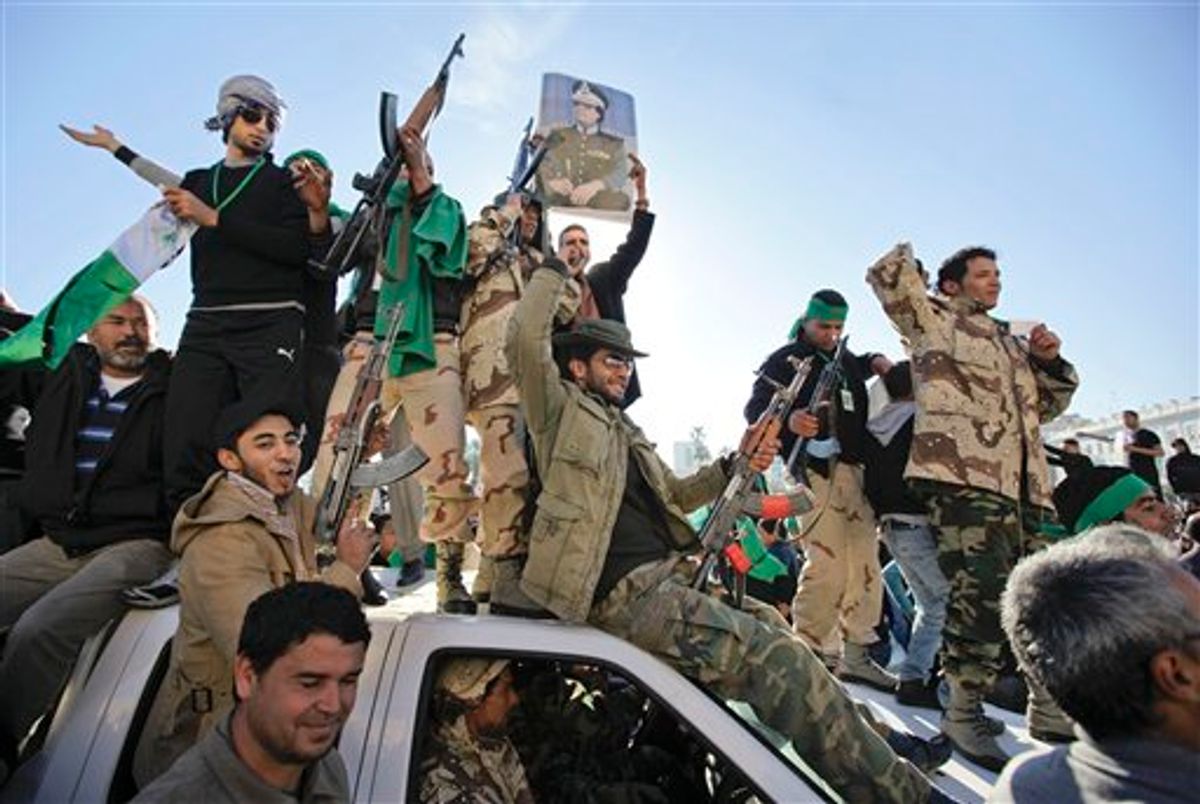
Libyan warplanes launched a fresh airstrike on rebel positions around a key oil port Monday, trying to block the opposition fighters from advancing toward Moammar Gadhafi's stronghold in the capital, Tripoli.
Rebels in the area said they can take on Gadhafi's elite ground forces, but are outgunned if he uses his air power.
"We don't want a foreign military intervention, but we do want a no-fly zone," said rebel fighter Ali Suleiman. He added that the rebels can take on "the rockets and the tanks, but not Gadhafi's air force."
Libya appears to be sliding toward a civil war that could drag out for weeks, or even months, as rebels try to oust Gadhafi after 41 years. Resorting to heavy use of air attacks signaled the regime's concern that it needed to check the advance of the rebel force toward Sirte -- Gadhafi's hometown and stronghold.
Anti-Gadhafi forces would get a massive morale boost if they captured Sirte, and it would clear a major obstacle on the march toward the gates of Tripoli.
There were no casualties in Monday's airstrike on Ras Lanouf, which came one day after pro-regime forces pounded opposition fighters with helicopter gunships, artillery and rockets to stop the rebels' rapid advance toward Tripoli.
Mohamad Samir, an army colonel fighting with the rebels, said his forces are expecting reinforcements from the east.
The uprising against Gadhafi, which began Feb. 15, is already longer and much bloodier than the relatively quick revolts that overthrew the longtime authoritarian leaders of neighboring Egypt and Tunisia.
A government spokesman, Abdel-Majid al-Dursi, denied rumors that there had been an assassination attempt against Gadhafi, saying the claims are "baseless rumors."
Hundreds if not thousands of people have died since Libya's uprising began, although tight restrictions on media make it near impossible to get an accurate tally. More than 200,000 people have fled the country, most of them foreign workers. The exodus is creating a humanitarian crisis across the border with Tunisia -- another North African country in turmoil after an uprising in January that ousted its longtime leader.
The turmoil is being felt more broadly still in the form of rising oil prices. Libya's oil production has been seriously crippled by the unrest.
The conflict in Libya took a turn late last week when government opponents, backed by mutinous army units and armed with weaponry seized from storehouses, went on the offensive. At the same time, pro-Gadhafi forces have conducted counteroffensives to try to retake the towns and oil ports the rebels have captured since they moved out of the rebel-held east.
An opposition force estimated at 500 to 1,000 fighters has been cutting a path west toward Tripoli. On the way, they secured control of two important oil ports at Brega and Ras Lanouf.
If the rebels continue to advance, even slowly, Gadhafi's heavy dependence on air power could prompt the West to try to hurriedly enforce a no-fly zone over the country. The U.N. has already imposed sanctions against Libya, and the U.S. has moved military forces closer to its shores to back up its demand that Gadhafi step down.
Enforcing a no-fly zone could take weeks to organize, however, and U.S. Defense Secretary Robert Gates has noted that it must be preceded by a military operation to take out Libya's air defenses. British Foreign Minister William Hague said Sunday that a no-fly zone over Libya is still in an early stage of planning and ruled out the use of ground forces.
As fighting across Libya grew more fierce, the international community appeared to be struggling to put military muscle behind its demands for Gadhafi to give up power.
U.N. Secretary-General Ban Ki-Moon spoke to Libyan Foreign Minister Musa Kusa on Sunday, and called for an end to hostilities, according to a U.N. statement, which said Kusa agreed to the immediate dispatch of a humanitarian assessment team to Tripoli.
Valerie Amos, United Nations under-secretary-general for humanitarian affairs and emergency relief coordinator, said in a statement that the Benghazi Red Crescent reported that Misrata was under attack by government forces.
"Humanitarian organizations need urgent access now," she said. "People are injured and dying and need help immediately."
Suleiman, the rebel fighter, said his forces are waiting for reinforcements in Ras Lanouf.
"The orders are to stay here and guard the refinery, because oil is what makes the world go round," Suleiman said.
Shares