Salon Home
Topic

Japan Earthquake

Friday, Mar 11, 2011 4:01 PM UTC2011-03-11T16:01:00Zl, M j, Y g:i A T

Japan’s devastation goes viral

The Internet can't stop watching videos of the horrific earthquake and its aftermath. Why are we so fascinated?

APTOPIX Japan Earthquake

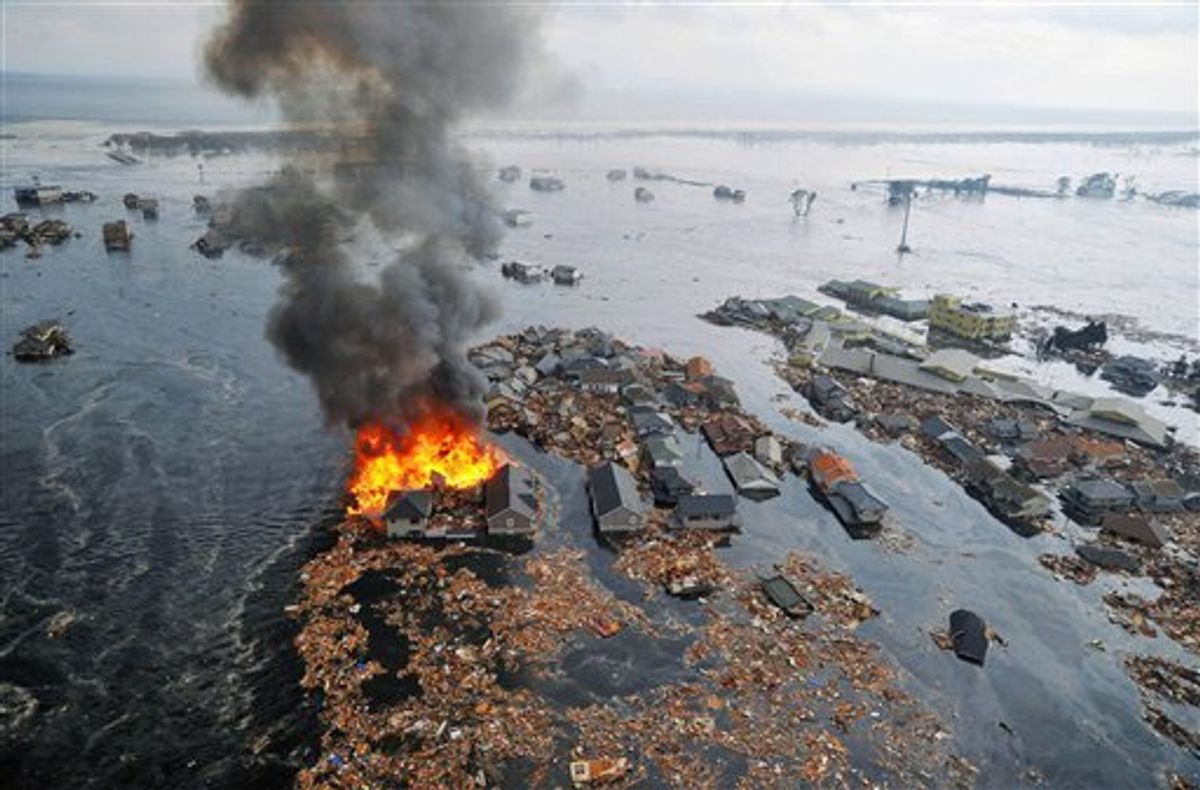
Houses swallowed by tsunami waves burn in Sendai, Miyagi Prefecture (state) after Japan was struck by a strong earthquake off its northeastern coast Friday, March 11, 2011. (AP Photo/Kyodo News) JAPAN OUT, MANDATORY CREDIT, FOR COMMERCIAL USE ONLY IN NORTH AMERICA, NO SALES (Credit: AP)

When the Indian Ocean earthquake and tsunami hit on Boxing Day, 2004, there was no YouTube or Twitter yet. Facebook was still mostly an Ivy League geek hangout. And images of the devastation were still mostly disseminated by the major news outlets. Even when a massive earthquake hit Haiti in January of 2010, the images coming out of the poorest country in the Western Hemisphere were scattershot. But when a relentlessly powerful 8.9 earthquake — and series of havoc-wreaking tsunamis — hit Japan on Friday, the one thing we didn’t lack for was an overwhelming wealth of firsthand accounts and harrowing footage. In a very new and real way, devastation has gone viral.

On Twitter, the Earthquakes Tsunamis feed has been updating every few minutes since the first, chillingly plain-stated report of an earthquake off the east coast of Honshu came in. Today hashtags are mounting and the online community is scrambling, via Facebook and Twitter, to exchange both news and personal accounts. But it’s the dramatic videos that are riveting the world today, and creating an already uneasy sense of horror and awe.

Continue Reading
Mary Elizabeth Williams

Mary Elizabeth Williams is a staff writer for Salon and the author of "Gimme Shelter: My Three Years Searching for the American Dream." Follow her on Twitter: @embeedubMore Mary Elizabeth Williams

Wednesday, Jun 29, 2011 2:40 PM UTC2011-06-29T14:40:00Zl, M j, Y g:i A T

Lady Gaga sued over fundraising for Japan

The megastar's spokeswoman says lawsuit over charity wristbands is meritless

Lady Gaga

Lady Gaga poses for photographers with a coffee cup with a message in Japanese "Pray for Japan" during a press conference to promote of MTV Video Music Aid Japan in Tokyo, Thursday, June 23, 2011. Lady Gaga said that she will sell the coffee cup at auction and donate the money for the tsunami-hit northeastern Japan. (AP Photo/Shizuo Kambayashi) (Credit: AP)

Lady Gaga’s spokeswoman says a lawsuit accusing the music star of misleading fans with an online pitch for donations to victims of the Japan earthquake is meritless.

Lady Gaga’s website is selling $5 wristbands that say, “We Pray For Japan.” The website also allows people to make additional donations and says “all proceeds go directly to Japan relief efforts.”

A lawsuit filed in Detroit notes that sales tax and a $3.99 shipping charge are added. Detroit-area attorney Alyson Oliver believes not all money is going to help the Japanese and she wants an accounting.

Lady Gaga’s spokeswoman, Holly Shakoor, said Tuesday that no profit is being made on shipping costs. She says $5 from each wristband is going to Japan.

The lawsuit seeks refunds for people who bought wristbands.

  More Associated Press

Thursday, Jun 9, 2011 3:34 PM UTC2011-06-09T15:34:00Zl, M j, Y g:i A T

Fukushima’s “mutant” earless bunny

A video captured of a rabbit born without ears sparks (likely unfounded) fears of radiation side effects

Fukushima's "mutant" earless bunny

This story is almost certainly not about a genuine mutant bunny. However, Japanese media outlets have hailed the birth of an earless rabbit allegedly born near the damaged Fukushima nuclear facility as evidence of fearsome side effects of the catastrophe.

The bunny, captured on video and posted to YouTube, was reportedly found near Fukushima at the end of last month. According to radiation experts, however, the likelihood that the rabbit’s unusual features are a result of nuclear mutation is very slim.

Continue Reading

Natasha Lennard is Brooklyn-based writer and a project officer for the International News Safety Institute - North America.   More Natasha Lennard

Friday, May 27, 2011 1:15 PM UTC2011-05-27T13:15:00Zl, M j, Y g:i A T

Fukushima’s tsunami plan was a single page

Document reveals TEPCO had ruled out the possibility of a tsunami large enough to knock the plant offline

Japan Earthquake

In this April 12, 2011 photo released by the Japan Defense Agency via Kyodo News, Japanese soldiers wash an armored vehicle to remove potential radiation contamination at J-Village, a soccer training complex now serving as an operation base for those battling Japan's worst nuclear disaster, northeastern Japan. The sports complex is about about 20 kilometers (12 miles) from the crippled Fukushima Dai-ichi nuclear plant. (AP Photo/Japan Defense Agency via Kyodo News) JAPAN OUT, MANDATORY CREDIT, NO LICENSING IN CHINA, HONG KONG, JAPAN, SOUTH KOREA AND FRANCE (Credit: AP)

Japanese nuclear regulators trusted that the reactors at Fukushima Dai-ichi were safe from the worst waves an earthquake could muster based on a single-page memo from the plant operator nearly a decade ago.

In the Dec. 19, 2001 document — one double-sized page obtained by The Associated Press under Japan’s public records law — Tokyo Electric Power Co. rules out the possibility of a tsunami large enough to knock the plant offline and gives scant details to justify this conclusion, which proved to be wildly optimistic.

Continue Reading

  More Yuri Kageyama

  More Justin Pritchard

Saturday, May 14, 2011 6:01 PM UTC2011-05-14T18:01:00Zl, M j, Y g:i A T

Japan’s distinctly un-American brand of heroism

On a recent trip, I saw how differently they respond to crisis than we do -- and how they could change the world

Japan's distinctly un-American brand of heroism

On a trip to Japan three weeks after the devastating earthquake, tsunami and nuclear power plant disaster, I repeatedly ran into the theme of “change.” Young people in their 20s and 30s likened the Tohoku catastrophe to 9/11, after which Americans were enveloped by a sense of unity. “That feeling disappeared,” I warned.

“It won’t disappear here,” everyone insisted. “Japan is going to change.”

I tried imagining a similar conversation following a national tragedy with friends and family in New York, California and Nebraska. I know what I would hear: the names of potential candidates to lead the Democratic and Republican parties, state laws that could serve as models for the nation, criticism and praise of the media. In other words, I would hear a small-scale version of the garrulous chatter that surrounds us every four years during a presidential election.

Continue Reading

Marie Mutsuki Mockett is the author of "Picking Bones from Ash." Her work has appeared in the New York Times, The New Yorker online, Glamour and NPR.  More Marie Mutsuki Mockett

Saturday, May 14, 2011 3:12 PM UTC2011-05-14T15:12:00Zl, M j, Y g:i A T

Worker dies at Japan’s crippled nuclear plant

Authorities say body showed no signs of radiation poisoning

Japan Earthquake

A Japan Ground Self-Defense Force soldier works in a sewer in an area devastated by the March 11 earthquake and tsunami in Taro, Iwate Prefecture, northeastern Japan, Friday, May 13, 2011. (AP Photo/Junji Kurokawa) (Credit: AP)

A man died on his second day working at Japan’s tsunami-wrecked nuclear power plant Saturday, and the plant operator said harmful levels of radiation were not detected in his body.

The contract worker in his 60s was the first person to die at the Fukushima Dai-ichi nuclear plant in northeastern Japan since the March 11 quake and tsunami damaged the facility, causing a string of fires, explosions and radiation leaks in the world’s second-worst nuclear accident.

The worker was carrying equipment when he collapsed and died later in hospital, said Naoyuki Matsumoto, spokesman for Tokyo Electric Power Co. The company does not know the cause of his death, Matsumoto said.

Continue Reading

  More Associated Press

Page 1 of 23 in Japan Earthquake

Other News