Air Travel
What if an earthquake strikes as a plane is landing?
There is a worst-case scenario, but the only place you're liable to see it is in a Hollywood movie
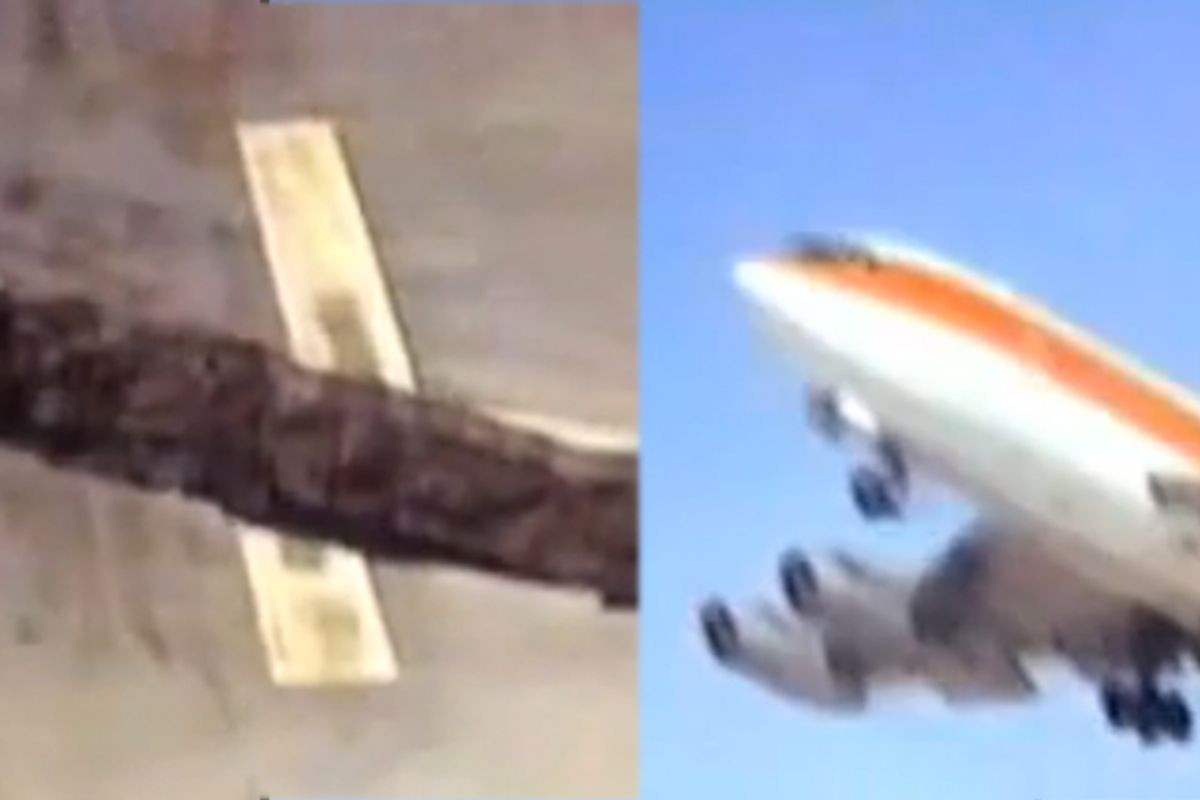
Scenes from the 1974 movie "Earthquake" So, here I am trying to work this earthquake business into a column about air travel. Airplanes, airports, earthquakes. Tsunamis. There has to be a way to link them.
Except not really.
Sure, I get certain, if somewhat silly questions all the time:
What happens if an earthquake strikes just as a plane is landing or taking off?
Aircraft landing gear are designed to withstand some pretty severe jolts, but it would depend on the strength of the shaking and the speed of the plane. And better to have this happen during landing, when the idea is to stay on the ground and decelerate, rather than on takeoff, when you’re accelerating and attempting to fly. A high-speed upset on takeoff could be very dangerous, especially if the runway begins to buckle or the plane is knocked side to side and manages to smash a wingtip or an engine. (Note: The shaking of a 7.0 temblor is roughly equivalent to one of the author’s normal landings, so nothing new there.)
But what if the runway were to fracture or split apart?
I can’t imagine there are airports built directly over fault lines, but I suppose this is possible nonetheless. What would happen? Well, in a worst scenario: a 747 is accelerating through 150 knots when the runway heaves and cracks and suddenly there’s a 5-foot ledge of broken concrete dead ahead. The jet slams violently into the fissure, shearing off the gear and engines. It pancakes and spins, clipping the wingtips of several planes on a nearby taxiway and setting all of them on fire …
Statistically, though, about the only place you’re liable to see that happen is in a Hollywood movie.
Or not even: The 1974 disaster film “Earthquake” had its chance, but gave us a near-miss instead. In the scene — if I’m remembering it right — a Boeing 707 is about to touch down at LAX just as The Big One hits Los Angeles. The runway starts shaking and cracking and a huge fissure opens up. The crew spots it, though, and executes a safe go-around just in the nick of time.
They don’t make disaster movies like they used to.
What if a tsunami comes washing across the airport, smashing through the terminal and washing away planes. If you were in one of those planes, would you ride it out or try to escape?
Let’s not have this discussion anymore. [Note: Somebody really sent me that question]
Look, airports have been struck by quakes, if maybe not tsunamis, many times in the past, and I am unaware of any onboard casualties. When it comes to natural disasters, the more potent threats to flying are hurricanes, tornadoes, cyclones and typhoons — phenomena that spawn violent winds, shears, extreme turbulence and the like.
And as we know, it’s not the moving of the ground that kills and injures people during a quake, but rather structures collapsing on top of them. Few places could be safer than an empty expanse of airport tarmac, and excepting those far-fetched scenarios above, you’d be better off inside a plane, certainly, than inside the terminal.
I was at the airport in Mexico City a month or so ago, at the new Terminal 2 — an airy, if cheerless structure of fragile-looking honeycombed concrete. This was Mexico City, after all, and presumably this building was designed with quakes very much in mind. Still, it just didn’t look safe.
I felt better once I was in the plane.
- – - – - – - – - – - -
Do you have questions for Salon’s aviation expert? Contact Patrick Smith through his website and look for answers in a future column.
Patrick Smith is an airline pilot. More Patrick Smith.
Behind the underwear bomb
The latest airplane terror plot wouldn't have been foiled without airport security -- but not the kind we all know
Travelers line up at a TSA checkpoint at Los Angeles International Airport.
(Credit: Reuters/Danny Moloshok) Another deadly plot taken down in the planning stages. This time, thanks to the work of a CIA double agent, officials were able to infiltrate a Yemen-based al-Qaida plot to destroy a U.S.-bound jetliner using a nearly undetectable underwear bomb.The moral of the story: Airport security works!Am I being facetious? Not necessarily. It depends on your definition of airport security.
In my mind, the key to keeping airplanes safe is, and always has been, stopping acts of sabotage while they are still in the planning stages. Here in the age of the TSA checkpoint, with its toothpaste confiscations and obsession with pointy objects, we tend not to think this way, preoccupied instead with a kind of airport Kabuki — the tedious, fanatical screening of passengers and their carry-ons. Real airport security takes place offstage, as it were. It is the job of the folks at the CIA and the FBI, working together with foreign authorities. And while TSA has an important role here too, we can do without the spectacle of airport guards rifling through innocent people’s bags in a pathological hunt for what are effectively harmless items.
Continue Reading ClosePatrick Smith is an airline pilot. More Patrick Smith.
How the rich took over airport security
Security checks were one of America's most democratic places -- until rich passengers got their own speedy lines
(Credit: Reuters/Salon) The other day at Bergstrom Airport in Austin, Texas, I witnessed a striking manifestation of the new American plutocracy. Along with getting a photo at the Department of Motor Vehicles and sitting in a jury pool, standing in line at airport security with a mob of other people, miserable though it is, remains one of the few examples of civic equality in our increasingly oligarchic republic. Much airport security, of course, is theater, designed to provide alibis for bureaucrats and politicians in the event of a terrorist attack. But while we can debate what a rational airport security system would look like, no rational system would discriminate among passengers on the basis of ability to pay.
Continue Reading CloseMichael Lind’s new book, "Land of Promise: An Economic History of the United States", will be published in April and can be pre-ordered at Amazon.com. More Michael Lind.
When parents drug their kids
Antihistamines can knock out even the loudest child on a plane. Is it safe -- or just bad parenting?
(Credit: Ilya Andriyanov and KAMONRAT via Shutterstock) When I wrote last week about the 2-year-old girl who, along with her whole family, was kicked off a JetBlue flight for having a tantrum, I expected an outpouring of responses. What I hadn’t imagined was how much of it would be in favor of sedating kids as a practical means of getting them from point A to point B. “You know how I traveled with toddlers?” the stay-at-home mother of two tweeted to me. “Benadryl. Works like a charm.”
Continue Reading Close
Mary Elizabeth Williams is a staff writer for Salon and the author of "Gimme Shelter: My Three Years Searching for the American Dream." Follow her on Twitter: @embeedub. More Mary Elizabeth Williams.
When a flight becomes “pre-schoolers gone wild”
A family with toddlers is ejected from a JetBlue plane -- and kicks up a storm about kids and travel
(Credit: Kenneth Man via Shutterstock) Very few venues in this world — especially ones that invlove confined spaces — are thrilled to welcome a 2-year-old. Unless you’re at a Wiggles reunion show, the most common response is a lot of rolled eyes, anticipatory grimacing and the question “Can we change our seats?” So when JetBlue staff noticed young Natalie Vieau boarding a flight from Turks and Caicos with her parents and her 3-year-old sister last month, it’s possible they were already steeling themselves for Natalie to behave exactly like, well, a 2-year-old. When young Miss Vieau complied, pitching a fit that would have made Chris Brown proud, the crew kicked her and her family off the plane. Discuss.
Continue Reading Close
Mary Elizabeth Williams is a staff writer for Salon and the author of "Gimme Shelter: My Three Years Searching for the American Dream." Follow her on Twitter: @embeedub. More Mary Elizabeth Williams.
The things I carry
All those gadgets, chargers, adapters and cords are supposed to make my life easier. I'm not so sure
(Credit: Patrick Smith) The scourges of modern-day air travel.
I can think of a few: TSA, delayed flights, garbage in your seat pocket. Screaming kids and misdirected luggage. “CNN Airport News.”
Or, how about the blizzard of cardboard placards that hotel chains insist on littering their rooms with? I spend a quarter of my life in hotel rooms, and I resent having to spend the first five minutes of every stay gathering up an armful of this diabolical detritus and heaving it into a corner where it belongs. Attention, innkeepers: This is fundamentally bad business. One’s first moments in a hotel room should be relaxing. The room itself should impart a sense of welcome. It shouldn’t put you to work.
Continue Reading ClosePatrick Smith is an airline pilot. More Patrick Smith.
Page 1 of 122 in Air Travel