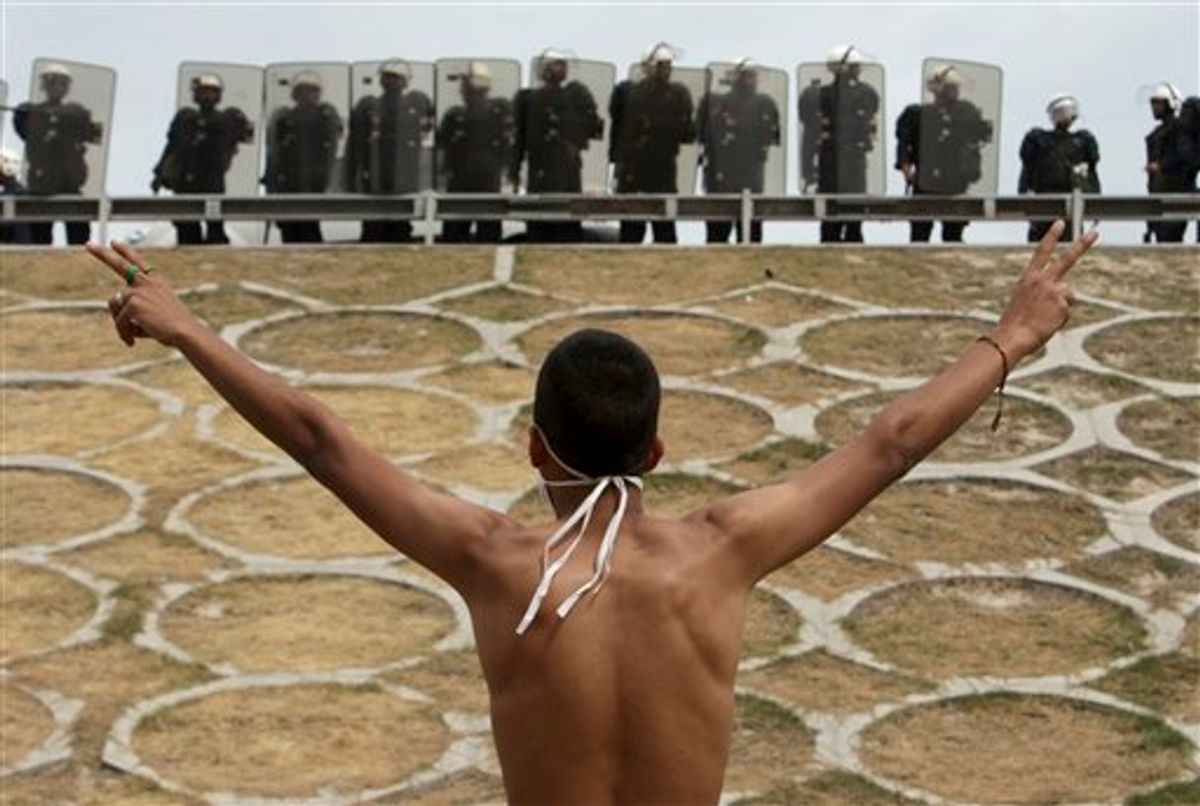
A Saudi-led military force crossed into Bahrain Monday to prop up the monarchy against widening demonstrations that have sent waves of fear through Gulf states over the potential for enemy Iran to take new footholds on their doorsteps.
The Bahrain conflict is sectarian as much as pro-democracy, as the strategic Gulf island nation's majority Shiite Muslims see an opportunity to rid themselves of two centuries of rule by a Sunni monarchy.
But Gulf Sunni leaders worry that might give Shiite Iran a stepping stone to its arch-rival Saudi Arabia, connected to Bahrain by a wide causeway.
Instead, the Saudis and the other members of the Gulf Cooperation Council sent forces the other way, deploying about 1,000 troops by land and air and cementing the entire six-nation alliance to the fate of Bahrain's rulers, key U.S. allies as hosts of the U.S. Navy's 5th Fleet.
The first cross-border offensive against one of the rebellions sweeping the Mideast was not greeted with celebrations.
Shortly after word of the foreign military reinforcements began to spread through the island nation, protesters blocked roads in the capital Manama. Thousands of others swarmed into Pearl Square, the symbolic center of the monthlong revolt.
Shiite-led opposition groups denounced the Gulf military task force as an occupation that pushes the tiny island kingdom dangerously close to a state of "undeclared war."
"No to occupation," demonstrators cried in Manama's packed Pearl Square.
Gulf leaders see it completely differently.
The Sunni kings and sheiks fear any cracks in Bahrain's ruling system could threaten their own foundations. Protests are already flaring in Oman, Kuwait and even tightly ruled Saudi Arabia. The leaders also perceive political gains by Bahrain's Shiites as potential avenues of entry for Iran's Shiite regime -- even though there are no apparent links between Tehran and Bahrain's Shiite opposition.
"The Gulf leaders have tried to legitimize this. They portray it not as intervention in an internal Bahrain dispute, but rather as an action against an external threat," said Sami Alfaraj, director of the Kuwait Center for Strategic Studies. "Bahrain is the arena for the worries about Iran."
In Tehran, authorities had no comment on the Gulf force moving into Bahrain. Iranian Foreign Minister Ali Akbar Salehi called on Bahrain to avoid using "violence and force," according to the semiofficial Fars News Agency.
In Washington, White House spokesman Jay Carney pointedly did not call on the Saudi-led force to withdraw. Asked about that, he said, "We are calling on the countries in the region to show restraint, and pointing to the fact that the dialogue that can bring about political reform is essential for the stability of the countries in the region and their continued economic prosperity."
It's not clear when the tipping point arrived for Bahrain to seek outside help. The rulers have faced a month of nonstop unrest that has left seven people dead and the country drifting toward open sectarian conflict.
There have been scenes of defiance and disobedience so unsettling that pro-government parliament members appealed to Bahrain's king to impose martial law. On Sunday, protesters paralyzed Bahrain's finance district with roadblocks and then stood their ground -- and in some cases pressed forward -- against riot police firing tear gas in Pearl Square.
A statement on the state-run Bahrain News Agency said troops from the GCC's Peninsula Shield Force have been deployed "in line with the principle of common destiny bonding" the bloc, made up of Saudi Arabia, Oman, Kuwait, Bahrain, Qatar and the United Arab Emirates.
The statement said the reason for the mission was "the common responsibility of the GCC countries in maintaining security and stability. "
The Shield Force was created in the 1980s. Military units under a GCC command have been sent to Kuwait, including during the 1991 U.S.-led campaign to oust Saddam Hussein's force and in 2003 before the invasion of Iraq. The current action marks a significant shift to help a government quell internal unrest.
"It changes the role of the GCC actually," said Jane Kinninmont, a senior research fellow and Bahrain expert at the London-based think tank Chatham House. "They've always had their collective defense (pacts) ... The idea of gathering together to protect a government against its own people seems to be quite another thing."
The United Arab Emirates and Saudi Arabia have announced their forces were sent to Bahrain, but it was unclear about the contributions from the other states. By midday Monday, dozens of Saudi military vehicles were crossing over the causeway connecting the countries. The Gulf Daily News, which is close to Bahrain's rulers, said the Gulf forces would protect sites such as electricity stations and oil facilities.
Opposition leaders were outraged and -- in an ominous sign for Bahrain's rulers -- taking about resistance rather than possible dialogue.
"We consider that any military force or military equipment crossing the boundaries of Bahrain -- from air, sea or land -- an occupation and a conspiracy against the people of Bahrain ... and threatens them with an undeclared war by armed troops," said a statement from a coalition of seven main opposition groups.
For their part, Bahrain's leaders have expressed increasing frustration that opposition factions have not accepted offers to open a dialogue.
In a series of Twitter messages, Bahrain's prime minister, Sheik Khalifa bin Salman Al Khalifa, lashed out at the Shiite-led protesters. "What we are witnessing in Manama is no peaceful protest," he wrote. "It's wanton, gangster style takeover of people's lives."
Shiites, who account for 70 percent of the population, have long complained of systematic discrimination by the Sunni dynasty.
The grievances include allegations of being blackballed from key government and security posts. They also strongly object to government policies that give citizenship and jobs to Sunnis from other Arab countries and South Asia as a way to offset the Shiites' demographic edge.
The main opposition groups have called for the Sunni rulers to give up most of their powers to the elected parliament. But as violence has deepened, many protesters now say they want to topple the entire royal family.
U.S. Defense Secretary Robert Gates visited Bahrain on Saturday and urged leaders to quickly move on reforms. On the same day, Bahrain's Interior Ministry said the sectarian strife was threatening the "social fabric" of the nation.
Last week, the GCC promised $10 billion in aid to both Bahrain and Oman, which also had faced protests calling for more jobs and a greater public voice in political affairs.
Elsewhere in the region, Yemen's president, Ali Abdullah Saleh, came under increasing pressure as workers and university staged strikes and more powerful tribal chiefs turned against his 32-year rule. On Sunday, Saleh fired a government minister for failing to persuade protesters to end their monthlong revolt.
Murphy reported from Dubai, United Arab Emirates. Associated Press writer Maamoun Youssef in Cairo, Adam Schreck in Dubai, and Ahmed Al-Haj in Sanaa, Yemen, contributed to this report.
Shares