Lessons from Japan’s economic aftershock
The Japanese will do a better job recovering from their disaster than the U.S. did from its financial meltdown
By Andrew LeonardTopics: Japan Earthquake, Earthquakes, How the World Works, Politics News
Is it overly callous to even ask the question of what impact Japan’s horrendous earthquake will have on the world economy? Judging by the blistering reaction to CNBC host Larry Kudlow’s appalling comment that “The human toll here looks to be much worse than the economic toll, and we can be grateful for that,” this is territory that demands care.
Kudlow later apologized, saying he had “flubbed” his line. Oops. Maybe he would have been better served by a moment of a silence. As the death toll mounts in Japan and nuclear power plants teeter on the edge of meltdown, worrying about what’s going to happen to GDP growth rates — in Japan, the U.S. or globally — shouldn’t be a high priority.
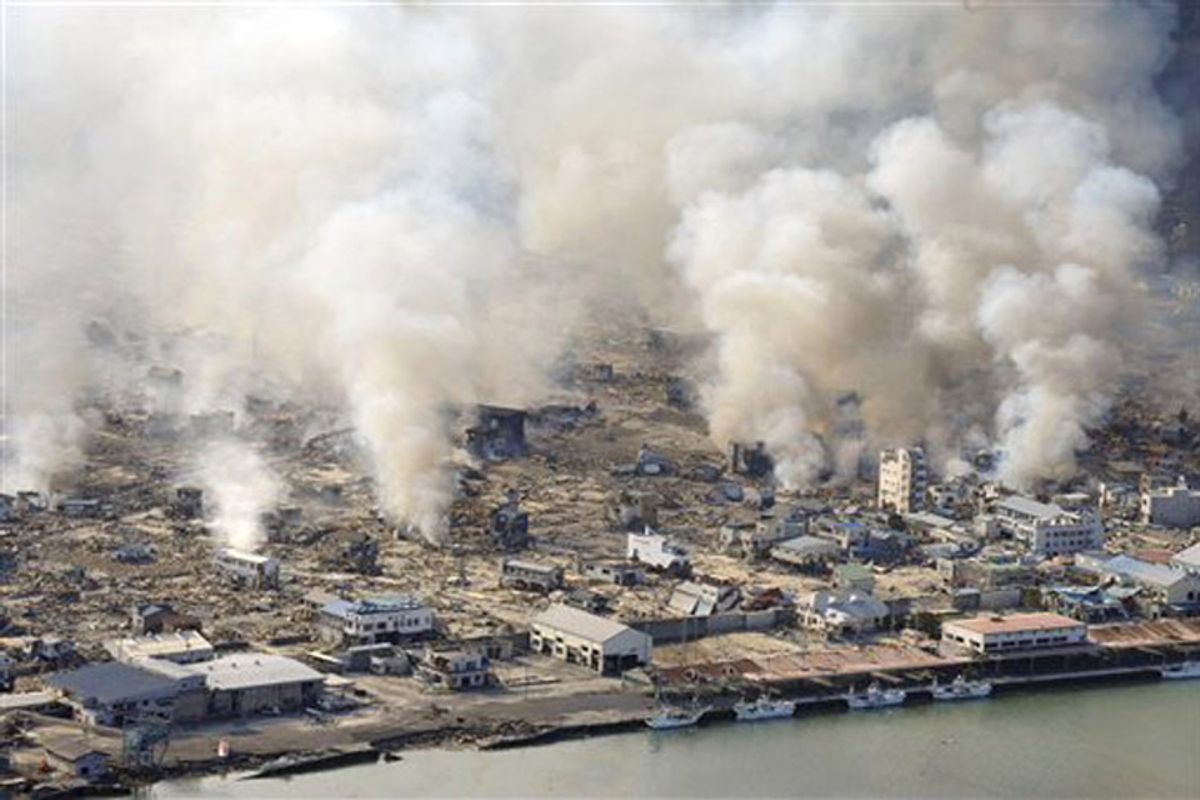
But even with that mind, there are still some useful lessons to be taken from how Japan goes about recovering from this disaster. There’s a kind of consensus opinion on the part of the economists that natural disasters do not pose a significant long term threat to rich economies because governments ramp up spending quickly to repair the damage, creating an automatic stimulus. Japan will be rebuilding a lot of infrastructure. Stock prices of companies that make construction equipment are already rising.
It won’t be easy — the most recent estimation of the cost of “recovery and reconstruction” starts at around $180 billion dollars. That puts Japan in a tough position, because the government is carrying a ton of debt — in percentage terms, Japan is far worse off than the United States — which means finding the cash to pay for the rebuilding effort will require a scramble. Bond market watchers are already wondering if Japan — one of the biggest foreign purchasers of U.S. Treasuries, will curtail spending on bonds while diverting funds to reconstruction. If demand from Japan falls for Treasuries, could that be a catalyst for a broad-based flight from U.S. debt, with all the consequent economic and political fallout that rising borrowing costs will entail? That’s the kind of out-of-the-blue danger scenario that no one can predict when cataloguing downside threats to an economy.
But here’s the interesting thing. The government is reportedly considering a temporary tax increase to pay for recovery efforts. It’s a natural response — – when you have a great disaster, you need to fix the problem. The faster you do so, the better off everyone is — so-called V-shaped economic recoveries are common after destructive events like earthquakes. Absent the emergence of a Japanese Tea Party rebellion, the general public will probably go along with a tax increase. The horrific visuals on every TV screen require such a response.
When we can’t see the damage so easily, we handcuff ourselves. We know now that financial crises impose far deeper longterm economic consequences than natural disasters or oil shocks or even wars. Is the fact that there doesn’t appear to be a consensus that repairing the damage caused by a financial crisis should be accomplished as quickly and comprehensively as possible the reason why?. The great Wall Street crash of 2008 didn’t annihilate towns from the face of map or result in thousands of deaths, but it did put millions of people out of work — and they’re still out of work. We should be engaging with that disaster every bit as forthrightly as Japan will face its own crisis. Nobody sits around and waits for things to fix themselves after an earthquake.
The United States is producing a lot less than it could be producing primarily because a large number of people, the unemployed people, aren’t producing anything at all. And yet we have functioning office buildings they could sit in. We have factories running at below capacity they could work in. We have trucks and cranes and other machines they could operate. We haven’t been hit by an earthquake, our power plants aren’t exploding, our roads aren’t blocked by displaced automobiles, we’re just not putting everyone to work. That’s the very definition of a country with inadequate aggregate demand, and we should be fighting the situation with every tool at our disposal. Instead the debate in congress is about how much short-term spending to cut, and voices slamming the Fed for being too loose continue to be heard louder than those slamming it for being too tight.
Andrew Leonard is a staff writer at Salon. On Twitter, @koxinga21. More Andrew Leonard.
Related Stories
More Related Stories
-
Developers evict historic women's shelter to build luxury hotel
-
Guantánamo prisoner on hunger strike cries for help on Twitter
-
3 possible solutions to international tax avoidance
-
“I just want the U.S. to send my father home”
-
Army weapons engineer tied to white nationalist organizations
-
Ted Cruz against the world
-
David Vitter's hypocritical, punitive, horrible new amendment
-
Louie Gohmert: Women should be forced to carry nonviable pregnancies to term
-
Could hackers destroy the U.S. power grid?
-
Democrats may be even worse than Republicans at regulating Wall Street
-
Eric Holder versus journalism
-
A progressive defense of drones
-
There's no substitute for government disaster relief
-
Holder signed off on search warrant for reporter
-
Mississippi could begin prosecuting women for miscarriages
-
Mike Judge: "Bowling for Columbine" made me pro-gun
-
Closing Gitmo is not enough
-
Murkowski: Palin too disengaged to run for Senate
-
In IRS scandal, new GOP tactic is ignorance
-
Code Pink activist berates Obama at national security speech
-
Cuomo: "Shame on us" if New York City elects Weiner
Featured Slide Shows
The week in 10 pics
close X- Share on Twitter
- Share on Facebook
- Thumbnails
- Fullscreen
- 1 of 11
- Previous
- Next
-
Lisa Montgomery embraces her nephew Thursday after a tornado tore apart her home in Cleburne, Texas. The twister killed six people and destroyed entire swaths of the North Texas town.
Credit: AP/LM Otero -
Jack McMahon, the defense attorney for abortion doctor Kermit Gosnell, speaks outside the Criminal Justice Center in Philadelphia Tuesday. His client was convicted of killing three babies in his clinic, and will serve multiple life sentences.
Credit: AP/Matt Rourke -
A photo taken Monday captures Vice President Joe Biden's response to a Milwaukee second-grader's innovative proposal to end America's epidemic of gun violence. This guy!
Credit: AP/Jenny Aicher -
Sen. Rand Paul, R-Ky., flanked by a grouper-eyed Michele Bachmann, addresses the IRS' admission that it targeted Tea Party groups in advance of the 2012 election. In an op-ed for CNN Thursday, the Kentucky senator slammed the president for his faux outrage.
Credit: AP/Molly Riley -
Ousted IRS chief Steven Miller is sworn in on Capitol Hill Friday. Miller testified before the House Ways and Means Committee on the extra scrutiny the agency gave conservative groups applying for tax-exempt status.
Credit: AP/J. Scott Applewhite -
Attorney General Eric Holder pauses as he testifies on Capitol Hill before the House Judiciary Committee Wednesday. Holder is under fire, among other things, for the Justice Department's gathering of phone records at the Associated Press.
Credit: AP/Carolyn Kaster -
O.J. Simpson sits during an evidentiary hearing at Clark County District Court in Las Vegas, Nev., Thursday. Simpson, who is currently serving a nine-to-33-year sentence in state prison for armed robbery and kidnapping, is using a writ of habeas corpus to seek a new trial.
Credit: AP/Las Vegas Review-Journal/Jeff Scheid -
Major Tom to ground control: On Sunday astronaut Chris Hadfield recorded the first music video from space, a cover of David Bowie's "Space Oddity."
Credit: AP/NASA/Chris Hadfield -
When it rains it pours. President Barack Obama speaks during a news conference Thursday with Turkish Prime Minister Recep Tayyip Erdogan, inexplicably inspiring an #umbrellagate Twitter meme.
Credit: AP/Jacquelyn Martin -
A smoke plume rises high above a road block at the intersection of County A and Ross Road east of Solon Springs, Wis., Tuesday. No injuries were reported, but the the wildfire caused evacuations across northwestern Wisconsin.
Credit: AP/The Duluth News-Tribune/Clint Austin -
Recent Slide Shows
- Share on Twitter
- Share on Facebook
- Thumbnails
- Fullscreen
- 1 of 11
- Previous
- Next
Related Videos
Most Read
-
Tornado survivor to Wolf Blitzer: Sorry, I'm an atheist. I don't have to thank the Lord
Mary Elizabeth Williams
-
9-year-old slams Rahm over Chicago schools
Natasha Lennard
-
Oklahoma senator: Tornado aid "totally different" from Sandy aid
Jillian Rayfield
-
Judge tells lesbian couple to separate -- or lose kids
Irin Carmon
-
Experts: Fox News spying scandal a game-changer
Natasha Lennard
-
Greek yogurt, toxic waste hazard?
Kristen Gwynne, AlterNet
-
Inhofe and Coburn: Red state hypocrites
Joan Walsh
-
Facebook's hate speech problem
Mary Elizabeth Williams
-
Brad Pitt keeps breaking his silence on how boring marriage to Jennifer Aniston was
Daniel D'Addario
-
Graphic video reportedly shows possible London machete attack suspect
Jillian Rayfield
Popular on Reddit
links from salon.com

65 points66 points67 points | 2 comments

37 points38 points39 points | 10 comments

28 points29 points30 points | 2 comments
From Around the Web
Presented by Scribol
-
No Evidence FBI Is Targeting Chechen Separatists In Boston Bombing Case, Advocates Say - Welcome Back Weiner Puns
-
Bill De Blasio Won't Be Distracted By Anthony Weiner -
State Roadblocks Could Complicate Marriage Momentum - Obama Calls On Naval Academy Graduates To Help Put An End To Sexual Assault In The Military


Comments
17 Comments