Nuke industry continues desperate spin effort

The Nuclear Energy Institute maintains that the radiation release from Japanese plants has been "controlled"

Topics: Japan Earthquake, War Room,

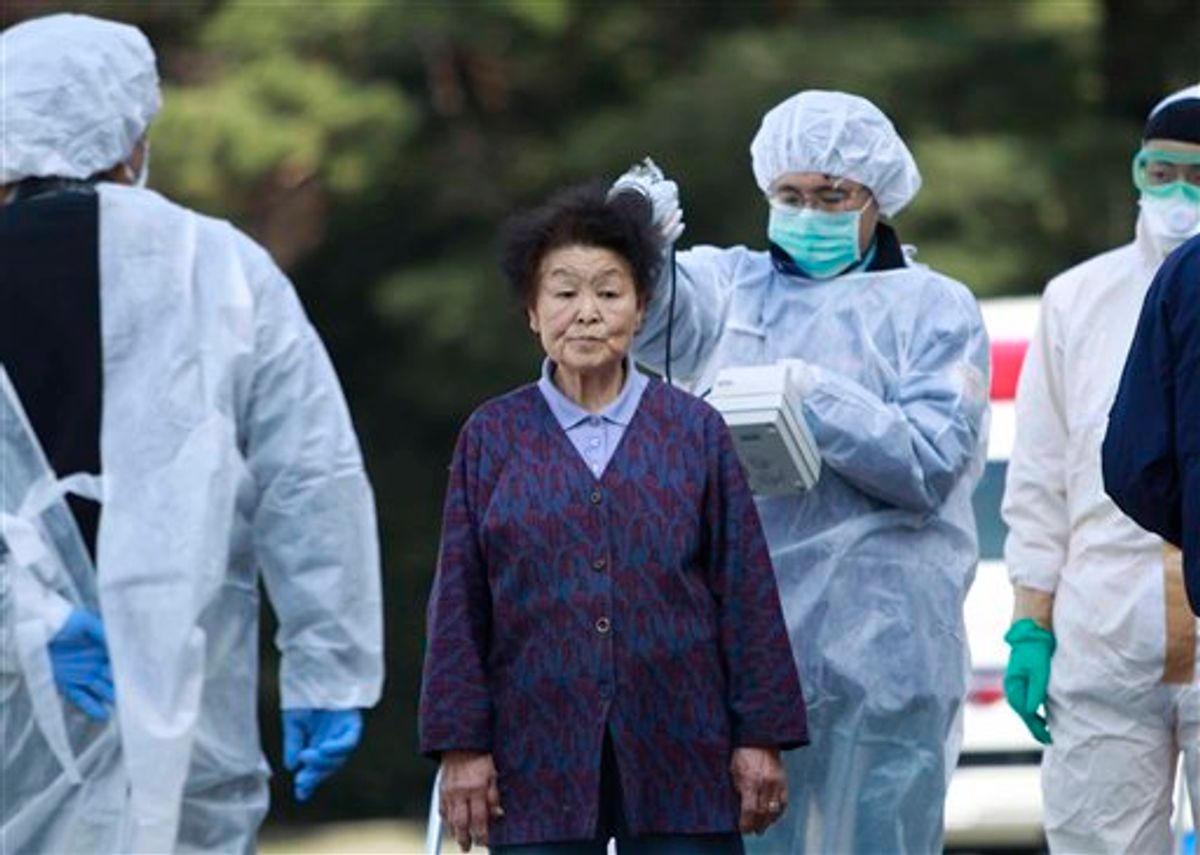
Nuke industry continues desperate spin effortResidents evacuated from areas surrounding the Fukushima nuclear facilities damaged in Friday's massive earthquake, are checked for radiation contamination, Sunday, March 13, 2011, in Koriyama city, Fukushima prefecture, Japan. (AP Photo/Wally Santana)(Credit: AP)

Yesterday I wrote about the emerging spin from the nuclear industry — that Americans should be “reassured” by the Japanese disaster because U.S. power plant operators will be able to learn from mistakes there.

Now, the industry trade group has posted a Q&A on its website that does not reiterate the “reassured” claim, but still makes some statements that deserve scrutiny.

The Nuclear Energy Institute document, which was updated Sunday at 3:30 p.m., says in part (emphasis added):

The events at Fukushima Daiichi show that nuclear power’s defense-in-depth approach to safety is appropriate and strong. Despite one of the largest earthquakes in world history, with accompanying tsunamis, fires and aftershocks — multiple disasters compounded one on top of the other — the primary containments at reactors near the epicenter have not been breached and the radioactive release has been minimal and controlled. This event will show that even under very severe circumstances, nuclear power plants are designed to withstand natural disasters.

We know that roughly 200,000 people around nuclear plants have been evacuated, 150 workers have been exposed to radiation, and some crew members on an American aircraft carrier 100 miles offshore got low-level doses of radiation. Clearly, though, many of the facts are still not known, and the crisis at multiple reactors is unresolved.

But the New York Times last night published a story that suggests, contra the industry’s statement, the effects of the radiation could be long-lasting:

Japanese reactor operators now have little choice but to periodically release radioactive steam as part of an emergency cooling process for the fuel of the stricken reactors that may continue for a year or more even after fission has stopped. The plant’s operator must constantly try to flood the reactors with seawater, then release the resulting radioactive steam into the atmosphere, several experts familiar with the design of the Daiichi facility said.

That suggests that the tens of thousands of people who have been evacuated may not be able to return to their homes for a considerable period, and that shifts in the wind could blow radioactive materials toward Japanese cities rather than out to sea.

Again, it’s too early to say where this is going. But the early signs are ominous — both for people in Japan and for the nuclear industry’s public image.

Justin Elliott

Justin Elliott is a reporter for ProPublica. You can follow him on Twitter @ElliottJustin

Next Article

Featured Slide Shows

Gripping photos: The people of the Turkey protests (slideshow)

close X
  • Share on Twitter
  • Share on Facebook
  • Thumbnails
  • Fullscreen
  • 1 of 11
  • The protests take on a festive element as police forces move out of the park and square. Wearing a gas mask, this young man dances to traditional Turkish music in front of Taksim Square’s Ataturk Monument.

  • In Gezi Park since March 31st, this protester, originally caught off-guard by the Government’s teargas and water cannons, went out and bought a Russian army mask from WWII, preparing for what was to come.

  • This rambunctious boy seems to be enjoying the chaos. After taking this picture he threw a stone at the already destroyed building in the background.

  • Forming a line, the police face off directly with protesters in Taksim Square. After a while, they retreated and there was a general cheer – a back-and-forth dance that has been common since the beginning of this protest.

  • An elderly woman in Gezi Park reads the news. The tent community occupying the park was violently destroyed on June 16th.

  • Many different groups had set up booths to promote their cause in Taksim Square and Gezi Park. Standing in front of one, this man waves his flag while posing with conviction.

  • Many home-remedies are used to minimize the effects of tear gas. This woman has put a milky solution on her face, removing her mask after the tear gas dissipated. Before sunrise, the police came again for another round of teargasing.

  • People capitalize on the uprising -- selling flags, beer, gas masks, sky lanterns and spray paint to name just a few of the popular items.

  • On Monday morning, June 11, the police execute a strong offensive. Many plain-clothed police officers, like the ones seen here, clash with protesters in the side streets away from the main stand-off in Taksim.

  • The authorities seem to be most aggressive in the night, pushing protesters away from the square and park. After being teargassed this young woman catches her breath with other protesters on Siraselviler Street.

  • Recent Slide Shows

  • Share on Twitter
  • Share on Facebook
  • Thumbnails
  • Fullscreen
  • 1 of 11

Comments

140 Comments

Comment Preview

Your name will appear as username ( settings | log out )

You may use these HTML tags and attributes: <a href=""> <b> <em> <strong> <i> <blockquote>