Japan Earthquake
Sympathy for Gilbert Gottfried
The comedian's insensitive Japan jokes may have cost him his job -- but they were a legitimate response to tragedy
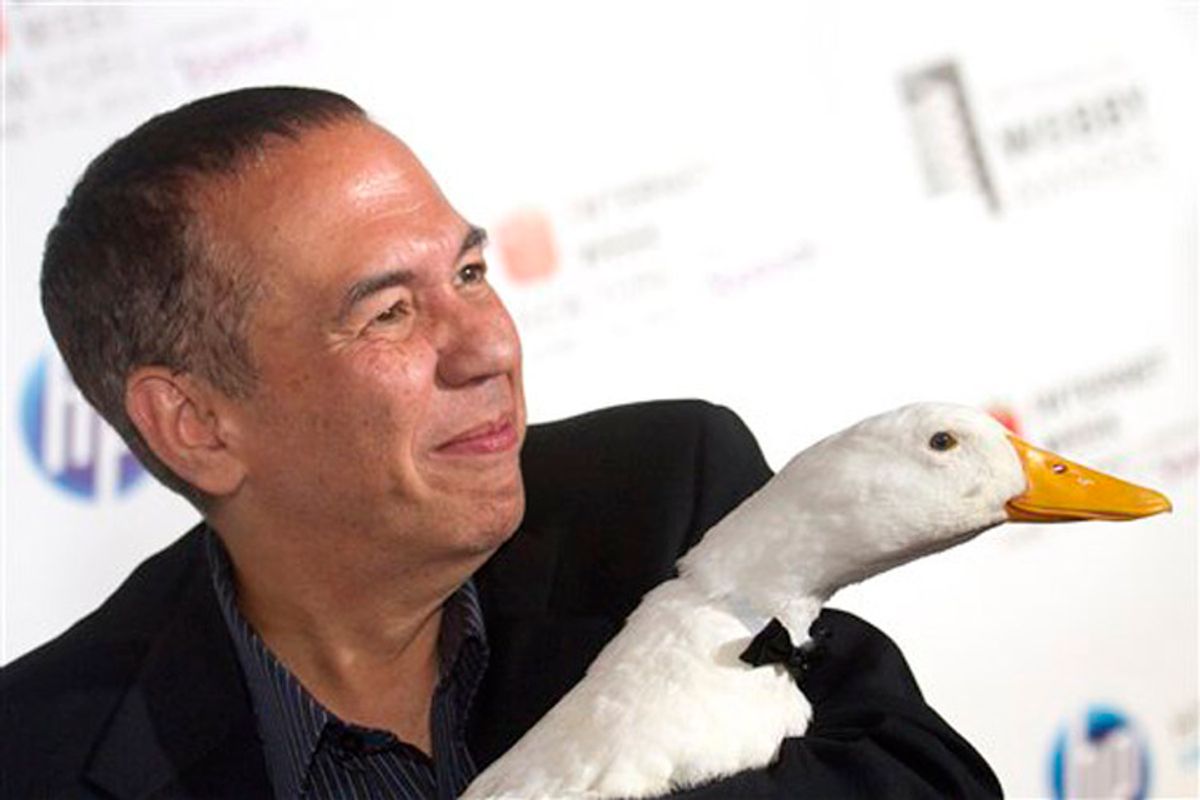
Gilbert Gottfried arrives with the Aflac Duck to the 14th Annual Webby Awards in New York, Monday, June 14, 2010. (AP Photo/Charles Sykes)(Credit: Charles Sykes) Too soon. After sending out a series of jokes about the Japanese earthquake and tsunami on his Twitter feed, comic Gilbert Gottfried has been roundly excoriated for his poor judgment, and on Monday, he lost his gig as the voice of the Aflac duck. Though he’s since deleted the offending gags, nothing ever goes away on the Internet. Buzzfeed compiled 10 of the more outrageous ones — a relentless string that included the observation that “I was talking to my Japanese real estate agent. I said ‘is there a school in this area.’ She said ‘not now but just wait’” and “I asked a Japanese girl to sleep with me. She said ‘okay, but you’ll have to sleep in the wet spot.’” Aflac, the No. 1 insurance company in Japan, said in a statement that the comments “were lacking in humor and certainly do not represent the thoughts and feelings of anyone at Aflac.”
Gottfried isn’t the first person in history, or indeed, even this week, to bomb. Michael Sorrentino, better known as The Situation, drew boos a few days ago at the Donald Trump roast for his crass, racist remarks. Do you know how hard it is to offend at a roast? For Donald Trump? And the always willing to say the wrong thing 50 Cent tweeted this weekend that “Its all good Till b*tches see there christian louboutins floating down da street shit gone get crazy” and “Look this is very serious people I had to evacuate all my hoe’s from LA, Hawaii and Japan.”
But the distinction between The Situation and 50 Cent and Gilbert Gottfried is that when The Situation and 50 Cent fall flat in their jokes, it’s because they aren’t comedians. There’s something that rings especially offensive when someone unskilled in the craft of humor attempts it and flubs — it’s like listening to Pierce Brosnan sing. Gottfried, on the other hand, may not be your cup of comedy tea, but he hasn’t been at this for over 30 years for nothing. And he’s been shocking people just as long.
Gottfried is known for a variety of things: the voice of the parrot in “Aladdin,” that Aflac duck, one of the millions of veterans of “Saturday Night Live.” He’s also the man who, nearly 10 years ago, introduced us formally to the concept of “Too soon!” At a Friar’s roast for Hugh Hefner just two weeks after 9/11, Gottfried got up and quipped that he was trying to get a flight to Los Angeles, but “they said they have to connect with the Empire State Building first,” inspiring that now-famous cry for comedic restraint in the face of disaster. Gottfried went on to win back the crowd by delivering a stunning version of the classic “aristocrats” gag — and Frank Rich later called the performance, 9/11 bit and all, “greatest dirty joke ever told.” “At a terrible time it was an incongruous but welcome gift,” he wrote. “He was inviting us to once again let loose.”
Of course, Gottfried was letting loose within the very culture that had suffered a blow. He wasn’t an outsider halfway around the world. And two weeks after 9/11, the smoke had mostly cleared and the dead were largely accounted for. Japan is still very much under siege. They say comedy is tragedy plus time, but how much time, exactly? Heard any good Katrina jokes lately? When was the last time somebody really killed on Conan with a routine about Darfur? And even when the cathartic power of humor finds its way into a harrowing story, there’s still a different level of acceptance for finding the funny in a movie clip about Hitler’s last days and out and out riffing on the Holocaust.
Was it insensitive for Gottfried to make light of human tragedy — and foolish to bite the quacking hand that feeds him? Absolutely. But what is a comic but another word for a fool? He was clumsy and tasteless, that’s why he removed the posts. He told the Hollywood Reporter Tuesday, “I sincerely apologize to anyone who was offended by my attempt at humor regarding the tragedy in Japan. I meant no disrespect, and my thoughts are with the victims and their families.” But relatively speaking, Gottfried’s ill-considered attempt at levity at a horrible moment still seems considerably less stupid than Glenn Beck’s cackling speculation that the earthquake was “a message” from God to follow the Ten Commandments. At least Gottfried knew what he was saying was over-the-top and ridiculous. He intended it to be so.
In the wake of unsurpassed devastation, it’s hard to find anything to smile about. Gottfried’s instincts were a comic’s: to look at catastrophe and try to attack it with the main weapon in his arsenal. In the worst moments of life, humor can be a potent force for healing (think of The Onion’s brilliant post-9/11 coverage) — or salt in a still bleeding wound. Gottfried was likely trying to lash out at the horror of the quake itself, but the barbs fell too close to its victims. And while timing is everything in comedy, for one comic, never might be too soon to start joking about this as-yet-unfathomable disaster.
Mary Elizabeth Williams is a staff writer for Salon and the author of "Gimme Shelter: My Three Years Searching for the American Dream." Follow her on Twitter: @embeedub. More Mary Elizabeth Williams.
“None of you are getting out of here”
I was working at the Fukushima plant when the earthquake hit. I thought we'd seen the worst. Then came the tsunami
The Fukushima Daiichi nuclear plant on November 21, 2004 (L) and on March 14, 2011 (R) as the No.3 nuclear reactor is burning after a blast following an earthquake and tsunami. (Credit: Ho New / Reuters) When the earthquake shook northeast Japan last March, Carl Pillitteri was leading a team of technicians in the Fukushima Daiichi Nuclear Power Plant. Pillitteri eventually led his team out of the building and retreated to a hillside where he saw the approaching tsunami slam about 100 feet from him. He was one of some 40 Americans working at the plant that day, and he spoke exclusively in this interview with Alex Chadwick, featured here as part of Salon’s partnership with the APM radio show, “The Story.” You can listen to the full audio interview here. It is also part of the radio documentary series “Burn: An Energy Journal.”
Continue Reading CloseCarl Pillitteri is a nuclear technician who was working at the Fukushima Daiichi Nuclear Power Plant when the earthquake and tsunami hit. More Carl Pillitteri.
Fukushima: Chaos reigns
Nearly a year after Japan's worst nuclear accident, towns remain deserted and the reactor cleanup has just begun
Debris is seen scattered near the Unit 6 reactor building of stricken Fukushima Dai-ichi nuclear power plant in Okuma town, Fukushima prefecture, northeastern Japan Tuesday, Feb. 28, 2012 (Credit: AP Photo/Yoshikazu Tsuno, Pool) FUKUSHIMA, Japan — A visit to the scene of Japan’s worst nuclear accident, almost a year after the area was struck by a powerful earthquake and tsunami, is a study in contrasts.
Elsewhere along the vast stretch of coast hit by the March 11 tsunami there are palpable signs of progress. Almost all of the 23 million tons of rubble has been removed, although rebuilding has yet to start.
Activists challenge Japan’s “nuclear village”
A year after Fukushima, an energized civil society pushes for solar power and accountability
A man wearing a mask attends an anti-nuclear rally in Tokyo September 19, 2011. (Credit: Yuriko Nakao / Reuters) The quiet resolve of Japanese citizens in the aftermath of last year’s triple disaster of earthquake, tsunami and reactor meltdown quickly turned into frustration as the government failed to adequately respond to the worst nuclear catastrophe since Chernobyl in 1986.
In the nearly one year since the March 11 earthquake, Japan has suffered a bevy of problems, from rolling blackouts and currency woes, to radiation fears, all under the tutelage of a central leadership that has failed to inspire public confidence.
Continue Reading CloseAkito Yoshikane is a freelance writer in Chicago. More Akito Yoshikane.
Lady Gaga sued over fundraising for Japan
The megastar's spokeswoman says lawsuit over charity wristbands is meritless
Lady Gaga poses for photographers with a coffee cup with a message in Japanese "Pray for Japan" during a press conference to promote of MTV Video Music Aid Japan in Tokyo, Thursday, June 23, 2011. Lady Gaga said that she will sell the coffee cup at auction and donate the money for the tsunami-hit northeastern Japan. (AP Photo/Shizuo Kambayashi)(Credit: AP) Lady Gaga’s spokeswoman says a lawsuit accusing the music star of misleading fans with an online pitch for donations to victims of the Japan earthquake is meritless.
Lady Gaga’s website is selling $5 wristbands that say, “We Pray For Japan.” The website also allows people to make additional donations and says “all proceeds go directly to Japan relief efforts.”
A lawsuit filed in Detroit notes that sales tax and a $3.99 shipping charge are added. Detroit-area attorney Alyson Oliver believes not all money is going to help the Japanese and she wants an accounting.
Lady Gaga’s spokeswoman, Holly Shakoor, said Tuesday that no profit is being made on shipping costs. She says $5 from each wristband is going to Japan.
The lawsuit seeks refunds for people who bought wristbands.
Fukushima’s “mutant” earless bunny
A video captured of a rabbit born without ears sparks (likely unfounded) fears of radiation side effects
This story is almost certainly not about a genuine mutant bunny. However, Japanese media outlets have hailed the birth of an earless rabbit allegedly born near the damaged Fukushima nuclear facility as evidence of fearsome side effects of the catastrophe.
The bunny, captured on video and posted to YouTube, was reportedly found near Fukushima at the end of last month. According to radiation experts, however, the likelihood that the rabbit’s unusual features are a result of nuclear mutation is very slim.
Continue Reading CloseNatasha Lennard covers the Occupy movement for Salon. A British-born, Brooklyn-based journalist, she has been covering Occupy Wall Street since before the first sleeping bag was unrolled in Zuccotti Park. One of the first journalists arrested at an Occupy action, she has managed to enrage Andrew Breitbart, Rush Limbaugh and Glenn Beck. You can follow her on Twitter (@natashalennard), and email her any Occupy updates/videos/ideas to natasha.lennard@gmail.com More Natasha Lennard.
Page 1 of 23 in Japan Earthquake