SALON

Workers evacuate nuke plant due to high radiation

Risk of radiation poisoning forces those working to keep reactors cool to suspend their efforts

Topics: Japan Earthquake, Nuclear Power, Japan,

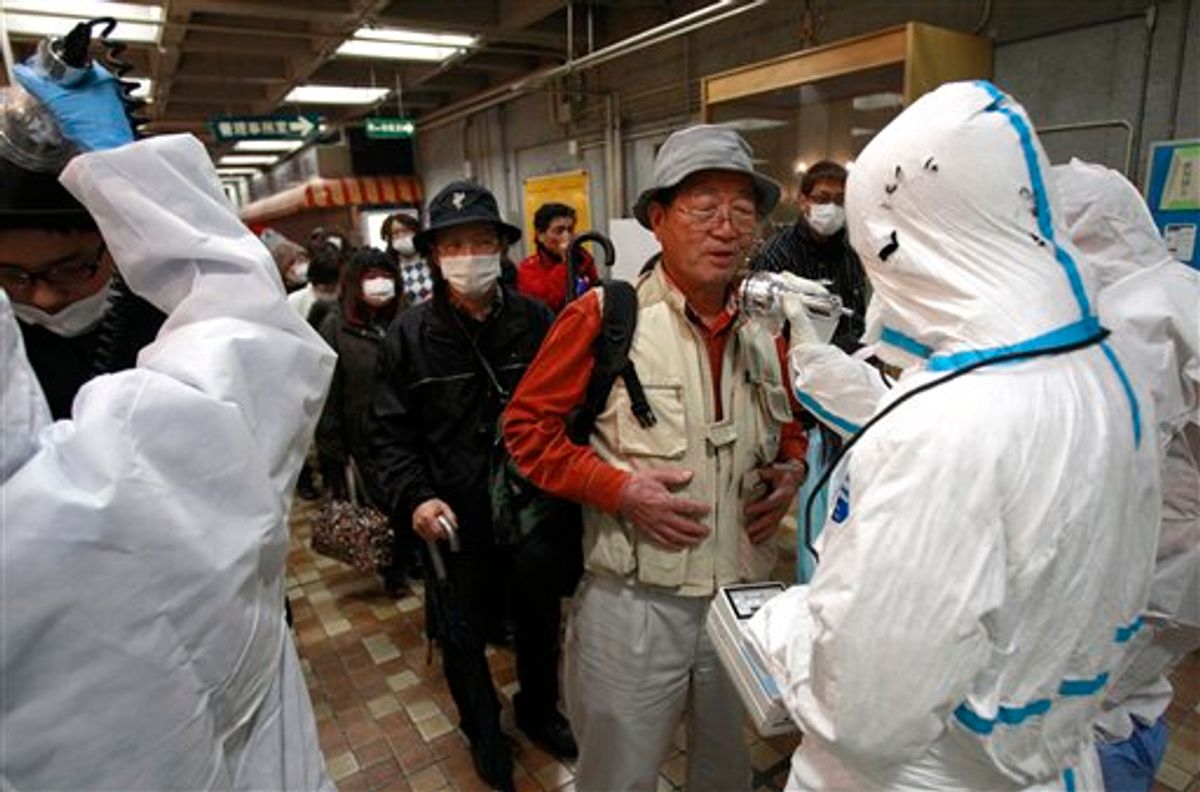
Workers evacuate nuke plant due to high radiationAn evacuee is screened for radiation exposure at a testing center Tuesday, March 15, 2011, in Koriyama city, Fukushima prefecture, Japan, after a nuclear power plant on the coast of the prefecture was damaged by Friday's earthquake. (AP Photo/Wally Santana)(Credit: AP)

Japan suspended operations to prevent a stricken nuclear plant from melting down Wednesday after a surge in radiation made it too dangerous for workers to remain at the facility.

Chief Cabinet Secretary Yukio Edano said work on dousing reactors with water was disrupted by the need to withdraw.

The level of radiation at the plant surged to 1,000 millisieverts early Wednesday before coming down to 800-600 millisieverts. Still, that was far more than the average

“So the workers cannot carry out even minimal work at the plant now,” Edano said. “Because of the radiation risk, we are on standby.”

Experts say exposure of around 1,000 millisieverts is enough to cause radiation sickness.

Earlier officials said 70 percent of fuel rods at one of the six reactors at the plant were significantly damaged in the aftermath of Friday’s calamitous earthquake and tsunami.

News reports said 33 percent of fuel rods were also damaged at another reactor. Officials had said they would use helicopters and fire trucks to spray water in a desperate effort to prevent further radiation leaks and to cool down the reactors.

The nuclear crisis has triggered international alarm and partly overshadowed the human tragedy caused by Friday’s double disaster, which pulverized Japan’s northeastern coastline, killing an estimated 10,000 people.

Authorities have tried frantically since the earthquake and tsunami to avert an environmental catastrophe at the Fukushima Dai-ichi complex in northeastern Japan, 170 miles (270 kilometers) north Tokyo.

The government has ordered some 140,000 people in the vicinity to stay indoors. A little radiation was also detected in Tokyo, 150 miles (240 kilometers) to the south and triggered panic buying of food and water.

There are six reactors at the plant, and three that were operating at the time have been rocked by explosions. The one still on fire was offline at the time of the magnitude 9.0 quake, Japan’s most powerful on record.

The Nuclear and Industrial Safety Agency estimated that 70 percent of the rods have been damaged at the No. 1 reactor.

Japan’s national news agency, Kyodo, said that 33 percent of the fuel rods at the No. 2 reactor were damaged and that the cores of both reactors were believed to have partially melted.

“We don’t know the nature of the damage,” said Minoru Ohgoda, spokesman for the country’s nuclear safety agency. “It could be either melting, or there might be some holes in them.”

Meanwhile, the outer housing of the containment vessel at the No. 4 unit erupted in flames early Wednesday, said Hajimi Motujuku, a spokesman for the plant’s operator, Tokyo Electric Power Co.

Japan’s nuclear safety agency said fire and smoke could no longer be seen at Unit 4, but that it was unable to confirm that the blaze had been put out.

——

Yuasa reported from Tokyo. Associated Press writers Elaine Kurtenbach in Tokyo and David Stringer in Ofunato contributed to this report.

Next Article

Featured Slide Shows

Gripping photos: The people of the Turkey protests (slideshow)

close X
  • Share on Twitter
  • Share on Facebook
  • Thumbnails
  • Fullscreen
  • 1 of 11
  • The protests take on a festive element as police forces move out of the park and square. Wearing a gas mask, this young man dances to traditional Turkish music in front of Taksim Square’s Ataturk Monument.

  • In Gezi Park since March 31st, this protester, originally caught off-guard by the Government’s teargas and water cannons, went out and bought a Russian army mask from WWII, preparing for what was to come.

  • This rambunctious boy seems to be enjoying the chaos. After taking this picture he threw a stone at the already destroyed building in the background.

  • Forming a line, the police face off directly with protesters in Taksim Square. After a while, they retreated and there was a general cheer – a back-and-forth dance that has been common since the beginning of this protest.

  • An elderly woman in Gezi Park reads the news. The tent community occupying the park was violently destroyed on June 16th.

  • Many different groups had set up booths to promote their cause in Taksim Square and Gezi Park. Standing in front of one, this man waves his flag while posing with conviction.

  • Many home-remedies are used to minimize the effects of tear gas. This woman has put a milky solution on her face, removing her mask after the tear gas dissipated. Before sunrise, the police came again for another round of teargasing.

  • People capitalize on the uprising -- selling flags, beer, gas masks, sky lanterns and spray paint to name just a few of the popular items.

  • On Monday morning, June 11, the police execute a strong offensive. Many plain-clothed police officers, like the ones seen here, clash with protesters in the side streets away from the main stand-off in Taksim.

  • The authorities seem to be most aggressive in the night, pushing protesters away from the square and park. After being teargassed this young woman catches her breath with other protesters on Siraselviler Street.

  • Recent Slide Shows

  • Share on Twitter
  • Share on Facebook
  • Thumbnails
  • Fullscreen
  • 1 of 11

Comments

10 Comments

Comment Preview

Your name will appear as username ( settings | log out )

You may use these HTML tags and attributes: <a href=""> <b> <em> <strong> <i> <blockquote>