
Afghanistan
U.S. doesn’t count civilians killed by drones
While Obama talks of saving civilians in Libya, information about innocents killed by U.S. drones is kept secret
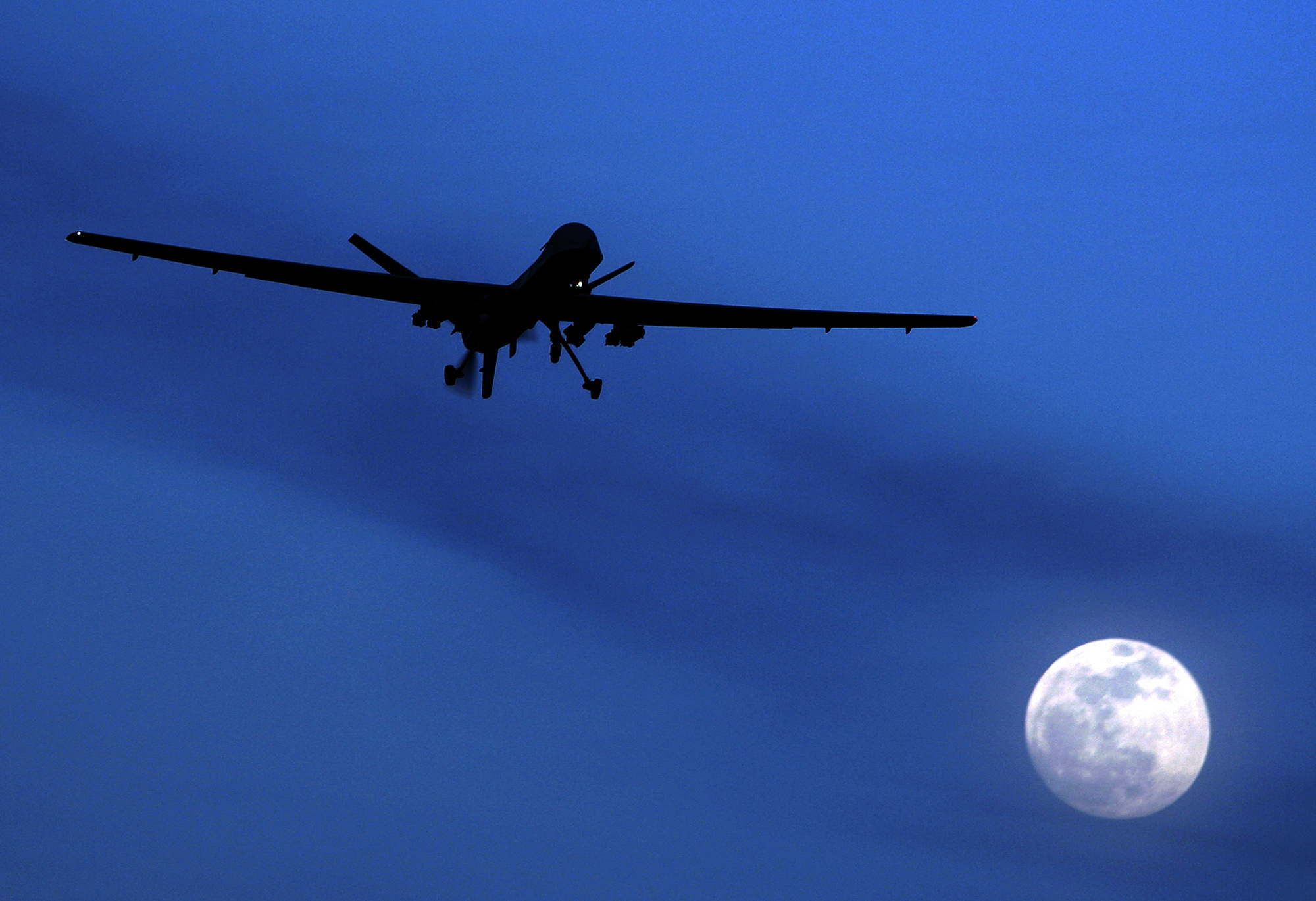
A U.S. Predator drone flies over the moon above Kandahar Air Field, southern Afghanistan Sunday, Jan. 31, 2010. The Pakistani army said Sunday that it was investigating reports that Pakistani Taliban leader Hakimullah Mehsud died from injuries sustained in a U.S. drone missile strike in mid-January. (AP Photo/Kirsty Wigglesworth)(Credit: Kirsty Wigglesworth) The big focus of the Obama administration in the last week has been, in President Obama’s words, “to stop the violence against civilians.” That’s in Libya, of course, where Moammar Gadhafi was threatening to quell a rebellion based in Benghazi.
In this context, it’s particularly striking to read the news from the ACLU — which has been waging a legal battle to wring information from the government about American drone strikes — that the military doesn’t even keep a tally of civilian deaths caused by drones:
The Department of Defense has confirmed that it does not compile statistics about the total number of civilians that have been killed by its unmanned drone aircraft. The DOD disclosed this information in a letter in response to a Freedom of Information Act (FOIA) lawsuit filed by the American Civil Liberties Union demanding that the government disclose the legal basis for its use of unmanned drones to conduct targeted killings overseas.
…
According to the DOD, the military’s estimates of civilian casualties do not distinguish between deaths caused by remote-controlled drones and those caused by other aircraft. While each drone strike appears to be subject to an individual assessment after the fact, there is no total number of casualties compiled. Moreover, information contained in the individual assessments is classified – making it impossible for the public to learn how many civilians have been killed overall.
That Defense Department letter is here (.pdf).
Many significant details about the use of drones by both the military and the CIA are shrouded in secrecy. The CIA, for its part, has entirely refused to respond to the ACLU’s request for information about the drone strikes in Pakistan. Now we also know that the Defense Department does not keep a tally of civilians killed by drones.
While the Pentagon does apparently have “individual assessment” reports on each drone strike, the government has said those are classified, ACLU attorney Jonathan Manes tells me.
Moreover, these attacks typically are in areas — like Afghanistan and northwest Pakistan — where it’s extremely difficult for reporters to operate safely and on their own. Thanks to the work of independent researchers, we do have some information on civilians killed by drones.
The administration, of course, says that all possible steps are taken to limit civilian casualties. But it’s impossible to scrutinize that claim when the government is keeping all the data secret.
“The overall numbers are important because they would allow the public to assess whether drones are a new, more precise method of exerting air power,” Manes says. “A lot of people do not believe that drones can discriminate between civilians and non-civilians, unless there is very good intelligence on the ground. Other people think that drones do a better job than other kinds of weapons.”
Justin Elliott is a reporter for ProPublica. You can follow him on Twitter @ElliottJustin More Justin Elliott.
Where the wounded are
Wars don't just cause casualties among soldiers, they drain medical staff. I traveled to see the costs firsthand
A soldier is prepared for an operation at Landstuhl Regional Medical Center. (Credit: Reuters/Kai Pfaffenbach) The weather’s getting warmer in Afghanistan and the war there is heating up again. That means – as it has meant every year for more than a decade — that the pace will quicken at the Landstuhl Regional Medical Center in Germany. More casualties will be brought to this largest American military hospital outside the United States. The Critical Care Air Transport teams and their C-17 Globemasters will fly in from “downrange,” as they call the Afghan battleground, and the injured will be brought by ambulance bus from nearby Ramstein Air Force Base to the hospital front door.
Continue Reading CloseMichael Winship is senior writing fellow at Demos and a senior writer of the new series, Moyers & Company, airing on public television. More Michael Winship.
NATO invites Pakistan to summit
A sign that Islamabad is ready to reopen its western border to NATO troops on their way to Afghanistan
Oil tankers, which were used to transport NATO fuel supplies to Afghanistan, are parked at a compound in Karachi, Pakistan, Tuesday, May 15, 2012. NATO on Tuesday invited Pakistani President Asif Ali Zardari to the alliance's summit in Chicago, after signs that the country could be moving to reopen its Afghan border to NATO military supplies. (AP Photo/Shakil Adil)(Credit: AP) ISLAMABAD (AP) — NATO on Tuesday invited Pakistan’s president to the upcoming Chicago summit on Afghanistan, the strongest sign yet that Islamabad is ready to reopen its western border to U.S. and NATO military supplies heading to the war in the neighboring country.
Pakistan blocked the routes in November after American airstrikes killed 24 of its troops on the Afghan border. The attack sent ties between Washington and Islamabad to new lows, threatening regional cooperation needed for negotiating an end to the Afghan war.
Continue Reading CloseAfghanistan, I can’t quit you
My mom pushed me to join the Marines. Now that she's gone, I'm still drawn to war zones
A child flies a kite in Kabul on Tuesday Mar. 27, 2012. (Credit: Geoffrey Ingersoll) The heat. That’s what I remember most. Shimmery and bright. Blinding. Stifling. Heeee-eeaat.
The kind that’s not just on you, wrapped around you, but balled up and pulsing inside you — a desert blanket with teeth. It’s a type of heat that makes your skin cry and your eyeballs sweat, even in the shade; heat like a predator you can’t run away from.
I notice it right as I get off the plane — not just the degrees but also the dust. Dust you can smell, kicked up by a thousand years of struggle. In a region this old, I’m sure each breath carries a dose of unintended history: Inhale, Alexander the Great; exhale, the Ottoman Empire; inhale, the USSR; exhale, the Taliban.
Continue Reading CloseGeoffrey Ingersoll is a freelance journalist, documentarian, writer, photographer, and veteran of Operation Iraqi Freedom. He is the recipient of the Sam Stavisky Award for Combat Reporting. More Geoffrey Ingersoll.
What Obama didn’t mention in Kabul
Just outside the Afghan capital, the Taliban is in control and preparing for a wider war
President Barack Obama addresses troops at Bagram Air Field, Afghanistan, Wednesday, May 2, 2012. (AP Photo/Charles Dharapak)(Credit: AP) MAHMUD RAQI, Afghanistan — The office of Kapisa’s governor sits high on a hilltop overlooking the provincial capital, Mahmud Raqi. It has a beautiful view of the river below and the mountains, trees and fields that stretch into the distance.
Beneath the tranquil surface, however, lies a grim truth. Just outside town roadside bombs are planted to target NATO convoys.
America’s real Hunger Games
Young people are already being sacrificed at the whims of the 1%. Just look at Iraq and Afghanistan
U.S. Army soldiers respond after a suicide attack on the US..-led provincial reconstruction team (PRT) compound in the Behsood district of Jalalabad, east of Kabul Afghanistan, on Sunday, April 15, 15 2012. (Credit: AP Phot/Rahmat Gul) When I was growing up, I ate books for breakfast, lunch and dinner, and since I was constantly running out of reading material, I read everyone else’s — which for a girl with older brothers meant science fiction. The books were supposed to be about the future, but they always turned out to be very much about this very moment.
Some of them — Robert Heinlein’s “Stranger in a Strange Land” — were comically of their time: that novel’s vision of the good life seemed to owe an awful lot to the Playboy Mansion in its prime, only with telepathy and being nice added in. Frank Herbert’s “Dune” had similarly sixties social mores, but its vision of an intergalactic world of disciplined desert jihadis and a great game for the substance that made all long-distance transit possible is even more relevant now. Think: drug cartels meet the oil industry in the deep desert.
Continue Reading CloseRebecca Solnit grew up in California public libraries and is thrilled to be revisiting them all over the state as part of the Cal Humanities California Reads project, which is now featuring five books, including her A Paradise Built in Hell: The Extraordinary Communities That Arise in Disaster. More Rebecca Solnit.
Page 1 of 122 in Afghanistan