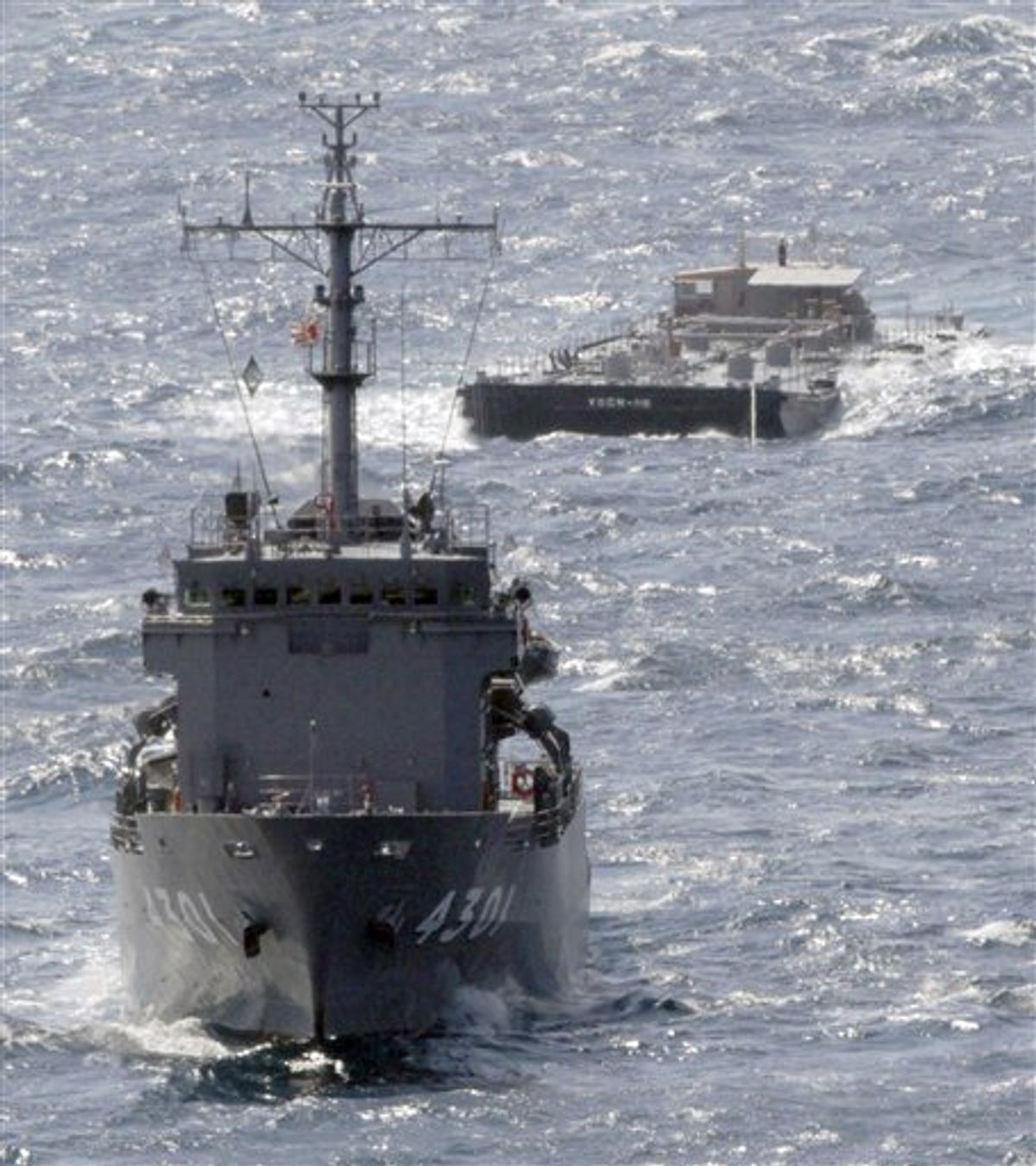
U.S. naval barges loaded with freshwater sped toward Japan's overheated nuclear plant on Saturday to help workers struggling to stem a worrying rise in radioactivity and remove dangerously contaminated water from the facility.
Workers at the stricken Fukushima Dai-ichi plant have been using seawater in a frantic bid to stabilize reactors overheating since a tsunami knocked out the complex's crucial cooling system March 11, but fears are mounting about the corrosive nature of the salt in the water.
Plant operator Tokyo Electric Power Co. is now rushing to inject the reactors with freshwater instead to prevent pipes from clogging and to begin extracting the radioactive water, Hidehiko Nishiyama of Japan's Nuclear and Industrial Safety Agency said Saturday.
The situation at the stricken plant remains unpredictable, government spokesman Yukio Edano said Saturday, adding that it would be "a long time" until the crisis is over.
"We seem to be keeping the situation from turning worse," he said. "But we still cannot be optimistic."
The switch to freshwater was the latest tactic in efforts to gain control of the six-unit nuclear power plant located 140 miles (220 kilometers) northeast of Tokyo.
The switch was necessary because of concerns that salt and other contaminants in seawater were clogging pipes and coating the surface of reactor vessels and fuel rods, hampering the cooling process, NISA said.
Defense Minister Yoshimi Kitazawa said late Friday that the U.S. government had made "an extremely urgent" request to switch to freshwater. He said the U.S. military was sending water to nearby Onahama Bay and that water injections could begin early next week.
The U.S. 7th Fleet confirmed that barges loaded with 500,000 gallons of freshwater supplies were dispatched to the Fukushima plant.
Radiation has been seeping from the plant since a magnitude-9 earthquake and an ensuing tsunami on March 11, making its way into milk, seawater and 11 kinds of vegetables, including broccoli, cauliflower and turnips.
Tap water in several areas of Japan, including Tokyo, has shown higher-than-normal levels of radiation. In the capital, readings were at one point two times higher than the government safety limit for infants, who are particularly vulnerable to radioactive iodine.
But levels have fallen steadily since peaking Wednesday, and Tokyo metropolitan officials said Saturday that tap water was now safe for babies to drink.
Just outside a reactor at the coastal nuclear plant, radioactivity in seawater tested some 1,250 times higher than normal, Nishiyama said. He said the area is not a source of seafood and the contamination posed no immediate threat to human health.
However, tests conducted 18 miles (28 kilometers) offshore found radioactive iodine-131 at levels nearing the regulatory limit set by the Japanese government, the International Atomic Energy Agency said. The tests also detected another radioactive substance, cesium-137, at lower levels.
IAEA experts said the ocean will quickly dilute the worst contamination. Radioactive iodine breaks down within weeks but cesium could foul the marine environment for decades.
Nuclear safety officials suspect a breach in one or more of the plant's units, possibly a crack or hole in the stainless steel chamber around a reactor core containing fuel rods or the concrete wall surrounding a pool where spent fuel rods are stored.
Suspicions were aroused when two workers suffered skin burns after unexpectedly encountering water that was 10,000 times more radioactive than levels normally found in the units, NISA said.
Such a breach could mean a much larger release of radioactive contaminants than had been thought. The most likely consequence would be contamination of the groundwater, experts said.
Radioactivity was on the rise in some units, Nishiyama said Saturday.
"It is crucial to figure out how to remove contaminated water while allowing work to continue," he said, acknowledging that the discovery would set back delicate efforts to get the plant's cooling system operating again.
Workers have begun pumping radioactive water from one of the units, Masateru Araki, a TEPCO spokesman, said Saturday.
Plant officials and government regulators say they don't know the source of the radioactive water. It could have come from a leaking reactor core, connecting pipes or a spent fuel pool. Or it may be the result of overfilling the pools with emergency cooling water.
But a breach in the chamber surrounding the reactor core seemed "more likely," Nishiyama said.
The nuclear crisis has compounded the challenges faced by a nation already overwhelmed by the disaster and devastation wrought by the tsunami.
Japanese soldiers and U.S. Marines were clearing away debris so they could keep searching for bodies and bury the dead. The official death toll was 10,151 Saturday, with more than 17,000 listed as missing, police said. Those lists may overlap, but the final death toll was expected to surpass 18,000.
Hundreds of thousands whose homes were destroyed still have no power, no hot meals and, in many cases, have not showered in two weeks. Those living within a 12-mile (20-kilometer) radius of the plant have been evacuated.
Life was also tough in the ghost towns inside a larger voluntary evacuation zone, with most residents choosing to flee and wary truckers refusing to deliver goods.
In Minamisoma, a city of 71,000 about 20 miles (30 kilometers) north of the nuclear plant, all but one or two shops shut their doors because of a lack of goods and customers, said city official Sadayasu Abe.
"Commercial trucks are simply not coming to the city at all due to radiation fears," he said Saturday.
Military troops and some private companies took up the task of delivering rice, instant noodles, bottled water and canned foods to eight central spots in the city, Abe said.
He said the city was urging the 10,000 or so still holding out to leave since the situation at the plant remains precarious.
"Life is very difficult here," he told The Associated Press by telephone. "We have electricity, gas and running water, but no food."
------
Yamaguchi reported from Tokyo. Associated Press writers Shino Yuasa, Jeff Donn, Mayumi Saito and Joji Sakurai also contributed to this report.
Shares