This originally appeared at New Deal 2.0
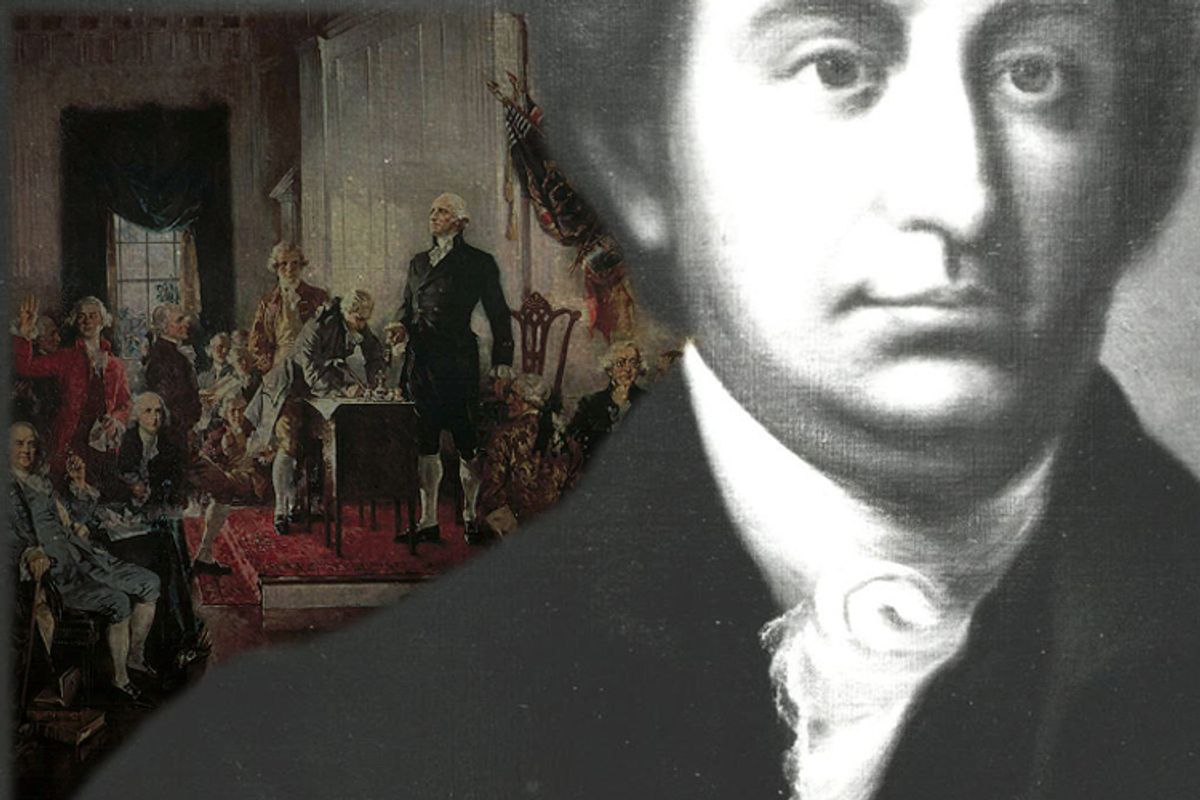
Edmund Randolph of Virginia kicked off the meeting we now know as the United States constitutional convention by offering his fellow delegates a key inducement to forming a new U.S. government. America lacked "sufficient checks against the democracy," Randolph said. A new government would provide those checks.
Randolph's listeners in Philadelphia in the spring of 1787 knew what he meant by "the democracy." And readers of this series probably will, too. He was talking about the 18th-century American popular finance movement, whose supporters agitated for policies to obstruct concentrated wealth and to give regular folks access to political power and economic equality. Amid depressions and foreclosures, ordinary people had long been rioting -- they called it "regulating" -- to pressure assemblies to restrain the merchant creditors, whose command of scarce gold and silver let them acquire immense wealth by lending at high, even predatory rates to the needier.
Then, with revolution against England, the popular finance movement turned its attention to changing the economic terms of American society. The 1776 Pennsylvania constitution, based in large part on ideas expressed by Thomas Paine in "Common Sense," smashed the ancient property qualification for voting and holding office. In Pennsylvania, new political leaders like the preacher Herman Husband, the weaver William Findley, and the farmer Robert Whitehill entered the assembly and began passing laws shutting down elite banking and requiring government to operate, for the first meaningful time anywhere, on behalf of ordinary people.
Democracy in Pennsylvania sent chills through elites of every kind throughout the newly independent country. Rioting for popular finance was bad enough, but rioting was temporary, spasmodic, and traditional. Debtors wielding legitimate political power to equalize economic life -- that was tantamount to a new kind of tyranny of the mob, hardly what Whig revolutionaries had fought England to gain. Neither Edmund Randolph nor other delegates of the Philadelphia convention, meeting in secret sessions in the Pennsylvania State House, felt any need for subtlety in seeking to suppress the political and economic equality burgeoning everywhere in America among "the democracy."
Present at the Philadelphia convention was the fabulously wealthy Pennsylvania financier and speculator Robert Morris, America's first central banker, no doubt licking his ample chops over the fulfillment, at long last, of his plan to wed nationhood to high finance. Yet it was the planter Randolph, not the financer Morris, who referred to "the plague of paper money," and he meant just what Morris meant. State legislatures' currency emissions and legal-tender laws depreciated the merchants' income from their loans; paper, the people's medium, built debt relief into money itself. Randolph also rued the country's difficulty in paying the investing class its interest on federal bonds. With those bonds, Morris had made private creditors into public creditors as well, swelling the domestic U.S. debt to vast proportions in an effort to connect national purpose to high finance.
Hence the need, Randolph said, for a national government with laws acting on all the people throughout the states. It's no coincidence that he also charged the delegates with repairing the federal government's military weakness. A debtor uprising in western Massachusetts known as Shays' Rebellion had marched on the state armory. That wasn't just a riot. It showed how far ordinary people might go in rejecting regressive taxes and policies giving investors huge paydays with public money. The United States, Randolph said, must be empowered to put down insurrections anywhere in the country.
So Randolph did indeed know what he meant by "the democracy," and his fellow delegates knew too. Why are historians typically so coy about the constitutional convention's financial purposes?
The fight over those purposes is almost 100 years old. In 1913, the historian Charles Beard published "An Economic Interpretation of the Constitution of the United States." There Beard argued that because delegates of the convention came overwhelmingly from the bond-holding class, the government they put into effect represents less a glorious triumph of republican philosophy than a rearguard action of money elites to assure their own payoffs. Beard's startling contention was that the framers acted at least as much on financial self-interest as on principle.
If that contention remains startling, we can thank an immense effort, carried out over generations, to throw out not only Beard's particular economic interpretation of the convention, but along with it any suggestion that struggles between elites and ordinary Americans over public and private finance played a role in framing our Constitution. It's not surprising that many of the popular founding father biographers routinely avoid the issue. But entire careers in academic history -- major ones, like Edmund Morgan's -- have been largely dedicated to depicting a founding generation acting with perfect intellectual consistency almost entirely on principle. Wherever self-interest did arise, Morgan suggests (in his popular book "The Birth of the Republic" and elsewhere), the nature of the founding mission was such that it enabled even greed to inspire the founders to good. In that kind of history, everyday political struggles over money between ordinary Americans and American elites just don't play.
Beard did err. A pro-Jefferson, anti-Hamilton bent led him to associate self-interest mainly with the high-finance elites; he saw the land-based, state-sovereign philosophy of many planters as tending more naturally toward democracy, and he miscast people like Jefferson and Samuel Adams as Paine-like democrats. Randolph's opening speech at the convention shows a confluence between Virginia planters and Philadelphia financiers on ending democratic finance (men who would never again agree on anything agreed on that!). As the historian Staughton Lynd has wisely suggested, citing Robert Brown in an essay in the anthology "Towards a New Past", had Beard referred less specifically to bondholding, and more generally to property-owning, he would have been standing on firm ground.
But many take Beard's errors as ample cause for heaving big sighs of relief, writing off any mention of founding conflicts over money and finance as "economic determinism," and resting easy in a certainty that, the founders' own words to the contrary, economic struggles played no important role in making us who we are as a people. "No, that's Beard," runs the objection to mentioning founding economic struggles. "Haven't you heard? Beard's been debunked."
Debunking Beard is full of bunk. Beard's leading critic, the historian and right-wing activist Forrest McDonald (he served, for example, as chairman of the Goldwater for President Committee of Rhode Island), rejected Beard's economic analysis in favor of uncritical adoration for the founders' sheer greatness. In his 1958 book "We the People", McDonald purported to dismantle Beard's argument with his own supposedly more accurate economic studies, but in a 1986 article in "The Journal of Economic History," Robert McGuire and Robert Ohsfeldt used what economists call "regression analysis" to show that McDonald set premises and drew conclusions far more tendentious than Beard's. McGuire's recent book "To Form a More Perfect Union" strengthens both the critique of McDonald and the adjustment and rehabilitation of Beard.
To men of the constitutional convention, some of our modern economic analyses might seem strangely redundant. If we know how to read them, the founders often tell us, unabashedly and in their own words, what they were trying to do. McDonald claimed that, Beard to the contrary, a multitude of interests prevailed at the convention, not just one. Well, that's true. What's striking is that despite their well-known mutual antipathies, on a well-known multitude of fateful issues those northerners and southerners, planters and moneymen, slaveholders and manumissionists, city dwellers and countrymen, nationalists and state sovereigntists meeting in Philadelphia in 1787 shared a desire even stronger than their antipathy for one another: stop the American democratic finance movement once and for all.
The fight wasn't over. But the men of the constitutional convention were making no bones about trying to win it.
William Hogeland is the author of the narrative histories "Declaration" and "The Whiskey Rebellion" and a collection of essays, "Inventing American History." He has spoken on unexpected connections between history and politics at the National Archives, the Kansas City Public Library, and various corporate and organization events. He blogs at http://www.williamhogeland.com.
Shares