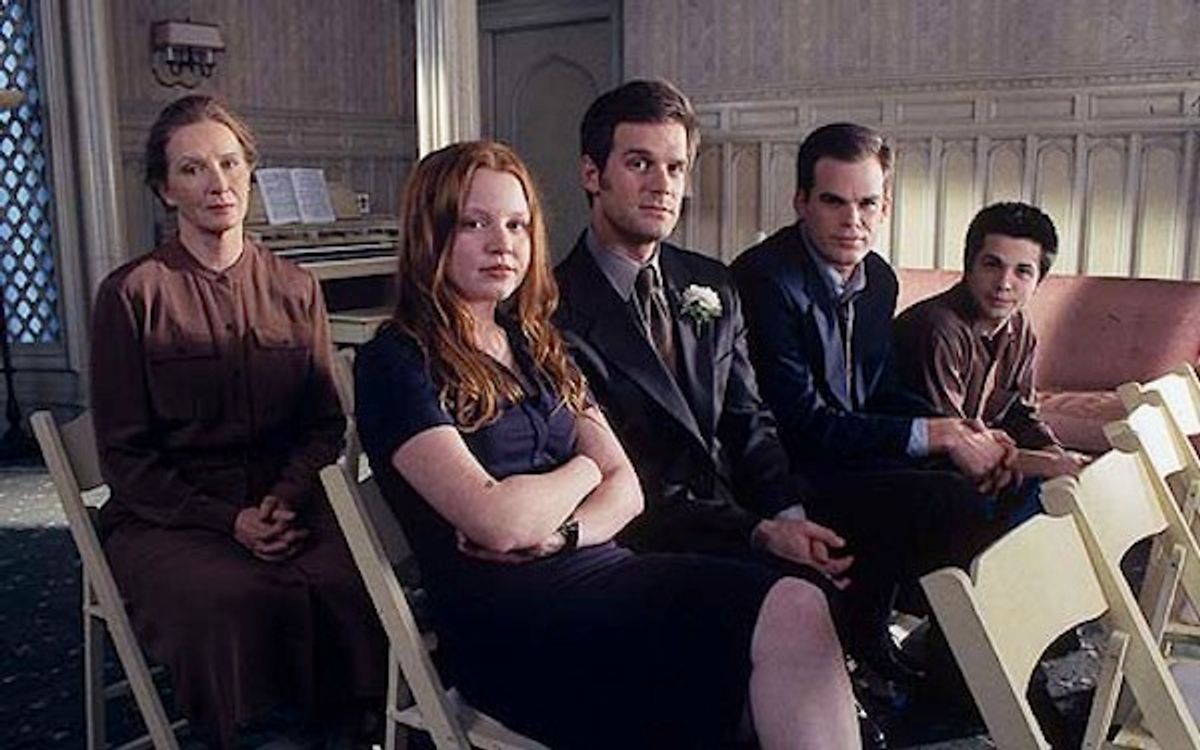
After a painful breakup, there’s always “that song” or “that band” that you can’t listen to anymore, because they are painful reminders of your former relationship. But I’ve always wondered about the good pieces of pop culture that survives past a relationship or other tragedy. You know, like the show you never would have watched unless your boyfriend made you, and which ultimately lasted longer than your dating history? Or that bluegrass band you only started to appreciate after your dad passed?
While we associate grief with a sense of loss — with throwing things away or storing them someplace and never looking at them again — we never talk about how these same artifacts can actually help us get through tough times. That’s what the new regular feature “Saved by Pop Culture” is about: those songs, movies, and shows that might be watched by millions but are important to you in a way that’s totally your own.
I never saw “Six Feet Under” when it was on TV. I’m terrible like that with TV, because while I am a total movie snob, I have never scraped up enough cash post-college to buy a set and pay for cable. Especially for things like HBO and Showtime, which, let’s face it, is where the good shit is at.
So no “Sopranos” for me, no “The Wire,” and no “True Blood,” a show that everyone told me I would love because it was about vampires and sex. I thought it sounded hokey in a total Anne Rice way, until I started dating a boy from New Orleans who swore by Sookie Stackhouse. I fell hard for the boy, and he had fallen hard for Bon Temps, so eventually he wore me down enough to watch the opening sequence of Alan Ball’s overwrought Southern gothic. Of course, I was hooked instantly. It was funny, it didn’t take itself too seriously, and — at least for the first season — it was scary as hell.
Then around Friday the 13th (I know), I lost my job and that boy on the same day. I was broke, and the guy who had introduced me to the vampire porn show had gone back to New Orleans himself (maybe to meet his own version of Sookie?). It was one of those breakups that hit you incredibly hard, almost more so for the relationship having been so short. I was still infatuated when he left, and I was devastated about his departure with an intensity that freaked me out. Didn’t I have other stuff to think about?
Apparently not. After watching the second season of “True Blood” for the third time, I realized it was time to move on. Of course, “moving on” in my case didn’t mean that I stopped obsessively making late-night calls to this guy, it meant taking a lot of pain medication that I had stockpiled from a previous surgery and tooth removal, lying in bed all day, and starting up another show. I decided on “Six Feet Under,” because I figured that since it was also written by Ball and was about death and dying, it would be like watching a longer, more boring version of “True Blood” while I slowly faded away.
Here’s a piece of advice: When you’re teetering on the brink of a major depression, watching five seasons of an intensely personal study in grief and death is not going to make you feel better. The fact that every episode began with an illustration of how death can take you at any time, any place (while diving in a pool, getting cut in half in an elevator door, or getting hit by frozen human waste falling from airplanes) didn’t make me appreciate the value of life, it scared the hell out of me. It also reinforced my belief that never getting out of bed was probably the safest way to exist, for the time being.
I guess I shouldn’t have expected a show about a funeral parlor to be really uplifting. But I cried during that first episode (Oh god, the phrase “buddy boy” still gets me to this day) and didn’t stop bawling until Claire drove away in the car that wasn’t a green hearse, heading toward New York and imagining, in the best montage in the history of television, how everyone she knows will die.
(Warning: Spoilers? Kind of? Although at this point you can’t blame me for ruining a show that’s been over for six years.)
I went through the entire show in about a month and a half, which is actually a pretty solid feat, considering that the show had 63 episodes, each an hour long. I told my concerned friends calling to check up that I was fine, I was hanging out with my friend Brenda, or Claire. (Ha.) I ordered in Chinese at night, slept all day, told my parents I was sick, and continued to buy meds I wasn’t prescribed from shady guys on Craigslist. I don’t think I knew it at the time, but I was watching “Six Feet Under” in the hopes that I’d get depressed enough to kill myself.
Fortunately, that’s not the effect the Fisher family had on me. This dark little family who dealt with mortality every day, whose business was literally trading in death (including their own) slowly, over the course of those painful six weeks, taught me more about appreciating life than the past four years of my own had.
I know, that sounds terrible. That I can’t cry in real life over the death of a pet or family member, but a show about imaginary people leading imaginary lives with their imaginary brain tumors can make me sob until I reach catharsis. And at first, I was really just crying for myself, for my own selfish reasons about everything just sucking and look, we all die in the end so what does it matter anyway? I was Claire in season four, where she’s a real asshole. I was Billy when he was off his meds. I was Brenda’s entire narcissistic personality disorder. Then two things happened.
The first was this one really, really odd night when in addition of my usual cocktail of antidepressants and Percocets I found an old pill of Ecstasy that I had been saving to do with the guy from New Orleans. In a moment of sheer, stupid rage I took it. (“That will show him!” I said to my completely empty apartment.) I knew I was courting a hospital trip, and I didn’t care. I turned on “Six Feet Under,” and it was the episode where Nate takes two aspirin before a family dinner. At first Nate (and the audience) can’t figure out why he’s acting so punch-drunk: spilling over the wine, touching his girlfriend Brenda’s arm in tactile wonder, laughing too loudly. Meanwhile, it slowly dawns on his brother David that Nate may have accidentally taken the Ecstasy tabs he had hidden in the aspirin. Odd coincidence, but all I remember at the time was wishing I could feel as happy as Nate did while inadvertently rolling. All I felt was more of that self-indulgent sadness welling up. Also, my sheets were really, really smooth.
When Nate tries to sleep off his trip, he dreams about his dad, Nathaniel Sr., which isn’t that odd considering that despite dying in the first act, the actor Richard Jenkins made an appearance in almost every “Six Feet Under.” It was all very “Twin Peaks,” with Nate meeting both Death and Life playing poker with his father:
Say what you will about that speech at the end — “All that lives will live forever, only the shell passes away” — but what really got me was Nate’s head on the chair, his dad stroking his head.
“Dad, I’m high. I know I’m high.”
Then Nate wakes up. I didn’t. (Not because I died or anything, just because I had never fallen asleep.) But I was really freaked out. How did the show know I was on drugs??? And then, like, speak to me through the screen?
I can accurately pinpoint that moment as the turning point when I stopped caring about my own stupid problems so I could focus more intently on the Fishers’. But that’s good escapism, right? People immerse themselves in the lives of characters crafted by brilliant writers, so their lives both reflect and outshine our own.
So skip ahead a couple seasons (blah blah Lisa disappears, who cares, Claire finally hooks up with Jeremy Sisto’s Billy, which I had been waiting for since forever, Ruth keeps sleeping her way around town while acting like an anorexic Piper Laurie in “Carrie,” David and Keith have a completely realistic and three-dimensional relationship which is the first of its kind for a gay couple on TV and I kind of don’t notice, Brenda continues to be the worst, etc., etc.,) and Nate has that seizure at his sister-in-law’s place. Or heart attack. Or brain aneurysm. Whatever. And everyone thinks, “Okay, we’ve seen this before, the ‘Nate is going to die’ thing,” because it was the cliffhanger in season two. And then he wakes up at the hospital, and he and David talk, and he has one of his dreams again. Except it’s a little weirder than the other dream sequences we’ve seen on “Six Feet.” Like instead of Nate walking around and talking to his dad, it’s him and David smoking weed in a van, going to the beach. And David is trying to tell Nate not to go in the water, but he does, and then David is left alone.
And then David wakes up because it’s been his dream all along, and he’s really alone. Nate has died.
Now, on “Six Feet Under,” people died for no reason all the time. Wasn’t that the point? Death is random, life is random, and even if you know all of this you’ll still take everyone in your world for granted because that’s how human beings work?
Still. Even knowing that. Even with every episode about death, and seeing people react to a loved one’s passing, I was not ready for the death of Nate Fisher. I actually just stopped watching the show, despite the continuation of episodes (apparently TV, like life, doesn’t just stop when someone dies). I was furious, because you can’t just kill off a show’s main character for no reason! No reason! There was no reason Nate should have died, it was so pointless and stupid.
I hated that show for killing off Nate, because Nate was us, he was our window into the world of “Six Feet Under.” The fact that the story could continue without him would be to admit that life could go on without us. Without me. And then, after I begrudgingly watched the last couple of episodes, some of the saddest ever on TV (besides maybe the last episode of “MASH”), it was devastating in a way that the passing of Nathaniel Sr. on the show’s premiere wasn’t. Watching a family suffer that much wasn’t even television (it was HBO?). I had never had anyone close to me die, but suddenly I felt like I was intruding on my best friend’s house as his family just completely lost it.
“This can’t happen,” I thought to myself, “My parents can’t ever go through this. What the fuck was I thinking?”
Wanting to die is inherently selfish, though there are always degrees of personal pain involved that might make the decision understandable. But what the hell had I been doing to myself? And more importantly, why? Because some guy who liked “True Blood” moved out of town? Because after three weeks, I thought I was “in love” and now life wasn’t worth it? I’ll cut myself some slack, because I had never seen death up close and personal, and hey, I’m not saying that a fictional person’s pretend death counts (Peter Krause is currently on “Parenthood,” alive and well), but it’s the closest I had ever come to seeing the profound and personal way a death affects a family, especially a death so random and senseless as Nate’s.
After that episode, I stopped buying painkillers from shady drug dealers. I got out of bed and got another job. (Well, I worked from home, so technically I still stayed in bed, but at least I was earning a paycheck.) I also took trips home to my mom’s house for weeks at a time, just happy that she wasn’t the frigid and uptight Ruth but also wanting so badly to never, ever put her through what Ruth had to go through.
I won’t say that “Six Feet Under” saved my life, because who knows, maybe an intervention would have just as easily done the trick, or I would have just gotten bored and would have eventually left my bed anyway. Oddly enough, it turned out I was more Claire than Brenda after all: A couple years later, and I’m back in New York, doing my form of art for a living. I’m even dating a goofy lawyer who wears a suit to work every day, like Ted, the Republican Claire ends up with. Luckily, mine isn’t a Republican.
Have you ever been moved to change by a movie, TV show, or album? Let us know. Leave your stories in the comments section or blog about it on Open Salon and tag your post “saved by pop culture.”
Ellen Pompeo and Patrick Dempsey in "Grey's Anatomy"
I didn’t set out to marry a doctor. If you’d asked during my Match.com days, I would have told you I didn’t even like doctors. They’re bossy, skeptical, self-important and weirdly nervous about feelings. They’re always sure they know more about your body than you do — and they’re only sometimes right. Also, they have bad taste in shoes.
When I moved to Seattle in my late 20s, I told myself I was ready to look for a mate, a viable life partner. I then proceeded to fall for an illegal Canadian alien, a 22-year-old, a married man, a more-or-less married man, and a guy who lived in Kansas. A woman I’d met at a neighborhood cafe hypothesized over coffee that doctors make “the best mates,” but I had my doubts.
The only physicians in my life were the one at the women’s clinic and the ones on “Grey’s Anatomy,” which I’d taken to watching on DVD in obsessive late-night marathons around the time I turned 30. Like any other writer (and, at the time, filmmaker) I was intrigued by the interpersonal dynamics and the minutiae — why did surgeons look down on everyone else? Why were doctors so lackadaisical about condom use? Why didn’t they ever lock the supply closet when they went there to have sex? Taking my cue from the surgical residents themselves, I’d stay up into the wee hours. But instead of trying to chase down the best surgeries, I was trying to chase away my loneliness, my heartache, my worry that I’d never get married and have a baby.
Wary as I was of actual doctors, I lusted after the fictional physicians of Seattle Grace Hospital the way a barista lusts after the perfect espresso pull or a Pacific Northwest cat lusts after just-caught salmon. I loved perfect-haired Dr. McDreamy as much as the next person, but honestly — male, female, resident, attending — it didn’t matter. If they could stay up all night having crazy sex and then perform successful heart or brain surgery on a toddler the next morning, I wanted them. Sure, they were bossy — but to each other, not to me — and they talked about their feelings quite a bit. Even when they announced they didn’t want to talk about their feelings, they sat together silently, clearly processing their feelings, which was almost as good. They were smart, sexy, a little wild and a lot sassy — who cared what their shoes looked like?
That said, they didn’t strike me as “the best mates.” They were always at work, always thinking about work, and always wanting to work. Plus, they didn’t have the best track record, fidelity-wise.
The show’s debut coincided with my move into one of Seattle’s federally subsidized low-income artist-housing units. Most of the men I met in my job as a part-time filmmaking instructor and at social functions in our building wore Utilikilts or had Asperger’s syndrome or claimed to be “born polyamorous” — or often all three. I wanted to branch out but didn’t want to necessarily have to go out. God bless the Internet. I could spend my evenings at home in my favorite leggings with my “Grey’s Anatomy” “friends” while my online profile did all the loathsome small talk and weeded out the least suitable suitors.
Given my paltry income, lack of health insurance, tendency to need therapy, and love of all things Anthropologie, I probably should have been dreaming about marrying a real-life McDreamy, but it didn’t occur to me — certainly not consciously. Trader Joe’s Three Buck Chuck wine suited me fine, and I enjoyed making art from junk I found on the street or purchased for 69 cents at Goodwill. Being “Mrs. Dr. Somebody” was not on my radar.
When I met the man who would become my husband, I didn’t know he was a doctor. His profile was brief and vague and revealed only that he had an advanced degree and had attended a Montessori preschool. From one of his pictures in hiking boots and cargo shorts on some sort of large hill, I guessed he might be a high school science teacher — the kind with a fondness for slightly-too-long nature walks and an endearing overappreciation of the life cycle of the fruit fly.
Had I known he was a doctor, there’s a chance I wouldn’t have ever agreed to go out with him. I’d met up for drinks and snacks with a doctor once, only to discover that I would be drinking and snacking solo because the doctor ate (and drank) on an every-other-day schedule ever since he’d read a study in which rats who were fed this way lived longer.
The Montessori guy took me out for a picnic dinner — of which we both partook — and at some point between the BLTs and homemade lavender shortbread I coaxed out of him the fact that he was an academic emergency medicine doctor. “Like in ‘Grey’s Anatomy’!” I chirped, displaying my vast knowledge of the American medical establishment. He was quick to inform me it’s “not like that at all.”
Of course not! A real neurosurgeon would need a nap between the crazy sex and the brain surgery.
Then it dawned on me that this guy might be my own personal Dr. McDreamy. It didn’t matter what a teaching hospital is like on television — this guy could be my own personal portal. The longer we dated, the more I would learn about the interpersonal dynamics and the minutiae.
I’d always thought my feelings of distaste for doctors was mutual. They always seem stubbornly wary of my stubborn wariness — as if by declining their samples of Prozac and asking for a recommendation for an acupuncturist, I’m calling into question the foundation of their livelihood. Which I only sort of am. But this doctor wanted to keep seeing me — over and over.
Even though he’s bossy and weirdly nervous about feelings and argues with me when I claim to have a symptom of something (You don’t have a migraine, just a tension headache… You’re not getting a cold — you’re probably just tired… You’re not PMSing — you’re just insane), I fell in love. Three years (and one baby) later, I still know almost nothing about what it’s like to be a doctor. It turns out that working in the E.R. all day is as exhausting as it looks on TV, and the last thing you want to do when you come home is to talk about it — especially about how you feel about it. Is it really that hard to tell someone they have cancer? Is it really that gross to disimpact someone’s bowel? These questions do not need to be asked. But there is a distance between my doctor husband and me — a distance created by the psychological difficulty of telling someone they’re rapidly dying, the terror of pulling a knife out of someone’s skull, the profound sadness of the heroin addicts, the entrenched alcoholics, the inexorable march of time. I want to know about these things, what it feels like to be immersed in them every day, but I’ve learned to hold my tongue — not because it’s the “right” thing to do but because peppering my husband with questions gets me nowhere good. When he comes home from what’s obviously been a hard day, I now offer him a drink and suggest — not unkindly — he go to bed early. I then don my favorite leggings and curl up on the couch to watch some other Seattle doctors provide a portal into my husband’s life. And sometimes the next morning over a cup of strong coffee he tells me what’s on his mind — unasked. The best kind of mate.
They weren’t the best band I had ever heard. The melodies were mundane, the words clichéd and often trite and the band members certainly didn’t have much going for them in the looks department. But when I was a lonely, depressed college freshman huddled on her floor with a razor blade and a prayer, JamisonParker was exactly what I needed.
It was the heyday of emo and screamo: angsty teens with bad haircuts, tight jeans and whiny voices backed by even whinier guitars. Most of these bands weren’t worth listening to. Their music was generally simplistic, and like virtually every new genre before them, their very existence depended on the angst of the teenage generation. Like all those other genres before them, they hardly lacked for material.
As a card-carrying member of this very demographic, emo spoke to me like I’m sure millions of other teens thought it spoke to them. It said, “Yes, the world sucks. Yes, your world is caving in. Yes, you want to hide behind your hair and cry and moan that no one loves you, and you’re probably right. Let’s all get together, hate the establishment and sing about it.” It fit me like my uniform of band T-shirts and jeans did: tight enough to be just a little rebellious against my conservative parents, dark enough to reflect my tortured middle-class soul and substantive enough to keep what really mattered firmly under wraps.
A big fish in a small pond, I had spent high school teetering on the pedestal of my own fragile reputation. Then, I went to college and realized not only that I wasn’t God’s gift to the world, I was also a much smaller part of it than I had previously been led to believe. Already prone to depression and anxiety, I spiraled downward. JamisonParker, with all their angst-ridden anthems of grief and despair, kept me company.
When my first real boyfriend — who had gone to a different college where he too was having trouble making friends — turned ugly and abusive, I sent him the lyrics to a JamisonParker song, “Here’s Everything I Always Meant to Say,” in a last-ditch effort to make him understand:
Just be in love and I’ll kiss you like you’ve always wanted
Just close your eyes, I’ll still live as if I’m dying
If I don’t make your heart skip a beat then hate me
If I don’t make you feel anything then it’s me
He didn’t see things quite the way I’d hoped, and eventually dumped me in the spectacular manner only privileged white kids with a flare for the dramatic can manage: by throwing a bag full of mixed tapes I had made him, along with a healthy dose of accusations and obscenities, at me in the middle of a free concert of a band we both liked. I ran crying from the venue, swearing all the way never to see his face or listen to that band again. JamisonParker’s “Goodbyes” comforted me as I wept, reassuring me that yes, the world is ending. But at least we can all wail about it together:
Your kisses and goodbyes
are leaving my lips numb
I’m jealous of headlights
cause they’re all that clings to you
I’ll pray that our shoes melt in the pavement
We step back slowly
and I’ll take the long way home
Just one more time,
they’ll be playing our song
The breakup, as so often happens, wasn’t as clean and neat as it could have been. What had started out as a few idle accusations turned into litanies of vitriol, spewed across phone lines and left toxically on Facebook and public online forums we both frequented, every jab a little sharper, every cut a little deeper, every word slivering away a little piece of my already-dwindling self-esteem.
That year was the sort of perfect storm therapists dream of: an unstable personality thrust into a new situation, no support network nearby, challenging classes and unexpected obstacles, plus a traumatic event to put the icing on the proverbial psychological cake. In my clichéd, black-eyelinered teenager way, I broke down, and hard. I had been given to self-harm in middle and high school, and started up again with a vengeance. And if there’s anything that shouldn’t be done emphatically, it’s activities involving a razor and one’s own skin.
Where my friends couldn’t help and my family didn’t know, I turned to my iTunes library. JamisonParker understood. My nightly ritual, after a long day of putting on a brave face and trying not to cry in class, saw me sitting on the floor, sobbing and scratching away with “Biting Bullets” on loop:
so here I am
a love worn masochist
with hearts carved straight across my chest
letting the carpet soak up all that’s left to give
Will you swear you won’t be sleepin’
cause I can’t begin to dream to shut my eyes
and I’m biting bullets and watching phones
for no apparent reason
and I don’t think that I’ll make it out alive
Was the song a blatant suicide reference? Was it enabling self-harming activities? Was it encouraging a clearly destructive mind-set? Probably yes to all of the above. But at the time, the concept that someone else had struggled through what I was dealing with and lived to tell the tale was enough to keep me scratching away at the surface instead of digging into the vein. Even if the tale he was telling was one of loss and despair, at least someone understood.
But sometimes a train passes through a dark tunnel and doesn’t come out into the light on the other side. Sometimes the train blows its distress whistle and the conductor’s asleep at the controls. Sometimes the train emerges into a darker night and it’s a long way ’til sunrise. I’d love to say I snapped out of my ennui when my hormones reached post-puberty levels, that I realized my boyfriend was not the love of my life and my self-destructive spiral wasn’t leading anywhere I wanted to go. I’d love to present with a tale of healing and redemption, of seeing the light and selling copies of my new self-help book in the lobby, but we all know life doesn’t always work out that way.
To say that JamisonParker saved my life would be an exaggeration. What I can say is that listening to the band’s dramatic, overstated, destructive lyrics made me feel a little less alone, a little less isolated and a little less desperate. I may have been filling my head with negative thoughts, but there’s a point where negativity is better than the panicking white noise it replaces. And in that mind-set, I needed a partner in crime. I needed someone who would cry with me, who would admit that the teenage perception is fatalistic and skewed, but also so very, very real.
I’m no longer that desperate girl crouched on a cold tile floor. I’m not the self-actualized adult I should be, either. I still wear tight jeans and band T-shirts and Chuck Taylors with song lyrics scrawled on the toes, but now I have to take off my business clothes from my day job first. I still write emotion-riddled poetry, but now it’s for my MFA studies instead of a barely shaving boyfriend. And I still listen to those angry teenagers. Not because I still see myself in their music, but because I see shadows of what I was and remain, in so many ways, still precariously close to becoming.
For our senior prank, my best friend and I papered the high school auditorium with photocopied, blown-up images from Daniel Clowes’ comic book “Ghost World.” While our classmates inserted porn in between the pages of the library’s encyclopedias and parked teachers’ cars in the middle of the quad, Nikki and I thought broadcasting our love for “Ghost World” was the ultimate act of rebellion: We took particular pride in posting the image of the book’s heroines, Enid and Rebecca, in commencement caps and gowns, giving their alma mater the finger. I knew even back then that I wasn’t as edgy and outspoken as Enid, but I really, really wanted to be.
I loved “Ghost World” in part because I could relate to it. “Oh my fucking God,” was a favorite expression of ours that Enid and Rebecca used ad nauseam, and like them, we sat around and complained about what huge losers everyone we knew was while concocting elaborate schemes. Enid and Rebecca are abrasive, they talk about sex all the time; they hang out with creepy losers. Like bored teenagers everywhere, we got a kick out of people-watching and snickering under our breath, had a comeback for every situation, and thought our one-liners impossibly witty.
In many ways, my life didn’t look much like Enid and Rebecca’s. Even if I felt emotionally adrift, I was a good student and had a post-high school plan: college. Enid and Rebecca spend much of “Ghost World” at loose ends, wondering what exactly to do now that they’ve graduated. Both girls come from unusual family situations: Rebecca lives with her grandmother, and Enid with her single dad. I grew up in a fairly conventional family: my parents, little sister and me.
My parents and I fought a lot during high school, about curfews and older boyfriends and whether it was a huge deal that I’d had a beer at a party, but we were always close. They insisted on eating dinner together every night. My dad helped me with my Algebra II equations, my mom edited my rambling English papers (“‘Hamlet,’ ‘The Godfather,’ and ‘The Lion King’”), they both bore witness to my lack of physical coordination at lacrosse practice, and even knew which boy I was obsessed with from month to month. Enid’s dad loves her, but they fail to connect.
Though much of my high school sufferings consisted of the usual slings and arrows of adolescence (six years of orthodontia, getting dumped the day before my 16th birthday) serious stuff happened, too. I was assaulted at 17, and too freaked out and ashamed to tell my parents for several weeks.
During that time, I spent a lot of time holed up in my bedroom, trying to stave off panic attacks. I took solace in reading “Ghost World” over and over. I copied Enid’s freckled nose into my own sketchbook, and drew myself (short, curvy, braces, ashy-blond hair, perpetual scowl) Clowes-style. It was relieving and refreshing to spend time with Enid and Rebecca: teenage girls who weren’t happy all the time, but still managed to turn their angst into something other than lying face-down on the bed, listening to Counting Crows and sobbing. There are plenty of frames in “Ghost World” where Enid does just this, but she also creates eerie, odd adventures for herself: driving to a dinky dinosaur sculpture park in her hearse, investigating a sleazy sex shop, and inventing back stories for the weird people she sketches in cafes. She might be miserable, sometimes, but she’s still capable of seeing the world on her own terms, marveling at the strangeness of what she sees.
Still, most of Enid’s responses to being young and in pain are not “healthy.” She doesn’t throw herself with manic dedication into stage-managing the high school production of “South Pacific,” volunteer for wilderness trail maintenance, take up knitting, or see a shrink, all things I tried during my senior year in efforts to distract myself. But Enid did teach me that it’s OK to live with a little darkness. I didn’t feel like being nice, or pretending that everything was cool, and neither did Enid. I felt like being angry, at least for a while.
Enid is damaged, but she’s more complicated than the average snarky smart aleck. She can be mean (orchestrating pranks against lonely men who post personal ads) but she’s also vulnerable (see crying face-down on the bed). Her love for Rebecca is real even after their friendship falls apart — the last words she speaks in the book, looking at an unsuspecting Rebecca through a cafe window, are: “You’ve grown into a very beautiful young woman.” While this last snatch of dialogue is sincere, Enid’s humor and intelligence come in part from her insecurity, from feeling out-of-step with the rest of the world. Enid brought me back to ordinary levels of angsty adolescence (“I just hate all these obnoxious, extroverted, pseudo-bohemian losers!”) when I couldn’t do it by myself.
At the end of the book, when she gets on a bus and leaves town for good, Enid also proves that she’s brave. For me, being brave meant accepting that something shitty had happened, but that it was only one piece of my experience.
Eventually, I told my parents what had happened. They were devastated, but never angry with me. They sent me to therapy; I continued with life as usual both the good and the bad. I continued to get in minor trouble with my friends (we were caught by security guards scrawling “Fuck Bush” on street signs in waxy red lipstick) but I also managed to do my homework and get my college applications in on time.
Throughout that fall, I was acutely conscious of my parents’ support, how much they loved me. Unlike Enid, I had parents I could talk to, even when talking was uncomfortable and awful. My mother’s always made a big thing of saying “I love you” every day, and as a teenager, I found this irritating, obvious and excessive. Still, it helped to hear it over and over, mantra-like, even if I only mumbled it back. Sometimes, the best you can do for someone else, indeed the only thing you can do for them, is to tell them that you love them.
When I left for college, I brought “Ghost World” with me. When I look at it today (coffee stains and doodles in the margins, black and blue-tinted frames transport me to my bedroom at seventeen, sitting cross-legged on my unmade bed, surrounded by pictures of Han Solo and Cary Grant and Meryl Streep tacked up on my walls with scotch tape. I trace the simple lines that form Enid’s mouth into a defiant pout when she dyes her hair green, or the fine crosshatching of her furrowed brow when she cries, and I remember my utter certainty that everything sucked absolutely forever. Being a teenage girl is not for the weak.
When I graduated from high school, I wore a white dress and smiled in photographs. Enid, stuck in her dual-chromatic world, never gets to grow up, or if she does, we don’t get to see it. I moved out, went to college, lived in new towns and uncharted places. I never once took a bus to get there. Part of me still wants to copy the final frames of “Ghost World”: to pack my worldly goods in a vintage valise and skip town without telling anyone where I’m going. I know I won’t do this. I can’t. Not because I didn’t learn how to be brave, but because unlike Enid, I found reasons to stay.
There are few things more brain-frying and panic-inducing than a New York City apartment hunt. More pleasant activities include urinary tract infections and burying beloved pets. And so, after my husband and I put in yet another application for a Brooklyn apartment, we found ourselves sitting on the sofa like sleepwalkers. As we cracked a bottle of wine, I reached for the remote, seeking respite from the anxiety wheel in my brain. I flipped past several informative news programs and a biography of Ashton Kutcher, and then I found it — the brain balm I was craving: There was Teresa Giudice, looking ever so much like “The Predator” in Prada boots. I watched as she yowled at her sister about someone’s christening, and I inhaled deeply. Something in my chest blessedly loosened, and I relaxed back into the couch.
I watch reality TV. And not of the “Extreme Makeover Home Edition” life-affirming variety. I watch “Jersey Shore,” “Big Fat Gypsy Wedding” and any of “The Real Housewives.” I watched “The Hills.” I watched “The City.” And were someone to sneak a look at my iTunes, they would see I even watched the short-lived “Kell on Earth.”
Am I embarrassed by this? Of course. Do I realize that many of these shows are not only vapid, but horribly offensive, and are tearing apart the very fabric of our culture? I do. Will I stop watching? Not likely.
I am no philistine. I know Egan and McEwan isn’t a funeral home, but the surnames of two of my favorite writers. I love the plays of Martin McDonagh and the paintings of Takashi Murakami. I have seen “The Wire” in its entirety. I have 9.4 days worth of music on my computer — some of which is so Indie hip it’d make even a Bushwick barista lower his frameless glasses in surprise. I’m not trying to suggest I’m some sort of cultural guru. (Gurus don’t pay to see Katherine Heigl fall in love. Again.) Rather, my point is that I am well aware of the many more fulfilling forms of entertainment I could be exposing myself to. As someone who actually enjoys the films of Errol Morris, why do I waste my time watching Luann de Lesseps eat a cobb salad and bitch about her weekend?
I don’t watch out of any sort of envy. I don’t stare at Camille Grammar’s Teflon face or her pool or Swarovski tampons and think: “Why not me, God?” I don’t watch Kristin Cavallari shout, “Like, I mean, like, you know?!?” to Brody’s smirk as she sips her apple-tini and think: “Maybe someday I too …”
Nor are my reasons purely of the schadenfreude variety. I don’t delight in Snooki getting a right hook to the jaw. I don’t feel superior when the Situation inadvertently makes love in a bed of parmesan. (People who live in glass houses …) I can honestly say I don’t watch to make my own scrambled, chaotic life seem better. No, these shows are my own 60-minute spa treatments, wherein I exfoliate the ricocheting neurons out of my brain. In short, I watch as a way of managing my anxiety.
I have mild OCD and a smidge of hypochondria, meaning that I occasionally spend longer than necessary “making sure” the oven is off. And yes, I have a few unwarranted cat scans under my belt. I am at times an anxious person, and like most anxious people, intense stress can send me into a downward spiral. The next thing I know I’ve spent 20 minutes relocking the doors, or examining a mysterious new mole until the wee hours of the morning. I’ve lived in New York for almost 10 years, so of course I’ve done therapy, and yes, it was helpful in teaching me various breathing exercises, mantras and so on. But you know what’s also helpful? Zoning out in front of the TV while a Romanian teen bride tries not to be smothered alive by a physics-defying dress.
The first time I realized I was using reality TV as a kind of Zen meditation for imbeciles was back when I was planning my wedding. I was suffering from terrible insomnia, and the handfuls of melatonin weren’t making a dent. As I stared bug-eyed at the ceiling, I came to a realization: If I laid back in bed and let my mind retrace that evening’s episode of “Real Housewives,” my brain just slowly shut down, my intestines untangled, and I relaxed. The strategy has served me several times since. When I was packing up to move from Ireland back to New York, Snooki was my little bump-it-sporting Sandman. Thoughts of passports and airline tickets and shipping costs and culture shock were banished as my brain replayed Nicole Polizzi sinking her ass into her own refrigerator. And soon I sank into a deep, sound sleep.
My little reality show reflection is like popping some sort of natural Xanax, albeit one with possibly more destructive side effects to my cerebral cortex. I’m aware other people watch these shows (obviously) but the majority of my friends do not. (Or so they claim.) They’re all very busy watching political dramas on the BBC and documentaries about the evils of bottled water. And while I watch these things too, I find “Inside Job” just doesn’t have the same soothing effects. Ronnie and Sammie’s completely destructive relationship, on the other hand? It’s like I’ve just hit play on a relaxation CD. Except the dolphin squeaks are replaced with shouts of “you whore!”
So I don’t think I’ll give up my reality shows any time soon. Especially not when I’ve just moved back to anxiety-incubation central, a town known as “the City that Never Sleeps.” However, I do set boundaries for myself. I refuse to watch “The Kardashians” (even I have my limits for vapidity). I fear that were I to tune in, by the time the credits rolled my husband would find me in a catatonic state similar to Jack Nicholson’s at the end of “One Flew Over the Cookoo’s Nest.” I can just imagine my husband breaking the window on our new Brooklyn apartment, as stoic as the Chief, as he carries me out into the street … brain-dead, but at peace.
Johanna Gohmann has written for Bust, The Morning News, and The Chicago Sun-Times. Her essays appear in "The Best Women’s Travel Writing 2010"; "The Best Sex Writing 2010"; and "A Moveable Feast - Life-Changing Food Adventures Around the World." Her website is JohannaGohmann.com.
More Johanna Gohmann.
1994 was a rough year; my long-term partner David had just passed away from AIDS. This was back in the early ’90s when the deaths were grizzly, drawn out, movie-of-the-week affairs. For three years, he had been in and out of hospitals until he was finally sent home when there “wasn’t anything left to do.” We set up a bedroom with a hospital bed and arranged for around-the-clock nursing. The few weeks he was given to live dragged out into an excruciating three months. And every morning I got suited up to go to work at an office where I couldn’t discuss what was going on with my partner, much less with me.
After he finally passed away, I had a come-to-Jesus meeting with my doctor. For the past three years, everything had been about David; I’d put myself on the back burner. “So, Doc, just how long do I have?” He told me I could expect another six months of good health, “at most.”
At the time, AIDS was pretty much a death sentence. And I wasn’t all that far behind my partner’s progression. Yet it proved to be a critical difference. As new drugs became available, he was always too sick to take them. I was always just in time. But my prospects were still dim. So I did what a lot of people would. I took his insurance money, some time off, and planned a budget summer in Europe. Traveling abroad for the first time was the big thing at the top of my bucket list.
The movie “Philadelphia” had already come and gone in the States, but it was all over Europe that summer. I went to it the first time to see what it would be like dubbed in a foreign language. Yet, between my recent loss and my own situation, I found myself weeping uncontrollably. In that movie theater, in a strange place an ocean away, among strange people I’d never see again, I just let the tears go. The same thing happened the next time I saw it, in Germany, I think. I got some strange glances, but people let me sob in peace. Over the course of that summer, I saw “Philadelphia” at least eight or nine times. Sometimes it was in English with subtitles; more often it was dubbed into another language. It made no difference; I grew so familiar with the movie I knew exactly what they were saying, no matter if it was in Italian, German or Spanish. Over time, my sobbing subsided. In cinemas across Europe, I finally let go of some of my grief.
There was another bit of pop culture that ran through every place I visited, every bar, every restaurant like a theme song. That summer, the Pet Shop boys had released the song “Go West,” a peppy euro-dance cover of the old Village people song. “Go West” was a celebration of leaving oppressive small-minded towns and moving out to California where there was acceptance for gays. Just as “Philadelphia” allowed me to work through my grief, “Go West” helped me rediscover a small bit of hope and optimism.
I learned a lot that summer. I had this crazy notion that I had to see every church, every historic spot in every city. Then after collapsing from exhaustion, I realized you can only do so much. I found beauty and grace in many places I expected to, but in surprising ones as well. I learned that people can be giving and open. And I learned to give myself some slack.