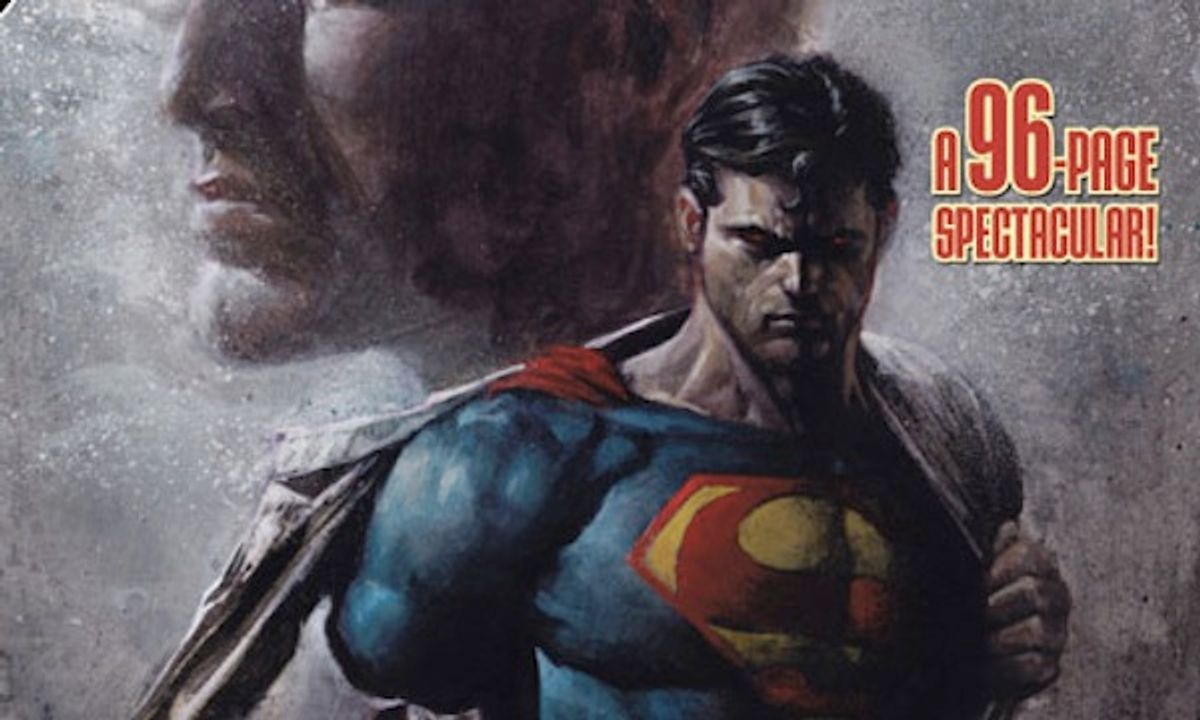
Superman no longer identifies as American

When the man of steel renounces his U.S. citizenship, what does that say about our country?

Topics: Comic Books, American History, Books,

Superman no longer identifies as AmericanMore powerful than a locomotive...but how about a head of state?

Hey, has anyone seen Superman lately? It’s like the man of steel has just given up on America ever since Donald Trump started asking to see his certificate of live birth from Krypton. No, but actually: Superman is no longer a U.S. citizen. In  “Action Comics #900,” released Wednesday, the D.C. character renounces his alliance with the United States after a trip to Iran leads President Ahmadinejad to believe America is going to war with Tehran. Whoops!

And though this all may sound like a big joke (after all, what does Superman stand for, if not the American way?), the scenario has played out before in alternative-reality comic book series. In Mark Millar’s “Red Son,” for instance, the baby Kal-El was born in Soviet Russia instead of the U.S. and worked for Stalin. In John Cleese’s (yup, the guy from Monty Python) “True Brit” there was no “Clark Kent,” but there was a very proper young lad named “Colin Clark.”

Now, however, Superman won’t be claiming any nationality as his own. And we have to realize what a profound change that will be for one of our country’s most iconic figures: Superman has always represented immigrant culture, the ability to literally “make it in America.” In a key panel of #900, Superman states his reason for leaving, saying, “I’m tired of having my actions construed as instruments of U.S. policy.” As the Comics Alliance mentioned in their post about the issue:

What it means to stand for the “American way” is an increasingly complicated thing, however, both in the real world and in superhero comics, whose storylines have increasingly seemed to mirror current events and deal with moral and political complexities rather than simple black and white morality.

Quite the analogy here: If Clark Kent has turned his back on us, then we haven’t just failed in international policy, we have failed to identify what it means to be an “American.” Though as Douglas Wolk points out in the Time.com blog Techland, the criticism on current politics doesn’t play so well when you are dealing with a fictional character like Superman:

Since when, for instance, has anybody thought Superman was an agent of U.S. policy, rather than a private citizen, especially since he just spent a year living off-planet and commanding a New Kryptonian army? How is an entirely nonviolent demonstration of solidarity an “act of war”?

And yet: if it takes a comic book to mirror our current political situation back to us in a way that we can understand, well, what is more U.S. of A. than that?

Drew Grant

Drew Grant is a staff writer for Salon. Follow her on Twitter at @videodrew.

Next Article

Featured Slide Shows

Gripping photos: The people of the Turkey protests (slideshow)

close X
  • Share on Twitter
  • Share on Facebook
  • Thumbnails
  • Fullscreen
  • 1 of 11
  • The protests take on a festive element as police forces move out of the park and square. Wearing a gas mask, this young man dances to traditional Turkish music in front of Taksim Square’s Ataturk Monument.

  • In Gezi Park since March 31st, this protester, originally caught off-guard by the Government’s teargas and water cannons, went out and bought a Russian army mask from WWII, preparing for what was to come.

  • This rambunctious boy seems to be enjoying the chaos. After taking this picture he threw a stone at the already destroyed building in the background.

  • Forming a line, the police face off directly with protesters in Taksim Square. After a while, they retreated and there was a general cheer – a back-and-forth dance that has been common since the beginning of this protest.

  • An elderly woman in Gezi Park reads the news. The tent community occupying the park was violently destroyed on June 16th.

  • Many different groups had set up booths to promote their cause in Taksim Square and Gezi Park. Standing in front of one, this man waves his flag while posing with conviction.

  • Many home-remedies are used to minimize the effects of tear gas. This woman has put a milky solution on her face, removing her mask after the tear gas dissipated. Before sunrise, the police came again for another round of teargasing.

  • People capitalize on the uprising -- selling flags, beer, gas masks, sky lanterns and spray paint to name just a few of the popular items.

  • On Monday morning, June 11, the police execute a strong offensive. Many plain-clothed police officers, like the ones seen here, clash with protesters in the side streets away from the main stand-off in Taksim.

  • The authorities seem to be most aggressive in the night, pushing protesters away from the square and park. After being teargassed this young woman catches her breath with other protesters on Siraselviler Street.

  • Recent Slide Shows

  • Share on Twitter
  • Share on Facebook
  • Thumbnails
  • Fullscreen
  • 1 of 11

Comments

65 Comments

Comment Preview

Your name will appear as username ( settings | log out )

You may use these HTML tags and attributes: <a href=""> <b> <em> <strong> <i> <blockquote>