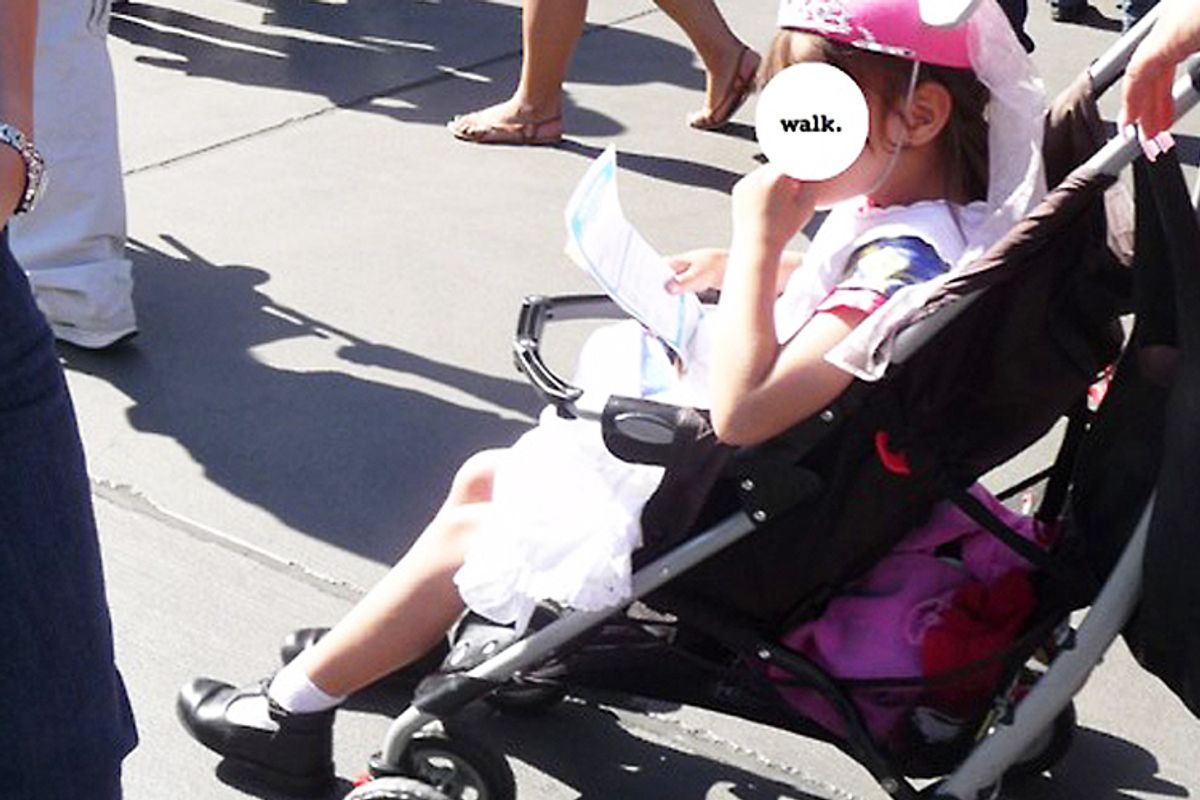
Maybe you're stuck in O'Hare during a particularly hellish travel season. Or you're strolling through downtown on a warm spring afternoon. Suddenly, you see it, and it just looks wrong: a child who is way too big and way too old being carted around in a stroller.
There's something hilarious and deeply grating about a child who can walk-- and, for that matter, do his multiplication tables -- being chauffeured via Bugaboo. It hits so many cultural hot buttons at once: a sense that we're overindulging a younger generation, the eyeroll-inducing eccentricities of parenting culture, an American tendency to take the escalator rather than the stairs. Maybe fellow parents see kids like these and feel sympathy. As someone without kids, I'm baffled and irritated -- and I was a nanny for two years.
That's why Too Big for Stroller is so gratifying. Its creator, Laura Miller (not the Salon book critic, by the way), was working in Manhattan's crowded Herald Square when the constant presence of huge tots in strollers inspired her to start the blog, which documents the trend in its own simple and snarky way. We talked to her by phone.
I think you've hit on something that bothers a lot of people. A friend sent me a link to the blog and said: "You're not the only person in the world that has this pet peeve!" Why do you think parents do this? Is it a particular type of parent?
I can't say it's a particular type. Often, it happens in tourist attraction type areas -- where you know you're going to be walking around a lot, and you know your kid might not be able to walk that much without whining. I get a lot of pictures from New York City, Times Square and Disney World. It's incredible in some pictures, because it looks like the kid is 8 years old. A few parents have sent me some emails in defense of this situation. They'll be like "You don't understand," and they're right. I don't have a kid. Maybe I don't fully understand. I understand the purpose and necessity of a stroller when you have a child, but I can't see the excuse when your kid is way too big to carry, and the stroller is way too small for that child anyway.
I don't have kids either, and so maybe this is naive, but when I see a kid who's way too big in a stroller, I think: "I'm never going to do that." Maybe there's something that happens after you have kids where you realize you can't deal and you need a stroller, but right now, it just doesn't make sense.
I wrote a caption at one that said: "When I have a kid, it will be strapped to me as an infant, and then walking, no middle ground." You know, a joke. And someone commented: "I said the same exact thing and I really meant it. But then my two-year-old started walking and she never walks in the same direction twice. The stroller is necessary." The blog is all kidding around. I do think that at some point I will have a kid and I will push a stroller but there's still this impractical or immature side of me that thinks there's something fundamentally un-cool about strollers. I mean, you could be the world's best businesswoman, but when you're pushing a stroller it just screams: "I'm a parent, this is all I am." I get why strollers are around, I don't hate them, they're appropriate for babies and toddlers. I just think it's funny when kids who are way too big for them are in them.
Where's the line when a kid is just too big for a stroller? How do you decide?
I don't know! When the kid's knees are bent up, when their feet are dragging on the ground. When I see some of these pictures, I wonder, aren't these kids a little embarrassed?
Where do you get the pictures? You said your friends send you some -- do you get them from random people now? How many submissions do you get?
A few I had taken myself. The more word got around, strangers started to send them too, especially now that the site's been getting more attention. I went from getting a few a week to at least one a day. Not all of them are usable, but I've been seeing a lot of enthusiasm. I had one woman, for a while, who sent me a ton. I don't know if she worked at Disney World, or was just going there a lot, but she was constantly sending me 10 pictures every week, at least. Without these submissions, I'd never be able to collect all these pictures myself, because it's a really hard thing to take a picture of.
It is. I'd assume most parents don't want people taking pictures of their child.
It's a tricky thing. It's never comfortable to be taking pictures of someone's kids on the down-low. It's a little creepy. I want to be clear, too, that I obscure the children's faces, and I make sure not to include (and I've never really gotten) pictures where the kid has a physical disability. I want to be very careful not to cross that line. And that is something that I'm a little worried about as far as reactions to the site. But you're never going to please everybody, especially when something becomes popular.
Right. This is something people are going to be sensitive about no matter what. Even if this is a site about able-bodied kids who are way too big.
It's mostly the aesthetic of it. It's just funny. There's nothing funny about a baby or a 2-year-old in a stroller. There is something funny about a giant child crammed into something that's meant for a toddler. That's what it comes down to.
What do people say when they see your blog?
Most people who reach out say that this is something that bothers them, too. I think lots of people are delighted to see that someone has homed in on this. I have gotten very little negative feedback, which I'm kind of surprised about. The response has been lighthearted and funny, because it's a funny thing to see. Especially in an urban area, where strollers are more predominant.
Have you ever had a personal encounter with a too-big-kid in a stroller?
I was walking down the subway stairs, and this lady was leaning over a stroller, like she was about to pick it up and carry it down the stairs. A gentleman approached her to help, and then he didn't. He walked away, and I remember thinking, what a dick, he didn't help her. Then I saw that the girl in the stroller was grown enough to get out of the stroller, help her mom carry it down the stairs and then climb back in it and strap herself in. She was 6, 7? I was like, are you kidding? Carrying your own stroller down the stairs and strapping yourself back into it? There's something wrong with this situation.
Shares