
Internet Culture

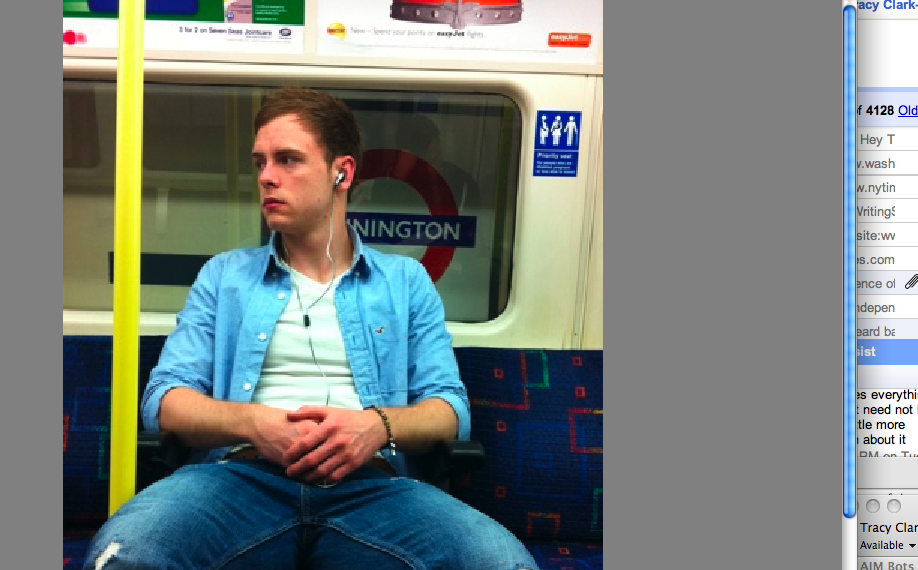
Men get the pervy candid camera treatment

TubeCrush publishes cellphone shots of unknowing hot guys. Is there a double standard afoot?

  • more
    • All Share Services

Men get the pervy candid camera treatment

When I hear about candid subway photos posted online, I think of upskirt and down-the-blouse snapshots. Next, Hollaback-style captures of fondlers and flashers come to mind. But a coed group of Londoners is subjecting men to unwitting Internet objectification with TubeCrush.net, a site devoted to hot guys encountered on the Underground. User-submitted shots are posted on the site with some eyebrow-wiggling commentary (e.g. “we just know there is a six-pack under that coat”) and visitors can give them a thumbs-up or a thumbs-down.

It’s getting a lot of coverage across the pond and, unsurprisingly, stirring up some controversy. The Guardian’s Sunny Hundul criticized the Evening Standard’s coverage of the site, which he argued was all too flippant and embraced an unfair double standard. He asked, “If the sexes had been reversed, would it have been seen so benign? Probably not.” Gail Dines and Wendy J Murphy also targeted the site in a recent Op-Ed:

The recent TubeCrush phenomenon, where young women take pictures of men they find attractive on the London tube and post them to a website, illustrates how easily women copy dominant societal norms of sexual objectification rather than exploring something new and creative.

I bristle at the suggestion that women who sexually objectify men are necessarily “copying” mainstream male sexuality (maybe they’re, I dunno, expressing how they really feel). In fact, I’m often tempted to celebrate mildly piggish female behavior — to a point — just because it at least contradicts the stereotype that female sexuality is adequately represented by, say, Twilight fan-fiction. (And isn’t fan-fiction just another mode of objectification, anyway?) I also happen to think that sexual objectification isn’t always a bad thing; it’s all about context and consent. (Dines is an anti-pornography activist, though, so we know where she stands on that issue.) It’s also interesting to think about the difference between candid shots taken for a street-style fashion blog versus a sexy-person-on-the-train blog: Why does the former seem so much more innocuous and reasonably objectifying?

Now, it’s important to point out the crucial difference between the photos that make it on TubeCrush and the explicitly sexual candids — most often of women — available all over the Web. These represent very different privacy issues: In one scenario, the one I’m concerned with here, a person’s photo is taken in a public space and then broadcast to a whole new audience, and in an unregulated venue for anonymous commentary; in the other case, a clear personal boundary — like a hemline — is trespassed in a public space and then the evidence is broadcast to a greater audience. Although, as I’ve written about before, the law doesn’t always distinguish between these two circumstances; there isn’t always a “reasonable expectation of privacy” beyond your hemline.

As for these tame shapshots, the legality isn’t as much an issue as the creep factor, which is entirely subjective (and not only dependent on the nature of the photograph but also the commentary that accompanies it). One unwitting TubeCrush subject tweeted that he was “5% demeaned, 35% flattered, 60% surprised” to find himself on the site. Now, he doesn’t speak for all men, and certainly plenty would find it far more unsettling than flattering, but that’s about the reaction one would expect from a straight man who discovers that a woman found him so drop-dead handsome she just had to snap his photo. That’s in part because most men are unaccustomed to objectification by women. (For example, after I brought a straight guy friend to a gay male dance club, he told me in awe: “I’ve never felt so attractive before in my life!”)

Women, on the other hand, are trained to be wary of strangers’ attention at every turn — and we know just how quickly compliments on the street or in the subway can become abusive and threatening. That isn’t a strong enough defense of a double standard when it comes to candid snapshots, though. Once we move beyond the question of whether women deserve a special pass for piggish behavior, we get to the far trickier privacy issues brought up by technology — and we’ll be trying to untangle those for quite some time to come.

Ultimately, sites like TubeCrush get at an essential truth about the Internet: People like to look at other people. After all, Mark Zuckerberg, King of The Web, got his start with a site that allowed visitors to rate people’s attractiveness online without their permission. And it also tells us something about the objectifying nature of human sexuality. As Camille Paglia put it, “Turning people into sex objects is one of the specialties of our species.”

Tracy Clark-Flory

Tracy Clark-Flory is a staff writer at Salon. Follow @tracyclarkflory on Twitter.

“Tubes”: What the Internet is made of

If you think your data lives in the cloud and flies through the air, you're wrong

  • more
    • All Share Services

Andrew Blum

The title of Andrew Blum’s “Tubes: A Journey to the Center of the Internet” is a ricocheting joke. When Alaskan Sen. Ted Stevens described the Internet as a “series of tubes” back in 2006, he was roundly mocked for not understanding the online world despite being chairman of the Commerce, Science and Transportation Committee and therefore instrumental in overseeing it. Stevens may not have known what he was talking about, Blum (a correspondent for Wired magazine) acknowledges, but he wasn’t wrong, either. In writing this account of “the Internet’s physical infrastructure,” Blum found that “one thing [the Internet] most certainly is, nearly everywhere, is, in fact, a series of tubes.”

The average resident of the developed world uses the Internet constantly, contemplating its impact on contemporary life and exploring its numberless delights, temptations and annoyances on a daily basis. Yet, for most of us, any notion of how all this information arrives in our homes and workplaces is weirdly immaterial. Stevens was ridiculed for his hopelessly old-fashioned reference to the physical world and the movement of palpable objects, while smart kids and late-night comics grasped that the Internet has zipped beyond all that to become the disembodied essence of human communication.

Only it’s not, and “Tubes” is about the actual, physical things — many of them tubes — that make up the pathways of the Internet. For all their significance to contemporary life, governance, commerce and industry, these conduits aren’t an alluring topic. Like a lot of important things, they are superficially dull and trivial: bundles of cables; deserted stations ringed in cyclone fencing beside lonely highways; featureless, windowless buildings in old warehouse districts and, above all, rooms filled with metal boxes, blinking lights and cool, dry processed air. This is not the stuff that dreams are made of — and at the same time it is, because dreams of every sort thrive online.

Fortunately, Blum is a smart, imaginative, evocative writer who embraces the task of making his readers feel the wonder represented by these unprepossessing objects. In the Cornish seaside town of Porthcurno, he’s shown a black cable emerging from the floor, “spooled into steel trays the size of merry-go-rounds, like something stolen from Richard Serra’s storehouse,” and pictures the thousands of miles it extends, through the depths of the Atlantic Ocean, all the way back to Long Island, where, in the form of light shining down strands of glass, it will carry home the email he writes to his wife from his hotel room that night. (Another cable, running from Portugal to Africa is a “nine-thousand-mile path of light… that would transform a continent.”) Swathes of cables lifted from beneath the streets of Manhattan by workmen are likened to “giant squid under the streetlights.”

This book is more than a electrical engineering travelogue, however; in the course of his research Blum interviewed representative examples of the people who make the Internet work and a smattering of those who helped build it in the first place. The computer science professor at UCLA who, in 1969, used a phone line to connect that university’s computer network with Stanford’s shows Blum the IMP (Interface Message Processor) used for the task: a file-cabinet-sized box — the first piece of the Internet! — now shoved into the corner of a shabby conference room. He attends a meeting of network operators, the people who, among other things, negotiate the direct, plug-in, network-to-network connections that are the building blocks of the net, and hears a Dutch woman imitating an old-school street hawker: “I have eyeballs, eyeballs, eyeballs. For all of you with content, please send me an email.”

So ingeniously beguiling is Blum’s way of conveying all this that, before you know it, you have acquired a sense of the basic structure of Internet — from old-school exchanges to fiber-optic regeneration stations. The Internet turns out to be not quite what Blum (and a lot of other people, including myself) assumed. “I expected to find a loose arrangement of little pieces,” he writes, expressing an idea probably shared by many of his readers. “It was all supposed to be distributed, amorphous, nearly invisible.” True, information can travel via a variety of routes, but most of the time it makes its way along major thoroughfares. While the Internet doesn’t exactly have a center, it certainly has nodes and backbones where most of the connections are made and the data stored. Blum tried to lay eyes on as many of these as he could.

It wasn’t always easy. Having arranged to visit a brand-new Google data center in rural eastern Oregon, Blum never gets closer to the servers than the lunchroom, and his interviews are supervised so oppressively it’s like taking an official tour of North Korea. (Perhaps ironically, a Facebook center in the same region proved much more open.) For months, Cablevision, his own Internet service provider, dodged his requests for an overview of how data got from their network to his home in Brooklyn. While the more secretive of the organizations he contacted often attributed their caution to security concerns, Blum was skeptical. He compares a stopover at the friendly visitor center at nearby Bonneville Dam to the “Orwellian atmosphere” at Google; both are important, strategically sensitive resources, but only one is shut up tighter than Fort Knox. Blum questions whether it’s wise to hand over “so much of ourselves” to corporations that are not obliged to return the trust.

Part of the utopian romance of the Internet is that it has no weight, no friction, no footprint, no smell. The buzzword of the moment — “cloud” — promises ethereality, pure information, a dream with almost supernatural intimations. Yet as one of Blum’s data-center tour guides explains, “This is the cloud. All those buildings like this around planet create the cloud. The cloud is a building. It works like a factory.” It needs power, raw materials and staff. And its roots are in the earth.

Continue Reading Close
Laura Miller

Laura Miller is a senior writer for Salon. She is the author of "The Magician's Book: A Skeptic's Adventures in Narnia" and has a Web site, magiciansbook.com.

Internet doomsday, explained

According to media reports, July 9 will be our online apocalypse. The better story is how this crazy rumor started

  • more
    • All Share Services

Internet doomsday, explained

The apocalyptic story line was once reserved for truly apocalyptic events. Nuclear war. The return of Christ. Environmental or economic collapse. But it’s 2012, and the apocalypse has become the basis for everything from Super Bowl commercials to summer romantic comedies – and no media story is too small to have an apocalyptic moniker attached to it. (Remember Snowmageddon?) If you want to get the world’s attention, simply proclaim that the world will soon end — or the Internet. Just read coverage of the so-called Internet Doomsday virus, which will supposedly strike and shut down the Web on July 9.

Here’s how the story got started. Back in October, the FBI announced that it had broken up an international crime ring when it arrested six Estonians in what was then heralded as “the biggest cyber criminal takedown in history.” The Estonians had, over the course of four years, hijacked more than 4 million computers in 100 countries through the use of malware known as DNSChanger. By redirecting the infected browsers of unwitting users, DNSChanger was able to send high volumes of traffic to the criminal ring’s rogue websites and servers, collecting more than $14 million in fraudulent advertising revenue and exposing their victims to information theft in the process.

“Operation Ghost Click” (as the FBI dubbed its sting operation) put an end to the Estonian scheme, but a problem remained. If the feds simply shut down the Estonian servers, the 4 million infected machines — nearly 1 million of which were in the United States — would be unable to reach the Internet. To give the cyber-crime victims time to clean up their machines, the FBI contracted the Internet Systems Consortium (ISC) to maintain valid servers in place of the criminal servers. The new servers would remain online until March 8, 2012.

And so it came to pass that the FBI tried to warn the people, but the people were not listening. The people were too busy swatting the pop-up ads that buzzed like flies around TMZ.

As things turned out, a cabal of Estonian thieves in an international crime ring wasn’t enough to get the public’s attention. By early February, nearly half of all Fortune 500 companies and half of all major federal agencies still had computers infected with the virus — along with 400,000 other computers around the world. If the government shut down its proxy servers on March 8, as was planned, all of these computers would be unable to access the Internet. (The FBI, frankly, hadn’t done the best job in getting the word out about DNSChanger: It slapped up a PDF on the Web and assumed people would find it.)

And then it happened. Somebody put two and two together. There was a larger, more familiar narrative at work here. The tale of Operation Ghost Click and DNSChanger held all the elements of a familiar story. A set date. The need for the wayward computer users to repent before the date came. The smug satisfaction that when the date finally came, the non-believers would be cast into a disconnected hell, with nary a Google Map to lead them out of it. Have you not accepted Norton AntiVirus as your savior? IT nerds across the nation waved their MacBooks in contemptuous indignation.

This wasn’t just any old computer virus. For those who did not repent — or at least scan their computers for the virus — March 8 would be INTERNET DOOMSDAY.

Let’s back up for a moment: “Doomsday?” one might ask. Really? Some accountant at Hormel might not be able to access the Internet one day because of slovenly security habits, and that becomes doomsday? Has the apocalyptic bar really been set that low?

In fact, it has — and there are three reasons for this.

Understanding the first reason requires a quick trip back to the last time apocalyptic rhetoric was as mainstream as it is today — the 1970s, when the country was buffeted by oil shocks, stagflation, Watergate, spiraling crime, inner-city decay, and defeat in Vietnam. A paranoid and pun-filled tome soon emerged to explain the chaos as signs of the end of the world — Hal Lindsey’s “The Late Great Planet Earth,” the “No. 1 nonfiction seller of the decade” (as the New York Times put it), which found its way onto the bookshelves of more than 15 million Americans. And now the teens and 20-somethings who had clutched copies of “The Late Great Planet Earth” in the 1970s are editors, writers and producers, and they bring to the media landscape the narrative of their youth, in much the same way that indie music from the 1980s and ’90s, which never sold very well at the time, has reached a wider audience in the 2000s as Gen Xers find themselves program directors at radio stations or music supervisors at ad agencies and television networks.

The second reason came at the dawn of the next decade, with the launch of CNN in 1980. The rise of cable news (and, in the late ’90s and early 2000s, the rise of the Internet) didn’t merely transform the media landscape; it exponentially expanded it. Prior to 1980, the “Big 3” networks — ABC, CBS and NBC — programmed little more than three hours of news per day. Nowadays, even the “24-hour news cycle” seems like an antiquated idea; Twitter has brought us the 24-minute news cycle, with reporters on their Tweetdecks chasing headlines like little kids playing soccer. In this new media landscape, where speed and hyperbole trump investigation and accuracy, apocalyptic headlines draw the all-important consumer eyeball, regardless of the story that runs beneath.

The third reason that we so readily embrace the apocalyptic story line — not merely as producers of news, but as consumers — can be found in the decade behind us. As we’ve written before, the first decade of the 21st century was a decade punctuated by historic events that seemed (or were treated as) nearly apocalyptic in scope. From preparations for Y2K to the attacks of Sept. 11, from rising evidence that climate change has arrived to the economic collapse of 2008 in which we still find ourselves entangled, the belief that the world is coming undone — that the final straw is just moments away from being lowered onto the camel’s back — has surged from the edges of conspiracy and into the center of our public discourse.

The problem with this arms race toward the ever more apocalyptic is that it depletes our reservoirs of concern. If everything is an apocalyptic threat, then nothing is. And when each overhyped threat passes with nothing happening — where are you now, Ebola virus? — we find ourselves more capable of dismissing real concerns like climate change as overhyped as well.

We called the FBI Press Office to ask them why they were trying to frighten people with their overheated rhetoric about “doomsday.” Didn’t they know that small children also used the Internet, and might be haunted by nightmares of never feeding their Moshi Monsters again? “I don’t think we’ve ever used that word,” the press officer who answered at FBI headquarters assured us. “We’ve never called it ‘Internet doomsday.’”

Ever since Y2K, the media has mastered the technique of combining any potential threat — no matter how remote the probability and no matter how localized or contained its likely impact — with the apocalyptic story line. The result has been an increasing hyperbole in the news, and an endless parade of stories that imagine the “end of the world” in the most unlikely of scenarios, from solar flares to polar shifts to … well, some get-rich-quick scheme cooked up by some hoodlums in Estonia.

Take, as another example, the headlines in March that warned us that an impending solar flare could knock out most of our satellite communications, GPS and utilities, plunging the world into unplugged chaos. Beneath the headlines, usually in the final paragraph, was a little-noticed caveat: Such flares occurred with regularity a decade ago, with virtually zero impact.

But it’s the headlines that matter, not the details or the subsequent paragraphs, and “Internet Doomsday” was a great headline. The blogs lit up with stories about the horrors that might befall us if we couldn’t access Gawker. And like all good apocalyptic narratives, the Internet Doomsday quickly took a turn toward the conspiratorial: The FBI itself was going to pull the plug on the Internet on March 8, it was said. Government efforts to protect computer users had become a government plot to unplug computer users. There was much logging on, and rumors of not logging on.

But this was not yet the end. A judge, apparently consulting with Harold Camping (who knew much about the flexibility of having a backup date for the apocalypse), ordered the FBI to keep its goodly proxy servers going for another 120 days, until July 9, to give the unrepentant more time to download Kaspersky. And the FBI became more Internet savvy: A few weeks ago, it unveiled a new website where computer users could check to see if their computers were infected with DNSChanger.

The press dutifully reported on the FBI’s valiant effort to help the remaining victims of the scam — perhaps 200,000 out of 2.3 billion Internet users in the world — repair their computers. The most common headline? You guessed it: “Internet Doomsday Coming July 9.”

Continue Reading Close

Mathew Gross is considered one of America's top new-media strategists. Together with Mel Gilles he is the author of "The Last Myth".

Mel Gilles is a writer and a former advocate for victims of domestic abuse. Her essay, "The Politics of Victimization," went viral in 2004, reaching more than 2 million readers.

Nobody ever calls me anymore

I feel like the last person who still likes talking on the phone. Why did we give it up, and should we reconsider?

  • more
    • All Share Services

Nobody ever calls me anymore (Credit: Anatema via Shutterstock)

As a teenager, my friend Jennifer used to sneak into her mother’s room after bedtime and steal the phone. She would call the boy she was dating, or “going with,” or whatever we called it back then, and they would talk all night, sometimes till 4 a.m.

But something shifted a few years ago. She became afraid of talking on the phone. Just hearing it ring could provoke panic. Maybe it was the suffocation of carrying her cellphone all day long. (“There are these tentacles in you all the time,” she said.) But she rarely answered the phone, preferring to text message, and the voice mail piled up like unopened bills dumped in a desk drawer – frightening and unknown and ever present — until she couldn’t bear it anymore, and in a rush of guilt she would delete dozens of messages that had been left for her without even listening to them.

Sometimes she would text the person to find out what they needed: “Sorry I missed your call,” she would type, although technically she wasn’t, and technically she hadn’t. Instead, like so many people I know, she had simply stopped using her phone for the one purpose Edison intended: to speak to another person.

Jennifer calls this “telephobia,” and whenever she mentions it, friends nod in vigorous empathy: I have that. Me too. But “telephobia” is not quite accurate, because the truth is that most of us, Jennifer included, covet and depend on our telephones in a way that was unfathomable to previous generations, burdened by such clunky accouterments as Samsung video recorders and leather Day Runners big as a phone book. (Dang, phone books: Remember those?)

Instead, our phones have become so powerful, and so enmeshed in our lives, that a whole genre of journalism has sprung up around our thorny relationship to them: People who can’t break away from their cellphones for a mere conversation; people who rediscover the joy of life only after chucking them. Our phones are a 24/7 carnival of distraction – Facebook, Twitter, texting, Words With Friends – and the temptation to lose yourself, to become overwhelmed by the demands of a portable fun factory is an American experience currently being hammered out in a thousand trend stories (this one included).

People talk about how tough earlier generations had it, and I for one have no clue how to plow a field. But challenges simply mutate according to the demands of the day. I may be worthless with crop rotation, but I’d like to see a pioneer woman take a left-hand turn at a busy intersection while reading a suggestive text from the guy who is currently making her heart pound. Or, because we all know that’s a terrible idea, I would like to see her take that left turn and not read that text message from the guy. The internal fortitude it requires not to cave in to these seductions on a minute-to-minute basis? Massive.

But this is a story about talking on the phone, and why so many of us stopped doing it. It’s not news that this happened. A December 2011 Nielsen study on mobile media usage shows that voice calls have dipped 12 percent since 2009, while text messaging has exploded in the same time period, even tripling in volume among teens. When I asked friends whether they felt anxiety about talking on the phone, the response was more of a confused look: Why would I talk on the phone? A great 2011 New York Times Styles story by Pamela Paul talked about this shift, how much easier it was to punt our daily communication over to text and email, where we could fiddle with the knobs at our convenience, leaving a trail of evidence as to what we agreed upon and when. Even Miss Manners declared that the old-fashioned phone call was, well, kind of rude.

What I wish I heard more in all these stories about how we communicate — whether it’s about the death of voice mail, or whether or not Facebook is destroying our humanity — is the fact that it’s just plain scary to talk to other people. We avoid it not because people don’t matter — but because they do. And each of us brings emotional baggage to these interactions. When my phone rings, and I don’t recognize that number – forget it. I’m too scarred by the years I spent dodging credit card companies to take that kind of dare. I also don’t jump off cliffs, or do cartwheels on the highway. In fact, it’s amazing to me that there was a time when the phone rang, and someone just answered it. Who could it be? Could it be the guy who was currently making your heart pound? Oooh, let’s pick it up and find out! Now, when I see an unfamiliar number, I feel nothing but outrage: How the hell did someone in the 405 area code get this number? What could they possibly want?

Our social expectations evolve. After all, there was a time when door-to-door salesmen made the rounds in every neighborhood, but if anyone rang the doorbell in my New York apartment, I would cower like I’d seen a masked man outside wielding a crowbar. That’s just the moment we’re living in. We make ourselves wildly available online – dangerously available, some would say – and in real life, we are way more defended. Celebrities pay publicists hefty salaries to control their image, and then jump on Twitter and tippy-type away. Surely it won’t always be like this.

But we have so many alternatives for communication that agreeing on one dominant form is simply not necessary. A lot of people I spoke with despise the phone, and have for a long time. Why would they use it if they didn’t have to? “I’m pretty much always better in written communication than spoken,” a male friend told me via Gchat, where our conversations can thread throughout an entire workday, flaring up for 10 minutes at noon only to pick up steam again at 5 p.m. He adores instant message. “You don’t have to worry about interrupting the other person. You don’t have to listen to the other person while also trying to think of what you want to say. If the other person is telling a long, boring story, you can just let them tell it.”

A voice call, on the other hand, demands too much attention from him while offering not enough in return. No visual stimulation. Even a casual silence “can feel like a thousand deaths.” Not to mention crappy reception. As phones all go digital, the warmth of a land line has been replaced by an irritating buzzmuffle that requires constant affirmation. Can you hear me? Are you there?

Still, I was taken aback by the vitriol some friends have for talking on the telephone. “I really, really hate it,” a friend said over email, which is how she and I often have deep conversations. “Maybe it’s that there are too many distractions (TV, folding laundry) and I am guilty of giving in to them OR it’s that I can hear the other person doing the same thing. There just never seems to be a good time to sit down and speak into the void.”

Another friend complained that chatting on her iPhone was like “cradling a brick to my ear.”

And don’t even get people started on voice mail. Everyone detests it. “I cannot handle how uncomfortable it makes me,” said a friend, who is the kind of extrovert who can join any conversation. “There is an intimacy that seems too great, like a song that was written just for me.”

At a time when devices keep us at arms’ length, phone calls rocket the voice straight into the ear. It’s a revealing way to communicate. “The telephone conversation is one that really exposes nuances of meaning,” says Edward Tenner, a visiting scholar in the Rutgers School of Communication and Information, who is also the author of “Our Own Devices.” “So much of language is not just the words as they might appear but the inflection or accent, the deciphering of sarcasm.” Tenner and I spoke by phone, naturally, where the land line he used was nearly decadent in its clarity. I felt, at times, like he was in the room with me. “People have become much more guarded about their public persona,” he continued. “They will manage it on social media and dating sites. They will present carefully tailored pictures. When they’re in an actual conversation, there’s more revelation than they’re comfortable with.”

But that’s different from not wanting to converse at all. In fact, what I heard in these conversations was not a retreat from connectedness but a desire to do it better, to play to one’s own strengths. I happen to love long conversations on the telephone, probably because I think I’m pretty great at it – I’m highly verbal, thrilled by the joust and parry of a good debate, and the pure audio allows me to stop worrying about stupid stuff like how I look in this dress, and what your eyes are staring at right now OMG there is something in my nose. Because my closest friends are scattered across the country, I make regular phone dates that I treat like actual dates. That’s not to say I play Barry White and sprinkle rose petals on the bed (though, sure, when the mood strikes), but I do commit to offering that person my full attention for an hour, or an evening, or until the batteries on our phones go dead. A phone call offers a connection you can’t get anywhere else — not from a text, or email, or Gchat. Not even from a face-to-face conversation.

Then again, I also understand my friend Jennifer’s irrational fears of the phone. How do you say no to someone on the other end? How do you untangle yourself from an awkward conversation? Avoiding those messy, human questions can be awful tempting. But Jennifer found her anxiety, or her “telephobia,” or whatever we’re calling it was getting in the way of her life. “I was not available for people,” she says, “and that bothered me a lot.”

So she made a resolution to call a friend every weekday for a month. They didn’t always have long conversations. Often they were quite short. She says it was nothing short of amazing, though. I don’t want to pretend that Jennifer made a few phone calls and, poof, her life changed. But I also don’t want to undersell how transformative it can be to stare down a real, live fear and slay that sucker. In her month of voice calls, Jennifer grew a little closer to people in her life, but she also grew a little closer to the person she wants to be, who is not someone ducking into the closet whenever the phone rings.

The tricky thing about technology is letting it work for you, but not letting it do all the work. Otherwise, you don’t grow. Personally, I hope in the future we have robots that can do difficult things, like standing in line at the DMV or waiting for a text message from the guy who is currently making your heart pound. Until then, I have my friends to help. I can call Jennifer – and I know she’ll pick up.

Continue Reading Close

Sarah Hepola is an editor at Salon.

Who owns the cloud?

Google claims users retain intellectual property rights, but the terms of service tell a more complex story

  • more
    • All Share Services

Who owns the cloud? (Credit: winul via Shutterstock)

When you hear the phrase “property rights,” you probably think of farmers fighting environmental regulators and homeowners arguing with oil drillers. But in the Information Age, you should also be thinking about your computer – and asking, how much of you is really yours? It’s not a navel-gazing rumination from a college Intro to Existentialism class – it’s an increasingly pressing question in the brave new world of social networking and cloud computing.

Last week’s big technology announcement spotlighted the thorny issue. As the Los Angeles Times reported, Google’s announcement of its “Google Drive” came with the promise that users will “retain ownership of any intellectual property rights that you hold in that content.” But when you save files to Google’s new hard-drive folder in the cloud, the terms of service you are required to agree to gives Google “a worldwide license to use, host, store, reproduce, modify, create derivative works, communicate, publish, publicly perform, publicly display and distribute (your) content” as the company sees fit.

When asked about this, Google argued that its provisions merely “enable us to give you the services you want – so if you decide to share a document with someone, or open it on a different device, you can.”

As reassuring as that seems, though, it’s not that simple when considered in a larger context.

In the last few years, major technology companies have become integral to interpersonal communication and information management. At the same time, many of these firms have tweaked user agreements in exactly the way Google has, helping the industry legally position itself for a mass intellectual property grab. That means whether you are using a photo-sharing site or a Web-based email account, you may have signed off on letting one of these corporations do whatever it wants with your data. As evidence of that reality, Facebook in 2009 let advertisers employ users’ uploaded photos to market products without users’ explicit approval.

Such a use unto itself may not offend you, but remember – that’s only what you can see. Indeed, nobody has any comprehensive idea of how tech companies are using these provisions in their secret business-to-business dealings. If they are already using your photos, what else are they doing behind their firewall? Are they selling your data? Are they mining your cloud files looking to preemptively appropriate the next great innovations? Nobody knows … well, except the tech companies themselves.

It’s easy to ignore such concerns by believing that the scope of a mass data mining operation is prohibitively large. But that’s not true. With the government already mining data from millions of Americans’ phone records in the name of fighting terrorism, it’s perfectly reasonable to believe that multibillion-dollar corporations can do the same.

Of course, companies providing these services assert that intellectual property is a substitute currency for cash. As the logic goes, even though online services cost money to create and maintain, you the user don’t have to pay actual cash for them because you are already paying in information about yourself, which technology companies then monetize.

That may seem at first like a good deal. But amid companies’ ever-intensifying pursuit of profit, the monetization process opens up the possibility for serious shenanigans. And here’s the worst part: If a company ultimately pilfers inventions or trade secrets or anything else from users, it will already be too late. Because we so quickly hit “agree” when we originally opened our accounts, we will have signed away any claim to what we believed to be ours and ours alone.

Continue Reading Close
David Sirota

David Sirota is a best-selling author of the new book "Back to Our Future: How the 1980s Explain the World We Live In Now." He hosts the morning show on AM760 in Colorado. E-mail him at ds@davidsirota.com, follow him on Twitter @davidsirota or visit his website at www.davidsirota.com.

Lessons of a baby bucket list

Avery Lynn Canahuati accomplished a lot in her six months of life. Imagine what the rest of us can do in a lifetime

  • more
    • All Share Services

Lessons of a baby bucket listAvery Lynn Canahuati (Credit: http://averycan.blogspot.com/)

What have you accomplished since November? What dreams have you fulfilled? In that time, Avery Lynn Canahuati threw out the first pitch at a baseball game, got a letter from the president and dressed up like a troll doll. She experienced deep love, and changed the lives of her family and friends. And that’s just what Canahuati got done in the first six months of her life. They were also the last.

Canahuati was born in Texas on Nov. 11. This past Good Friday, she was diagnosed with spinal muscular atrophy (SMA), a group of rare neuromuscular diseases that, in her case, were terminal. “We asked our doctors specifically if there is anything. Is there trial drugs, anything out of the country?” her mother, Linda, told CNN this week. So after “sitting around for two days crying and being devastated, since there is no cure and there is nothing we can do,” her father, Mike, decided to make the most of what was left of his daughter’s cruelly brief expected lifespan. Writing in Avery’s voice, he created a blog — and set a few goals.

“Imagine you’ve been diagnosed with an incurable genetic disease and you are told you will not only lose your ability to walk and move your arms, but you will die between now and the next 18 months. What would you do?” Avery’s blog reads. “This has become my reality. But before I die, there’s a few things I’d like to accomplish … this is my bucket list and my story.”

During an adventure riddled with so much good humor, so many images of smiling, laughing people that it’s damn near impossible to read about it without dissolving into a sobbing, balled-up wreck, Avery and her family went about achieving the feat of simply “celebrating life.” Avery’s objectives were as seemingly mundane as to “stay up past midnight” and “keep smiling even after surgery” — and as grand as raising a million dollars to fight SMA. Along with good-natured jokes about man-purses, hospital cribs that look like “Lockup: Texas Children’s” and insanely cute pictures of a smiling baby with a chick fuzz hairdo, are the harrowing realities of life with a fatal disease. There were tubes and operations and weight loss and reflux issues that affected her breathing and swallowing.

For all the items Avery got to cross off her list in just a few brief weeks — “eat ice cream,” “meet someone else with SMA” — there are many she didn’t. She didn’t, as she’d written she’d hoped to do, graduate college. Or get married. She didn’t play in a softball game or ride a Ferris wheel or attend a birthday party. She died suddenly on Monday afternoon, when, as her father wrote later, “one of her lungs collapsed and she went into cardiac arrest.” And one last time in Avery’s voice, he wrote that her final dream was “spreading awareness and helping to fund a cure for my friends.”

We live in a mortality-denying culture. Just this month, an Aflac WorkForces Report announced that “sixty-two percent of U.S. employees say it’s not likely they or a family member will be diagnosed with a serious illness.” Yet disease comes for many of us, and death comes for everybody. That’s not an abstract concept. It’s the truth. I didn’t always get it, either. But I certainly understand that much better now than I used to, after watching a few of my loved ones die over the past year while my best friend and I faced our own life-threatening cancers. And I’ve got to say, death really clarifies the hell out of one’s to-do list.

Avery’s goals were not her own, of course. They were the ones her parents set to maximize her remaining time. But it’s easy to see in her photos what a cheery, friendly baby she was, and the ways in which her sunny nature inspired others. It’s easy to see a mother and father who could have become embittered by a devastating twist of fate, who instead chose to fight fear with love, pain with compassion, who are trying to use their loss as a means of raising awareness and doing service for others. They did it in a matter of weeks. Think of what the rest of us could do with a few decades.

You shouldn’t have to wait for a diagnosis to consider the possibility that you are going to die. You are. Maybe even in the next six months. The question is: What will you do with the time you have left? Will you eat a cupcake, get a kiss? Avery did. Will you reach out and connect? Will you love and be loved? Will the ones you leave behind be able to call your life a “celebration” too? As Avery and her parents tell us, “You can live life dying or you can die living life.” Imagine you’re on the clock. Start acting like it. Go.

Continue Reading Close
Mary Elizabeth Williams

Mary Elizabeth Williams is a staff writer for Salon and the author of "Gimme Shelter: My Three Years Searching for the American Dream." Follow her on Twitter: @embeedub.

Page 1 of 55 in Internet Culture