Libraries and librarians

Why libraries still matter

Critics say they're obsolete, but New York's main branch is a reminder of what the Internet can never do

  • more
    • All Share Services

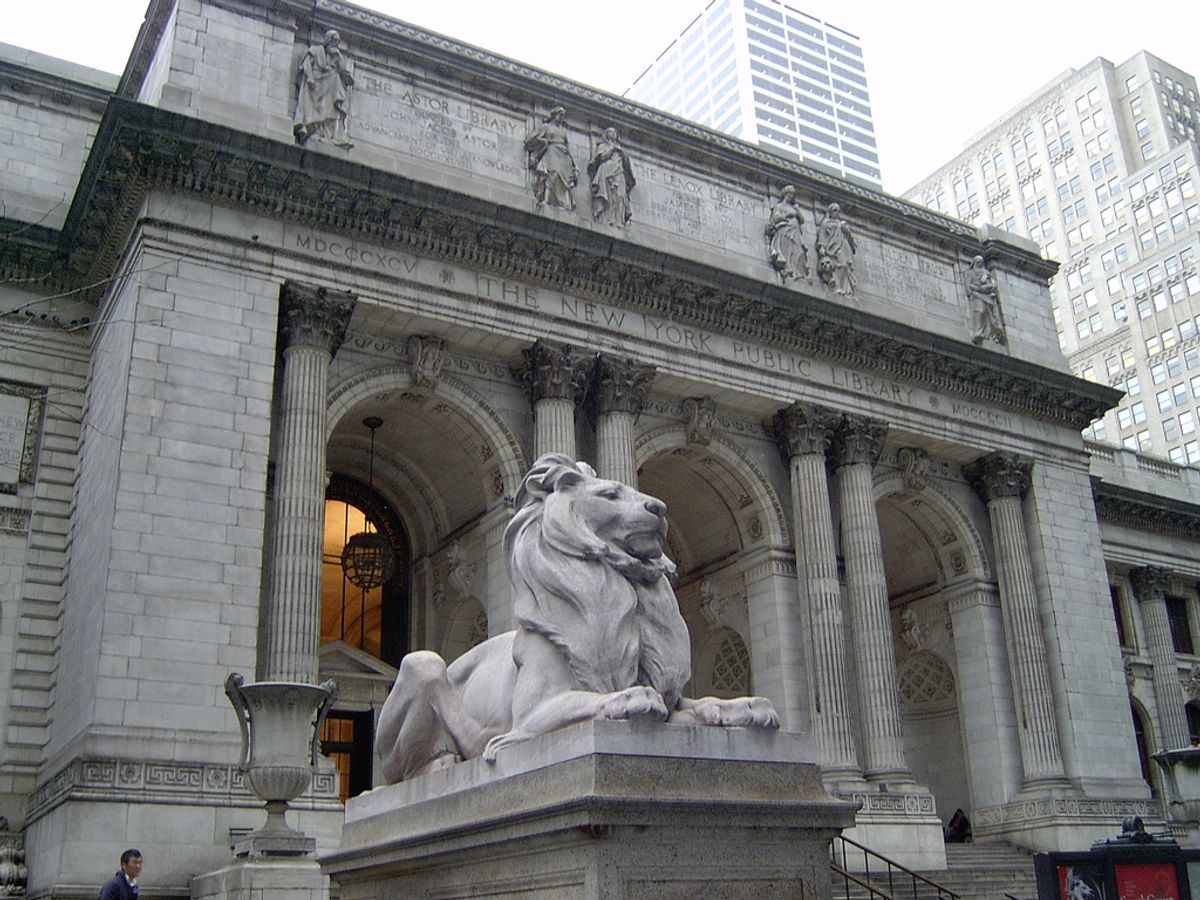
Why libraries still matterThe main branch of the New York Public Library

There are bigger and busier libraries in America, but none more iconic than the main branch of the New York Public Library on Fifth Avenue, that stately, marble Beaux-Arts temple of knowledge whose entrance is flanked by two enormous stone lions. May 23 is the 100th anniversary of the edifice (which was renamed the Stephen A. Schwarzman Building in 2008, after the financier donated $100 million toward a major renovation).

The library is celebrating with a festival featuring events, an exhibition of some of its most prized items and a kind of writing project cum scavenger hunt devised by game guru Jane McGonigal, in which 500 contestants will spend the night in the building, exploring the collections on various “quests.” The New York Public Library commemorated the centennial of its incorporation (in which several smaller public and private libraries were merged) back in 1995; this week’s celebration is for the building, the most visible part of a much larger system.

Some would also say that it’s a superfluous part. Public libraries across the nation and the globe now face drastic funding cuts from politicians and administrators who often claim that they’re obsolete. For months, Britain has been rumbling with protests against plans to close as many as 400 local branches. Earlier this year, Gov. Jerry Brown announced that he was cutting all state funding to California’s libraries, leaving cities to pick up the slack. Defenders of such cutbacks typically ask why, in the age of Google and e-reader devices, anybody needs libraries.

Let’s set aside the obvious rejoinder that many citizens can’t afford e-readers and, furthermore, can only access Google via a library computer. The anniversary of the NYPL’s main building is an occasion to talk about why the library needs to be a place as well as an ethereal mass of data residing somewhere in “the cloud.” Not everything we need or want to know about the world can be transmitted via a screen, and not every experience can be digitized.

Also, not everything a library collects is a scannable book or document. The NYPL’s anniversary exhibit includes such treasures of print culture as a Gutenberg Bible, a copy of the Declaration of Independence written in Thomas Jefferson’s hand, and a first quarto edition of “King Lear.” It also features the personal effects of writers, such as Jack Kerouac’s rolling papers, harmonica and Valium box (with notes scribbled on it):

Charlotte Brontë’s writing desk:

Charles Dickens’ letter opener (with the paw of his beloved cat Bob preserved as the handle):

There’s even a lock of Mary Shelley’s hair:

I’ve always found the material presence of such objects quietly thrilling. They remind me that literary figures, who sometimes seem so Olympian, also muddle through an ordinary human existence like all the rest of us. Other gems in the NYPL exhibit simply don’t translate well to the screen. You really have to see the enormous pages of an actual edition of James Audubon’s “Birds of America” in person to fully grasp its magnificence. The same goes for the library’s illustrated scroll of Lady Murasaki’s “The Tale of Genji,” sometimes described as the first novel, but certainly the single most beautiful “book” I have ever laid eyes on.

Those items are priceless, but what about a small folding pamphlet titled “What to Do If You’re Arrested,” distributed in the bad old days of the 1960s by the gay-rights organization the Mattachine Society and just the size to fit discreetly into a back pocket? Or the underground anti-Nazi propaganda tracts from 1939, complete with the tomato seed and tea packets they were originally concealed inside? The exhibit includes copies of anti-Semitic German children’s books published around the same time and a collection of lapel buttons from the civil rights era.

Unlike the Dickens and Brontë memorabilia, which could just as easily be enshrined elsewhere, these are once-mundane objects you’d never find in a museum, but they’re an important part of our written culture and well worth saving. The library collects millions of such items — things, and to store and properly display things, you need a place in the world (preferably climate controlled), not just bytes in the cloud. Every human community creates such materials, and they all need libraries to preserve them.

In a smaller side room, there’s also an exhibit of books researched and written in the main branch itself — one of the most famous is Betty Friedan’s “The Feminine Mystique.” The NYPL runs several programs providing research assistance, grants and work space for qualifying writers, but as any bookish New Yorker (and many visitors) can testify, the Adam R. Rose Main Reading Room makes itself available to everyone. There’s something about that vast, serene, light-filled space, with its monumental oak tables and brass lamps, that steadies and focuses the most jittery mind. When I’m finding it hard to work anywhere, I can always work there.

Today, those oak tables have power outlets and more than half the patrons are tapping on laptops. Yes, they have laptops and yet they’ve come to the library. Librarians (who are of course the most invaluable feature of any library) tend to bristle at the stereotype of their profession as a glorified shush patrol, and typically respond by pointing out the many, many community services libraries provide, from storytelling for children to multimedia resource centers for job seekers to gathering places for seniors. But let’s not totally discount the shushing, because a good library can also give its patrons something that’s getting harder and harder to find: quiet.

The Rose Reading Room is an exceptional place, but even the humblest branch library can provide the same precious resource to its patrons. There’s nothing “elite” about needing some tranquility, either: If anything, the poorer and younger you are, the harder it is to find a quiet spot to read, write and think, where family isn’t crowding around and countless electronic devices aren’t blaring at you from every corner. Access to a little peace and quiet is as essential to a humane society as access to parks and art. That’s not something the Internet is ever going to be able to give us. It can only be found in a real, not a virtual, place, which is what libraries have always been and what we all still need them to be.

Further reading:

The New York Public Library’s web site

Web site for the centennial celebration of the Stephen A. Schwarzman Building

Laura Miller

Laura Miller is a senior writer for Salon. She is the author of "The Magician's Book: A Skeptic's Adventures in Narnia" and has a Web site, magiciansbook.com.

Arizona’s very Arizonan armed library guard debate

Do libraries really need to be guarded by private security officers with guns? One county says yes!

  • more
    • All Share Services

Arizona's very Arizonan armed library guard debateMari Morneau, of Gilbert, shoots at Caswells Shooting Range Tuesday, April 6, 2010 in Mesa, Ariz. On Monday, April 5, 2010, Gov. Jan Brewer has signed into law two bills supported by gun-rights activists. One of the bills signed Monday would broaden the state's current restrictions on local governments' ability to regulate or tax guns and ammunition. The other bill declares that guns manufactured entirely in Arizona are exempt from federal oversight and are not subject to federal laws restricting the sale of firearms or requiring them to be registered. (AP Photo/Matt York)(Credit: Matt York)

Do libraries in Maricopa County, Ariz., need to be guarded by private security officers with guns? Yes, probably, because everyone should be armed at all times, especially when they are defending our library books or collecting late fees. Only then will we be free, and safe.

Apparently Maricopa County has guards — private security firm employees, not county employees, with guns — proper guns — at most of its libraries.

“In large buildings with multiple rooms and lots of people, you need to have some feeling among the staff, as well as the public, that it’s a secure place, particularly where it’s used a lot by children,” said library-district director Harry Courtright, who retired Friday.
[...]
In his 12 years with the district, Courtright said there have been no incidents of a guard drawing a gun.

“And they shouldn’t have to, because they have the training. But that gun makes a difference to the people who are coming in the building who might want to do something that could be bad; they see an armed guard, and the reality is they back off and they don’t do things – it’s a preventative thing,” he said.

Right! Which is why all large libraries in big cities have armed private guards in them. Right, Phoenix libraries?

Interviews with officials at city-run libraries in the Valley that don’t belong to the county district indicate that armed guards are uncommon.

In Mesa, library-security guards are unarmed. The topic of arming them has never come up, said city spokeswoman Lily King-Cisneros.

“If there is a problem, they call the police,” she said.

Chandler’s libraries have a simple behavior policy to follow up on negative behavior, Manager Brenda Brown said.

Chandler employs security guards sparingly: Park rangers help during high-traffic times at the Downtown Library, while at Hamilton and Basha branches, both located on school campuses, security guards are present for a few hours following schools’ closing times. None is armed.

“Most of our behavior issues take place downtown, and police are less than a block away. We call them quite often and quite frequently,” Brown said, adding that stolen bikes are a common problem but threats to librarians are rare.

Phoenix, which has 16 libraries, trains its own guards, who are city employees and unarmed.

Incidents are rare even at the Burton Barr Central Library, where the surrounding neighborhood has a high number of homeless people, said Lupita Barron-Rios, acting deputy director for public services.

“For the most part, we don’t have a lot of incidents that require calling the police,” Barron-Rios said.

Barron-Rios said police are called when a patron’s car or bicycle is stolen.

Of course, none of these minor behavioral issues and occasional thefts would happen at all if literally every person in that library, from the children to the librarians to the homeless people, was carrying a clearly displayed handgun. It’s just a fact.

Is this armed guard program controversial? It wasn’t, until one library made a fuss.

Doesn’t Southwest Regional Library in Gilbert, Ariz., look like a lovely place? Looks can be deceiving! This library is suffering from a rash of “hostile encounters with irate patrons over late fees and other issues,” which is why the town decided to reinstate the guards they let go for funding reasons last year. But! “Town officials contend that the library district never told them of the plans to arm the guards once funding was restored …” I feel like town officials should’ve understood that they’re dealing with Maricopa County, here. There were going to be guns involved, no matter what.

[Via Michel Marizco]

Continue Reading Close
Alex Pareene

Alex Pareene writes about politics for Salon and is the author of "The Rude Guide to Mitt." Email him at apareene@salon.com and follow him on Twitter @pareene

The greatest books that never were

Literature is full of imaginary books. Given the choice, which one would you read?

  • more
    • All Share Services

The greatest books that never wereThe library of St. Florian in Austria

Imaginary books seem to be nearly as numerous as the real ones, and that’s even when you don’t count all those bestselling thrillers people believe they’ll write someday if only they can find the time to write the damn thing down. Nonexistent books certainly have some devoted fans, such as the proprietor of the ever-diverting Beachcomber’s Bizarre History Blog, who is making bold moves to expand the collection known as the Invisible Library.

“The Invisible Library” has, for at least a decade or so, referred to those books that exist only within works of fiction. A man named Brian Quinette founded a website by that name in the late 1990s, presenting it as a catalog of “imaginary books, pseudobiblia, artifictions, fabled tomes, libris phantastica, and all manner of books unwritten, unread, unpublished and unfound.”

The original Invisible Library disappeared from the Web in the mid-2000s (though you can still find snapshots of it in the Internet Archive Wayback Machine), and since then other pseudobibliophiles have opened their own “branches,” although these too have a tendency to end up abandoned. The novelists Ed Park and Levi Stahl created a catalog of imaginary titles that inspired an interactive exhibition at a London art gallery, but they have only occasionally updated it since 2008. Loss of interest is, perhaps, inevitable, since when you maintain such a list, tiresome people are constantly proclaiming their disappointed astonishment that their particular obscure favorite isn’t listed.

The pseudonymous Dr. Beachcomber would like to expand the Invisible Library to include fake books — that is, titles that don’t even exist in a fictional universe. They appear only on the spines of sham bookshelves used to disguise secret doors in exceptionally interesting houses. Charles Dickens had just such a door installed in his own study in London, with fake titles of his own devising, including “Socrates on Wedlock.”

Most such titles are jokes (“Cat’s Lives” in nine volumes, etc.), but then so are many of the celebrated holdings in the Invisible Library proper; if there’s one thing authors relish, it’s a chance to make fun of other authors. Hence, such immortal imaginary works as “Only a Factory Girl,” by Rosie M. Banks, a popular sentimental love story that often crops up in the fiction of P.G. Wodehouse; “The Industrious Muse: Narrativity and Contradiction in the Industrial Novel,” by Robin Penrose, in David Lodge’s academic satire, “Nice Work;” and “My Big Ol’ Feets Gon’ Stomp Dat Evil Down” by Isshee Ayam from Trey Ellis’ send-up of 1980 multiculturalism, “Platitudes.”

Who’d want to slog through those — let alone tackle another of Dickens’ japes, “History of a Short Chancery Suit” in 21 volumes? The vast majority of the Invisible Library is, let’s face it, better off not existing. The world does not need “Feeling GREAT,” by Ashley Tralpis, M.D., Ph.D. (from Jonathan Franzen’s “Corrections”). And if a reader learns anything from the fiction of H.P. Lovecraft, it’s to stay well away from the “Necronomicon” of Abdul Alhazred, perhaps the most famous — and certainly the most infamous — imaginary book of all time.

Which raises an intriguing question: If allowed to choose only one, which volume in the Invisible Library would you most want to read?

Assuming that “The Hitchhiker’s Guide to the Galaxy” counts as an imaginary book (seeing as it’s also a real book, by Douglas Adams), then it would surely have the longest list of patrons waiting to check it out at the Invisible Library’s front desk. Fans of the late Chilean author Roberto Bolaño might opt for a masterpiece by Benno von Archimboldi, whose works captivate the characters in “2666.” Others would surely select something from the extensive imaginary works invented by Jorge Luis Borges — “The Garden of Forking Paths” by Ts’ui Pên, perhaps?

For myself, the choice is easy. I’d take “The Higher Common Sense” by the Abbé Fausse-Maigre, the indispensable philosophical handbook of Flora Poste, heroine of Stella Gibbons’ great comic novel, “Cold Comfort Farm” (1932). Flora, an admirer of Jane Austen, goes to live with the Starkadders, relations in the Sussex countryside, and finds herself plunged into a doom-laden agricultural milieu familiar to readers of the rural gothics popular at the time, overwrought “earthy” novels written in imitation of Thomas Hardy and D.H. Lawrence.

Armed with the insights of the Abbé (I like to think of him as a more avuncular version of Montaigne), Flora tidies up the seemingly intractable messes at Cold Comfort Farm, from dispatching the hellfire-and-brimstone paterfamilias on a missionary road trip to shipping her oversexed cousin Seth off to Hollywood and imparting romantic and contraceptive advice to the local girls. At every turn, “The Higher Common Sense” provides her with a sound footing to tackle any challenge, including the most formidable of all — Aunt Ada Doom, who refuses to leave her room on account of the shock she incurred as a girl upon witnessing “something nasty in the woodshed.”

In times of trial and confusion, one can’t help but long for a copy of this invaluable imaginary volume. Readers who’d make a different choice if offered a single checkout from the Invisible Library are invited to leave their thoughts in the comments thread.

Further reading

Beachcombing’s Bizarre History Blog’s extensive postings on imaginary books and invisible libraries

The Invisible Library blog by Ed Park and Levi Stahl

Poets & Writers magazine on the Invisible Library exhibition at Tenderpixel Gallery in London in 2009

The Malibu Lake Branch of the Invisible Library, with links to other branches

Continue Reading Close
Laura Miller

Laura Miller is a senior writer for Salon. She is the author of "The Magician's Book: A Skeptic's Adventures in Narnia" and has a Web site, magiciansbook.com.

British Library, Google, in deal to digitize books

Internet users will soon be able to read 250,000 books from the British Library thanks to a new deal with Google

  • more
    • All Share Services

Google has struck a deal with the British Library to make thousands of historic books available online.

The deal, announced Monday, will let Internet users read, search and copy 250,000 texts published between 1700 and 1870.

The deal applies to works in the library’s collection that are no longer covered by copyright restrictions.

Google has similar deals with libraries around the world. Its plan to put millions of copyrighted titles online has been opposed by the publishing industry and is the subject of a legal battle in the United States.

The British Library has a collection of 14 million books and almost 1 million periodicals.

Last year it announced plans to digitize up to 40 million pages of newspapers dating back three and a half centuries.

Should we allow porn in libraries?

We talk to librarians who disagree on whether smut viewing is a defensible First Amendment right

  • more
    • All Share Services

Should we allow porn in libraries?

If you found this article while searching for porn that fetishizes bookish bespectacled women, you’re going to be sorely disappointed. In this rare case, we’re talking about porn in libraries, not librarians in porn. That’s because earlier this week, the Los Angeles City Council voted against filtering out all porn on library computers. Just the day before, the Brooklyn Public Library publicly defended patrons’ right to watch any legal adult content of their choosing. The first case was prompted by an incident in which kids were exposed to pornography being watched by an adult on a library computer; and the second followed a physical altercation between a man watching porn on a library computer and another man waiting to use said computer.

A little background: The 2000 Children’s Internet Protection Act requires libraries receiving federal assistance to filter out obscenity, child pornography and material that is harmful to minors, but — this is key, so take note — it also requires librarians to abide by adults’ requests for the filtering software to be turned off to “enable access for bona fide research or other lawful purpose”). The American Library Association, with the help of the ACLU, challenged the law, arguing that it violated First Amendment rights — but the Supreme Court ultimately decided that it did not, since adults could ask to have sites unblocked. But what the case didn’t definitively answer was whether adults should be allowed to watch hardcore porn in the library — and so here we are.

While the ALA has unsurprisingly fallen on the anti-filtering side of this debate, and librarians in general are especially attuned to threats of censorship, there is by no means a consensus on the answer to this question. Christian Zabriskie, the founder of the advocacy group Urban Librarians Unite, told me, “I personally think that this is a poor decision on the part of these libraries that are going this route. While they may be protecting the First Amendment rights of some patrons [the ones looking at porn], they are ignoring the rights of other patrons,” say, the right to bring your children to the library without concern that they will be exposed to porn while they are working on a term paper. Some libraries have addressed this concern with privacy screens or by moving computers to less-trafficked areas.

Shannon McNeill, a librarian outside Pittsburgh, supports filtering but said, “Libraries are pretty liberal with the filters and there really does need to be a line drawn with what is appropriate for the sake of children and other people using the library.” Complicating things is that “there are a lot of different ways to get around it,” she said, citing the men she’s seen using library computers to watch sexy workout videos.

Jessamyn West, a librarian and a moderator on MetaFilter, wrote in an email, “My personal perspective is that our role is to provide people with access to information that they can use for whatever purpose they want, whether that’s to become a better citizen, do homework, or just for entertainment.” She added: “I think the U.S. is a little hung up on sexuality and policing other people’s sexual expression.” She also pointed out in a MetaFilter thread on the subject that it’s questionable whether seeing two people having sex is any more traumatizing to a child than the nonsexual graphic images easily accessible online (and off, for that matter) — like photos of the carnage of war.

While librarians differ on how porn-viewing patrons should be dealt with, many are in agreement that the issue has been blown out of proportion by the media. McNeill says that at her library they have to ask someone “to please ‘not look at questionable material’ at least once a month.” The last person she had to confront was a man in his early 20s who was taking pictures of Internet porn with his cellphone. Similarly, Zabriskie said, “In more than a dozen years as a public librarian I have thrown probably about five guys out of the library for watching porn.” He continued: “This ‘porn in the library’ thing is being made out to be an epidemic. It is not. The epidemic is the loss of libraries, staff and collections in our new budget realities.”

Continue Reading Close
Tracy Clark-Flory

Tracy Clark-Flory is a staff writer at Salon. Follow @tracyclarkflory on Twitter.

Camden, N.J., preparing to close all its libraries

One of the nation's poorest cities plans to shut down its three branches, blaming a lack of funding

  • more
    • All Share Services

The library board in Camden, one of the nation’s poorest cities, is preparing to close all three of its branches by the end of the year, saying its funding has been slashed so drastically that it cannot afford to keep operating.

Library officials are hoping enough money surfaces to save the system, but they’re preparing for a shutdown and say they’re not just threatening it as a ploy.

Budget cuts across the country have caused local officials to close library branches, reduce hours and spend less money on books, computers and other materials. But officials at the American Library Association believe Camden’s library system would be the first in the U.S. with multiple branches to check out entirely.

“Of all places, they’re one of the places that needs free public libraries the most,” said Audra Caplan, president of the Public Library Association.

The city consistently ranks as one of the nation’s most impoverished. It’s a place where most families don’t own computers, where just one big bookstore serves the local colleges and where some of the public schools don’t even have librarians.

Camden Free Public Library is a major hub for many residents and draws 150,000 visits a year.

It’s a place to get online to do research, type papers, apply for jobs and check Facebook. Homeless people stop by for respite from the weather and to read. Children listen to stories, do crafts and play board games.

“If you close the library, what are the kids going to do?” asked Frank Lee, a hospital security guard who plays chess at the library’s main branch nearly daily and teaches youngsters the game. “What are they going to do?”

The problem is money.

The city has a permanent financial crisis. Even when times are good, it relies heavily on the state government for support.

But the state also is in crisis. This year, Gov. Chris Christie filled an $11 billion budget deficit, largely by making cuts. Cities, schools, libraries and just about everything else are getting less from the state.

The effects are especially acute in Camden, which now has to compete with more cities for a smaller pool of special aid.

Camden Mayor Dana Redd has asked all departments in the city to cut costs by nearly one-fourth. Even police and firefighters are bracing for layoffs, though none has been announced yet.

The library received $935,000 from the city and $88,000 from the state last year.

This year, the library asked the city for $823,000 and considered the 12 percent reduction a way to share in the sacrifice, interim library director Jerome Szpila said.

But the mayor offered only $281,666 — nearly a 70 percent cut. It was too little to qualify for any state assistance, library board member and activist Frank Fulbrook said.

City Hall was closed Friday because it was a furlough day for most city workers, and Redd did not return messages left with two of her top aides.

The only thing the library could do was close, Fulbrook said. The plan, approved by the library board on Thursday, is to shutter one branch next month, then another in October and the system entirely on Dec. 31.

Twenty-one employees would lose their jobs.

Szpila already is starting to work on plans for what to do with the 187,000 books and artifacts the library has acquired since it opened in 1904 with a $100,000 gift from Andrew Carnegie. They would have to be sold, donated or destroyed, he said.

In the meantime, state and national library associations are trying to come up with ways to save the library. And activists are considering where to go to ask for donations big enough to save the system.

The first goal is to try to get the city council to offer up more funding, Fulbrook said. A little over $100,000 more from the city would be enough to qualify for about $40,000 in state aid, available only if there’s a minimum level of local support.

That amount should be enough to keep one branch operating, Fulbrook said.

No one could keep their voices at a whisper at the library’s main branch on Friday.

Essence Paige, 24, said she stops by the library three or four times a week as she works on her GED. She uses the computers for research and word processing and the reference librarians for all sorts of help, including guiding her to books to assist her with math.

She said she has no idea where she’d get those answers without the library.

Thirty-four-year-old Curtis Williams, who works odd jobs when he can find them and reads at the library when he can’t, was sitting at a table with a half-dozen novels.

He remembers eight years ago when the state put $175 million into Camden, much of it to build up the city’s hospitals and universities, in an effort to attract private investment.

“You give a city $175 million and they don’t even try to save some money for things like this,” he lamented. “When it comes down to it — money or helping the community — it comes down to money every time.”

Children’s librarian Robin Guenther runs a summer reading program and always has games and crafts available, making the library the rare free spot where kids can be entertained.

On Friday, 4-year-old David Council, a library regular, gave Guenther a picture he’d made from materials in her craft box. And 5-year-old Jenessa Guzman was listening as her mother read to her from a Highlights magazine.

If the library does close, Guenther said she’ll do anything she can to save her department — maybe by moving with its collection to a community center.

“If I had a room to sit and open up a library, I would,” she said.

Continue Reading Close

Page 1 of 3 in Libraries and librarians