Budget Showdown
The real reason the GOP refuses to raise taxes
Everyone knows increasing revenues has to be part of a budget deal. But if Republicans give in, Obama wins big
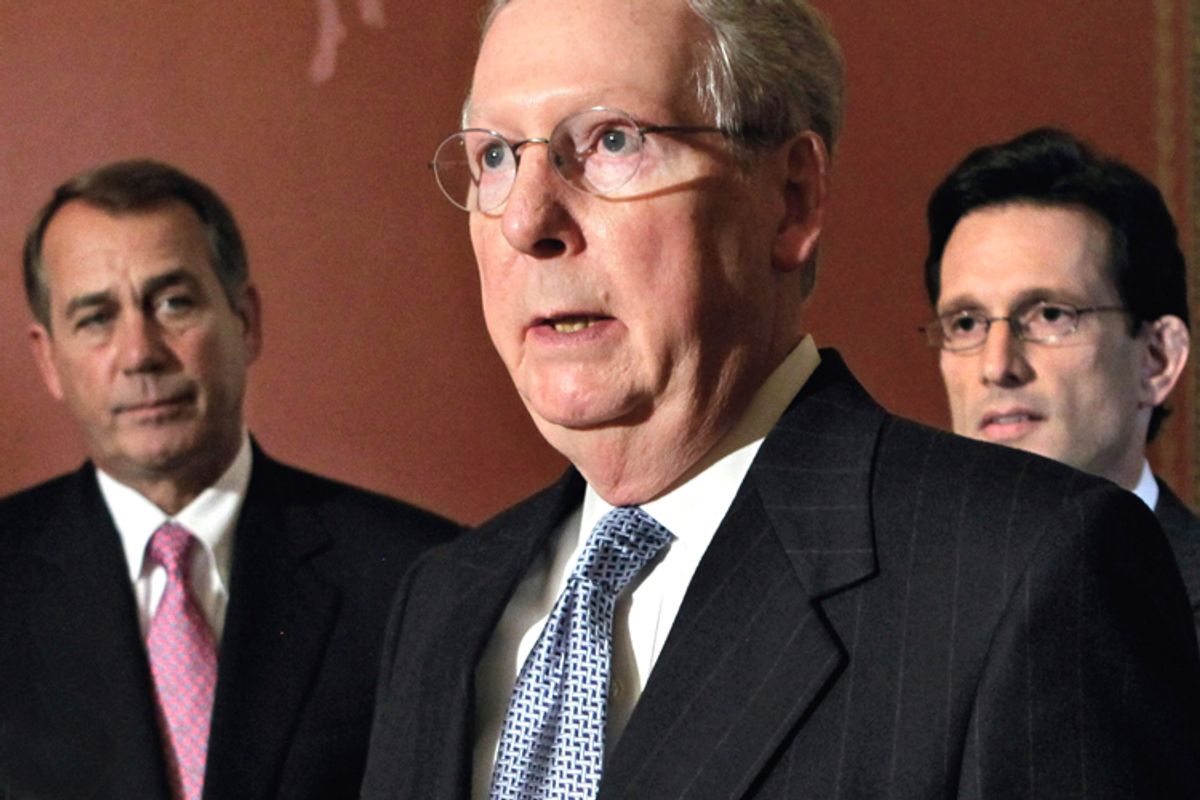
John Boehner, Mitch McConnell and Eric Cantor Bloomberg reports that “global investors” are convinced the U.S. will have to raise taxes as part of a deal to address the long-term budget deficit.
Assessments of the U.S. budget impasse show no such regional variation, with majorities of investors in the U.S., Europe and Asia concluding a tax increase is a necessary part of a deficit-reduction deal. Asked if it is possible to reduce “substantially” the deficit without raising taxes, 64 percent of respondents say no, while 33 percent say it’s possible.
The view on taxes is significant because of the political outlook of the global respondents: Those describing themselves as “right-of-center” outnumber “left-of-center” investors by more than 3-to-1; 37 percent say they are “centrists.”
But why should we limit ourselves to just the investor class? Americans in general, as Bruce Bartlett exhaustively documents, support raising taxes as part of a deficit deal.
- A May 11 Ipsos/Reuters poll found that three-fifths of people favor raising taxes to reduce the deficit.
- A May 4 Quinnipiac University poll found that 69 percent of people, including 49 percent of Republicans, support raising taxes on those households making more than $250,000.
- An April 29 Gallup poll found that only 20 percent of people say the deficit must be reduced only with spending cuts; 76 percent say that taxes should play a role.
- An April 20 Washington Post/ABC News poll found that by a 2-to-1 margin people favor a combination of higher taxes and spending cuts over spending cuts alone to reduce the deficit. It also found that 72 percent of people favor raising taxes on the rich to reduce the deficit and this is far and away the most popular deficit reduction measure.
- An April 18 McClatchy/Marist poll found that voters support higher taxes on the rich to reduce the deficit by a 2-to-1 margin, including 45 percent of self-identified Tea Party members.
Whether grudgingly or not, most people who are not Republicans elected to Congress agree that higher taxes must be a part of the solution to out-of-whack government finances. This is not merely a question of bringing revenue and spending levels in line with each other — this is a question that determines what kind of country we are. Paul Krugman makes this explicitly clear in an absolutely essential column today. We must raise taxes in order to take care of our aging population. It’s really as simple as that.
Given the realities of the federal budget, a party insisting that tax increases of any kind are off the table — as John Boehner, the speaker of the House, says they are — is, necessarily, a party demanding savage cuts in programs that serve older Americans.
Americans are getting older, and healthcare costs are rising. To balance the budget while ruling out any revenue increases is to guarantee that seniors get worse care.
In a rational world, it would seem that a political party that had chosen to stake its future on degrading the quality of life of a huge demographic slice of the voting population would be guaranteeing its own demise. And you would think that the leaders of the other political party would be in a very strong position in any budget negotiations. Perhaps the most bizarre aspect of the current state of politics in Washington is the fact that the party that is bucking the will of the people (and the conclusions of the investor class) is the one that the conventional wisdom regards as setting the terms of debate.
Bartlett believes the GOP orthodoxy is beginning to crumble. But I’m not so sure. Because even if the obviously right thing to do for both the long-term fiscal security of the United States and the wellbeing of older Americans is to craft a grand bargain that includes budget cuts and revenue increases, the brutal political truth, for Republicans, is that if Obama negotiates such a deal, he’ll be untouchable in 2012 and greatly strengthened as a leader. For the current congressional GOP leadership, that prospect is apparently far more horrible than a severely degraded standard of living for senior Americans.
Andrew Leonard is a staff writer at Salon. On Twitter, @koxinga21. More Andrew Leonard.
House Republicans lose their will to fight
The GOP's readiness to cut a payroll tax deal reveals a political party in retreat
Eric Cantor and John Boehner (Credit: AP/Charles Dharapak) Have House Republicans lost their mojo? That’s the first conclusion that jumps to mind when attempting to read the tea leaves of the current negotiations over extending the payroll tax cut. On Tuesday, the most popular word used to describe the House GOP’s purported decision to abandon requiring spending cuts to offset the cost of another extension of the payroll tax cut was “cave.”
Ouch. A full two weeks before the ultimate deadline, Republicans are already willing to cut a deal that will add another $100 billion to the deficit. It wasn’t so long ago that these same Republicans were playing last-second brinksmanship while threatening to shut down the federal government in fervent protest of Big Government. Since when did the Tea Party become so meek?
Continue Reading Close
Andrew Leonard is a staff writer at Salon. On Twitter, @koxinga21. More Andrew Leonard.
Obama’s unwinnable payroll tax cut fight
The president's political position is strong, but Democrats still have to cut a deal that won't be pretty
President Obama (Credit: AP/Carolyn Kaster) With barely more than two weeks left to go in 2012, it is only fitting that Congressional Republicans and Democrats are once again engaged in doing what they do best: playing politics with the economy. The current fight over extending a payroll tax cut and unemployment benefits is just one more installment in the nation’s least favorite reality TV show: Partisan Gridlock.
Both sides more or less agree that it would be a bad idea to raise taxes and cut benefits during a weak economy — the question is what kind of pound of flesh will be extracted in exchange for a deal. Democrats want to pay for the extensions by taxing millionaires. Republicans want to pay for the measures by scooping money out of Obama’s priorities, such as health care reform, while pursuing their own agenda — gutting EPA regulations, getting the Keystone XL pipeline built, making it harder for poor women in Washington D.C. to get an abortion.
Continue Reading Close
Andrew Leonard is a staff writer at Salon. On Twitter, @koxinga21. More Andrew Leonard.
The economic price of the supercommittee fail
The interests of the wealthy are protected again, at the expense of economic growth
Mervin Sealy from Hickory, North Carolina, takes part in a protest rally outside the Capitol Building in Washington, October 5, 2011. (Credit: Jason Reed / Reuters) On Monday, the Dow Jones industrial average fell 300 points, a plunge immediately blamed on the supercommittee’s failure to agree on a debt reduction deal. If this is true, investors were displaying a remarkable lack of attention to current events. Is there anyone on Wall Street or in Washington, D.C., or anywhere else who expected the supercommittee to succeed? Failure should already have been “priced in” by the markets. As anticlimaxes go, the only surprising thing about the supercommittee’s impotence is that anyone was surprised by it.
Continue Reading Close
Andrew Leonard is a staff writer at Salon. On Twitter, @koxinga21. More Andrew Leonard.
Senate blocks House disaster aid bill
Relief legislation voted down after House Republicans passed offset-heavy version yesterday
Senate Majority Leader Harry Reid of Nev. gestures during a news conference on Capitol Hill in Washington on Thursday, Sept. 22, 2011, to discuss FEMA funding and the Continuing Resolution to fund the government. (AP Photo/Harry Hamburg)(Credit: AP/Harry Hamburg) The Democratic-led Senate blocked a House-passed bill on Friday that would provide disaster aid and keep government agencies open, escalating the parties’ latest showdown over spending and highlighting the raw partisan rift that has festered all year.
In a tit-for-tat battle, the Senate first used a near party-line vote of 59-36 to derail the measure from the Republican-run House. The House bill would fund federal agencies and provide $3.7 billion in disaster assistance, partly paying for that aid with cuts in two loan programs that finance technological development.
Continue Reading CloseHouse passes disaster aid, but Senate Dems object
Bill adds more offsets to secure Republican passage, all but guaranteeing death in Senate
Senate Majority Leader Harry Reid of Nev. gestures during a news conference on Capitol Hill in Washington on Thursday, Sept. 22, 2011, to discuss FEMA funding and the Continuing Resolution to fund the government. (AP Photo/Harry Hamburg)(Credit: AP) With the economy sputtering, the warring factions of Congress have lurched toward gridlock over the usually noncontroversial process of approving disaster aid and keeping the government from shutting down.
The GOP-dominated House early Friday muscled through a $3.7 billion disaster aid measure along with a stopgap spending bill to keep the government running past next Friday. The narrow 219-203 tally reversed an embarrassing loss for House GOP leaders that came Wednesday at the hands of rebellious tea party Republicans.
Continue Reading ClosePage 1 of 58 in Budget Showdown