Scavenger

The best foraged meal I’ve ever made

I went on a mystical hike to hunt down wild ginger -- and discovered how amazing it really is

  • more
    • All Share Services

Topics: ,

The best foraged meal I've ever made

The forest comes upon us suddenly. One moment we are in a backyard and the next we’re in the woods, like stepping through the looking glass. Even on a cloudy day like today, the quality of light is different — filtered — and the moss, which is everywhere, seems to absorb and muffle sound. The ground is springy with moss, and a silky patchwork clothes the Doug firs that loom above us. The well-worn trail cuts through a carpet of moss and false Solomon’s seal.

Mizu is taking me to a patch of wild ginger she’s been visiting since she was a kid. We are accompanied by two of her three daughters. Helen, who is 4 and the middle child, stomps ahead, brandishing a stick. Mizu and I follow behind with Lucy, who seems remarkably sanguine about the steep hill. Seeing the little girls in the woods brings back memories. Like me, Mizu spent a long stint in the city but eventually chose to return home to the Oregon Coast Range. It’s good to be neighbors again. When we were children, Mizu, her brother Japhy and I used to play together on this same land — Mizu the ringleader and Japhy the daredevil forever nudging at my timid nature. With them, I climbed higher, jumped to the farthest slippery creek rock, and vowed I’d learn to skip a stone more than 20 bounces. The same spark of adventure still flickers in Helen’s wolf-blue eyes.

“Ah here it is,” Mizu says, crouching. “Do you see it?” she asks her girls. I look too, my eyes lighting on an exotic looking grass that pokes from the leafy carpet. Clearly wild ginger, I think to myself. I’m wrong, of course. Helen points out the wild ginger, hidden here and there amid the false Solomon’s seal, its heart-shaped leaves a perfect camouflage. Mizu picks a leaf, crushes it and hands it to me. The smell is intensely pleasant — gingery, yes, but sweeter and milder, like good incense. “It’s one of my favorite plants,” Mizu says.

When I got interested in foraging, my friend Tom sent me a box of books on plants. I’ve enjoyed the reading, particularly when it pertains to lore and history, but I’ve found that identifying wild edibles by the book can be a tedious process. Learning is easy, but knowing is a different story. Foraging with Mizu is saving me from tedious cross-referencing. After all my time alone in the woods, it’s refreshing to make an expedition in knowledgeable company: Unlike me, Mizu is a science person.

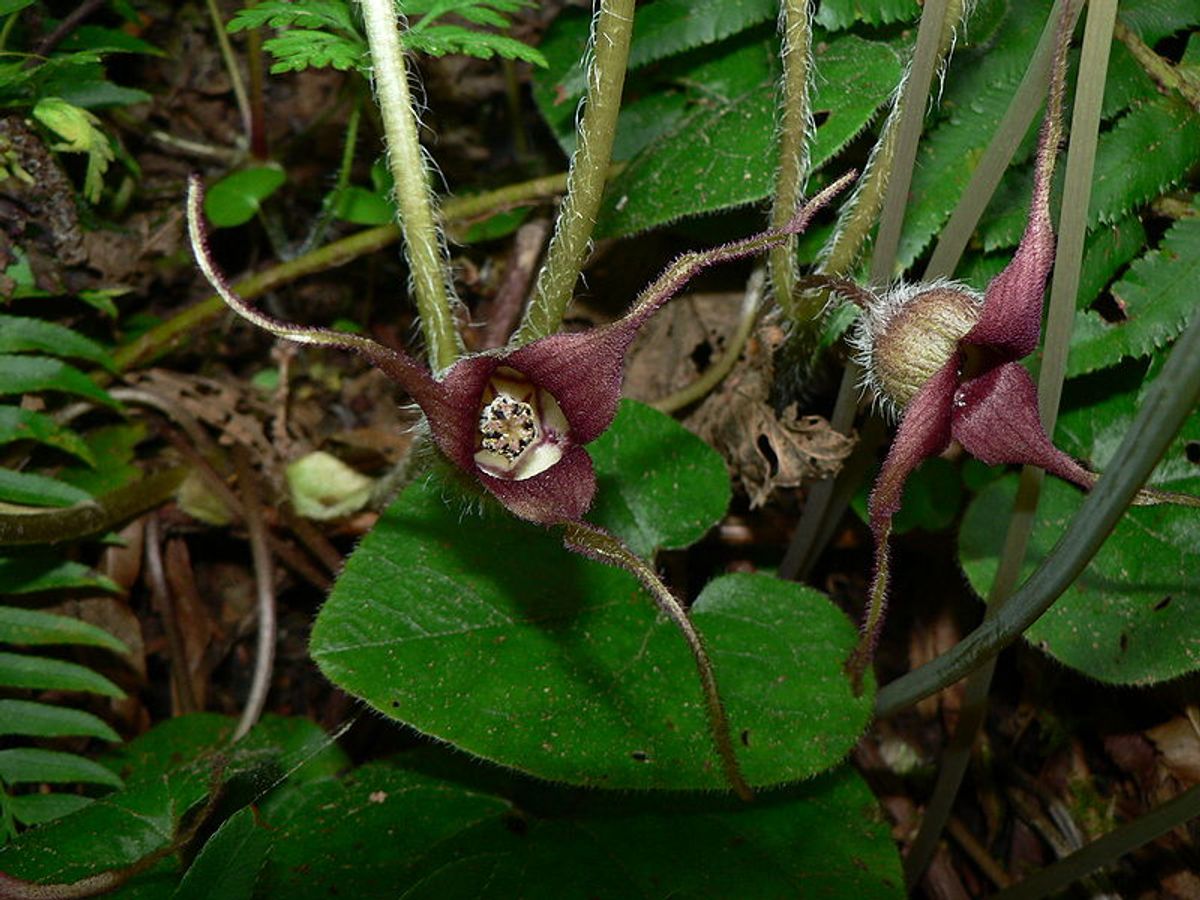
Wild ginger, or Asarum caudatum, is an edible native plant, though it’s not actually a ginger, Mizu tells me. It’s called ginger because it smells like ginger. I trace the scalloped leaf edge with my finger, while Mizu pokes around until she finds a flower, which is the color of wine and looks exotic somehow. We each dig up a few roots, leaving most of the patch intact. The plant doesn’t grow too fast, and Mizu says that though the family often walks this path, she only harvests ginger for tea once every year or two.

Mizu is passing her knowledge and curiosity on to her girls — Helen crouches to inspect a beetle, raspberry red against electric green sorrel, and she points out plants along the way: Smith’s fairy bells, false lily-of-the-valley, bleeding hearts.

“Have you ever smelled bleeding hearts?” Mizu asks. I haven’t, and this surprises me — I’ve been gathering the flowers since childhood. I bend down to smell a cluster, which is redolent of cinnamon. Thanks to Mizu, I now know that bleeding hearts smell as pretty as they look. I’ve spent hour upon hour alone in the woods this past year, and having company on a foraging expedition is a novelty. I feel stupidly moved by the ways a friend or stranger can enrich our lives: In company, we have the opportunity to see (or in this case smell) aspects of the world we might have missed.

When we return to her house, Mizu brews a pot of tea with the wild ginger root, and I linger longer than I intended. Mizu uses a small root, but the aroma of the tea is surprisingly intense: For a native plant, the wild ginger smells luxurious and exotic, like a place I would have imagined as a child — a land of brocade tents and magic carpets.

Back home again, I hit the books. Now that I’ve gotten the pesky identification process out of the way, I’m left to the entertaining part of my research. “Plants of the Pacific Northwest Coast” tells me that all of the local tribes used wild ginger in one way or another: The plant was applied as a poultice for headaches, intestinal pains and knee pain, and it is known to have antibiotic properties. To treat arthritis, the Sechelt added the boiled leaves to bath water. To treat tuberculosis, the Squamish and the Skagit ingested the leaves. The Stl’atl’imx also bathed in the leaves, but in this case for good luck and protection. The Skokomish and the Nuxalx drank wild ginger-root tea to settle the stomach. “Plants of the Pacific Northwest Coast” says the plant is edible, but when I look online, in addition to a handful of recipes and recommendations, I find a few references to wild ginger’s potential to both cure and/or cause cancer. Evidently it may contain traces of aristolochic acid, which was once believed to reduce tumors but is now considered carcinogenic. (It’s worth noting that study results pertain to Asarum canadense, not Asarum caudatum).

Yet another example of the potentially paralyzing effect of having a world of information at our fingertips. Once upon a time, a book and a friend’s tradition would have been enough, but now I have to go digging around on the Web to discover information I didn’t want to know. So do I follow a thousand years of native tradition or do I heed the Internet? I guess a more cautious soul would change tonight’s dinner plans, but when I think of all the bad habits I’ve nursed over the years and the reputed cancer-causing properties of common household items (antiperspirant, cell phones, sugarless chewing gum), I kind of doubt it’s going to be a teaspoon of wild ginger that gets me in the end. As usual, my curiosity takes the upper hand.

The menu: stir-fried elk with wild greens and wild ginger, served over rice and accompanied by a salad of our garden’s first greens. I choose short yet stout salmonberry and thimbleberry shoots from my front yard. The shoots snap off easily at the base of the plant, and the newborn thorns and leaves peel away with minimal effort. I’ve never cooked with either variety of shoot, but they’re mild raw, so I’m hoping they’ll add body and crunch to my stir-fry without drowning out the flavor of wild ginger. Inspired by Fat of the Land, I also pick a handful of cat’s-ear. Carrots and peas will add a little color to the dish, and half a serrano chile will provide kick. I’m worried that the flavor of the wild ginger won’t come through, so I practice unusual restraint with the chile, garlic, onion chives and scallions.

The finished dinner is arguably the best meal I’ve ever made using wild ingredients, though I have to share some credit with my husband, Rich, who grew the lettuce and spinach for the salad. It’s awesome to be eating from our garden again: The salad is light and crisp in the manner particular to just-picked greens. As for the stir-fry, it exceeds my expectations. I needn’t have worried about obscuring the ginger. The flavor saturates, spicy and sweet with shades of amber. The wild ginger tastes better than actual ginger — it’s lighter and far more complex. Perhaps due to my unusual restraint with the garlic and scallions, the individual flavor of each ingredient is still evident: The thimbleberry and salmonberry shoots have a spring fresh crunch, and the cat’s-ear is silky and rich. Carrots and peas provide robust contrast.

Using five wild ingredients (wild ginger, elk, thimbleberry shoots, salmonberry shoots and cat’s-ear) and five garden ingredients (lettuce, spinach, shallots, onion chives and garlic) cuts down on the cost. Including the salad dressing and rice, the meal costs approximately $2, or $1 per person. Of course there are evident risks and hidden costs — the life of the elk, the time and money our friend invested in hunting the elk, the days Rich worked in the garden, the hours I spent hiking with Mizu and the girls, and the time I spent researching and cooking. I try to chew slowly as I think about the work and life that went into this meal. This is the last of our elk, and I may never eat wild ginger again, which gives my last forkful a certain poignancy.

Elk Ginger Stir-Fry (Serves 2-3)

Ingredients

  • 1 cup rice

Group I

  • 3 tablespoons coconut oil
  • 1 teaspoon salt
  • 1 teaspoon wild ginger (chopped)
  • 1 clove garlic (chopped)
  • ¾ lb elk or beef, cut into strips against the grain

Group II

  • 1 tablespoon coconut oil
  • 1 tablespoon salmonberry shoots (chopped)
  • ½ serrano chile
  • 1 tablespoon chopped scallions
  • 1 large handful cat’s-ear
  • ¾ cup frozen peas

Group III

  • 1 tablespoon thimbleberry shoots
  • 1 tablespoon onion chives
  • 1 tablespoon white wine or sherry

Group IV

  • 1 teaspoon sugar
  • 1 tablespoon cornstarch
  • 2 tablespoons soy sauce

Directions

  1. Cook the rice.
  2. Heat wok over high heat. When wok is hot, add 3 tablespoons of coconut oil.
  3. When oil is hot, turn down to medium and add salt, wild ginger and garlic. Stir-fry for a moment.
  4. Turn heat back to high and add elk. Stir-fry until elk is no longer red. (Be careful not to overcook.)
  5. Remove all Group 1 ingredients from wok, including oil. Set aside.
  6. Reheat wok to medium high. Add 1 tablespoon of coconut oil. When oil is hot, add  ingredients from Group II.
  7. Stir-fry for 1 minute.
  8. Add ingredients from Group III and cook for another minute.
  9. Turn heat down to medium. Add ingredients from Group IV and stir until a gravy forms. Serve over rice.

Continue Reading Close

Felisa Rogers studied history and nonfiction writing at the Evergreen State College and went on to teach writing to kids for five years. She lives in Oregon’s coast range, where she works as a freelance writer and editor.

Would you eat this lamb’s heart?

Since I was a child, I've dreamed of consuming that most meaningful of organs. Then my chance came ...

  • more
    • All Share Services

Topics: ,

Would you eat this lamb's heart?

I’ve always thought it would be fun to eat a heart. As a kid, the beet was my favorite vegetable because biting into the firm garnet flesh allowed me to imagine I was eating a heart. I don’t think my childhood relish stemmed from a deep-seated hatred of humanity or a serious interest in cannibalism, and, in my defense, a morbid fascination with the heart pervades all human cultures. In fact, I probably got the idea while touring Mayan and Aztec ruins; I was fascinated by the Bonampak frescoes: faded murals of heart sacrifice beneath a starry dawn sky.

Ten thousand years ago, Cro-Magnon hunters etched hearts in stone. Eight thousand years later, Egyptians would revere the heart as the cradle of intelligence, wisdom and memory, an organ that guarded or revealed moral shortcomings: After the deceased had crossed the dangerous country between the land of the living and the land of the dead, he or she entered the Hall of Two Truths, where the jackal god Anubis weighed the hearts of the dead. Anubis placed a heart on one side of a scale and an ostrich feather on the other. The feather symbolized truth, and only a heart of the same weight was worthy of the fields of heaven. (The jackal god tossed unworthy hearts to “the gobbler,” a crocodilian monster that waited at the base of the scales.)

Aristotle identified the heart as the most important organ in the body, and in the second century, the Roman physician Galen described the heart as the body’s hearthstone. He wrote, “The heart is a hard flesh, not easily injured. In hardness, tension, general strength, and resistance to injury, the fibers of the heart far surpass all others, for no other instrument performs such continuous, hard work as the heart.”

During the Middle Ages, the heart, which inhabited the upper and more pure part of the body, was an icon of clarity and sincerity. By this time, the heart was also linked to romantic love — in one 13th century romance, a woman’s jealous husband forces her to eat the embalmed heart of her lover, who has died in the Crusades. On the less tawdry end of the symbolic spectrum, Christians came to see the heart as a symbol of their savior’s love for humanity. In 1674, a nun named Margaret Mary professed visions of the sacred heart of Jesus, an event that cemented the burning heart’s place in the Catholic pantheon.

My own interest in the heart is not based on science or romance or spirituality, but rather my consuming obsession with food. My friend Rachel Mercer is well aware of my interest in cooking odd or free items, and promised me a heart from one of her lambs. Rachel’s lambs are the most delicious I’ve ever tasted, so I eagerly awaited the arrival of the frozen heart.

A few days before Rachel’s visit, I was perusing the grocery aisle thinking of what to cook for her; she was bringing a friend, and obviously one lamb’s heart is not going to feed four people. I had hearts on my mind, and I couldn’t resist checking to see if the store had any to offer. Sure enough, packets of chicken hearts were on quick sale. For only 93 cents I was the proud owner of 30 of them.

Rachel arrived from eastern Washington, bringing a gift of sheep’s milk cheese, ripe yellow tomatoes from her garden, the frozen sheep heart, and her friend Ali, who was from Morocco by way of Portland. Neither guest seemed surprised or disgusted by a dinner of pasta tossed with kale chive pesto, summer squash, tomatoes and sautéed chicken hearts; Rachel grew up on a farm and Ali said he used to eat chicken hearts all the time because they were cheap. He grumbled that the prices have gone up; probably, we agreed a result of organ meat becoming popular with hipster gourmands.

Rachel and Ali seemed to enjoy the meal, but I was its most vocal proponent—the sautéed hearts didn’t taste anything taste anything like chicken livers (my fear). Instead they tasted and felt like chunks of succulent dark meat. If I had closed my eyes, I would have guessed I was eating chunks of chicken thigh, my favorite part of the bird.

My husband, Rich, didn’t try the pasta until the next day. He was eating it happily when I asked him how he liked the chicken hearts. He froze, dropping a heart from his fork.

“I thought they were mushrooms,” he said weakly. (This is a true testament to the power of suggestion. Although the hearts look somewhat like morels, the texture is much firmer and the flavor tastes like, uh, chicken.) Although he dutifully ate one more heart, I could tell he was now unable to enjoy the meal. Clearly when it was time for the lamb heart, I was going to have do something to disguise it.

I had imagined stuffing the lamb heart with sheep feta, basil and wild salal berries, but when I unwrapped the white paper I discovered that the butcher had trimmed away the excess fat and the arteries; the heart was in two clean pieces. Although this development interfered with my plan to fulfill my childhood notion of biting into a whole heart, I saw an upside: At least now Rich wasn’t going be able to tell what he was eating.

I didn’t feel weird about touching or eating the heart until I cut into the organ. Suddenly it was very clear that the dark mass wasn’t just any cut of meat. I was reminded of Leonard Da Vinci: “The heart is of such density that fire can scarcely damage it.” On that note, I couldn’t resist making my incisions in the form of a cross, which I stuffed with basil and salal berries.

While fir branches burned down to coals in my grill, I blended a barbecue sauce of blackberries, red wine and garlic. I added a dash of cayenne to make the flavor pop. The sauce was good: thick and bright. Over the shimmering coals, the heart seared quickly. The pieces shrank and grew darker, and minutes later I was removing the smoking meat from the grill. I sliced the heart (part of the subterfuge) and served it with cucumber kale salad from our garden and homemade biscuits stuffed with Rachel’s merlot sheep cheese and onion chives.

My first bite was a disappointment. There was an echo of liver to the flavor and, as with tongue, the texture was vaguely disconcerting. The second bite was better; the liver flavor seemed to diminish and I was left with ultra-tender and succulent meat, swathed in the tart, sweet essence of summer berries and wine. Rich was suspicious from the get-go and only ate a few token pieces, focusing on the cheese-filled biscuits. He didn’t seem too surprised when I confessed that he was eating lamb heart. I should have lied about the chicken hearts.

Like the ancient Egyptians, our modern culture sees the heart as an arbiter of truth. We have the pure of heart, the heavy of heart and the black of heart. We are counseled to look into our hearts to understand ourselves. We speak from the heart, our hearts are warmed, our hearts are crushed, our hearts are in the balance. During my time writing this series, my heart has been subject to the verbs listed above. When I wrote my first piece about my struggle to put food on the table, I hesitated before submitting it to Salon. Like most low-income people, I’m not exactly proud of my financial status and spilling my trials in a public forum seemed embarrassing. But pretending that everything was OK wasn’t getting me anywhere either. I’d gotten so harried by the vagaries of life that when I sat down to write, a story of my tribulations was the only thing that spilled forth.

I was surprised, pleased and alarmed when my editor invited me to write a regular series about my adventures cooking on an unpredictable budget. I couldn’t turn down the opportunity to get paid for writing, but I was still leery about putting my financial troubles and life decisions in a spotlight. That said, the choice was clear. I swallowed my pride and began work on the scavenger series.

A year of scavenging for food has been incredibly rewarding: I feel a more powerful connection to the world around me, to the changing seasons and the grace of nature. I see other animals as competition and weeds as potential. Gathering food has kept my senses sharp. Scrambling up slippery logs and ducking through thorny thickets has made me agile. I made it through a year out here, and I put a decent dinner on the table every night, no matter how broke we were. As far as I know, I’m in better health than when I started, and I’ve learned a lot.

Writing about the experience has been equally rewarding but occasionally harrowing: Salon has a lively comments section, and it’s not easy to have your existence parsed on a regular basis. I’ve been called every name in the book and then some. Broadcasting my tribulations to the world put me in the weird position of feeling defensive or guilty every time I did have a little money. On the other hand, I’ve developed a thicker skin. The stories and recipes and words of wisdom from thoughtful readers have more than made up for the vitriol. I am deeply thankful for the kindness of strangers.

While wild ingredients are seemingly endless, the philosophical potential of a column about being broke is not. I’ll continue to write for Salon, and I’ll continue to forage. I’ll probably continue to struggle financially. But Scavenger as a regular series is over. As a wise sage once said, “I’m done. Stick a fork in me. It’s been grand!”


Blackberry Barbecue Sauce

Ingredients

  • ½ cup of blackberries
  • 3 tablespoons of red wine
  • 1 tablespoon of beer
  • 1 tablespoon of olive oil
  • 2 cloves of garlic
  • 2 leaves of fresh basil
  • 1 tablespoon of onion chives
  • ¼ teaspoon of salt
  • Dash of cayenne pepper

Directions

  1. Put ingredients in blender.
  2. Blend on high for 20 seconds.


Kale Chive Pesto

Ingredients

  • ½ cup of kale
  • ½ cup of onion chives
  • 1 clove of garlic
  • ¼ cup of walnuts (or pine nuts, if you have them)
  • ¼ cup of olive oil
  • ¼ cup of grated Parmesan cheese
  • ½ cup of fatty chicken stock

Directions:

  1. Blend ingredients until a creamy sauce forms.


Summer Pasta With Chicken Hearts

Ingredients

  • 4 cups of cooked pasta (al dente)
  • kale pesto sauce (see above)
  • 1-2 tablespoons of olive oil
  • 3 green onions (chopped)
  • 20-25 chicken hearts
  • 2 cloves of garlic (chopped)
  • 2 tablespoons of white wine
  • 2 small summer squash (diced)
  • 4-5 smallish yellow tomatoes (quartered)
  • 4 basil leaves (cut in ribbons)
  • Salt and pepper to taste

Directions:

  1. Heat oil in large pan over medium heat.
  2. Add onions. Cook for 1 minute.
  3. Add chicken hearts, garlic, and a pinch of salt. Cook until chicken hearts begin to change color.
  4. Add summer squash and white wine. Cook for 1-2 minutes. Stir occasionally.
  5. Add tomatoes. Cook for 30 seconds.
  6. Toss contents of pan with basil, kale pesto sauce and noodles.
  7. Add salt and pepper if needed.


Continue Reading Close

Felisa Rogers studied history and nonfiction writing at the Evergreen State College and went on to teach writing to kids for five years. She lives in Oregon’s coast range, where she works as a freelance writer and editor.

Gardening my way out of the doldrums

Insomnia and marital tension leave me feeling depressed. Harvesting kale and making crepes helps temper my malaise

  • more
    • All Share Services

Topics: ,

Gardening my way out of the doldrums

The morning has not been good so far. Insomnia has left me ghostlike, my husband and I have stumbled into a minor cold war, I’m feeling utterly uninspired on every possible level, and when I attempt to dust the dining room, I knock over a potted cactus. Dirt coats the surfaces I just cleaned.

I spent my teenage years deeply unhappy, but when I was 20 my dad’s sudden death snapped me out of it. I realized that wallowing in the doldrums was a narcissistic waste of my time. Most days it’s easy for me to remember that lesson: I haven’t felt this familiar weight on my chest in a long time. I think about calling my friend Becky, my go-to person in moments of duress, but my listlessness is too severe. As I stand by the phone, it rings. I wait for the answering machine to pick up.

“Hey babylove, it’s Michelle. I just wanted to call because I have my feet in a bucket of cherries and I’m stomping them, and I’m going to hold the phone down so you can hear the sound effects.”

I laugh. The sound is exaggerated cartoonish squelching. She’s making cherry wine. I pick up the receiver.

“I was trying to squash them with my hands but then I decided to go Italian on it,” Michelle explains. “That’s all. I just thought you would get a kick out of the sound.” She says goodbye and I hang up, still laughing. The phone call doesn’t magically erase my feeling of ennui, but I walk away feeling distinctly grateful for the comfort that comes unasked. You can spend years weaving a safety net only to have it disintegrate, but, conversely, salvation can materialize out of thin air: uncalled for relief, unexpected sustenance. In short, I am thankful for the windfalls and volunteers.

My husband, Rich, spent the winter drawing detailed diagrams of his vegetable garden (that is his way), and leafing through seed catalogs. Despite his enthusiasm for the project and his natural talent with plants, snags rose up every which way. Our faltering income limited our purchase of seeds, starts and soil supplements. The rains lasted till midsummer, and Rich spent all of spring’s rare sunny days doing yard work for neighbors. We were happy for the income, but the combination of limited time and bad weather killed our chances at serious food production. We do have a garden, it’s just not what we were aiming for: Our tomatoes hang matte green, our cabbages are the size of baseballs, and our beets and lettuce never materialized, leaving a hunk of Rich’s meticulously planned layout completely bare — until a few weeks ago.

One morning Rich took me down to the garden to show me a magical bounty — an army of volunteer kale had sprung up in the rows where our beets had failed. I couldn’t have been more delighted, and I barely even paused to wonder what my old, more rock ‘n’ roll self might have made of anyone capable of getting so deliriously excited about kale, let alone my use of the word “magical.” (I’m sure my commentary would have included the epithet “hippie.”)

The kale has taken the place that nettles served this spring — a free fallback option that ensures we eat something green with every meal. We’ve enjoyed baby kale salad, steamed kale, sautéed kale, chicken kale sandwiches, handmade kale pasta and summer squash, kale pesto and, lately, kale-filled crepes. I do not find all this kale monotonous because it’s forcing me to push the envelope with my cooking: The versatile ingredient takes on new life every time I master a new skill, such as crepe making.

My dad did a pretty mean Julia Child impression, but other than that I don’t know much about French cuisine. As it turns out, making crepes is easier than I thought. In my vast collection of cast iron (an inheritance from said dad) I find the perfect pan: a light 6-inch cast iron with a long handle and slanted sides. A blender, a rubber spatula, a measuring cup and “Mastering the Art of French Cooking” complete my arsenal. To my amazement, my first crepe is faultless.

To make the filling, I wander down to the garden and pick a few handfuls of ruffled kale leaves, veined in heliotrope and sparkling with water from last night’s rain. Raw, the leaves have a nice crunch and an undertone of mustard. Sautéed in olive oil with onions, sea salt and garlic, the kale is a savory counterpoint to the decadence of crepes and sour cream. Homemade chipotle sauce (a gift from friends) is the perfect topping.

For dessert we have more crepes, filled with honey yogurt and topped with salal honey syrup. Our house is surrounded by native salal bushes and somehow I never thought to eat the fruit until this year. The berries are like thick-skinned, slightly sour blueberries, but they make a startlingly good syrup.

A handful of kale and berries is not a cure for serious blues, but getting it together to go down to the garden, to go out into the sunlit woods to pick berries, to prepare a nice meal for myself and the ones I love: That’s a start. As I finish dinner and linger in the evening shadows, I’m grateful for the volunteers — the people and moments of grace and bounty that come to us unbidden and allow us to weather life’s more tedious days.

Ingredients

Kale filling

  • 1 tablespoon olive oil
  • ½ red onion (chopped)
  • ⅔ cup stock
  • 2 cloves garlic (chopped)
  • 1 cup kale (chopped)
  • 1 cup turnip greens (chopped)
  • 2 tablespoons fresh parsley (chopped)
  • 2 petite summer squash (chopped)
  • Salt to taste
  • 8-10 nasturtium blossoms

Salal Raspberry Syrup

  • ½ cup wild black raspberries
  • ½ cup salal berries
  • ½ cup water
  • 1 tablespoon butter
  • 4 tablespoons raw sugar

Crepes

  • 1 cup sifted white flour
  • ¼ teaspoon salt
  • ½ cup milk
  • ½ cup water
  • 3 tablespoons butter (melted)
  • Bacon grease

Directions

Kale filling

  1. Heat olive oil in a large pan. Add onions. Sauté 1-2 minutes.
  2. Add a splash of stock and the garlic. Continue cooking until onions are translucent.
  3. Add kale, turnip greens, squash, parsley, salt and remainder of stock. Cover and cook for 2 minutes.
  4. Remove from heat and add nasturtium blossoms.

Salal Raspberry Syrup

  1. Blend water and berries in blender.
  2. In a small sauce pan, melt butter over a low flame. Add berry mixture. Add sugar and stir.
  3. Simmer for 3-4 minutes. Stir regularly.

Crepes

  1. Put milk, water, salt and eggs into blender. Add flour and butter. Blend at high speed for about a minute.
  2. Put batter in freezer for 30 minutes, or refrigerate for an hour or two.
  3. Heat one teaspoon of bacon grease in a 6-inch cast-iron pan at medium until it begins to smoke, but just barely.
  4. Remove from heat. Pour ¼ cup of batter into pan. Roll your wrist until batter spreads across entire bottom surface of pan. Return pan to flame. Cook for 45-60 seconds.
  5. Loosen edges of crepe with rubber spatula. Shake crepe back and forth in pan. Use spatula to turn crepe. Cook for an additional 10-20 seconds.
  6. Repeat.
  7. Serve, filled with toppings and sour cream or yogurt.

Continue Reading Close

Felisa Rogers studied history and nonfiction writing at the Evergreen State College and went on to teach writing to kids for five years. She lives in Oregon’s coast range, where she works as a freelance writer and editor.

How to preserve the sweet taste of summer

You won't find these berries at the store, but their delicious flavor makes for a perfect simple syrup

  • more
    • All Share Services

Topics: ,

How to preserve the sweet taste of summer

The red is sumptuous, like a queen’s boudoir or a bordello. The texture is soft as velvet ribbon. The plant itself — deep red berries, delicate white flowers and broad fuzzy leaves, is pretty like the illustration in a children’s book or the backdrop to a Strawberry Shortcake cartoon.

I’m happy thimbleberry bushes are so pretty, because they grow around my house in drifts, crowding my hydrangeas, obscuring our spindly roses, and popping up through the tops of the mammoth rhododendrons. In the spring, I put up a fight. I tore up root systems and amassed a brush pile the size of a car. My glory was short lived. Like their evil cousin, the thorny salmonberry, thimbleberry bushes spread from rhizomes deep underground. In the blink of an eye the bushes had returned, full-size and already sporting white flowers.

“We’ll have to go after those things again,” Rich said. He spoke too late. By this time in our lives, foraging was taking up a sizable chunk of my mind. When I looked at the white blossoms I saw food. “Let’s wait till after they fruit,” I said. Rich (the Bert to my Ernie, the Felix to my Oscar) sighed, no doubt mourning another battle lost to the combined creeping chaos of his wife and the Oregon woods.

Thimbleberries are not as prolific as blackberries — typically, each plant will yield only a few clusters of berries. But if you take the effort to pick a cup, you’ll find your time well spent. The flavor is tart and sweet with an interesting undertone — a dry bite, reminiscent of good white wine.

You won’t find thimbleberries at the store for three reasons: The berries are soft and do not transport well, seeds are abundant, and the texture takes some getting used to. Thimbleberries taste fantastic, but settling your teeth through the seeds causes a strange sensation, something akin to biting a piece of felt. It’s not unpleasant, but it’s definitely unusual.

In the old days, in the villages that dotted the Northern Pacific coast, the native people developed ways to improve the texture and longevity of thimbleberries. The Nuu-chah-nulth dried the berries. The Kwakwaka’wakw harvested the berries early and ripened the fruit in storage before drying. The Nuxalk boiled the seedy berries in cedar boxes until they were a jamlike consistency and then spread the berry mash on drying frames. They wrapped the finished cakes in thimbleberry leaves and stored the packets in cedar boxes. All three methods were born from the wish to preserve summer’s sweetness. Preserving berries allowed the tribes to mitigate the ungodly drear of a Northwestern winter with bright reminders of August.

Having survived one such winter recently, I certainly understand this desire. So far, thimbleberry rosemary simple syrup is my best version of summer in a bottle. My recipe requires only one cup of thimbleberries (which is nice, because it’s hard to pick more than a cup at a time). Straining the berries into syrup eliminates the weird texture and the overabundance of seeds. You are left with the flavor — rich and red and divine.

I make my thimbleberry simple syrup with honey from my friend Carl’s bees. I often replace sugar with honey to sustain my delusion of a healthy diet, but in this case it’s an apt substitution: Honey works well with wild flavors. Sprigs of rosemary (an idea I stole from Robin Leventhal) add complexity and prevent cloying; a dash of lime juice makes the flavor pop.

I started experimenting only a week ago, and I’ve already found plenty of uses for this syrup. Pour it over whole yogurt, and you’ve got a satisfying and reasonably healthy dessert. Thimbleberry rosemary syrup makes an excellent marinade for pork chops, a good Italian soda, and an even better cocktail (try two tablespoons of syrup with six ounces of soda water and two ounces of vodka). Or you can just grab a spoon …

Rich has proclaimed the syrup a success, but I’m sure he won’t be truly pleased until the last berry had been processed and he can take to the thickets with his machete and shovel.

Thimbleberry Rosemary Simple Syrup (makes about 12 oz.)

Ingredients

  • ½ cup of honey
  • ½ cup of water
  • 1 cup thimbleberries
  • 1 lime
  • 3 sprigs fresh rosemary (chopped)

Directions

  1. In a small saucepan, heat honey and water. When liquid comes to a boil, add berries. Stir. Remove from heat.
  2. Add lime juice and rosemary. Leave to steep for 3-4 hours.
  3. Strain. If necessary, press berry mash against strainer to release liquid.
  4. Chill and serve.
Continue Reading Close

Felisa Rogers studied history and nonfiction writing at the Evergreen State College and went on to teach writing to kids for five years. She lives in Oregon’s coast range, where she works as a freelance writer and editor.

Recession lessons from my backwater childhood

When my mom started selling crafts on a recent camping trip, I remembered where my foraging instincts came from

  • more
    • All Share Services

Topics: , , ,

Recession lessons from my backwater childhood

We go camping and my mother sets up shop. She spreads swaths of flowered oilcloth on the mossy ground and hangs Mexican shopping bags from a fir tree. She pins signs to each item: Bags $7, Bracelets $10. A basketful of coin purses made out of recycled pop-tops is the centerpiece of our picnic table. This is my mom to the core. We traveled to the Umpqua National Forest for a family reunion, not a swap meet, but my mother can’t resist the thought that some member of our group of 30 campers might be in dire need of a bright Mexican accessory. My mom has spent a good chunk of the last 40 years living on the cheap in Latin America, and she’s developed some distinctly third-world traits: creative moneymaking skills and a certain disregard for regulations. (When I mention that it’s probably illegal to set up a retail shop in a national forest, she pretends not to hear me.)

The pop-top coin purses represent another key to my mother’s character: She despises waste and is gaga for any form of creative recycling. As the proprietor of the small folk art business she and my father started 30 years ago, she gravitates toward merchandise that represents a neat marriage of third-world ingenuity and sustainability: boxes crafted from pop cans, handbags woven of candy wrappers. A core belief ruled my parents’ life: make do and waste not. The subtext: Thrift is not only a necessity, but also an essential wellspring of creativity. They saw opportunism as a virtue and Mexico as a Mecca of thrift. My mother could accessorize with trash and my father could explore his favorite realm: street food. He was a devotee of the church of the whole pig and delighted in eating ingredients that might have been brushed to the wayside in a more prosperous country. “Now that’s creative,” he’d say, fishing a hairy pig’s ear from his bowl of pozole.

Mexico is a big country with a large professional class and a distinctly cosmopolitan upper crust, but my parents were more interested in the backwaters. We spent every winter exploring the mercados of obscure mountain villages. “Look! This guy is selling mattress ticks stuffed with plastic bags!” my mother would say, sounding like she was stumbling upon Botticelli’s Venus for the first time. “Mmm,” my dad would reply, his mouth full of iguana tamale.

At the time, I thought my parents were completely nuts. Over the years, I’ve come to appreciate the role thriftiness can play in creativity. I would never have discovered some of my favorite dishes if I hadn’t been missing a vital ingredient (say, cooking oil). Other favorites have resulted from my quest to use every part of an abundant ingredient (cooking with radish greens).

Living through this recession has made me grateful for my weird upbringing. My thriftiness has gone from standard (saving bacon grease) to slightly less standard (saving chicken drippings) to somewhat obsessive (attempting to make cat food out of ground table scraps). At times I’ve felt like a Depression-era housewife or a peasant, but something always happens to snap me away from identifying with either set too much. For instance, I doubt many Depression-era housewives were left to wonder: “Huh. What am I going to do with this leftover champagne?”

Celeste (purchaser of said champagne) and I are on our way back from mushroom hunting when we spot pale orange salmonberries and hit upon the answer. The champagne in question is Ballatore (which may explain why we didn’t finish the bottle). The answer to the question is wild berry champagne barbecue sauce. The overly sweet Ballatore will be the perfect foil for the slight bitterness of the salmonberries and the tartness of red huckleberries. We fight our way through the stickery thicket, plucking wet salmonberries from far-flung branches. When we have a cup of salmonberries, we move on to huckleberries, which we pop from shimmering fans of tiny leaves.

With the berry picking out of the way, it takes Celeste under 15 minutes to prepare the sauce. We leave it to sit while we burn hunks of firewood down to coal. A few hours later, we’re pulling dinner from the grill. Celeste’s execution is brilliant: juicy chicken drumsticks, skin glazed to tangy sweet perfection. A garden salad made with mustard greens, lettuce, baby kale, spinach, fresh dill and borage flowers complrments the berry-glazed chicken. The end result is a perfect summer meal that costs next to nothing (about $1.50 per person). Yes, there was a tremendous amount of work involved (gardening, foraging, standing by a hot grill), but I don’t factor in the cost of labor when it serves as a free form of entertainment.

If I’ve learned anything from a childhood in the backwaters of Mexico, it’s that being poor doesn’t need to mean being dreary. Part of my parents’ love for Mexico stemmed from a deep respect for the self-sufficient campesino, who could spin moments of pure delight from lives that were too hard for us to fathom. Poverty is not a virtue, but making the most of your resources can save you from a diet of cereal and water. So while I enjoy luxuries (cheap champagne) foreign to your average Mexican peasant, I still look to the south for inspiration and comfort. Champagne may not be an appropriate ingredient for a column on budget cooking, but for tonight I’ll take a cue from my mother’s playbook: appreciate the cards you’re dealt and use them wisely. Here’s to pop-top fashion and budget cooking with champagne.

Note: Thimbleberries or raspberries would be a good replacement for salmonberries in this recipe.

Ingredients

  • ¼ cup of olive oil
  • 1 tablespoon of chopped garlic
  • 1 cup fresh huckleberries
  • 1 cup fresh salmonberries
  • ¼ cup spumante champagne
  • 2 tablespoons of honey
  • 2 tablespoons of ketchup
  • ¼ teaspoon of salt
  • dash of Worcestershire

Directions

  1. In a saucepan, sauté garlic in olive oil.
  2. Add remaining ingredients.
  3. Bring to a boil.
  4. Reduce heat and simmer 15 minutes or until slightly thick.
  5. Remove from heat; cool.
  6. Place mixture in a blender; process until smooth.
  7. Use as sauce over pork, steaks or poultry.
Continue Reading Close

Felisa Rogers studied history and nonfiction writing at the Evergreen State College and went on to teach writing to kids for five years. She lives in Oregon’s coast range, where she works as a freelance writer and editor.

On the hunt for wild mussels

A wildlife biologist, a fellow forager and I brave the tide pools to capture these delicious mollusks

  • more
    • All Share Services

Topics: ,

On the hunt for wild mussels

The minus tide begins at 7 a.m. and we’re on the road by 7:20, which is pretty good when you’re traveling with Kamari and Abigail. Kamari has the slow truculence of a giant sloth, and Abigail flits around in circles like a flustered moth, but somehow the amount of time wasted usually comes out about even. This morning they are both unusually focused, probably because our expedition speaks to their guiding interests. In Kamari’s case, the guiding interest is always free seafood. Abigail is a different story.

Abigail has straight brown hair and a slight British accent, but somehow she still reminds me a little of Dolly Parton. It’s not just her rack (which is nice, but not quite of Dolly proportions), but her attitude. She calls everyone darlin’ and honey, and she has a magpie’s penchant for sparkly objects. The fuzzy pink seat cover of her ’94 Honda Civic says “Princess,” and somehow when Abigail’s behind the wheel, the car does take on a regal air. In Abigail’s mind her airstream trailer is a small palace and her Honda is actually a pristine pink Cadillac limousine.

Abigail certainly shares Dolly’s childlike enthusiasm: Her conversation is littered with exclamations: “Son of a ditch witch!” and “Holy tits! Look at this quadrangular anemone!” Like Dolly, Abigail swears like a sailor. Unlike Dolly, Abigail’s most enthusiastic utterances are reserved for invertebrates. She has an ardent devotion to marine life, particularly mollusks and sea slugs. I suppose it makes sense that Abigail gravitates toward creatures often overlooked. She is something of an underdog herself: She dropped out of the sixth grade, lived on the street for a spell as a teenager, toiled at menial jobs through her 20s, and eventually worked her way through college, graduating at age 35 with a degree in biology from the University of Oregon. She is now a wildlife biologist, who volunteers at the aquarium and gives presentations on marine ecology to interested parties.

Over the years of our friendship, I’ve been privy to many of Abigail’s informal presentations on marine life, and I’m betting she’ll find plenty of opportunities today as she shows us around the tidal pools at Seal Rock on Oregon’s spectacular coast. Although Abigail mentions various species of edible mollusk we might find, our primary quarry is the California mussel, Mytilus californianus. As we pull into the park’s parking lot, Abigail regales us with interesting mollusk facts. For example, “a professor at OSU used the byssal threads of mussels (which they use to cling to rocks) as inspiration for a super strong, nontoxic adhesive. How bloody cool is that?”

In the parking lot we suit up. For me, this involves rolling up my jeans. Abigail contemplates her wet suit, but settles on chest waders instead. She won’t be doing any actual foraging today — she doesn’t eat mollusks. I always assumed she was disgusted because she knew too much about their feeding habits or something, but when I press her for details she finally admits, rather sheepishly: “I don’t eat them because I like them too much.” And this from someone who consumes bacon like it’s going out of style.

Kamari and I feel no such sympathy for the mollusk: We are armed with $7 foraging permits (which will be good till the end of the year), utility knives, pliers and plastic buckets. We follow Abigail through a tiny forest where stunted, wind-twisted pines grow from a carpet of false lily of the valley and salal. Around the bend, the path opens up to the Pacific Ocean and the massive basalt formation that is Seal Rock. The expansive tableau is made more awesome by the gilding light of early morning and the intoxicating smell of the sea. The minus tide is in full effect; on the beach far below, family groups pick their way through the tidal rocks.

We climb over driftwood and cross the wet beach to the rocks, which hiss with streams of water from the receding tide. I’m still taking it all in, but Abigail is off — hopping up and down through rocks and pools in her chest waders and movie star sunglasses. My bucket, purse and slippery flip-flops render me considerably less agile. The towering rocks are silky with sea grass, and I’m amazed at the size of the pools — I imagined navigating puddles, but now I can see why Abigail considered bringing her wetsuit: The tide pools are huge and brimming with purple starfish and blue-green anemones. We climb on tapestries of seaweed and boulders armored in barnacles.

“I wonder if we’ll actually find any mussels?” Kamari muses, sounding worried. Her timing couldn’t be better: We’re cresting a large rock. Abigail gets to the top first.

“The mussel beds, my dears,” Abigail says, flinging her petite wrist in a good approximation of Vanna White displaying a brand-new convertible. As far as we can see, the rocks are covered in shiny black mussels. I look at Kamari. If Abigail really had offered Kamari a brand-new convertible, she would probably look less excited than she does now.

The mussels are not easy to pop out of their dense colonies, and I wish I’d brought gloves. I move from rock to rock, using my utility knife to cut a mussel or two at each stop. It would be easier to remove large clumps, but that method is bad for the health of the colony: In order to grip the rocks, mussels need each other for support. If you take too many from one spot, the colony will eventually cede to the savage force of the surf. To avoid the purported iodine flavor of the larger mussels, Kamari and I are hunting for shells the size of our thumbs. She reaches her legal limit of 72 mussels while I’m still at about 25, which proves that even the great sloth is capable of lightning quick movements when free seafood is involved. Meanwhile Abigail is also proving surprisingly speedy: She’s made it all the way out to the farthest point and is barely visible through the morning haze.

I gather only 30 or 40 mussels (I’m not sure I’ll actually like them that much), and after protecting the mussels in our buckets with a layer of wet seaweed, we spend the rest of our time at the beach following Abigail around. She discovers two juvenile nudibranchs, and gives us an informative speech while cradling one of the tiny luminous sea slugs in the palm of her glove. She’s right: The nudibranch is beautiful, with dayglo orange accents and pearly feelers. “Those are rhinophores. That’s how they tell what the hell is going on, since they don’t have eyeballs,” Abigail explains, adding, “Look! He’s sliming across my hand so happily!” I’m reminded of a line from a poem by Mary Oliver: “Every day/I see or hear/something/that more or less/kills me/with delight.” As the tide comes in, we say a fond goodbye to Abigail and head for home on the logging roads. The sky is deep blue and the Alsea River shimmers green-gold in the summer sun. Kamari brought her pole and mutters about fishing the whole drive, but we don’t stop because we are concerned about the health of the mussels in the backseat; it’s actually hot out, for once. We do make a brief stop at an oyster log so I can gather a handful of wild mushrooms; I’ve been wanting to try oyster mushrooms with actual seafood.

Most at the recipes I look at call for serving the mussels in their shells, in the broth they were cooked in. But I’m remembering the delicious mussel pasta my dad used to make after trips to the coast: a savory sauce made with onions, cream and shelled mussels. I put my metal steamer in a pot of water spiked with cooking wine, pile the mussels on, and turn on the heat. I feel guilty cooking the creatures alive, but I grin and bear it. I’m not about to stop eating seafood, so I guess I’ll just have to put the kibosh on the guilt.

Humans have been eating mussels for at least 8,000 years, and when I bite into a bright orange mollusk I gain a complete understanding of its ongoing popularity. I’ve eaten mussels before, but surely they were never this delicious. I don’t know if it’s the satisfaction of gathering the food myself or the freshness factor, but the mussel is superlative. The flavor is bright and naturally salty; it’s perfect without condiments or spices of any kind. I taste the sea, but the flavor is light and fresh and almost lemony. I’m tempted to eat through the pile of mussels then and there, but I manage to gain control of myself. I put a pot of water to boil for pasta.

While I wait for the water, I shell the mussels, cutting away the byssal threads with kitchen scissors. Next, I rinse the oyster mushrooms and toss them in a dry cast iron pan over high heat. When the liquid is gone, I add butter, onions, garlic and rock sea salt. The onions turn translucent, and the mussels hit the pan, along with a splash of white wine and a generous spoonful of fresh parsley.

The final meal consists of fettuccini with a light cream sauce, crowned with a pile of sautéed oyster mushrooms and bright orange mussels. Though my cream sauce is not perfect (too much white wine, I think), the overall result offers deep satisfaction. Plus, for what it is, it’s cheap. The cost of the entire meal, which serves four, comes out to $4.44. We had other reasons to be out at the coast, but if you want to factor in the cost of gas it’s more like $10.44 total, or $2.61 a head. Not my cheapest foraged meal, but pretty fancy for under $3. I’m not counting the cost of the permit, because I fully intend to get more mileage out of my $7. I’m already dreaming of butter clams.

Pasta with mussels and cream sauce

Note: The cream sauce is a revised and improved version of the first one I made.

Ingredients

  • 8 oz. fettuccini (cooked al dente)
  • Parmesan cheese and pepper
  • Group 1

    • 30-40 mussels
    • 1 cup water
    • ½ cup white wine

    Group 2

    • 1 cup oyster mushrooms
    • 2 tablespoons butter
    • 3 cloves garlic
    • 2 green onions
    • 3 tablespoon white wine
    • Mussels (sans shell)
    • 1 teaspoon chopped parsley

    Group 3

    • 1 tablespoon butter
    • 1½ tablespoons flour
    • ½ cup half and half
    • ¼ cup stock
    • ¼ teaspoon salt
    • ½ lemon

Directions

Phase 1

  1. Rinse mussels and steam in mixture of water and white wine. When shells open, turn off heat.
  2. When mussels are cool enough to handle, remove meat from shells and use kitchen scissors to snip bysall threads from mussels. Put mussels in a bowl and set it aside.

Phase 2

  1. In a dry cast iron pan, cook oyster mushrooms over medium heat until liquid disappears. Turn down heat and add butter.
  2. When butter melts, add garlic and onions. Cook for one minute. Add 2 spoonfuls of wine and cook until wine is absorbed.
  3. Add last spoonful of wine, and the parsley and mussels. Cook until mussels are hot. Set aside, covered.

Phase 3

  1. Heat a small, thick-bottomed pan over a medium-low flame. Add butter. When butter is melted, add flour. Stir flour and butter for 2 minutes.
  2. Meanwhile, in a small saucepan, heat milk and stock until it boils. Stir. Add salt. Remove from heat.
  3. Pour liquid into roux and stir. When mixture begins to bubble, add lemon juice and remove from flame.

To serve

  1. Pour cream sauce over pasta and top with mussels and mushrooms. Sprinkle with Parmesan cheese and pepper.

Continue Reading Close

Felisa Rogers studied history and nonfiction writing at the Evergreen State College and went on to teach writing to kids for five years. She lives in Oregon’s coast range, where she works as a freelance writer and editor.

Page 1 of 5 in Scavenger