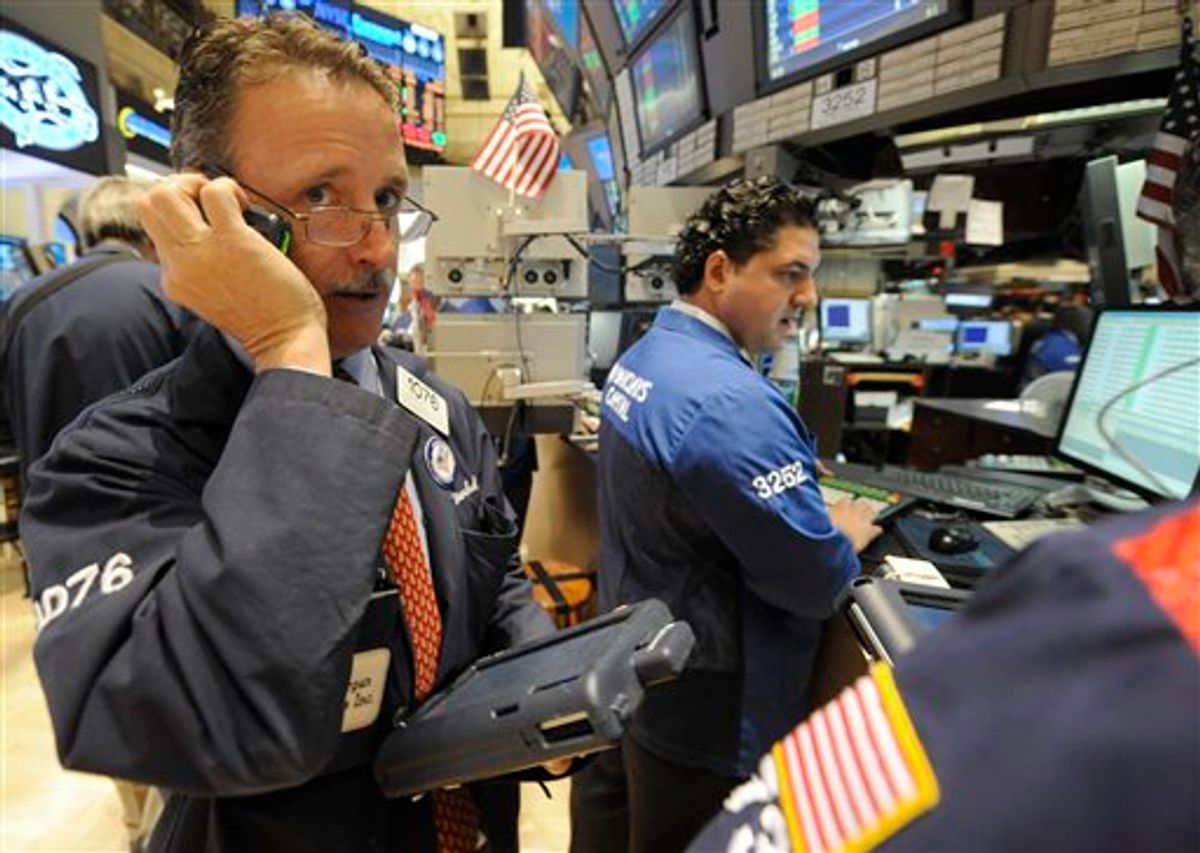
Nasdaq and IntercontinentalExchange on Monday withdrew their joint $11 billion bid for the parent of the New York Stock Exchange after the U.S. Department of Justice informed the companies that it would pursue a lawsuit to block the deal.
"NYSE and Nasdaq are iconic...they are fierce competitors," said Christine Varney, Assistant Attorney General of the antitrust division of the Department of Justice, in a conference call. "If these two competitors had merged it would have effectively created a monopoly leading to higher prices, inferior service and less innovation."
The decision by the two exchanges to back off clears an obstacle to NYSE Euronext Inc.'s previous $10 billion deal to combine with the German exchange operator Deutsche Boerse. The withdrawal of the competing bid makes it unlikely that the German exchange will feel compelled to raise its lower bid.
Shares of NYSE Euronext dropped $4.64, or 11 percent, to $36.26 in mid-afternoon trading.
Shares of Nasdaq OMX Group Inc. also fell 36 cents to $26.55, while Atlanta-based IntercontinentalExchange Inc. gained $4, or 3.4 percent, to $122.32.
Varney pointed out that 100 percent of the top 500 companies based in the U.S. are listed in either NYSE or Nasdaq. The merger would have substantially eliminated competition for such corporate stock listing services and other data products.
Though Nasdaq and NYSE are the two largest stock markets in the U.S., both have been under immense pressure to find a merger partner. That's because technology has driven down the cost of trading to almost nothing. Newer, smaller and more high-tech companies such as the BATS Exchange and Direct Edge have emerged to give investors the opportunity to find the best price for a security in milliseconds. That has taken business away from both NYSE and Nasdaq.
Moreover, stocks are a smaller part of the trading business. Exchanges are making more of their money from options and the complex investments known as derivatives. In response, the world's major exchanges have been combining with one another. In February, the London Stock Exchange and the parent company of the Toronto Stock Exchange announced a $2.9 billion merger, and the Singapore Exchange and Australia's ASX revised its own $8.3 billion merger plan.
Nasdaq OMX CEO Bob Greifeld said in a statement Monday that the companies had offered a variety of "substantial remedies" to try to secure regulatory approval, including the sale of the NYSE Self-Regulatory Organization and its related businesses.
"While we are surprised and disappointed in the antitrust division's conclusion, some of the uncertainty, at least as it relates to our joint proposal, has been resolved," he said.
NYSE Euronext's board had twice rejected the Nasdaq and ICE bid in favor of the Deutsche Boerse offer despite the lower price.
In a statement, Duncan Niederauer, CEO of NYSE Euronext, continued to tout the benefits of the existing transaction. "As we have consistently maintained, the combination with Deutsche Boerse creates the world's premier exchange group -- a geographically diverse business across multiple asset classes that will create compelling long term value for our shareholders."
In a separate statement Deutsche Boerse said it is moving forward with integration planning.
NYSE Euronext shareholders are scheduled to vote in early July on the deal with the German company.
Shares