Religion
Live from the end of the world
"I think I may well be the messiah," says one, while a staffer privately scoffs at tomorrow's doomsday date
When I walk up to the modest headquarters of Family Radio in an industrial area down the street from the Oakland Athletics’ ballpark, the first person I encounter is a middle-aged man in a T-shirt opening the barbed-wire gate that encloses the building.
Noticing my notebook, the man looks around to make sure no one else is in the parking lot. He walks over and leans in. “This hasn’t come through in the news reports, but I’d say 85 to 90 percent of the staff doesn’t believe what Camping says. We’re coming to work next week,” says the man, who processes mail for Family Radio.
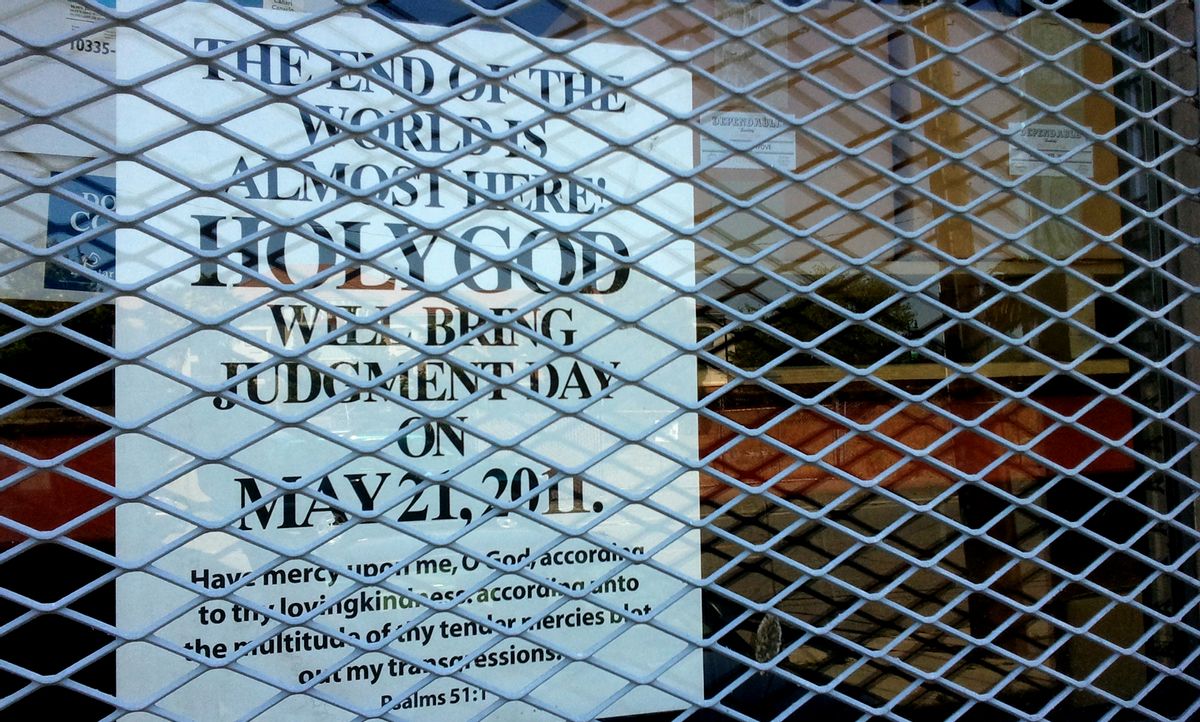
Camping, of course, is Harold Camping, the 89-year-old radio prophet whose numerological analysis concludes that on May 21, 2011 — this Saturday — Christ will return and the world will be destroyed by an epic earthquake. He and a movement of significant but unknown size have devoted themselves to buying billboards, distributing pamphlets and preaching on the airwaves to warn the masses that Judgment Day is afoot. There are stories and rumors of Camping’s followers blowing their life savings, becoming alienated from non-believing family members, and even putting down their pets, all in anticipation of May 21.
It’s become a big business for Camping, with Family Radio now comprising 65 stations around the country and taking in millions of dollars every year.
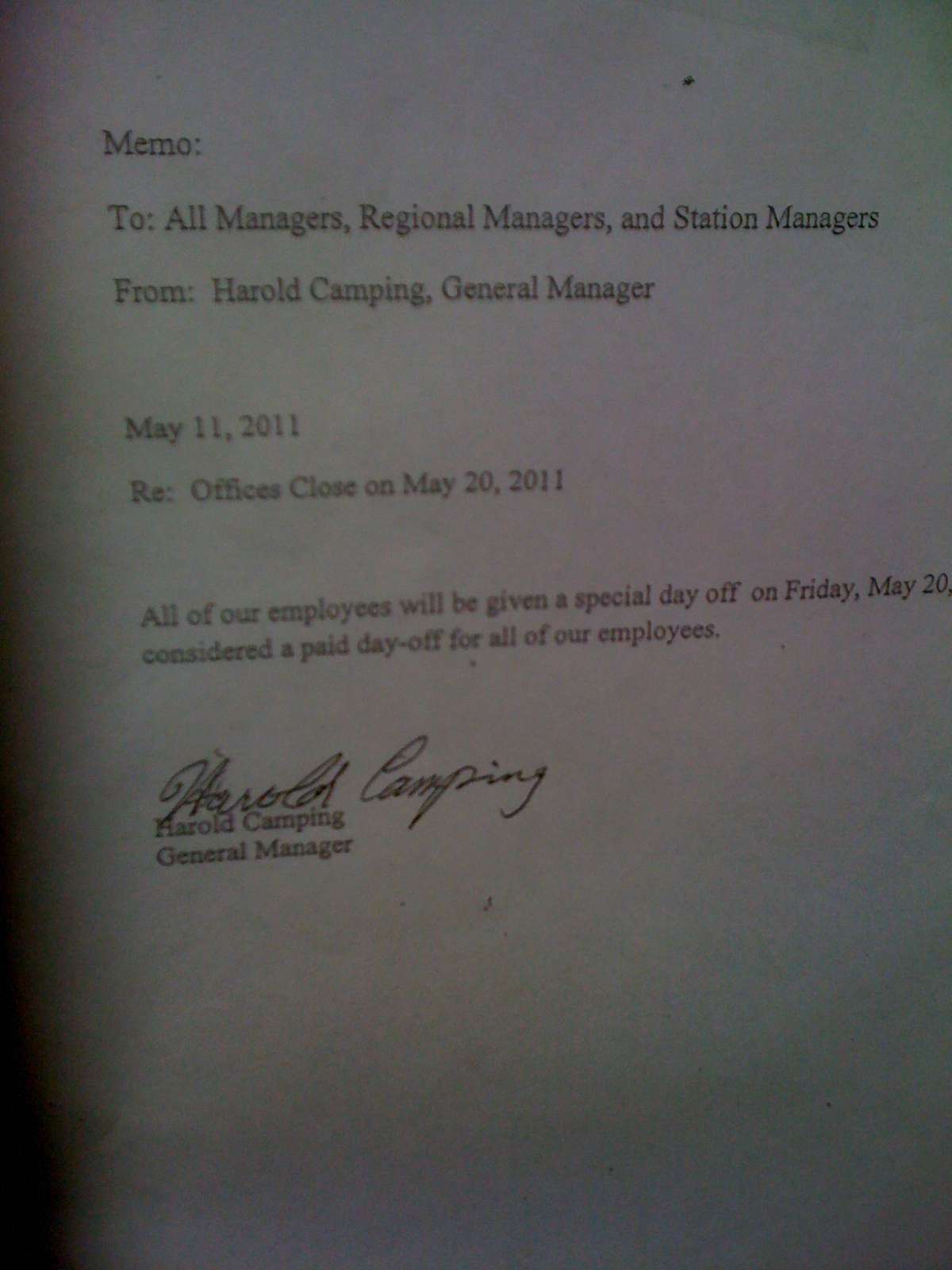
When I arrived at Family Radio Thursday afternoon, the building had been locked up and the remaining skeleton staff, fed up with media attention, wasn’t letting anyone in. Camping was said to be at home. Today is a paid day off for the staff, according to a memo Camping sent employees. That it’s paid seems to be a concession to the possibility that the world will go on.
But there were a few die-hard Camping listeners hanging out in the Family Radio parking lot on Thursday. One, a middle-aged former stockbroker named Chris, told me he’s not sure about May 21 but “anything can happen.”
“I think I may well be the messiah,” Chris confided to me. “I’ve been on a journey for several years now.” Chris, like several other Camping listeners I encounter, is down on his luck. He’s been without a permanent address for five years.
Another listener named Mike came to Family Radio headquarters seven weeks ago, at which point his minivan promptly broke down. He’s been sleeping in it ever since. Others say they left their lives behind and came to Oakland this week from as far as Milwaukee and North Carolina, though none wanted to give their names.
Not everyone was a believer. I spoke with an older man and woman who told me they are Camping listeners but they don’t agree with his May 21 prediction, and they felt it is important to make clear that not all Christians subscribe to such ideas:
Here are a few photographs from outside Family Radio.
A local TV reporter sets up a shot next to one of Camping’s RVs:
Bumper stickers like these are common in the Family Radio parking lot:
The radio tower, with a Camping listener in the foreground:
Justin Elliott is a reporter for ProPublica. You can follow him on Twitter @ElliottJustin More Justin Elliott.
Atheism’s new clout
Non-believers are becoming increasingly successful fundraisers -- and cultural forces to be reckoned with
A billboard erected by atheists in Oklahoma City. (Credit: AP/Sue Ogrocki) Why would any organization or social change movement want to ally itself with a community that’s energetic, excited about activism, highly motivated, increasingly visible, good at fundraising, good at getting into the news, increasingly populated by young people, and with a proven track record of mobilizing online in massive numbers on a moment’s notice?
If you need to ask that — maybe you shouldn’t be in political activism.
And if you don’t need to ask that — if reading that paragraph is making you clutch your chest and drool like a baby — maybe you should be paying attention to the atheist movement.
Religious belief: How it helps conservatives
Christianity provides the right wing with stability, self-confidence and ambition. What can liberals learn from it?
(Credit: Antonov Roman via Shutterstock) Progressives often marvel at how focused, coordinated and aggressive our conservative opposition is. They seem to fall into lockstep and march, building large organizations and executing complex strategies with an astonishing rate of success. We may be smarter, better educated and more reality-based — but they seem to have a cohesion and a discipline that eludes us. What’s going on here?
There are a lot of answers to that question. But I’d suggest that some intriguing answers might come from a close study of conservative religious paradigms, which play an essential role in giving conservatives a unique kind of emotional and social durability.
Sara Robinson is a trained social futurist and the editor of AlterNet's Vision page. More Sara Robinson.
Obama’s faith-based failure
A troubling hallmark of "compassionate conservatism" -- the faith-based initiative -- persists despite promises
(Credit: Reuters/Kevin Lamarque) “Compassionate conservatism” may seem a relic of the Bush era, but one of its signatures — the so-called faith-based initiatives — quietly persist under President Obama.
The Obama administration’s Friday night news dump of recommendations for reforming faith-based initiatives was yet another frustrating disappointment in the sad history of the president’s faith-based effort. More than a year late, the recommendations were reportedly delayed because the administration wanted to avoid further inflaming the fevered imaginations of those who claim he’s waging a “war on religion.” Insurance coverage for contraception and guaranteeing constitutional rights for Americans who receive taxpayer-funded social services from faith-based organizations are apparently two great tastes that don’t taste great together.
Continue Reading CloseSarah Posner is the senior editor of Religion Dispatches, where she writes about politics. She is also the author of God's Profits: Faith, Fraud, and the Republican Crusade for Values Voters" (PoliPoint Press, 2008). More Sarah Posner.
Joel Osteen worships himself
At a D.C. rally, it's clear that the megachurch pastor's childlike faith is really about the power of narcissism
Joel Osteen If history is told by the winners, then Joel Osteen — the relentlessly upbeat spiritual caretaker of the national attitude — is history’s designated chaplain. In a marathon Sunday faith rally in the heart of the nation’s capital, Osteen, who presides over America’s largest megachurch congregation, the nondenominational Lakewood Church in Houston, exhorted the tens of thousands of believers amassed in Nationals Stadium to “live in victory,” to seize their “destiny moments,” and to fulfill God’s plan for their personal, financial and emotional success.
Continue Reading CloseA holy war over gay marriage
In North Carolina, two churches face off over an upcoming vote on whether to constitutionally ban same sex marriage
(Credit: mehmet alci via Shutterstock) When North Carolina voters head to the polls on May 8, they will be asked to decide on a constitutional amendment – known as “Amendment One” – that prohibits marriages between same-sex couples. Same-sex marriage is already illegal by statute, but N.C. is the only state left in the Southeast without a constitutional ban.
So this is quite a showdown. There’s much talk of liberty, lifestyle and family — and a whole lot of talk about God. As opponents and supporters target churches all the way from Appalachia to the Outer Banks, religious leaders are flooding the airwaves to share their views on a hot button issue that throws core values into stark relief.
Lynn Parramore is an AlterNet contributing editor. She is co-founder of Recessionwire, founding editor of New Deal 2.0, and author of "Reading the Sphinx: Ancient Egypt in Nineteenth-Century Literary Culture." Follow her on Twitter @LynnParramore. More Lynn Parramore.
Page 1 of 136 in Religion