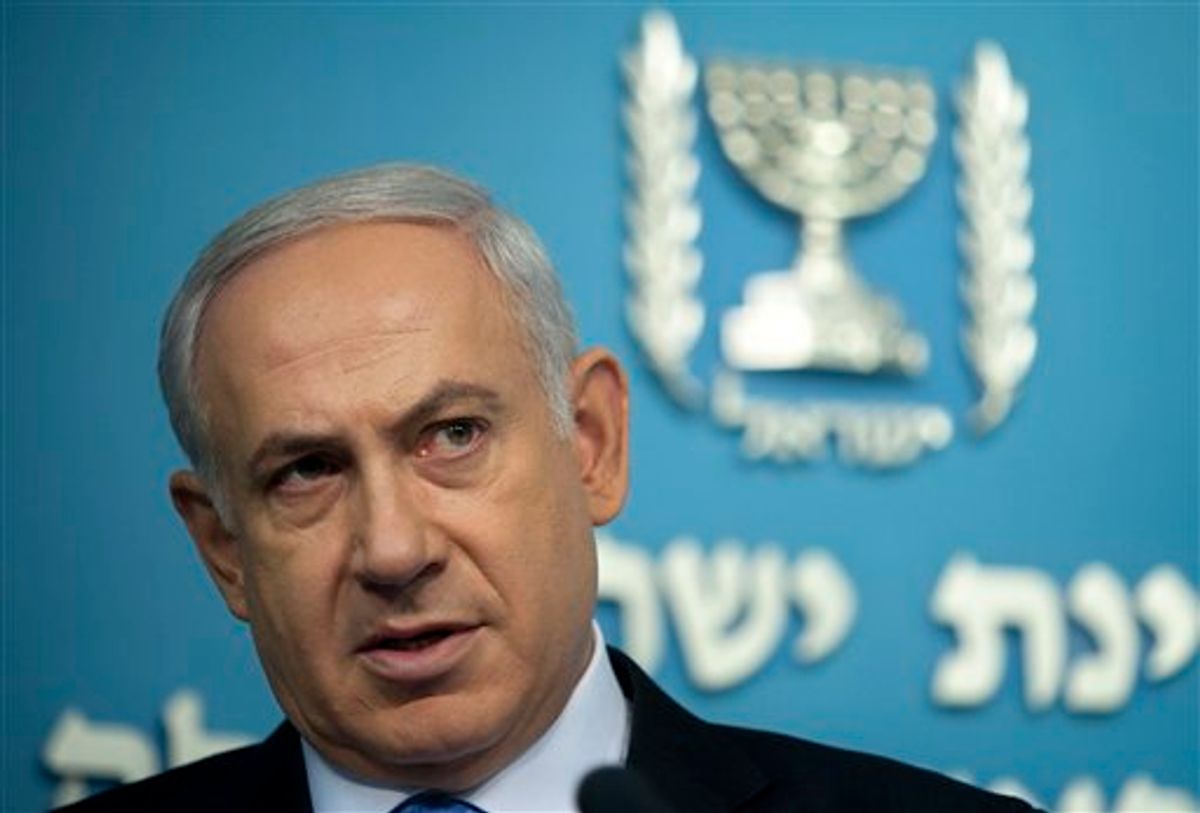
President Barack Obama and Israeli Prime Minister Benjamin Netanyahu were sharply at odds over terms for Middle East peace ahead of a highly anticipated Oval Office meeting Friday.
In a speech Thursday on U.S. policy in the Mideast, Obama for the first time endorsed the Palestinians' demand that their eventual state be based on borders that existed before the 1967 Six Day War in which Israel forces occupied east Jerusalem, the West Bank and Gaza.
From Jerusalem, Netanyahu dismissed the position as "indefensible," saying it would leave major Jewish settlements outside Israel. Then he boarded a plane for his long-scheduled visit to Washington, vowing to seek clarifications in his meeting with Obama at the White House. He arrived in Washington early Friday.
The encounter will pit a president deeply frustrated with a peace effort in shambles against an Israeli leader confronted by a Palestinian government he says he cannot do business with. International pressure is growing on both to answer the demands of the Palestinian people as the revolts sweeping the Arab world crest against Israel itself. Palestinian protesters emboldened by the winds of change marched on the Jewish state's borders this week and at least 15 people were killed.
Against that backdrop, Obama is aiming "to try to convince Netanyahu and the Israelis that there's a greater urgency in reaching agreement with the Palestinians because of the dramatic changes under way in the region and greater diplomatic pressures and efforts to isolate Israel and delegitimize its existence," said Haim Malka, deputy director of the Middle East program at the Center for Strategic and International Studies.
"So he was speaking to both the Israelis and the Palestinians and trying to urge them to move forward and conveying a sense of urgency and risk in the status quo," Malka said.
Netanyahu's tough response to Obama's speech "expresses disappointment at the absence of central items that Israel had demanded, primarily the (Palestinian) refugees," a senior Israeli official, speaking on condition of anonymity because he was not free to discuss U.S. policy on the record, told reporters traveling with the prime minister.
The official said Netanyahu was disappointed the speech did not address the Palestinian demand to repatriate to Israel millions of Palestinians, most descendants of people who were driven from or fled homes in the war over the Jewish state's 1948 creation.
"There is a feeling that Washington does not understand the reality, Washington does not understand what we face," the official said.
Obama's stance on the 1967 borders was not a major policy change, since the U.S -- along with the international community and even past Israeli governments -- previously endorsed an agreement building on the 1967 lines.
But it was the first time he'd explicitly endorsed those borders as a starting point, a position Netanyahu rejects. Obama said Israel can never be a truly peaceful Jewish state if it insists on "permanent occupation." But he did say the 1967 borders should be accompanied by land swaps agreed to by both sides, which could accommodate existing Jewish settlements.
Obama was unsparing, too, in his words for the Palestinian leadership, repudiating its pursuit of unilateral statehood through the United Nations and questioning its alliance with a Hamas faction bent on Israel's destruction. It was not immediately clear, however, whether Obama's statement on the 1967 borders as the basis for negotiations -- something the Palestinians have long sought -- would be sufficient to persuade the Palestinians to drop their quest for U.N. recognition.
Obama's blunt attempt to steer the peace effort was a major change in tactics from a president who has avoided imposing any U.S. plan but is now running out of patience and reasons to be subtle. Seeking to shake up a dynamic of mutual blame for the stalled peace talks, Obama pushed both sides to accept his starting point -- borders for Palestine, security for Israel -- and get back to solving a stalemate "that has grinded on and on and on."
"The international community is tired of an endless process that never produces an outcome," the president said Thursday at the State Department. "At a time when the people of the Middle East and North Africa are casting off the burdens of the past, the drive for a lasting peace that ends the conflict and resolves all claims is more urgent than ever."
That doesn't mean resolution is anywhere in sight.
Ahead of his trip to Washington, Netanyahu delivered a speech to his parliament in which he made clear his opposition to talks with a newly constituted Palestinian government that shares power between the mainstream Palestinian Fatah faction led by Mahmoud Abbas and the radical Hamas movement that rules Gaza. He also made a series of demands that the Palestinians -- and especially Hamas -- are not likely to meet. Among them were dropping their claim to east Jerusalem, their would-be capital, and recognizing Israel as the Jewish homeland.
Palestinians, for their part, refuse to negotiate while Israel continues to expand Jewish enclaves in the West Bank and east Jerusalem, which the Palestinians want to be part of an eventual state. Israel refuses to freeze settlement construction, saying the matter should be resolved through negotiations.
With talks at a standstill, the Palestinians are planning to unilaterally take their bid for statehood to the United Nations in September, a step Obama rejected Thursday, saying, "Symbolic actions to isolate Israel at the United Nations in September won't create an independent state."
But Obama had no solution to the question of Hamas, and no blueprint for how to solve enormous conflicts over the status of Jerusalem and the fate of Palestinian refugees. The border issue, he conceded, was just a start.
------
Associated Press writers Ben Feller in Washington and Amy Teibel traveling with Netanyahu and Josef Federman in Jerusalem contributed to this report.
Shares