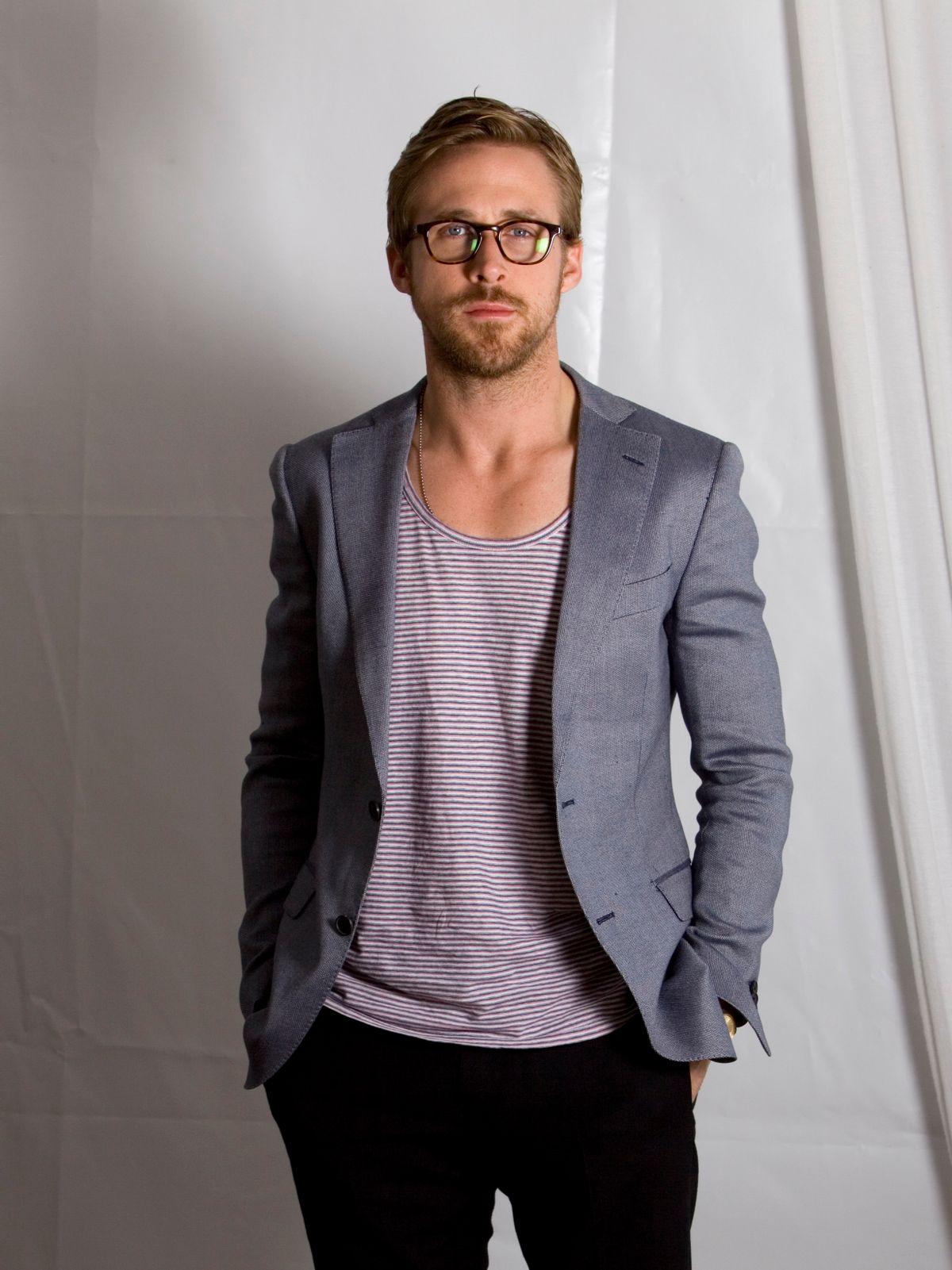
CANNES, France — “Drive,” the stylish Los Angeles heist movie that has emerged as a smash hit at this year’s Cannes Film Festival, started with a first date. That getting-to-know-you encounter was between Danish filmmaker Nicolas Winding Refn and star Ryan Gosling, who had directorial approval on this long-simmering adaptation of James Sallis’ noirish novella. In conversations here, both men have described their relationship in highly sexualized terms, while occasionally resorting to awkward reminders that in fact they’re both straight, ha ha ha, and nothing like that really happened.
As they tell the first-date story now, Refn was ill with the flu and after they met for dinner Gosling wound up driving him home. (Refn does not drive, an irresistible if irrelevant footnote to this movie.) The ride was uncomfortably silent until Gosling switched on the radio, and REO Speedwagon’s “I Can’t Fight This Feeling Anymore” began to play. Refn cranked it up and started singing along. Suddenly he understood the movie, he told Gosling: A guy driving around in Los Angeles at night, listening to the radio.
As the actor and director were changing tables during interview sessions at a beachfront restaurant here, Refn took Gosling by the wrist. “I’ve been telling them that you took advantage of me, Ryan,” he said. “You got me alone in the car when I was tired, and you played soft-rock music to get me in the mood.”
“Then I gave you a baby,” said Gosling, with an almost angelic smile. “A movie-baby.” Before moving on to his next interview, he murmured, “I hate following Nicolas. People are always asking me, ‘So — does Nicolas really make love like an eagle falling from the sky?’” He shrugged. “I guess.”
Both guys were still riding high on the explosive success of the previous night’s premiere screening — Refn would eventually win the festival’s best-director prize, and if there were an audience award at Cannes, I suspect “Drive” would be the runaway winner — so the pseudo-erotic giddiness was pretty understandable. By the time Gosling got to my table and sat down, he was in a calmer mood, eager to discuss his nameless character’s psychotic personality, the hidden influence of underground film pioneer Kenneth Anger and the reasons why “Pretty in Pink” isn’t quite a masterpiece. When he took off his linen jacket to reveal his muscular arms in a striped tank top, with a single, simple tattoo on his upper left triceps, you could almost feel the eyes of onlookers as they casually pretended not to stare. But as undeniably handsome as Gosling is, much of his allure derives from the sense that he’s been elusive and highly selective in his acting career as an adult, and seems more interested in making good movies than in making millions of dollars.
So “Drive” is now officially a huge hit, at least at Cannes. It could be because we’re all beaten down after two weeks of challenging art films, and we wanted a change of pace. What was your reaction to the screening last night?
I was shocked. I didn’t expect people to cheer like that. At one point after the film I think we started dancing — people were clapping on the beat and stuff. I didn’t expect it to be so much fun. I didn’t expect people to have so much fun, and I’m sure you’re right, it has a lot to do with the timing.
I’m sure they brief you on how it’s going to go — we’ll pick you up at a certain time and at this point you walk up the carpet, all of that. But what’s it like when you actually do it — a red-carpet premiere at Cannes?
I had spent the night before — at 2 a.m. we went to the Palais, just five or six of us, and we sat and watched a little bit of the print, just to check the color and sound. Apparently they only go to 7, but we made them go to 7.5. It was loud in there, but I think it could have been louder. It was a very special experience to get to be there alone, see the film, walk around in the theater when it was empty. It made going there the next day less nerve-wracking.
Then of course REO Speedwagon was playing when we came down the red carpet, I was wearing a blue tuxedo and I felt like me and Nic were going to prom. [Laughter.] And then everyone just seemed to have so much fun at the screening. It was just a magical night.
At the press conference, Nicolas said something about your character being psychotic but not a psychopath, and I wasn’t sure I understood that. How do you understand the Driver?
He’s someone who’s seen too many movies. He has seen so many movies that he’s begun to confuse his own life with one.
Are you talking about violence of his character or the sense of restraint? Because both of those things are in there.
Well, both. The duality of the film really came from the fact that we were watching “Pretty in Pink” and we agreed that if there was a good, old-fashioned head-smashing in it, it would be the perfect film. The lack of violence was keeping, say, “Sixteen Candles” from being a masterpiece.
In some ways the Driver is kind of a macho icon, like Clint Eastwood’s Man With No Name, and in some ways he’s not. I noticed that he never lies and never brags. He doesn’t threaten anyone, unless he means it. He never tries to come on to the girl.
Yeah, I guess you’re right. It never felt right to talk much. We never talked about those classic, archetypal characters — the strong, silent type — but every time I started talking, it didn’t feel right. Maybe that’s just me.
This movie has basically no exposition or back story, so we really don’t know anything about the Driver or his past — how long he’s been working as a stuntman and getaway driver, where he comes from, any of that. Did you and Nicolas work all that stuff out?
Well, I’m used to figuring out the minutiae of the character, and Nicolas could care less. He wants to think in dream logic, and it was so freeing to think that way. This movie’s a dream that’s turning into a nightmare, and you’re experiencing this story from the inside of Driver’s world. This could just be his fantasy or his nightmare. It’s not literal. So we didn’t really think about those things.
You made this movie with a foreign director who’s never worked in L.A. before and doesn’t know how to drive. It seems like that would pose a distinctive set of challenges.
I’ve never made a film like this before, so I don’t know what it would be like with someone else. But it was a nice chemistry — my favorite thing to do in Los Angeles is drive around at night and listen to music. I like to listen to this radio show where family members call in and dedicate songs to other family members who are in prison. Some woman will dedicate a song to some guy named Winky who’s getting out in six months: “Stay safe and keep your head down.” So I started taking Nic into that world, which is driving around at night and listening to music, and the spell that a car puts you under. You get in the car and turn the key, and suddenly you’ve arrived at your destination and you don’t remember how you got there. That kind of trance that it puts you in. The movie became more about driving than about stunts, and more about being in the car than about the car itself.
At the press conference you said something about how you didn’t want this movie to be macho.
I just think there’s enough of that. This frat guy mentality, posturing and secret handshakes. It’s just been done. I thought it would be nice to make this film with a certain femininity about it. I mean, the female praying mantis eats the male praying mantis when she’s done mating with him, and she does it because the protein ensures the health and well-being of the newly fertilized eggs. What could be more brutal than that? But it’s not personal. It’s just her nature. There’s a violence to femininity that we wanted to explore.
So do you think of the character as feminine in some ways? He has this very calm, polite, civilized manner so much of the time, and then when he explodes into violence it’s pretty terrifying.
I think we tried to make a werewolf movie without the makeup. There’s a violence in him that he’s afraid of. He’s in a race to try and find a good cause that he can channel it into, before it turns on him.
He clearly falls in love with Carey Mulligan’s character, but when he figures out that she’s married and that her husband is coming home from prison, he’s totally respectful of that. He backs off, although it’s not so clear that she wants him to.
Well, it’s a non-sexual connection. That was key for us, when we took out the sexuality and it became more about how he was her knight, and his duty was to serve her in any way, and to die for her. That was his destiny. She was a princess locked in the tower, and he needed to defend her and slay a dragon.
Look, you’re this very accomplished young actor with great cheekbones and visible triceps. [Laughter.] You must be shown every crappy action script in the world. What makes this a movie you wanted to pull the trigger on?
It felt like this was an opportunity to play a character that had seen all those films, like I said earlier, and who was reinventing himself as some amalgamation of all those heroes that he had grown up worshiping.
You’re working here with so little dialogue. You have to express so much with just your eyes and your face.
Well, it was complicated not to try to tell the story. That’s what you get trained to do as an actor, help communicate the story. In this movie my job was to let Nicolas tell the story, and just to be there. To help create space, space for the audience to think whatever they want to think, and not try to control what they’re thinking every minute. It’s hard just to allow there to be space.
You had to create chemistry with Carey in near-total silence. So much of your relationship is just looking at each other.
It was funny on set, because sometimes we would just stare at each other for hours. It became like a joke. One time I went in to do a scene with Albert Brooks, it’s a big scene and he’s got a lot of dialogue. He asks me if I want a drink and I don’t answer him, and it was driving him nuts. After I did the first take, he said, “You’ll say something. I’ll ask you if you want a drink and you’ll nod your head or shake it, but you’ll give some indication. This not talking thing, it’s not working. It’s interesting, you’ve tried it, but it’s clearly weird. You’ll say something.”
Did you crack? Did you say something?
No. No, but while you’re doing it you’re constantly feeling this pressure to do something. But then you reach these moments — for instance, there’s a natural harmony between a man and a woman and a child, when they’re all in the same space with one another. If you allow there to be silence, you can hear it. You don’t have to act like a man, or act like a sexy woman, or act like a cute, ironic, funny kid in order to communicate. That almost drowns it out.
Obviously the driving scenes are a big attraction in the movie, and they’re really distinctive. I assume those take a long time to set up and shoot.
It was frustrating, because I learned how to actually do those stunts, and I just wanted to do them. You have to shoot them and set up rigs and lights, and that part of it is very frustrating. It does look beautiful. I can tell you that the process of learning to drive like that was pretty exciting. I went with the stunt coordinator to this church parking lot with a new Mustang or a new Camaro, and we would do stunts until it started smoking or caught on fire. Then some tow truck would take it away and we’d go home and wait until they found us another car. I’ve never had more fun on a film, ever. But it’s a skill you can’t use, a hobby you can’t really indulge. There’s no place to do it!
When you talk about the Driver as a guy who has seen too many movies and begins to identify with them too much, do you ever feel that way yourself?
When I was a kid, in first grade I saw “First Blood.” And the next day I filled my Fisher-Price Houdini kit with steak knives and took it to school and threw them at the kids at recess.
No, you didn’t!
Yeah. I got suspended and my parents banned me from watching R-rated movies. I could only watch National Geographic films, Bible movies or Abbott and Costello.
Wow. So for you there’s an element of this movie, under the surface, that’s critical of exactly this kind of movie, that sees them as a problem.
Well, yeah. I’d say going around smashing people’s heads in is a problem. I think he is psychotic. Look, as much as we changed about the novella, certain things had to remain. He had to go around killing people in the end, and how do you ever justify that? Why didn’t he just call the cops, as opposed to going on this revenge spree? He had to be a character with an unnatural and unhealthy sense of romanticism. This killing spree he was on was for love, so we had to try to understand the world of somebody that would do that.
That’s why we incorporated the stuntman element, and make it about the world of Hollywood. We even incorporated our own film set into the film. When he goes to the film set and gets the mask — becomes the werewolf — you can see fake heads in the background that we actually use for a character in the film, before we blow them up.
Right, and when you go on the movie set your white satin jacket is stained with blood, but nobody even notices because it’s a movie set. Speaking of that, Nicolas claims the big yellow scorpion on the back of your jacket comes from Kenneth Anger’s underground art film, “Scorpio Rising.”
It’s the scorpion from “Scorpio Rising.” When it was official that he was doing the movie, the first thing he did was tell me to watch “Scorpio Rising.”
The connection’s not all that obvious.
No. It’s just a bunch of guys taking their clothes off and putting them back on. Great music. What he meant was Kenneth Anger more generally, I think.
Maybe there’s a pop iconography in that movie that suggest your character.
Yeah, there is. So we borrowed the scorpion as, like, our Batman symbol in the sky.
CANNES, France (AP) — Despite the mood in Europe, don’t expect any austerity at the Cannes Film Festival, the annual Cote d’Azur extravaganza where glamour is wrapped in world cinema fervor and gauzy Mediterranean sunshine.
Except for the Oscars, it’s the flashiest red carpet in the world, a ruby staircase flanked by tuxedoed photographers — and a world away from financial turmoil.
Yet Cannes, the 65th edition of which starts Wednesday, fetes its directors as much as it does its stars. This year, there are plenty of both: esteemed international filmmakers like Abbas Kiarostami and Michael Haneke to big-name talent like Brad Pitt and Nicole Kidman.
Among the 22 films in competition, there’s a particularly large American contingent, starting with the opening night film, Wes Anderson’s “Moonrise Kingdom.” The movie about adolescent love on the run brings a few new actors (Bruce Willis, Edward Norton) into Anderson’s carefully orchestrated world.
Later, there’s David Cronenberg’s Don DeLillo adaptation “Cosmopolis,” starring Robert Pattinson, and Walter Salles’ (“The Motorcycle Diaries”) anticipated adaptation of Jack Kerouac’s beloved “On the Road.” That film, produced by Francis Ford Coppola, stars Sam Riley and Garrett Hedlund, but has attracted more attention for its supporting roles, including Pattinson’s “Twilight” co-star Kristen Stewart as Dean Moriarty’s girlfriend.
There’s also John Hillcoat’s “Lawless,” a Prohibition-era bootlegging tale starring Shia LaBeouf and Tom Hardy, and Andrew Dominick’s “Killing Them Softly,” a crime film starring Pitt as a Mob enforcer. The unusually large U.S. group is rounded out by Jeff Nichols’ “Mud,” with Matthew McConaughey and Reese Witherspoon, and Lee Daniels’ “Precious” follow up, “The Paperboy,” a death row drama starring McConaughey, Zac Efron and Kidman.
“The Americans are coming!” heralds Daniels, whose “Precious” screened in Cannes’ Un Certain Regard section.
That echoes the same sentiment of Cannes’ artistic director Thierry Fremaux, who declared America cinema “back in full force” when announcing the lineup.
For Daniels, the festival is a comfortable place to premiere his latest.
“We get so caught up, as Americans, in a specific type of film experience that we forget that this is a small fraction of what cinema is about,” he says. “It’s OK to be odd. I remember when I was doing ‘Precious,’ everybody looking at me and scratching their heads like, ‘What are you doing, really?’ I remember feeling that I was odd, and I don’t feel odd at Cannes.”
Terrence Malick’s “Tree of Life” last won the festival’s top prize, the Palme d’Or, the first American film to do so since Michael Moore’s “Fahrenheit 9/11″ in 2004. Although the French silent film ode “The Artist” was bested by “Tree of Life” at Cannes, it went on to win best picture at the Academy Awards.
“The Artist” had been picked up for U.S. distribution ahead of Cannes by Harvey Weinstein, whose Weinstein Co. will release “Lawless” and “Killing Them Softly” this fall. He’s frequently used Cannes as a place to both acquire and launch films.
“Cannes is a worldwide arena,” says Weinstein. “It’s just a great opportunity to launch something. The worldwide press is there and it commands worldwide attention. You get such a difference of opinion, and when it comes together as a consensus, you can really launch a movie like we did ‘The Artist’ last year.”
Several films in competition will be looking for distribution, and some have already found it. “On the Road” was last week acquired by IFC Films and Sundance Selects with plans for a release late this year. In deals signed in hotel rooms and aboard yachts, many other films in various stages of production will be bought and sold. After a robust market in 2011, Weinstein — “a buyer and a seller” this year, he says — describes this year’s market as “maybe stronger.”
Other films will seek to benefit from the global convergence of media, like the upcoming DreamWorks animation blockbuster “Madagascar 3: Europe’s Most Wanted,” which will screen out of competition, and “The Dictator,” for which Sacha Baron Cohen is expected to make an in-character promotional appearance on the waterfront Wednesday. The festival will also host a fundraiser for several Haiti charities, including Sean Penn’s.
Whereas Penn and Pitt are familiar favorites at Cannes, this year’s festival includes a new crop of young actors seeking more adventurous work, including LaBeouf, Efron and Pattinson.
“When you fantasize about how the world views you as an actor, you’re like, ‘I want to be recognized at Cannes,’” says Pattinson, who has drawn high compliments from his director, Cronenberg, for his performance in “Cosmopolis.”
Pattinson has previously been to Cannes to promote the “Twilight” film “New Moon” in 2009, but he’s clearly thrilled to be a part of the main slate.
“Hopefully, people don’t hate it,” he says, alluding to Cannes’ famously vocal audiences.
Newcomers, though, are outnumbered by veterans this year. More than two-thirds of the directors with films in competition have previously had films at the festival.
There are no women directors in competition this year, after four last year — an outcome that the feminist group La Barbe has condemned in an online petition.
Haneke, the Austrian director who won the Palme d’Or for “The White Ribbon” in 2009, returns with “Amour,” about an octogenarian couple. The British filmmaker Ken Loach, winner of the Palme in 2006 for “The Wind That Shakes the Barley,” is back with “The Angels’ Share” — atypically for Loach, a comedy. The Iranian master Kiarostami, whose “Taste of Cherry” won the Palme in 1997, has the Tokyo drama “Like Someone in Love.”
That also leaves international heavyweights Jacques Audiard (“Rust and Bone”), Cristian Mungiu (“Beyond the Hills”), Matteo Garrone (“Reality”), Hong Sang-soo (“In Another Country,” Carlos Reygadas (“Post Tenebras Lux”) and the 89-year-old Alain Resnais (“You Haven’t Seen Anything Yet”).
Several of the American films are international collaborations, helmed by filmmakers from Brazil (Salles), New Zealand (Dominik) and Australia (Hillcoat).
At Cannes, the context is always macro: all the world, all of cinema.
“It’s great to have an American genre film in that kind of arena, where what you’re coming to do is just share storytelling and the love of filmmaking as opposed to national boundaries,” says Hillcoat. “That’s what’s really exciting about Cannes.”
Continue Reading
Close
As anybody who’s ever taken a film-history course knows, there’s already a pretty famous European movie about a preteen boy and a bicycle. If Vittorio De Sica’s 1948 neorealist classic “Bicycle Thieves” (in my day, and perhaps in yours, the English title was singular) is about a kid who has a father but must search for a lost bike, Jean-Pierre and Luc Dardenne’s new film is about a kid who finds his bike but must search for his lost father. Whether or not you’ve ever heard of the Dardennes or their cinematic excursions into the social underbelly of Belgium’s third-largest city, “The Kid With a Bike” is an edge-of-your-seat emotional roller-coaster ride, set among ordinary people in a nondescript neighborhood. It’s a story about a 30-ish, unmarried hairdresser and an angry, abandoned child, and from those ingredients the Dardennes create something that’s part thriller, part love story, part fairy tale and altogether wonderful.
I’d like to claim that “The Kid With a Bike,” which is arguably sunnier and more accessible than previous Dardenne films, will bring the Belgian duo a larger American audience. But I’ve made those predictions before and been wrong. The Dardennes are celebrated auteurs in the Francophone world, having twice won the Palme d’Or at Cannes (for “Rosetta” in 1999 and “L’Enfant” in 2005), but they represent a strain of low-budget, social-realist cinema that has little traction in the United States, even on the indie fringe. If you’ve never seen any of the Dardennes’ movies, they’re likely to sound medicinal and non-entertaining no matter how much I insist otherwise — but once you see one, you’ll get it. The brothers create lean, elegant, often haunting fables about unglamorous characters in moments of crisis, facing enormous moral questions or matters of life and death. They generally shoot in and around their home city of Liège, a French-speaking metropolis near the Dutch and German borders, often exploring its inept criminal underworld and probing the weak spots in Europe’s decaying social democracy. (I don’t imagine the local tourist board is fond of them.)
Dardenne films have a distinctive rhythm; although they convey the feeling of real life, they are tightly edited and exciting dramas, where not a single second of screen time is wasted and every scene has a purpose. Their characters are constantly in motion, both physically and emotionally. In “The Kid With a Bike,” 11-year-old Cyril (played by the irresistible discovery Thomas Doret) is somewhere between a human turbine and a wild animal, with so much energy and desire in his pre-adolescent frame he can’t possibly contain it. Cinematographer Alain Marcoen’s camera flows alongside the characters, but never in a way that focuses your attention on technique. The Dardennes borrow plot twists and narrative beats from the world of thrillers, but invest them with a tragic potential we rarely see in actual thrillers. We’re constantly aware that the destiny of actual human beings — in this case, the entire life of a boy who has not yet entirely lost his innocence — rests on the outcome of an idiotic criminal scheme hatched by Belgian lowlifes.
When the story begins, Cyril has neither a dad nor a bike. He’s a nearly uncontrollable kid in a group home, ferociously dedicated to escaping and finding his dad, and completely immune to the mounting evidence that his father has bailed out and wants nothing to do with him. During one of his escape attempts, he tries to hide in a doctor’s office and winds up clinging to a woman named Samantha, played by the wonderful Cécile de France, a well-known French actress who is Belgian by birth. “Not so tight,” Samantha tells Cyril, as the youth counselors gradually pry him loose. “You can hold onto me, but not so tight.” That becomes the motto for their improbable relationship.
The Dardennes are great believers in the present tense, which can be difficult for viewers used to back story and psychological exposition. Cyril’s missing mother is never mentioned. (I suppose the possibilities are limited and obvious: She’s dead, she’s in prison, she ran away.) When Cyril and Samantha finally catch up with Cyril’s dad, Guy (played by Dardenne regular Jérémie Renier, in another of his blond, feckless dude roles), he has almost nothing to say for himself. He’s working in a restaurant across town, and has made no effort to contact Cyril. Yeah, he moved without leaving so much as a phone number. Yeah, he sold Cyril’s beloved bike to some guy at a gas station, to raise a little cash. He doesn’t bother apologizing: He was “in the shit,” financially speaking, and he tells Samantha that seeing Cyril just stresses him out. As deadbeat dads in movies go, Guy’s pretty much the prince of the tribe. He doesn’t even have an unbeatable heroin habit (like the guy Renier played in “Lorna’s Silence,” the Dardennes’ last film) or gambling debts to gangsters or whatever. He’s just a total loser.
For that matter, what makes Samantha, a single and childless hairdresser with middle-class aspirations, take such a sudden parental interest in a thoroughly un-housebroken kid who nearly choked her on their first encounter? (Among many other efforts to make amends to Cyril for his crappy life, she tracks down his bike and buys it back again.) I guess the point of “The Kid With a Bike” is that questions like that matter a lot less than the question of what Samantha and Cyril are going to do now. And the movie’s second half sees Samantha locked in an increasingly dangerous competition for Cyril against a neighborhood gang leader named Wes (Egon Di Mateo), one of the Dardennes’ patented low-rent thugs. A charismatic, semi-tough teenager with a car, a PlayStation and a mini-fridge full of beer and soda, Wes moves right in on this fatherless kid’s obvious weak spot, seducing him into a criminal scheme that’s both cruel and stupid, a bad idea doomed to go wrong.
If the brief, sunny idyll of Cyril and Samantha’s life together is interrupted by an act of terrible violence, this time around the Dardennes are more focused on the redemptive possibilities of their Dostoevskian universe than on its bleakest pits of despair. Cyril makes a bad mistake and must pay for it, and by falling for the wrong substitute parent he injures the only person who’s ever offered him unconditional love. But he turns out to be the hero of a fairy tale after all, as well as the toughest kid you’d ever want to meet, and he’s better than most adults at admitting his mistakes and adjusting to reality. If Cyril has what remains of his innocence stripped away from him during the denouement of “The Kid With a Bike,” he still has the moral freedom symbolized by that bicycle — and he still has a fairy godmother who hasn’t quite given up on him.
“The Kid With a Bike” opens this week in New York and Los Angeles, with wider release to follow.
Continue Reading
Close
Australian novelist-turned-filmmaker Julia Leigh’s “Sleeping Beauty” is one of the strangest pictures I’ve seen all year, and given my known proclivities, that’s actually saying something. It plays like a mixture of not-that-softcore porn, Lacanian psychoanalysis and feminist conceptual art, and seeing it near the beginning of last spring’s Cannes festival was like drinking a tall, chilly draft of laudanum in the Riviera sunshine. Whether “Sleeping Beauty” is good-strange or bad-strange is a highly subjective question; I found it gorgeous, opaque and disturbing in roughly equal portions, but it’s a riveting experience all the way through.
It’s highly unfortunate that French director Catherine Breillat already released a film this year with a nearly identical title. Leigh’s film is in English with a contemporary setting, and unlike Breillat’s “The Sleeping Beauty” is not based (to any measurable extent) on a fairytale, although it certainly possesses that sort of mysterious undertow. Emily Browning, also seen this year as the 22-year-old star of “Sucker Punch,” returns here in a vastly different kind of movie but with even less clothing. Actually, she wears no clothing at all for much of the film, especially after Lucy, the loose-cannon sexpot she plays, takes a job that involves sleeping with a succession of leathery, repellent, gargoyle-ish older men. “Sleeping with” is not a euphemism in this case; Lucy goes to visit a beautiful, buttoned-up schoolmistress type named Clara (Rachael Blake) and drinks a tea that knocks her out cold for eight to 10 hours. During this time she is subject to the attentions of ancient lechers, but Clara assures her, rather too clinically, that she will not be penetrated: “Your vagina is a temple, my darling.”
Lucy doesn’t think her vagina is a temple; in fact, she doesn’t seem to care too much what happens to it, or to her. We’ve already seen her offer herself to strangers in a bar based on the result of a coin flip, and she meets Clara through her work as a lingerie-clad wine waitress at some kind of faintly kinky underground supper club. (It’s arguably preferable, and definitely better paid, than the menial jobs and medical guinea-pig work she’s otherwise doing.) Browning is indeed a remarkable beauty, with perfect, brilliant-white skin and delicate doll features, and delivers a powerful performance as this self-destructive adventuress. Leigh’s assured direction wants to play on all the emotions we may feel toward Lucy, from desire to concern to fear to shame.
Lucy herself mostly seems at home in this sinister, erotically charged landscape, where nothing is forbidden and her acts do not appear to have consequences. Leigh has created a world that looks like our own, but seems full of secret corridors built by Michel Foucault, the Marquis de Sade, and Pauline Réage, author of “The Story of O.” (The chilly, beautiful compositions are the work of cinematographer Geoffrey Simpson.) But don’t get the wrong idea; “Sleeping Beauty” has an atmosphere charged with sexual electricity, but it doesn’t have any sex. Lucy has one semi-normal encounter, when she does drugs with a good-looking co-worker and brings him home, but we don’t see any of what happens between them.
Otherwise this is a fable about frustration and desire, about wanting things and not being able to have them. When told about the no-penetration rule, one of Lucy’s geezer clients grumbles, “The only way I can get a hard-on is to eat a truckload of Viagra and have a beautiful woman stick her fingers up my ass. I’m the one that needs the penetration.” In a funny, upside-down way, in fact, “Sleeping Beauty” is more about intimate relationships between women than it is about the corrosive marketplace of heterosexuality. Every time Lucy is in the frame with another female character, the moment seems loaded with all sorts of potential energy that almost but doesn’t quite explode, whether that’s narcissism or sexual attraction or violence or psychological breakdown or some combination thereof.
I halfway suspect that if we could fully grasp Leigh’s intentions here they might sound didactic: a parable about how women’s lives have become sexual commodities and too often they repress their true emotions and participate in their own oppression, etc. But she isn’t delivering a lecture and doesn’t necessarily want us to understand everything about Lucy or “Sleeping Beauty.” This movie isn’t exactly overflowing with warmth and human goodness, and will no doubt strike many viewers as simultaneously too chilly and too pervy. But in its own way it builds toward a moral and emotional crisis and catharsis, and it’s without doubt a strikingly impressive debut.
“Sleeping Beauty” is now playing in New York, with other cities to follow. It’s also available on-demand from many cable and satellite providers.
Continue Reading
Close
If you know about Steve McQueen as a legendary race-car-driving 1970s movie star but not as a British artist-turned-filmmaker who’s one of the hottest talents in contemporary cinema, consider this your introduction. The younger McQueen — and yes, it’s his real name — was born in London in 1969, about a decade before the movie star’s death. By the mid-’90s he had become a prominent gallery artist on the burgeoning British art scene, but began to move toward narrative films and videos with such black-and-white, minimalist shorts as “Bear” and “Deadpan,” the latter a restaging of one of Buster Keaton’s most famous stunts.
McQueen broke into feature-length cinema in 2008 with “Hunger,” an extraordinary sound-and-vision experience that starred Michael Fassbender as Bobby Sands, a legendary Irish hunger striker who starved himself to death in a British prison. Largely a wordless, kinetic and almost physically grueling experience, “Hunger” was almost like a triptych built around an intensely talky scene between Sands and a visiting priest, in which the camera never moved. A movie that felt more like a transmission from an alien planet than a conventional historical drama, “Hunger” won the Caméra d’Or at Cannes (for best debut film at the festival) and went on to collect many more awards.
So expectations in the film world could hardly be higher for “Shame,” McQueen’s NC-17-rated film that again stars Fassbender, this time playing a sex addict in 21st-century Manhattan. His character, Brandon, is an executive in some unspecified financial or I.T. profession who measures his days and nights by anonymous sexual conquests, not to mention dates with hookers, online chat sessions and regular old porn-fueled masturbation. As you may have heard by now, Fassbender is stripped naked in “Shame,” but the physical full-monty nudity (while likely to be of interest to many viewers) is honestly the least of it.
Here’s what I wrote after first seeing the film in Toronto:
“Shame” hints at a conventional movie narrative a fair bit more than “Hunger” does, but it’s first and foremost a visual and sonic symphony, and a Dante-esque journey through a New York nightworld where words are mostly useless or worse. (The credits say the movie was “based on a screenplay by” McQueen and Abi Morgan, which suggests that what we see on screen was largely improvised.) I would say we get 12 or so minutes into the film before anyone says anything, and most of that is a tense and powerful scene of Brandon trying (and apparently failing) to pick up a married woman on the subway. Even when someone finally speaks, it’s only Brandon asking a co-worker what happened to his computer, which is infested with viruses from all the hardcore porn sites he visits. (A man has to have his priorities straight.) Whatever garbage in their past has driven Brandon and Sissy (Carey Mulligan), his drunken, slutty and suicidal sister, onto their self-destructive paths, we never learn about it and don’t need to. (Can we revise Tolstoy’s famous maxim so it observes that all unhappy families are alike?)
A bottle-blond cabaret singer who shows up from L.A. to camp on Brandon’s couch, Sissy somehow catalyzes a crisis in his life of unrepentant, beyond-compulsive horndoggery. Again, we don’t exactly know what specters Sissy’s arrival conjures up, and I would argue we don’t need to. Perhaps because of his career working in largely or entirely nonverbal media, McQueen feels no urge to overexplain. Sissy sings a killer cool-jazz rendition of “New York, New York” that reduces Brandon to tears (and may well do the same for you). Then she goes home with his married boss, who’s way more of a loser than Brandon is. Brandon tries to go cold turkey, stuffing all his porn — and even his laptop — into trash bags and going on an actual date with an attractive woman from work who actually seems to like him. But he can’t even fake an interest in the normal rituals of courtship. When his date (the African-American actress Nicole Beharie) asks him about his longest relationship, he says it lasted four months, but we suspect it was more like four hours, or $400.
Fassbender and Mulligan both give massive, irresistible performances (the former won the acting prize in Venice) as people drowning in a hostile sea of commodified sexuality and self-hatred. For all the nakedness and all the screwing, much of it framed by views of Manhattan at its most anonymous and terrifying, “Shame” is more a clinical spectacle than a prurient one. McQueen combines ’80s disco-pop and 19th-century Romantic music brilliantly, in one of the best soundtracks of the year, and cinematographer, Sean Bobbitt, uses the antiseptic New York interiors as no one has since Mary Harron’s “American Psycho.” While “Shame” isn’t an easy film to sit through, to describe or to figure out, it’s riveting, spectacular, passionate cinema.
I met Steve McQueen in a SoHo hotel room that was alarmingly plausible as a place where Brandon might have sex with a woman (or man) he’d never see again. A gruff, fast-talking guy with an East London accent and the traces of what I suspect was a childhood speech impediment, McQueen doesn’t crack jokes or engage in small talk. He did tell me, before I turned on my digital recorder, that he’s had to abandon his childhood passion for the Tottenham Hotspur soccer team because of “too much grief, too much heartache.” What struck me upon listening to the interview a second time was the intense earnestness, even idealism, of his vision to cinema, which is quite the opposite of the ironic or detached demeanor you might expect from someone with McQueen’s art-world reputation.
I want to start by talking about your relationship with Michael Fassbender, which I already characterized as being a little like the one between Scorsese and De Niro, or maybe between Josef von Sternberg and Marlene Dietrich. You’ve made two movies with him, and I certainly hope you’ll make more. Is it the kind of situation where you guys talk over the film a lot, or do you just get out there and do it?
Just do it. I’m not so keen on talking, I’m more keen on doing. It’s often the case that when you talk about something, you talk yourself out of it. Or, you know, you think too much about it. Sometimes you’ve just got to jump. Michael has the capacity to do that; he’s similar to me in that regard. You’ve got to find out through doing. It’s a great collaboration, to work with him, but I don’t write scripts for him at all. It’s not that I have him in mind. But what happens is that he can transform himself into that situation.
What you get in “Hunger,” with Bobby Sands, is a person who’s very different from Brandon. He’s using language, he’s trying to find things through language. Once you push violence to its total, absolute extreme you push language, and that’s what he’s doing. He’s trying to find things through communicating, through talking, as in the long scene with the priest. And this person, in “Shame,” he hardly talks at all, you know, it’s all internal. It’s an incredible feat to communicate that to the audience, and I think within the first 10 minutes we put the whole sex addiction thing to bed, in a way. We understand it, we get it out of the way.
Right, well, we certainly understand that Brandon’s sexual addiction is an extreme example.
This is not a person who’s just in the situation of being promiscuous. It’s a person whose days and nights are spent dealing with sex, in the same way some people deal with alcohol. To get through a day this person may have to relieve himself sexually 20 times, or engross himself in pornography for 72 hours at a stretch. So there’s a big difference.
Both of these films, as I see them, are about the body. What Bobby Sands and Brandon do with their bodies is quite different, I guess. But they’re both pretty extreme examples.
We all use our bodies, that’s how we are. We hardly ever talk. In film, people are talking all the time about how they feel and whatnot, and in reality that’s just not the case. We made “Hunger” in the way we did to reflect some kind of reality, and I feel the same way about “Shame.” The whole idea of back story and what could have happened to them — I wanted to make that situation familiar rather than unrecognizable. I wanted it to be about what we know, about what happens to them in everyday life. You meet someone for the first time and you have no idea who that person is really. What they do is present themselves the best way they can, and possibly through a period of time, after getting to know them, through the present you might see the past in them. And that’s exactly what I wanted to do with Sissy and Brandon and the audience.
If you think about the way Bobby Sands used his body, he was in a maximum-security prison in Belfast and within that he created his own freedom by stopping eating. On the other side of the pond in a different decade, Brandon is living in Manhattan in this metropolis of excess and Western freedom. He has a great job, he’s attractive, he has money. Within those possibilities, he creates a prison for himself through his activities with sex. So they are polar opposites, in a way, but they are somehow related. The situation of the body is very much in there. But, see, the body is what we do. In reality we are not Shakespearean actors having long conversations about how we live and whatever. We groan and grunt and get through a day. And often when we do talk, we talk a lot of shit, because it’s a way of filling time, avoiding stuff. If we do talk, possibly to our best friend or our psychiatrist or whatever, most of the time people don’t listen.
There’s no explicit social commentary in the film, in the sense that it’s a story about one guy and his sister and their problems. But you could definitely read it as a parable about social isolation, about family trauma, about sexual dysfunction, about consumer society and so on.
We’re making a film about now. It’s not a costume drama, it’s not something that happened 40 or 50 years ago. It’s about now, and for me — I don’t care what anyone says — I think cinema has a responsibility. You’ve got HBO and AMC doing whatever they’re doing, but cinema has another way of doing things, which can actually be closer to how we live today than any nine-part series on television. Absolutely. We can do that, and people are interested in seeing that and having a conversation about it.
What happens when you make a film about now is that it does have an aspect of social commentary because it’s urgent, there’s an immediacy about it. Particularly about the Internet, about pornography on the Internet, and about how that affects us, how we navigate this maze of sexual content that’s all about us.
Well, there’s the environment in that sense, and there’s also the physical environment of this film, which is a hyper-modern, anonymous, vertical vision of life in New York. You were obviously very careful about picking locations …
I wouldn’t say I was so careful. People have said that before, but I wasn’t careful at all. What I was careful about was where Brandon lived, where he worked, how we would travel to work, where he would get his dry cleaning done, where he would get his takeout food. These things were basically about ritual, about following Brandon and his rituals. So something could be the ugliest building in the world, and I’d have to shoot there, and that’s fine. Actually I love that limitation. It makes me happy to work with it to tell the story. It’s all about the story. I don’t make adverts, I’m not choosing wonderful locations. I’m choosing the reality that this character lives in and works in, how he gets from A to B.
One can also talk about the fact that a lot of New Yorkers live and work in the sky. It sounds corny and some people in New York tilt their heads and look at me, but it’s true. It’s amazing.
Well, a certain class of people in Manhattan, yes. Not me or most of the New Yorkers I know.
That’s right. It’s not everyone, but it’s a lot of people. You get these huge windows, like we have right here [in this hotel room], and you’re putting yourself in the perspective of the city all the time. It’s interesting, isn’t it? What happens is: Within this metropolis, you’re always in the frame. What am I, in this huge sea of people? It’s almost like reversing a telescope. It puts a microscope on you. Within the frame it’s quite lonely, these huge apartment buildings and office towers, all these windows and reflections, reflecting the surroundings where you are. It’s a lot of stuff to deal with, and it’s a reality. Maybe I heighten it by putting the camera on it — this is cinema — but it’s not a case of telling a story that’s different from what’s already here.
To the extent that we can’t resist identifying a character’s surroundings with his psychology, Brandon’s psychology seems kind of horrifying.
Yeah, absolutely. It’s like prison, in a way. A prison with no bars. Maybe it’s too much freedom.
You had that intense conversation at the center of “Hunger,” and you do something similar here, with the heartbreaking scene when Brandon goes on a real date and tries to have a conversation with a woman instead of just sex.
It’s the first time he actually opens up verbally, as opposed to opening up emotionally, which he does with Sissy. I love that scene, with the waiter coming every five seconds. It’s a bit comedic, but it’s also something that happens in reality when you have dinner. It’s difficult to have a conversation! The date happens in the walk-and-talk outside, and it’s so awkward and sweet, these people trying to get to know each other.
Talk about the song, Sissy’s killer rendition of “New York, New York.” That totally destroyed me, and maybe it’s just the way that Carey owns it, which is amazing. But it’s also the way it’s placed in the film, and of course how Brandon reacts to it.
What it does is that, in verse, it talks about the past and the present, and you can see what happens. Brandon, I imagine, would like to leave. He’d like to get out of that situation, but he can’t, he’s brought his boss to see his sister sing. So he’s forced to listen, and it’s the only time he actually listens. Earlier we were talking about listening, and people don’t listen, man. It’s difficult, isn’t it? And people don’t do it.
Sissy is communicating with him in verse, she’s singing the truth — it’s all there in the lyrics — and it evaporates his defenses. It opens doors which are locked inside him, and for that moment he’s opened up, he acknowledges the past. As soon as she stops singing, the doors are locked and the drawbridge goes back up again. That moment can give us so bloody much. We recognize it, we understand. It’s like setting off a dog whistle in the cinema; it’s something we know about although it’s not necessarily talked about or tangible. That’s the power of cinema, that’s what I’m talking about. That’s what cinema can give us, it can go much further on emotional journeys.
I don’t want to give away the ending, but you deliberately leave Brandon’s fate undecided. I don’t know what direction he’s going, but I have to say I fear the worst for the guy.
There has to be some kind of glimmer of hope. I hope he doesn’t get off that train! But of course he might stay on the train this time and get off another time. I don’t know. All of us are trying, that’s the thing. We’re all on that train. I want cinema to be like a mirror, that reflects the audience, so we see ourselves on the screen. Sometimes people might not want to look at that, because it’s not particularly attractive. But we have to look at it in order to move on, to engage with where we are, to reflect on what we are and alter what might happen.
“Shame” opens this week in Chicago, Los Angeles, New York, San Francisco and Washington, with wider national release to follow.
Continue Reading
Close