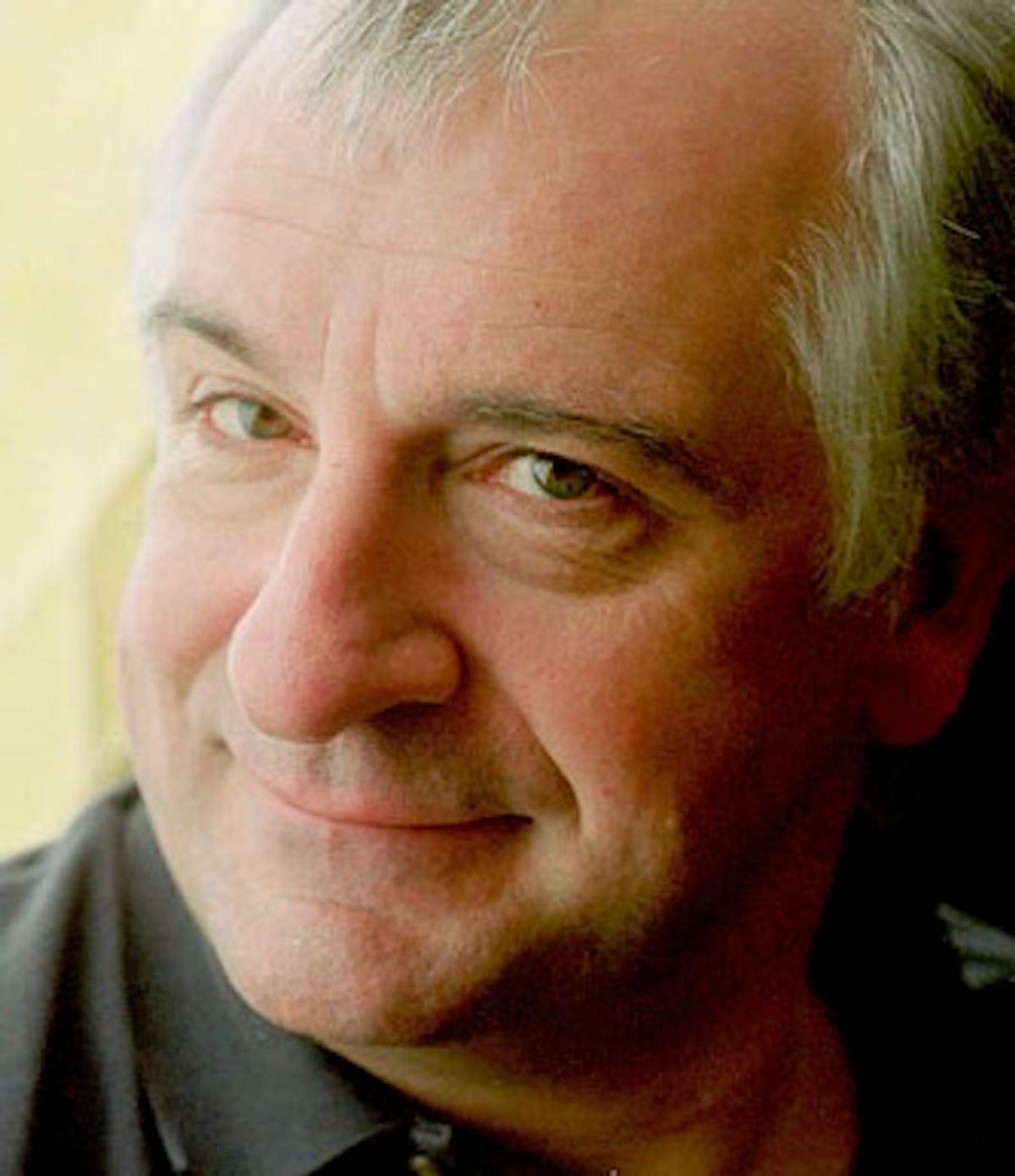
douglas adams inspired "Hitch hikers guide to the galaxy" H2G2(Credit: Michael Hughes)
42. This was the “Answer to the Ultimate Question of Life, the Universe, and Everything,” according to British science fiction writer Douglas Adams’ serial, “The Hitchhiker’s Guide to the Galaxy.” Of course, those familiar with Adams’ oeuvre know the problem with this answer, which is that no one can figure out what the question is. But what did it matter, when one was busy dealing with races of super-intelligent beings disguised as mice, lunk-headed Vogons, and all manner of outer-space bureaucrats?
Adams’ writing beyond the Hitchhiker’s series included episodes of “Dr. Who,” “Monty Python” sketches, and “Dirk Gently’s Holistic Detective Agency,” all of which add up to make him something of a Gandalf figure to comedy nerds. It didn’t hurt that Adams was a man of science, with an analogy of a giant sentient puddle to explain why he didn’t think God existed.
In May of 2001, Douglas died while working on a screenplay adaptation of “Hitchhiker’s Guide.” While Adams was a giant atheist, the almost religious devotion of his disciples keeps his works as relevant today as they were when he was alive. At the 10-year anniversary of his death, we remember one of his final appearances, speaking to students at the University of California at Santa Barbara about the wondrous absurdities of all life.
Carrie Bradshaw: one of 20th century television's most iconic figures.
June 3, 2001: Carrie Bradshaw and her three best friends hit HBO’s run … er … airways once again, beginning the fourth season right as Sarah Jessica Parker’s character was turning the big 3-5. “[It's] a landmark age for women,” Parker said during an interview about the episode, (titled “The Agony and the Ex-Tacy,” woof), “It makes her think about choices she makes and what she doesn’t want to repeat.”
But it wasn’t just aging wombs that were being counted down on “Sex and the City.” As they embarked on their fourth season, the show had definitely found itself a niche in women who both related and longed to live the lives of the lawyer, the writer, the sexpot, and the Connecticut princess in New York. But it was also an HBO show, straddled in a time slot right after “The Sopranos” and before a quirky new dramedy called “Six Feet Under” premiering that spring. Over the years, these women would struggle to stay relevant; not only in the dog-eat-dog NYC where young waifs ruled supreme, but as television characters whose lives were just a tad more frivolous than the Soprano’s or the Fishers’.
And you know what? They pulled it off. Say what you will about “He’s Just Not That Into You“ or Liza singing “All the Single Ladies” in that terrible movie sequel; “Sex and the City” had — has!– one of the largest influences on popular culture, specifically because it didn’t market itself as an HBO show. (You know what I mean, everyone who canceled their subscription after “The Wire” ended.) The issues touched on by Carrie and co. weren’t all schmaltzy girl stuff either: not only did it earn a place in Time’s top 100 list of best television shows alongside its heavyweight network brethren, but I know just as many straight guys who enjoy the show as much as I do. I’m not an obsessive fan and I never think which character I would be (Samantha…no, Charlotte! No…who is that one that fell out of a window at a cocktail party?) but I can appreciate the clever writing, if not the constant yapping about shoes and dinner reservations. Sometimes I thought those women would have been happiest if they were all engaged to Patrick Bateman. But then I realize I’m just bitter, because collectively I don’t think I’ve had four close female friends over the course of my life. Let alone in New York City. Bitches be scheming.
So love them for what they were or hate what’d become of them, it’s impossible not to see the “SATC” franchise as a force to be reckoned with — and by extension, the women themselves. Look how far these ladies have come: from New York to Abu Dhabi and back again. And hey, if the price is right, maybe one day you’ll see Carrie, Samantha, Charlotte, and Miranda toasting their 80th birthdays in space with a bunch of zero-gravity pink martinis and hunky, underage guys.
President Bartlet (Martin Sheen) on "The West Wing."
The “West Wing” ended its second season with one of the most powerful scenes in the show’s history, which is saying something for a program whose every line was spoken in Sorkin-ese. On May 16, 2001, “Two Cathedrals” aired to higher finale ratings than its blockbuster first season, as President Bartlet (Martin Sheen) attempted to come to grips with the death of a friend, the news of his multiple sclerosis becoming public, and the decision to run for reelection.
Suffice to say, it wasn’t really one of those “walk with me” episodes, or one that featured a lot of smirky quips from Josh Lyman. Instead, “Two Cathedrals” felt more like Sorkin’s infamous film scenes: concerned less with the rat-a-tat dialogue of everyday life than with those blood-and-thunder moments that so rarely happen in real life. When Martin Sheen confronts his God in the church after Mrs. Landingham’s funeral, it was “West Wing’s” “You can’t handle the truth” moment; it was Alec Baldwin’s “I am God” speech from “Malice.”
It’s not as if “West Wing” was lacking in dramatic monologues before, but none were as King Lear-esque as Bartlet’s rage at that moment. Maybe this had something to do with the climate outside of the show: Aaron Sorkin had been arrested for cocaine, marijuana and magic mushroom possession. Several weeks before the finale, the charges were bumped to felonies. And despite being a critical darling and a ratings success, the second season of “West Wing” had yet to live up to the first: a seemingly impossible task considering that the drama had won more Emmys than any other first season in history. Then there were the few but vocal dissidents in the crowd claiming the show was too simplistic, too idealistic and too liberal.
Despite the appearance of having its house in order, “The West Wing” was, at the end of its second season, suffering a crisis of faith that comes from being on top and knowing the only direction is down. The season finale of “Two Cathedrals” served both to voice that anxiety as well as remind viewers what made “The West Wing” such a force of nature in the first place.
The original "Spider-Man" poster that was pulled after 9/11.
Ten years ago, the first trailer for the hotly anticipated comic-book film “Spider-Man” premiered in theaters. Even though it would be an entire year before Sam Raimi’s adaptation would hit the big screen, you have to remember that back then, big-budget superhero movies weren’t the summer tent poles they are now. “Superman” was still a trilogy from the ’70s, “Batman” was a troubled Joel Schumacher franchise and Tony Stark barely blipped on anyone’s radar. With all the new CGI technology and Raimi’s patented directorial style (“Army of Darkness”!), getting ready for “Spider-Man” 12 months before audiences could see it didn’t seem like a tease; it seemed like a glimpse of the future. Especially since the first trailer featured one of the most iconic uses of the New York architecture in recent cinema history.
According to Sony Pictures, the scene from the trailer was never supposed to be in the film: It was a stand-alone story that was meant to drum up excitement for the film. Which makes sense, given that the trailer didn’t really fit into the logic of the film: How was Spider-Man ever going to build a web that large? Peter Parker isn’t a giant. And he uses his web-slingers to fly from building to building, not catch helicopters. But the trailer managed to invoke a powerful feeling with that image of the bad guys, suddenly so small and caught in between the twin towers in a gigantic death trap. The trailer was considered one of the most successful pieces of visual marketing since “Terminator 2.”
Four months later, Sony was scrambling to yank the trailer out of every theater, along with the original Spider-Man teaser poster that featured the towers reflected in Spidey’s eyes. They weren’t the only ones: After the attacks on the World Trade Center, soon-to-be-released movies that had been shot in New York before 9/11 underwent a crisis: Should they cut out scenes where you could see the towers, as they did with “Men in Black II and the opening to “Law and Order: Criminal Intent“? Should they digitally erase the World Trade Center’s existence with CGI technology as in “Zoolander”? Or should they simply try to work around the footage and attempt to downplay the buildings through editing, like in the romantic comedies “Kissing Jessica Stein” and “Sidewalks of New York”?
As it turned out, many audiences cheered when they saw the towers; it was a reminder that history couldn’t be neatly wiped off the screen. And a more recent parallel popped up after Hurricane Katrina, when the Kate Hudson horror film “Skeleton Key” was released. Though the film was universally panned, the images of an intact New Orleans, maybe the last to be caught in a Hollywood film, gave the film an emotional weight that certainly wasn’t in the script.
Looking back, erasing the Trade Center from the skyline may seem both excessive and over-cautious, but Sony’s heart was in the right place. It’s not that hard to remember how scary and uncertain that period of time was, when destroying all the evidence of the nightmare seemed like a safer idea than showing people what they had just lost.
Alan Jackson gains credibility for his song "Where were you?"
Country music has enjoyed a resurgence in the past decade, and while it may be a little derivative to give all the credit to the surge of patriotism that Americans felt post-9/11, consider this: In May 2001, the Country Music Association took heat from its fans when it officially changed its slogan to “Admit it. You love us.”
The message was clear to anyone reading between the lines. If you liked country music back in the early part of the aughts, you hid that love, like a high-school girl who only listens to musicals. (Hey, I can relate.) The CMA even issued a statement, saying the quote was “a challenge to everyone who has ever connected with a country song or a specific artist but may not feel a current connection to the format as a whole or is reluctant to share their enjoyment of the music with others.” Yikes.
The attempt was part of a campaign by the CMA to “brand” its music, something that had never been tried before “as far as we can tell,” according to the CMA executive director Ed Benso. It wasn’t that country music had taken a nose dive, but the ’90s had been such a booming time for the genre that producers and music executives were loath to take a hit. Garth Brooks, Lyle Lovett and Billy Ray Cyrus had allowed the brand to go international and platinum in the space of a few short years, but it was still a struggle to find the right marketing techniques to sell Europe on the Country Music Television channel.
And then, Sept. 11. If country music benefited as a result of the twin towers falling, then it was a bittersweet victory. CMT garnered its highest ratings in October of 2001 after holding the “Freedom Concert,” which raised $5 million for the Salvation Army Disaster Relief Fund. Alan Jackson achieved a moment of fleeting worldwide fame when his single “Where Were You (When the World Stopped Turning)” became a symbol both of America’s pain and cynical attempts to cash in on the hurt. (See “South Park’s” takedown of Jackson in the episode “A Ladder to Heaven.“) The same went for Toby Keith’s “Courtesy of the Red, White & Blue (The Angry American),” which the country star had to be coaxed into playing after an initial bout of discomfort with the material.
“… if country songwriters have been reluctant to talk, country fans have been more than willing to listen … both Jackson’s and Keith’s records topped the Billboard country singles chart, Jackson’s for five weeks. Several similar records, ranging from generally patriotic numbers to songs written in direct response to the attacks, have made at least nominal showings.”
Not all performers were shy about tackling the tough issues post-September either. Steve Earle put out his response in the album “Jerusalem” in 2002, which included the song “John Walker’s Blues,” written “from the vantage point of ‘American Taliban’ John Walker Lindh.” The song was met with criticism from both sides, with some calling it “unpatriotic” and others claiming that it was too controversial a subject. Some performers were accused of cashing in on the attacks, like Bruce Springsteen, who released “The Rising.”
But the legacy of country music is bigger than the individual. Once the dust has settled, what will people see when they look back at country music in the aughts? Taylor Swift, the CMT Awards, the CMA Awards (completely different), Carrie Underwood, Lady Antebellum, Brad Paisley, Miranda Lambert, Keith Urban, Gwyneth Paltrow and “Country Strong”; just in the past year the popularity of the genre has allowed its stars to overtake the Grammys, both in nominees and interest in other music award shows.
Perhaps we can attribute the rise in popularity of country music as much to Swift, Underwood, Miley Cyrus and “American Idol” as we can to the attacks on Sept. 11. But I’d wager that these fresh faces in the industry flocked to country music specifically because it resonated with the first historical event they were alive to witness.
Ten years can go by in a heartbeat, or it can drag on for so long that you’re looking back going, “What the hell was going on back then?”
Case in point: Talking about “Harry Potter” movies released in 2001 makes me feel old. Mention “Pearl Harbor” and “Survivor,” however, and I’m like, “The early aughts were so weird! Was that really only 10 years ago?” Reading this old CNN article, I actually feel like I’ve unearthed a time capsule.
And you thought the hype for “Pearl Harbor” would be so loud by May 1 you wouldn’t be able to hear yourself think. Instead, with summer’s movie blockbuster season right around the corner, there’s only one item for discussion in the hills of Hollywood on Tuesday: the pending writers strike.
You see, long before the writers strike of 2007, the Writers Guild of America was threatening to pull the plug the way they had in 1988. Except now it was 2001, and the networks were a little bit wiser. When the ’88 strike happened, Fox relied on new shows like “Cops” and “America’s Most Wanted,” shows that were basically reality programs before the term “reality programming” existed. The networks knew another strike was possible and didn’t want to get stuck with their pants down around their ankles again.
“There was a sense of powerlessness of having your product stream absolutely dry up,” said Mr. Littlefield [former NBC vice president], who now heads his own production company. “At some point you say, ‘We don’t want to be in this situation again,’ and you start to build alternatives. That process takes time.”
Luckily (for the networks) in 2001, networks had a little extra something to rely on: “Survivor” had proven to be one of the biggest boons in television history, proving that if you put people on an island long enough, eventually they would go all “Lord of the Flies” on each other. While shows like “Friends” and “CSI” still dominated the ratings for the 2001-02 season, Jeff Probst and his fire eliminations had clearly caught the attention of America. In 2004, writers would realize this formula worked even when it was scripted (as long as there was a smoke monster), and “Lost” was born.
Clearly, this was a force to be reckoned with. The 2001 writers strike ended up being more sound and fury than actual fire. By the time it came down to last-minute negotiations in early May, the writers union “won out” by getting the provisions of a $41 million pay increase over three years. Now they could get back to making more episodes of “Everyone Loves Raymond.” Silently in the wings, Fox prepared its own motherlode of a reality show, “American Idol.” By the time the 2008 strike rolled around, the chips were clearly stacked against the scribes, who now had to contend not only with the unscripted presidential election, but also with the force of Simon Cowell as well.